Tundra Silts31511 BCE
Thirty-one thousand five hundred and eleven BCE is not a recoverable Irish year but falls within a later Pleistocene interval of unstable climate. At Derryvree, Fermanagh, freshwater silts enclosed between tills record an ice-free or locally ice-free tundra landscape of pools, mosses, sedges, plants and insects, later sealed by renewed glaciation. Radiocarbon dating provides only a broad calibrated range, not a precise moment. Castlepook Cave, Cork, preserves cold-climate animal remains, including reindeer and mammoth. A cut-marked reindeer femur may indicate early human carcass processing, but cannot prove settlement. Glacial destruction and evidence preclude conclusions about Irish society, culture or occupation.
Dateline
The label 31,511 BCE cannot describe a recoverable year in Ireland’s past. No calendar, writing system, named people or dated event survives from this depth of time. Arithmetically, it falls about 33,460 years before AD 1950, the conventional reference point for radiocarbon dating, but that calculation is not a precise archaeological date. The responsible frame is the later Pleistocene, within Marine Isotope Stage 3 and the Irish Midlandian cold stage: a long, climatically unstable part of the last Ice Age. Evidence can illuminate broad intervals and local environments, not a particular day, season or generation in 31,511 BCE.
The most useful Irish evidence close to this notional date comes not from a settlement but from buried mud beneath a drumlin at Derryvree, near Maguiresbridge in County Fermanagh. There, roadworks exposed fine sands and organic freshwater silts trapped between two distinct sheets of till, the unsorted debris deposited by glacier ice. The sequence establishes an important order of events: ice had covered the ground; a non-glacial or locally ice-free interval allowed water, vegetation and insects to leave their traces; then a later advance sealed the deposit beneath fresh till. It is an unusually eloquent survival from a landscape subsequently remodelled by ice.
Dating a Lost Landscape
An original radiocarbon determination from Derryvree gave an age of about 30,500 ± 1,170 radiocarbon years BP. That is not the same thing as a calendar age. Atmospheric radiocarbon has varied greatly through time, and the relationship between radiocarbon years and calendar years is particularly uneven in the Pleistocene. Modern calibration curves are built from independently dated records, including tree rings, corals, cave deposits and varved sediments, but they still express probability ranges rather than a single certain year. Published discussion places the Derryvree material broadly within a calibrated span of roughly 36,900–31,700 cal BP, approximately 34,950–29,750 BCE.
Thus 31,511 BCE lies within the broad age-range relevant to the Derryvree deposit, but it cannot be assigned to a particular layer, pool or biological observation within it. The radiocarbon result dates organic material in a complex geological sequence, not the instant at which a moss grew, an insect died or a glacier changed direction. Nor should the deposit be treated as a complete picture of Ireland. It is a local archive, from one low basin in Fermanagh, whose exceptional preservation gives it wider importance.
Water Between the Ice
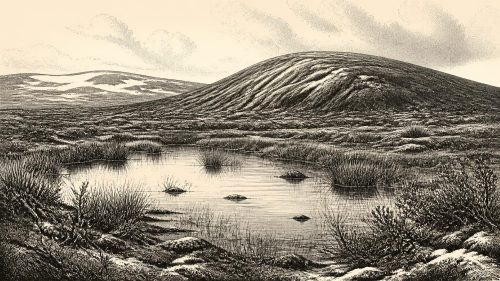
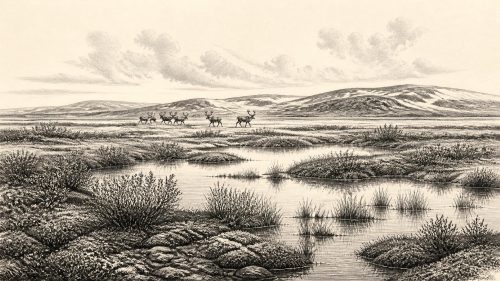
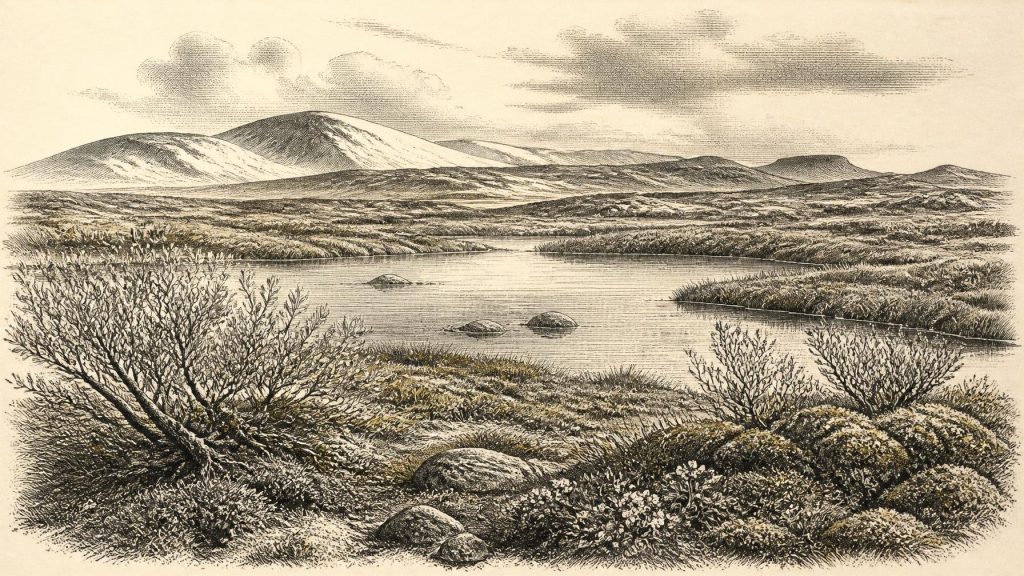
Derryvree preserves a cold, open landscape rather than the wooded island familiar today. Fossil plant remains, freshwater mosses, sedges, pollen and beetles indicate wet ground, shallow water and vegetation adapted to severe conditions. Researchers have described the setting as tundra or muskeg: a peaty, waterlogged mosaic of moss-rich hollows, pools, saturated margins and exposed ground. Plants recorded or associated with the deposit include dwarf willow, mountain avens, bogbean and alternate water-milfoil. Together they suggest freshwater habitats beside open, cold-climate vegetation, not fields, hedges, pasture or woodland.
This was nevertheless not a uniform, permanently frozen wilderness. Organic mud could accumulate only where liquid water persisted long enough for plants, insects and sediment to gather. The surrounding land probably experienced strong seasonality, with short productive summers and hard winters. Pollen preservation is imperfect and pollen may travel or be reworked, so it cannot furnish a detailed map of every plant community. But the combined botanical and insect evidence strongly supports treeless or nearly treeless country around the Derryvree basin. It is a direct record of life enduring in an ice-age interval, not merely an inference from modern climate models.
An Island in a Changing Ice World
Ireland’s ice cover did not advance and retreat as one neat, island-wide curtain. Different sectors of the developing Irish Ice Sheet responded differently to changing temperature, snowfall, sea level and topography. The older till beneath Derryvree shows that glacial ice had reached the locality before the freshwater interval; the upper till proves that ice later returned. This is why the deposit is so valuable. It demonstrates that, at some stage in the Middle Midlandian, a Fermanagh locality was sufficiently free of overriding ice for freshwater and tundra vegetation to develop, even though the wider region remained part of a highly unstable glacial system.
By the Last Glacial Maximum, broadly between 23,000 and 18,000 years ago, ice covered almost all of Ireland. That later expansion destroyed, buried or rearranged much of the older land surface. The scarcity of 33,000-year-old evidence is therefore not evidence that nothing lived on the island; it partly reflects what glaciers do to landscapes and archaeological sites. Derryvree survived because sediment was protected between tills. Cave systems in limestone districts, especially in south Munster, provide another kind of refuge for evidence: animal bones rather than a continuous open-air landscape.
Reindeer, Mammoths and Carnivores
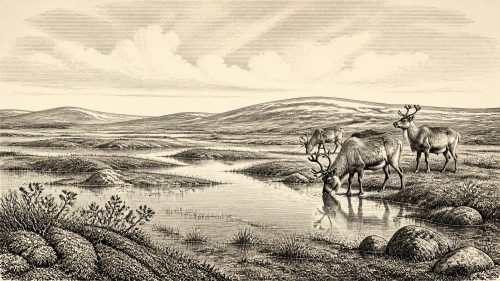
Castlepook Cave near Doneraile in north County Cork has produced one of Ireland’s most important collections of pre-Last Glacial Maximum animal remains. Radiocarbon dates obtained from the cave have shown that mammals occupied Ireland during a broad period between at least about 45,000 and 20,000 radiocarbon years ago, though individual specimens belong to different episodes and cannot be assembled into one simultaneous scene. Among the animals represented are reindeer, woolly mammoth, giant deer, brown bear, wolf, Arctic fox, lemmings and spotted hyaena.
That list should be read carefully. It confirms that cold-adapted and open-country fauna reached Ireland at different points in the later Pleistocene; it does not prove that every species ranged together across every region in 31,511 BCE. Even so, the ecological implication is important. Reindeer and lemmings fit the open, cold conditions indicated at Derryvree, while hyaena and mammoth remains show that Irish landscapes could form part of a much wider north-west European faunal world. Carnivores also complicate the archaeological record. They carried, gnawed and redistributed bones, while water, collapse and early excavation practices mixed deposits. A bone in a cave is not automatically evidence of a hunting camp.
The Castlepook Human Question
A reindeer femur from Castlepook has made this period especially significant for Irish prehistory. Zooarchaeological examination has identified a deep linear mark interpreted as a fresh-bone cut or chop made by a sharp stone tool during carcass processing. The bone has been reported as roughly 33,000 years old, and, if the human interpretation is sustained, it would push possible human activity in Ireland vastly earlier than the long-established post-glacial record. It would indicate that one or more people handled a reindeer carcass at the western edge of Upper Palaeolithic Europe.
That conclusion remains important but limited. The femur is not securely associated with a hearth, stone-tool assemblage, dwelling floor, food store, burial or repeated butchered assemblage. Its early excavation history and cave context make precise reconstruction difficult. A radiocarbon date establishes the age of the animal bone, while the identification of a surface mark as human-made is a separate specialist judgement. Natural damage, carnivore action and post-depositional processes must always be excluded. The find is therefore evidence for a serious research question about very early visits to Ireland, not proof of a permanent settlement or a named Palaeolithic population.
What Society Cannot Yet Be Seen
There is no evidence at this date for Irish political institutions, leaders, territories, warfare, diplomacy, agriculture, herding, trade networks, monuments or formal religious sites. There are no houses, campsites or human burials that can responsibly be assigned to 31,511 BCE. If people did reach Ireland during this broad period, their presence may have been brief, seasonal and mobile, perhaps connected with the pursuit or processing of large animals. Yet even that is interpretation, not a documented fact. The archaeological record cannot identify their language, kinship system, beliefs, clothing, boat technology or relations with groups in Britain or continental Europe.
Nor can absence be turned into a claim that people lacked culture, knowledge or social rules. Mobile hunter-gatherer groups can leave sparse remains, and later glaciation has removed much evidence. What can be said is narrower: no securely dated Irish material currently reveals art, ritual practice, learning or exchange for this moment. The possible cut-marked femur would imply skilled use of a sharp lithic edge, but no implement can presently be tied directly to it. The story is one of constrained evidence rather than of a society waiting to be described in modern categories.
A Prehistoric Threshold
For Ireland, 31,511 BCE is best understood as a threshold within a changing ice-age world. In Fermanagh, freshwater plants, mosses, sedges and cold-climate insects record a wet, treeless interval between advances of ice. In Cork, cave deposits preserve the bones of animals that moved through open country over many millennia, and one marked reindeer bone raises the possibility of an exceptionally early human encounter. These are not the ingredients of a year-by-year chronicle. They are fragments of a deeper history: a land repeatedly transformed by glacier ice, intermittently habitable for plants and animals, and perhaps visited by people whose presence has not yet emerged clearly from the ground.

Primary Sources
- A Middle Midlandian Freshwater Series at Derryvree, Maguiresbridge, County Fermanagh, Northern Ireland
- The Irish Quaternary Fauna Project
- Early Midlandian–Middle Midlandian, Pleistocene, Northern Ireland
- Figure 6.— The Subdivision of the Quaternary Period in Ireland
- Variations in Esker Morphology and Internal Architecture Record Time-Transgressive Behaviour of Meltwater Systems Beneath the Irish Ice Sheet
- Cenozoic: Tertiary and Quaternary
- The Late Quaternary History of East-Central Ireland
- Middle Midlandian Interstadial Deposits at Greenagho, Near Belcoo, County Fermanagh, Northern Ireland
- The Glacial Stratigraphy of the Sperrin Mountains and Its Relation to the Glacial Stratigraphy of North-West Ireland
- The Irish Quaternary Fauna Project
- Heritage Artefacts of County Cork
- Ireland's Palaeolithic Archaeology – Fleeting Footprints in a Frozen Land
- New Insights on the Fauna of Ireland's Younger Dryas and Early Holocene from Alice & Gwendoline Cave
- New Insights on the Fauna of Ireland's Younger Dryas and Early Holocene from Alice & Gwendoline Cave
- The Mesolithic in Ireland: When Was It?
- Salix herbacea
- ESCR Site Summary: Quaternary Deposits of Northern Ireland
- The IntCal20 Northern Hemisphere Radiocarbon Age Calibration Curve (0–55 cal kBP)
- IntCal Publications
- The IntCal20 Approach to Radiocarbon Calibration Curve Construction: A New Methodology Using Bayesian Splines and Errors-in-Variables
- The Problem of a Late Quaternary Landbridge Between Britain and Ireland
- The Marine δ18O Record Overestimates Continental Ice Volume During Marine Isotope Stage 3