
Mammoth Cave’s Reindeer Signal31505 BCE
Around 31,505 BCE, Ireland lay within a cold, unstable Middle Upper Palaeolithic landscape, before the Last Glacial Maximum. Evidence from Derryvree, County Fermanagh, records freshwater wetlands amid open, treeless tundra-like terrain, with grasses, sedges, juniper, mosses and cold-adapted insects. Castlepook Cave in County Cork preserves a mixed fauna including mammoth, giant deer, reindeer, horse, wolves and hyaenas, indicating a diverse cold-stage ecology. A marked reindeer femur, dated approximately 33,000 years ago, may show stone-tool processing by humans. However, its interpretation remains uncertain, and no settlement, tools, burials or other unequivocal evidence establishes human occupation. This evidence indicates possibility, not habitation.
Dateline
A Date Beyond Annals
31,505 BCE is not a year that can be recovered from an Irish calendar, an annal or an excavation diary. It is a modern way of marking a point roughly 33,450 calibrated years before present (cal BP, where “present” is 1950). At this depth of time, modern calendar-year precision is unavailable. Radiocarbon results have statistical errors, calibration produces ranges rather than single moments, and deposits may represent repeated episodes rather than one season. The responsible question is therefore not “what happened in Ireland in 31,505 BCE?” but what evidence can illuminate conditions in and around Ireland during this part of the Middle Upper Palaeolithic and Marine Isotope Stage 3. The answer is fragmentary but important: buried wetland sediments, glacial layers, cave bones and a disputed-looking yet potentially consequential trace of animal processing.
Ireland was then part of a rapidly changing north-west European world. The Last Glacial Maximum, when the last major Irish Ice Sheet reached its greatest extent, still lay in the future: current syntheses place its main maximum between about 27,000 and 23,000 cal BP. Around 33,450 cal BP, however, the climate was already cold, unstable and capable of changing sharply over centuries or less. Greenland ice-core records show repeated stadial and interstadial shifts during this wider period. They offer a regional climatic framework, not a weather report for Ireland, and they cannot turn 31,505 BCE into a precisely dated Irish event.
An Uneven Ice-Age Island
The image of a uniformly ice-covered Ireland is too simple for this earlier phase of the last glaciation. Ice margins advanced and retreated, while conditions differed markedly between uplands, coastal lowlands, caves and sheltered basins. The later ice sheets erased or buried much of the earlier terrestrial record, which is one reason evidence is so scarce. Yet sediments preserved between glacial tills demonstrate that at some times and in some places land and freshwater habitats existed between advances. Sea level was much lower than it is today, so shorelines lay farther out on the continental shelf; nevertheless, the precise accessibility of Ireland from Britain or the continent varied with sea, ice and local topography. It should not be assumed that there was either a permanent land bridge or an impassable sea barrier throughout the period.
The most revealing Irish environmental sequence is at Derryvree near Maguiresbridge, County Fermanagh. There, organic-rich freshwater sediments survived between two tills: deposits left by ice before and after the wetland interval. The original investigators obtained a conventional radiocarbon determination of 30,500 ± 1,170 BP from the series. That is not equivalent to a single calendar date, and subsequent frameworks correlate the deposit broadly with the Middle Midlandian, often termed the Derryvree Cold Phase. It is nevertheless close enough in geological terms to illuminate the kind of landscape that could have existed around the notional date used here.
Derryvree’s Cold Wetland
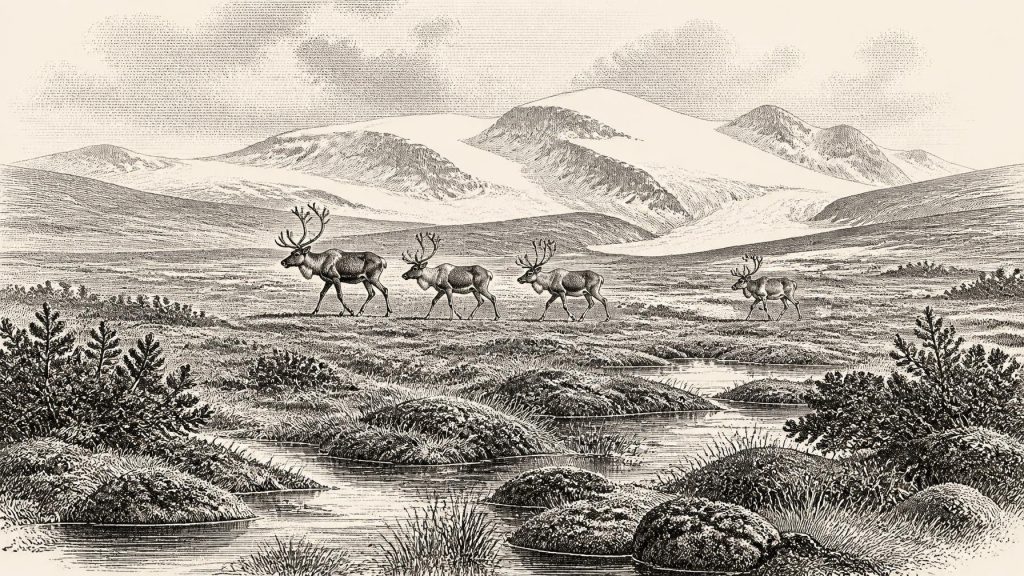
The Derryvree evidence is unusually rich because it combines plants, insects and sedimentary context. Its pollen and macrofossils point to an open, treeless landscape rather than forest: grasses, sedges, juniper and herbaceous plants occurred alongside a notable moss flora. Fossil insects indicate wet, plant-rich ground, small open pools and mossy margins. The best description is not a modern bog transplanted into the past, but a cold muskeg or tundra wetland: waterlogged patches in an exposed landscape, shaped by severe winters and short growing seasons. Mountain-avens, dwarf willow and other cold-adapted plants are part of the wider environmental picture reconstructed from Irish deposits of this age.
That reconstruction is evidence-based, but its limits matter. Derryvree is in Fermanagh, not a map of the whole island. Pollen can travel; fossil assemblages record particular habitats; and deposits may condense long intervals. Still, the sequence securely overturns any notion that Ireland at this time was simply inert ice. Where ground was exposed and water available, plants colonised, insects lived, and organic mud accumulated. Such places would have been ecologically productive in a sparse world, providing forage for herbivores and opportunities for predators and scavengers.
The Castlepook Fauna
North County Cork supplies a complementary archive. Castlepook Cave, also called Mammoth Cave, lies near Doneraile above the Awbeg Valley. Excavated in the early twentieth century under the Royal Irish Academy’s cave-investigation programme, it yielded a mixed Pleistocene animal assemblage. Recorded species include mammoth, giant deer, reindeer, horse, wolf, brown bear, spotted hyaena, foxes, stoat, hare and lemmings. Not every bone belongs to precisely the same moment or deposit, and caves are especially susceptible to reworking, carnivore activity and the mixing of material. The assemblage should therefore not be read as a single herd crossing the valley in one year.
Even so, Castlepook shows that Ireland’s cold-stage fauna was more varied than reindeer alone. Mammoth and horse evoke open grazing country; reindeer were well suited to cold, seasonal terrain; lemmings and arctic fox speak to severe conditions; wolves and hyaenas were major carnivores. Giant deer, the animal later celebrated as the “Irish elk”, also belonged to this larger Pleistocene fauna. The cave itself was not necessarily a human home or a hyaena den at every stage. It was a limestone trap and shelter whose bone record accumulated through several processes. Its importance lies in preserving evidence of an ecological network otherwise largely destroyed by glaciation and time.
A Single Marked Bone
The most arresting object associated with this period is a reindeer femur from Castlepook. In 2021, analysis publicised by zooarchaeologist Ruth Carden described a deep linear modification as consistent with a stone-tool cut or chopping mark, while the animal bone was reported as dating to about 33,000 years ago. If that interpretation is confirmed and the modification belongs to the animal’s fresh-bone history, it would be evidence that people processed a reindeer in Ireland during the Upper Palaeolithic—far earlier than the previously secure record of post-glacial occupation. It would be a remarkable discovery, but it is not a settlement, a tool-kit or a human skeleton.
Caution is essential. A radiocarbon date dates the death of the animal, not automatically the making of a mark or the arrival of a person in the cave. A single altered bone cannot reveal whether a hunter killed the reindeer, found a carcass, removed meat, hide, sinew or marrow, or processed it elsewhere before the bone entered the cave. Nor does it establish the size, identity, language or permanence of any group involved. The National Museum of Ireland’s general overview has continued to characterise unequivocal Palaeolithic human evidence as absent, a useful reminder that the Castlepook interpretation remains a significant but limited claim rather than a settled narrative of colonisation.
People, If Present
For that reason, political affairs, diplomacy and warfare cannot responsibly be described for Ireland around this date. There are no names, territories, graves, houses, monuments, weapons caches or written traditions. There is no basis for imagining chiefs negotiating alliances, tribes defending frontiers, or a settled Irish population organised into communities. Nor can religion be reconstructed: no ritual place, image, burial practice or symbolic object has been securely associated with an Irish human presence of this age. Silence in these categories is not an omission in the story; it is the central character of the evidence.
The same restraint applies to everyday life. If the Castlepook mark records human action, the minimum inference is a brief episode by one or more people able to use a sharp stone edge and exploit an animal resource. Comparable Upper Palaeolithic groups elsewhere in Europe were mobile hunter-gatherers, but Irish evidence does not permit their social arrangements, clothing, dwellings, seasonal routes or cultural affiliations to be transferred here as fact. No Irish lithic assemblage of this age has been recovered. The absence may reflect later ice erosion, submerged landscapes, limited excavation and the fleeting nature of visits; it does not prove that people never came.
Economy Without Markets
There is likewise no evidence for an Irish economy in the later historical sense: no farming, livestock keeping, metalworking, pottery production, market exchange or long-distance trade network can be demonstrated. The only plausible subsistence activity suggested by the Castlepook femur is animal processing, and even that rests on a single contested-looking trace. Reindeer, horse and mammoth would have represented substantial sources of meat, fat, hides, bone and sinew if people encountered them, but usefulness is not proof of exploitation. The fauna also belonged to carnivores, scavengers and natural deaths. Archaeology must keep those possibilities separate.
Culture and learning leave no direct Irish signature at 31,505 BCE. Upper Palaeolithic Europe elsewhere produced sophisticated stone technologies, personal ornaments, art and long-distance movement of materials. Those wider achievements make short human visits to the western edge of Europe conceivable, especially during more favourable climatic intervals. They cannot, however, be used to populate Ireland with cave artists, ritual specialists or established trading partners. The appropriate historical picture is of environmental possibility, not a fully evidenced human society.
What This Moment Means
Around 31,505 BCE, Ireland was an Ice-Age landscape of regional contrasts: advancing and retreating ice in the wider system, exposed cold-country habitats, freshwater pools and wetlands in favourable basins, and herds and predators moving through open terrain. Derryvree provides the clearest environmental testimony; Castlepook preserves the strongest faunal archive and the tantalising reindeer signal. Together they demonstrate that this was not an empty geological interval. Yet the human story remains deliberately small. A marked bone may record a fleeting encounter between people and reindeer, but it does not yet establish continuous occupation. That distinction—between direct evidence and an appealing interpretation—is the key to Ireland at this extraordinary depth of time.
Primary Sources
- Prehistoric Details
- A Middle Midlandian Freshwater Series at Derryvree, Maguiresbridge, County Fermanagh, Northern Ireland
- Irish Pleistocene Biostratigraphy
- Figure 6.— The Subdivision of the Quaternary Period in Ireland
- The Exploration of Castlepook Cave, County Cork
- The Exploration of Castlepook Cave, Co. Cork. With 3 Plates.
- Occurrence of Mammalia Relicts at Site Castlepook Cave
- Archaeological Heritage of County Cork
- 32564: Castlepook Cave, Co. Cork
- The Irish Quaternary Fauna Project
- Maximum Extent and Dynamic Behaviour of the Last British–Irish Ice Sheet West of Ireland
- Response of the Irish Ice Sheet to Abrupt Climate Change During the Last Deglaciation
- Timing and Pace of Ice-Sheet Withdrawal Across the Marine–Terrestrial Transition West of Ireland During the Last Glaciation
- The Deglaciation of the Western Sector of the Irish Ice Sheet From the Inner Continental Shelf to Its Terrestrial Margin
- Vertical Dimensions and Age of the Wicklow Mountains Ice Dome, Eastern Ireland, and Implications for the Extent of the Last Irish Ice Sheet
- Ireland: Submerged Prehistoric Sites and Landscapes
- First Evidence of a Late Upper Palaeolithic Human Presence in Ireland
- Palaeolithic Ireland – New Evidence Emerges From the Emerald Isle
- The IntCal20 Northern Hemisphere Radiocarbon Age Calibration Curve (0–55 cal kBP)
- IntCal: RadioCarbon Dating Research
- A Stratigraphic Framework for Abrupt Climatic Changes During the Last Glacial Period
- Reindeer Bone Found in Cork Cave Shows Human Activity in Ireland 33,000 Years Ago