The Castlepook Reindeer Femur31084 BCE
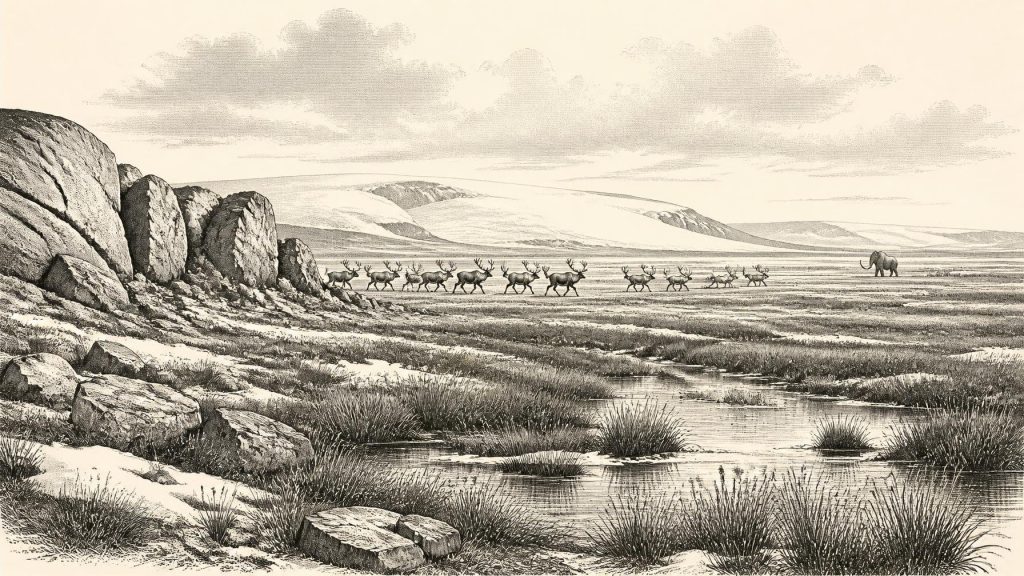
Around 31,084 BCE, Ireland experienced unstable Marine Isotope Stage 3 conditions, with advancing ice, lower sea levels and varied periglacial habitats rather than uniform frozen terrain. Derryvree, County Fermanagh, preserves wetland sediments between glacial tills, indicating cold, treeless freshwater environments during an ice-free interval. Castlepook Cave, County Cork, yielded diverse cold-stage fauna, including reindeer, mammoth, giant deer, predators and lemmings, although its deposits span multiple periods. A cut-marked reindeer femur may indicate Upper Palaeolithic butchery and a brief human visit, not proven settlement. Evidence reveals ecological complexity but cannot securely establish precise dates, communities, politics, culture or permanent occupation there.
Dateline
Modern calendar precision cannot responsibly be applied to Ireland in 31,084 BCE. No community on the island recorded years, no political chronology exists, and the surviving evidence is too sparse to identify an event on a particular day, season or even human lifetime. The date is best treated as a modern point within the later part of the Last Glacial Period, roughly 33,000 years before the conventional radiocarbon reference year of 1950. Archaeology and Quaternary science can illuminate a broad interval around it, but not a historical ‘year’ in the ordinary sense.
A Cold World in Transition
At this point Ireland lay within Marine Isotope Stage 3, a long cold phase marked by abrupt climatic oscillations across the North Atlantic. It was not yet the Last Glacial Maximum, when an expanded British–Irish Ice Sheet would cover most or all of the island. Yet the direction of change was towards harsher conditions and major ice-sheet growth. Ireland’s present shores, counties and road network are useless guides to the geography of that world. Much sea water was locked in continental ice, sea level was lower, and the outlines of coast, river and plain differed greatly from those of today.
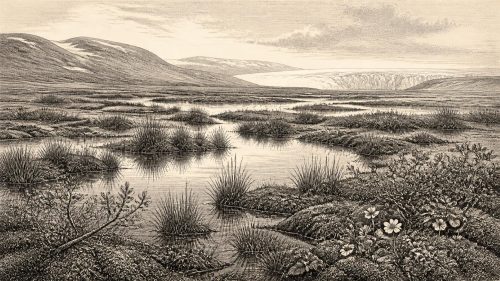
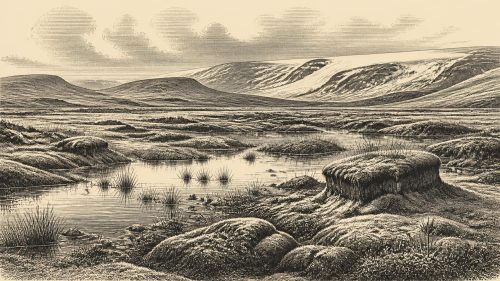
The island was not necessarily one uniform frozen waste. The best reconstructions instead suggest a shifting mosaic: ice margins and uplands in some regions, open periglacial ground in others, meltwater channels, shallow pools, seasonally saturated sedge wetlands and exposed mineral soils. Snow cover, summer thaw and wind-blown sediment would have varied substantially between years and regions. The climate was severe, but severe does not mean lifeless. Cold-adapted plants and animals could exploit temporary refuges and open habitats before the full expansion of the ice sheet transformed the landscape again.
Recent ice-sheet syntheses reconstruct rapid growth of the British–Irish Ice Sheet after about 31,000 years ago, while also stressing that its margins were asynchronous and dynamic. That wider pattern matters more than any misleading image of an island suddenly swallowed by ice. Around this date, parts of Ireland may have remained ice-free or only intermittently affected, whereas other districts were increasingly shaped by glacial advance. The chronological resolution remains measured in centuries and millennia, not in a single numbered year.
Derryvree’s Buried Wetland
The most revealing environmental archive close to this broad horizon lies at Derryvree near Maguiresbridge, County Fermanagh. Road works there exposed organic silts and fine sands trapped between two substantial layers of glacial till inside a drumlin. The deposit is remarkable precisely because later ice did not remove it entirely. It preserves a freshwater episode between glacial advances: a small wetland landscape, subsequently sealed beneath renewed ice and sediment.
A radiocarbon determination from the organic deposit was reported as 30,500 radiocarbon years before present, with a sizeable uncertainty. When calibrated, scholarship has placed its probable age broadly at about 36,900–31,700 calibrated years before present. The modern label 31,084 BCE falls within that wide range, but this does not mean that the Derryvree plants grew in that exact calendar year. It means that the deposit offers a responsibly relevant window on conditions in north-central Ireland around this era.
The botanical evidence indicates treeless, cold-climate ground rather than forest. Sedges, mosses and other plants associated with wet, open and often Arctic-alpine conditions occurred around standing or slow-moving freshwater. Bogbean, water-milfoil, mountain avens, dwarf willow and clubmosses are among the kinds of remains discussed from this interval. Together they point to a tundra-like or muskeg environment: wet in sheltered hollows, low-growing in vegetation, and exposed to cold and frost. They do not justify reconstructing a continuous carpet of identical vegetation across Ireland. Rather, they demonstrate that a productive freshwater habitat could exist locally amid a generally cold, unstable landscape.
Such deposits also reveal how Ireland’s physical regions were changing. The drumlin itself records glacial action; the organic layer records an interruption or ice-free phase; the upper till records renewed glaciation. This sequence is evidence, not a simple climatic story. Scientists debate how far individual ice masses extended at particular moments and how reliable older radiocarbon measurements are for reconstructing ice limits. Still, Derryvree securely conveys a central fact: Ireland’s landscape was being repeatedly reorganised by the advance, retreat and reworking of ice.
Animals at Castlepook
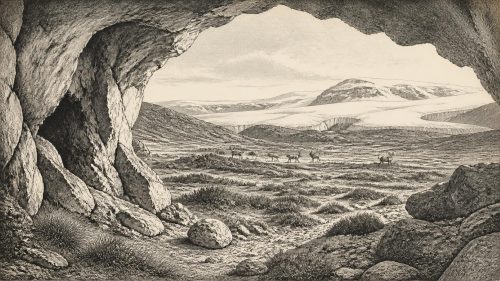
County Cork provides the other major archive relevant to this period. Castlepook Cave, also called Mammoth Cave, near Doneraile contains Ireland’s best-known assemblage of pre-Last Glacial Maximum large mammals. Recoveries from early twentieth-century digging, and later discoveries in the cave system, have included woolly mammoth, reindeer, giant deer, bear, wolf, fox, Arctic fox, hare, lemmings and spotted hyaena. These animals were not necessarily contemporaries in one herd-filled valley. Cave deposits accumulated through many episodes, and bones could be moved, scattered, gnawed, redeposited or mixed during excavation.
Even with that caution, Castlepook demonstrates that southern Ireland was part of the wider north-west European world of cold-stage fauna. Reindeer could use open country and wetlands; mammoths and giant deer imply access to substantial grazing landscapes; foxes, wolves and hyaenas occupied predator and scavenger roles. Lemmings are especially eloquent indicators of cold conditions. The assemblage should not be turned into a documentary scene populated by every species at once, but it makes clear that Ice Age Ireland supported more ecological variety than the phrase ‘frozen island’ suggests.
Newer radiocarbon work has complicated the older chronology. Re-dating of Castlepook material showed that several earlier bone dates were too young, and suggested that some animals, including giant deer and spotted hyaena, may have disappeared locally before the Last Glacial Maximum, perhaps around 40,000 calibrated years ago. This is an important warning. The cave is a long archive, not a snapshot, and its famous fauna cannot be assigned wholesale to 31,084 BCE. Reindeer remains are highly relevant to the broad period; exact associations between individual specimens, animals and environmental episodes require careful testing.
The Marked Bone and Human Presence
A reindeer femur from Castlepook is especially significant because it bears a deep incision interpreted by some researchers as a mark made with a sharp stone tool during butchery. Public heritage accounts have associated the bone with roughly 31,000 BCE, making it potentially far older than the long-established post-glacial evidence for people in Ireland. If the interpretation is confirmed, it would show that a person or small group handled a reindeer carcass in Ireland during the Upper Palaeolithic.
That possibility must be distinguished from a proven settlement. A date obtained from bone establishes the age of the animal, within a calibrated probability range; it does not date the cut to an exact year. Identifying a surface mark as a stone-tool cut is a separate taphonomic judgement, requiring comparison with damage caused by carnivores, sediment movement, excavation and other natural processes. Nor has Castlepook yet produced a securely associated hearth, stone-tool assemblage, dwelling surface, human burial or undisturbed camp floor of this age. Recent excavation has sought surviving Pleistocene deposits precisely because such context is needed.
Accordingly, it would be wrong to describe Ireland in 31,084 BCE as securely settled. Equally, it would be wrong to dismiss the femur’s potential importance. The most cautious conclusion is that a brief human visit is possible and that the bone may preserve evidence of carcass processing. Such an episode would fit a wider Upper Palaeolithic Europe in which highly mobile hunter-gatherers followed seasonal resources across open landscapes. It cannot, however, establish a permanent population, a migration route, a language, ancestry or any named community in Ireland.
No Politics, but a Deep Landscape History
There is no evidence from which to reconstruct rulers, territories, diplomacy, warfare, law, religion or formal learning for this date. There are no Irish settlements, monuments, graves, art panels, ritual deposits or traded objects securely attributable to it. If people visited, their social organisation and beliefs are unknown. It is tempting to project later hunter-gatherer customs backwards, but that would be interpretation without Irish evidence.
The same restraint applies to economy and trade. A possible butchered reindeer bone may indicate the use of animal meat, hide, marrow or sinew, and it implies access to a cutting edge if the mark is genuinely human-made. Beyond that, no Irish evidence demonstrates exchange networks, routine hunting territories or seasonal camps. The strongest economic story is ecological: plants converted brief summer growth into forage; herbivores moved through open country; carnivores and scavengers exploited carcasses; freshwater patches provided concentrated resources in an otherwise demanding terrain.
What survives from around 31,084 BCE is therefore not an annalistic chapter but a set of difficult clues. Derryvree preserves wetland life between ice advances. Castlepook preserves the bones of mammals that lived in a colder Ireland before the landscape was radically remodelled. One marked reindeer femur raises the possibility of a human hand. Together they portray a country not yet historically knowable, but already environmentally complex: a place of tundra pools, animal movement, advancing ice and fragile evidence waiting to be tested.
Primary Sources
- Growth and Retreat of the Last British–Irish Ice Sheet, 31,000 to 15,000 Years Ago: The BRITICE-CHRONO Reconstruction
- The Timing and Magnitude of the British–Irish Ice Sheet Between Marine Isotope Stages 5d and 2: Implications for Glacio-Isostatic Adjustment, High Relative Sea Levels and ‘Giant Erratic’ Emplacement
- Trimlines, Blockfields and the Vertical Extent of the Last Ice Sheet in Southern Ireland
- A Middle Midlandian Freshwater Series at Derryvree, Maguiresbridge, County Fermanagh, Northern Ireland
- The Irish Quaternary Fauna Project
- A Reconsideration of the Radiocarbon Dating of the Marine Isotope Stage 3 Fauna from Southern Ireland
- Dynamic Cycles, Ice Streams and Their Impact on the Extent, Chronology and Deglaciation of the British-Irish Ice Sheet
- Pattern and Timing of Retreat of the Last British-Irish Ice Sheet
- Oscillating Retreat of the Last British-Irish Ice Sheet on the Continental Shelf Offshore Galway Bay, Western Ireland
- Sedimentology and Chronology of the Advance and Retreat of the Last British-Irish Ice Sheet on the Continental Shelf West of Ireland
- Prehistoric Details: Mell Flint Flake
- The Archaeological Heritage of County Cork: An Overview
- 2022:564 – Castlepook Cave, Castlepook South, Cork
- Quaternary
- Figure 6.— The Subdivision of the Quaternary Period in Ireland
- New Insights on the Fauna of Ireland’s Younger Dryas and Early Holocene from Alice & Gwendoline Cave
- Pleistocene Vertebrates in the British Isles
- Mammoth Cave
- On the Discovery of Hyaena, Mammoth and Other Extinct Mammals in a Carboniferous Cavern in County Cork
- The Mesolithic in Ireland: When Was It?