A Reindeer Femur at Castlepook31668 BCE
At the notional date of 31,668 BCE, Ireland experienced unstable cold conditions of Marine Isotope Stage 3, not a single recoverable historical year. Inter-till wetland deposits at Derryvree, County Fermanagh, show treeless, wet tundra habitats during an ice-free interval, though dating remains broad. Castlepook Cave, County Cork, preserves Late Pleistocene bones of mammoth, reindeer, giant deer, predators and other cold-adapted animals, accumulated over potentially separate episodes. A cut-marked reindeer femur may indicate human carcass processing around 33,000 years ago, but lacks associated tools or settlement evidence. Climate, ice advances and seas limited access, leaving no proof of occupation or continuity.
Dateline
31,668 BCE is a modern chronological label, not a year that anybody in prehistoric Ireland could have named, recorded or remembered. Calendar-year precision is impossible at this distance. In scientific terms, the date falls roughly 33,600 calendar years before 1950, within Marine Isotope Stage 3 (MIS 3), a climatically unstable part of the Late Pleistocene. Ireland offers no settlement, grave, hearth or written testimony that can be assigned to this individual year. What can responsibly be described is a changing Ice Age landscape, reconstructed from cave bones, buried freshwater deposits, pollen, plant remains, insects, glacial sediments and radiocarbon measurements with broad statistical ranges.
A Cold, Changing Island
This was long before the Last Glacial Maximum, when the British–Irish Ice Sheet reached its greatest later extent, broadly around 27,000–23,000 calibrated years before present. Around the notional date in question, however, Ireland was not simply a featureless sheet of ice. The evidence indicates that conditions varied sharply through MIS 3. Periods of ice expansion alternated with intervals in which parts of the land supported open vegetation, freshwater pools and large mammals. The scale, timing and regional extent of ice remained uneven and are still debated by glacial geologists; a description that fits County Fermanagh need not fit north Cork at exactly the same moment.
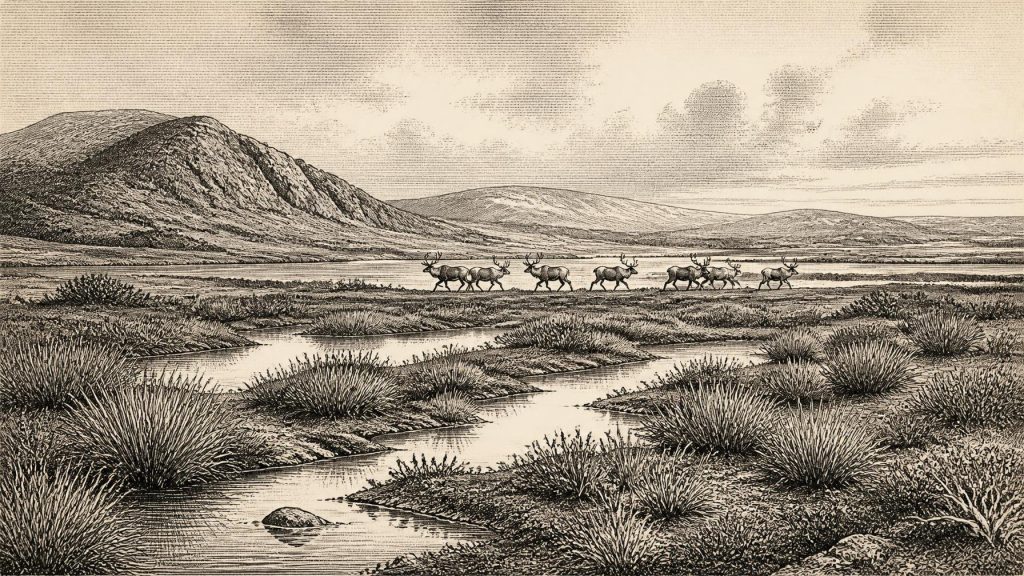
The familiar green, wooded Ireland of recent millennia did not exist. In places capable of supporting life, the prevailing scene was likely an open, cold and windy one: grassland, herb-rich tundra, sedge-dominated wet ground, dwarf shrubs and patches of sparse scrub rather than closed forest. Winters may have been severe and summers short. Such terrain could sustain grazing animals and their predators, but it was vulnerable to abrupt climatic reversals. The plants and animals recorded in Irish deposits are therefore evidence for habitats across broad intervals, not a guarantee that every species shared one valley or one season.
The Derryvree Window
One of the most valuable Irish records for this general world comes from Derryvree near Maguiresbridge, County Fermanagh. There, roadworks exposed freshwater silts, sands and organic sediments trapped between two deposits of glacial till beneath a drumlin. The sequence matters more than any single find. Lower till shows that ice had previously crossed the ground; freshwater sediment then accumulated during an ice-free interval; upper till shows that renewed glaciation later buried and protected the deposit. It is a geological archive of major environmental change, not a human habitation site.
A radiocarbon determination from Derryvree of about 30,500 radiocarbon years before present has a substantial uncertainty. Calibration places the relevant episode broadly within c. 36,900–31,700 calibrated years before present. That range overlaps the broad chronological neighbourhood of 31,668 BCE, but cannot pinpoint it. Mosses, sedges, bogbean, mountain avens and other plant remains, together with insect evidence, point towards a cold, open and wet landscape. Freshwater hollows and seasonally saturated ground existed amid treeless terrain. Scattered tree pollen is not enough to demonstrate nearby woodland: pollen can travel long distances or be redeposited.
Derryvree is particularly important because later ice did not erase everything. Much Irish evidence from this age was destroyed, disturbed or hidden by successive glaciations, rising seas and later sediment. The survival of an inter-till wetland gives historians and scientists a rare glimpse of ecological possibility in northern Ireland. It does not reveal settlements, languages, kin groups or beliefs. Its value lies in establishing that, during part of this broad interval, a periglacial environment existed in which animal movement and perhaps short human incursions were physically possible.
Castlepook’s Animal World
In north County Cork, Castlepook Cave, also known as Mammoth Cave near Doneraile, has produced Ireland’s most celebrated assemblage of older Late Pleistocene animal remains. Excavations conducted mainly in the late nineteenth and early twentieth centuries recovered bones attributed to woolly mammoth, reindeer, giant deer, brown bear, wolf, red fox, Arctic fox, mountain hare, collared lemming, Norwegian lemming and spotted hyaena. A radiocarbon age of 33,400 ± 1,200 radiocarbon years before present on mammoth collagen has long been used to place part of the assemblage in the Middle Devensian, the British and Irish term for this phase of the last glacial cycle.
That impressive list must nevertheless be handled with care. Castle deposits accumulated through natural deaths, carnivore activity, water movement and changing cave conditions. Antiquarian excavation also disturbed the deposits before modern recording standards existed. Some bones may belong to different episodes rather than a single contemporaneous community. The cave was not necessarily a mammoth-hunters’ camp; its fauna includes powerful carnivores, and hyaena remains and damage on bone show that predators used the area. Castlepook documents an Ice Age faunal landscape in southern Ireland, but it cannot by itself provide a neatly dated snapshot of one year.
The animals suggest an ecosystem unlike modern Ireland. Reindeer and lemmings are consistent with cold, open country; mammoth and giant deer indicate substantial grazing resources; wolves and hyaenas point to a food web in which carcasses were contested and rapidly consumed. Caves could offer shelter to animals and preserve bones, but they were not automatically desirable or safe places for people. An animal bone in a cave is evidence of the animal, not automatically of human hunting, food storage or residence.
The Mark on the Reindeer Bone
Human history enters the picture through one exceptionally small and contested-looking trace: a reindeer femur from the Castlepook collection. Zooarchaeologist Ruth Carden identified a deep linear mark on the bone as consistent with modification by a sharp stone implement while the bone was fresh, and County Cork heritage publications have presented it as evidence that Stone Age hunters processed reindeer around 33,000 years ago. If that interpretation is sustained by further study, it would be the earliest currently proposed evidence for human activity in Ireland by a very large margin.
Yet the conclusion must remain deliberately limited. A radiocarbon result dates the animal material sampled, within a probability range; it does not date every bone from a disturbed cave deposit or prove when a mark was made. Nor has Castlepook yielded a securely associated stone-tool assemblage, hearth, dwelling floor, human skeleton, ornament, burial or repeated domestic refuse of this age. Natural breakage, carnivore action and excavation damage can complicate the reading of bone surfaces. New investigations in the cave have identified surviving Pleistocene deposits, offering the prospect of better stratified evidence, but the case for people at Castlepook remains a promising inference rather than a fully documented settlement.
People Without a Political History
There is no responsible political narrative for Ireland in 31,668 BCE. No evidence identifies a chiefdom, territory, alliance, war, diplomatic meeting or named community. There is equally no basis for attaching later Irish identities, languages, religions or ancestry to any possible visitors. If people did reach southern Ireland, they were almost certainly mobile Upper Palaeolithic hunter-gatherers, probably Homo sapiens, operating within wider north-west European social networks. That is a comparative interpretation drawn from contemporaneous societies elsewhere, not a fact established by an Irish settlement.
Likewise, no Irish evidence of this age permits confident statements about households, gender roles, ritual, art, teaching or exchange. Elsewhere in Upper Palaeolithic Europe, people made sophisticated stone and organic tools, tailored clothing, ornaments and images, and maintained social links across considerable distances. None of these practices can simply be imported into Ireland without material proof. The most that the reindeer femur could indicate is a practical action: perhaps the cutting, jointing or removal of meat from a carcass by one or more people equipped with a sharp lithic edge.
Movement, Resources and Limits
If visitors were present, reindeer would have offered meat, fat, hide, sinew and bone; a single carcass could have been valuable in a resource-poor cold landscape. But the evidence cannot tell whether people killed the animal, encountered it already dead, followed a seasonal herd, or made only a short stop. Nor can it settle how they arrived. Lower sea levels changed the outlines of the Irish and Celtic seas, while ice and water created a complex, shifting geography. Geological work does not support a simple, durable walkable land bridge across the Irish Sea. Any journey from Britain or the European mainland may have involved difficult coastal, ice-margin or water crossings.
Permanent occupation is especially unlikely to be demonstrated from a lone modified bone. The later advance of the Irish Ice Sheet would have transformed or obliterated many landscapes and, if people had visited, probably ended any local occupation. There is no evidence of continuity between this tentative episode and the much later, better-attested settlement of post-glacial Ireland. The history here is not one of an established Ice Age population waiting to become later Ireland, but of a land repeatedly made hospitable and inhospitable by climate.
An Evidence-Rich Silence
The significance of 31,668 BCE lies in that tension. Ireland was not outside the Ice Age world: wet tundra basins survived in Fermanagh, large mammals ranged through parts of the island, and Castlepook preserves an extraordinary record of their presence in Cork. A marked reindeer bone raises the serious possibility that people briefly entered that world and processed an animal there. But the archaeological record does not yet allow a story of a camp, a family or a hunting expedition. For this remote date, intellectual honesty is not a lack of imagination. It is the recognition that bones, silts and pollen can illuminate an ancient landscape more securely than they can name those who may have crossed it.
Primary Sources
- The Irish Quaternary Fauna Project
- Pleistocene Vertebrates in the British Isles
- Archaeological Heritage of County Cork
- Heritage Artefacts of County Cork
- Archaeology Research Excavation Grant 2022: Final Report
- New Insights on the Fauna of Ireland's Younger Dryas and Early Holocene from Alice & Gwendoline Cave
- Ireland's Palaeolithic Archaeology – Fleeting Footprints in a Frozen Land
- The Subdivision of the Quaternary Period in Ireland
- Extent and Deglacial Chronology of the Last British–Irish Ice Sheet: Implications of Exposure Dating Using Cosmogenic Isotopes
- Pattern and Timing of Retreat of the Last British-Irish Ice Sheet
- Growth and Retreat of the Last British–Irish Ice Sheet, 31,000 to 15,000 Years Ago: the BRITICE-CHRONO Reconstruction
- Dimensions and Chronology of the Last Ice Sheet in Western Ireland
- Last Glacial Maximum Cirque Glaciation in Ireland and Implications for Reconstructions of the Irish Ice Sheet
- Deglaciation Chronology of the Donegal Ice Centre, North-West Ireland
- Stratigraphic and Palaeo-Geomorphological Evidence for the Glacial-Deglacial History of the Last British-Irish Ice Sheet in the North-Western Irish Sea
- The Problem of a Late Quaternary Landbridge Between Britain and Ireland
- Ireland: Submerged Prehistoric Sites and Landscapes
- Guide to the National Museum of Ireland
- Stone Age Collections
- Dryas octopetala
- Mammoth Cave
- Reindeer Bone Found in Cork Cave Shows Human Activity in Ireland 33,000 Years Ago
- Relative Sea-Level Changes and Crustal Movements in Britain and Ireland Since the Last Glacial Maximum