Derryvree Upper Till30306 BCE
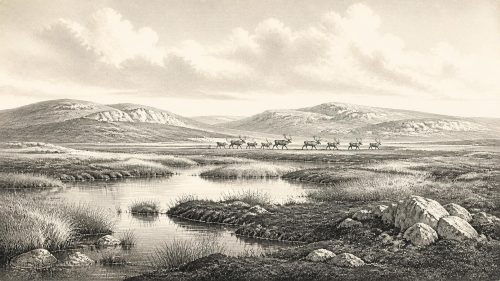
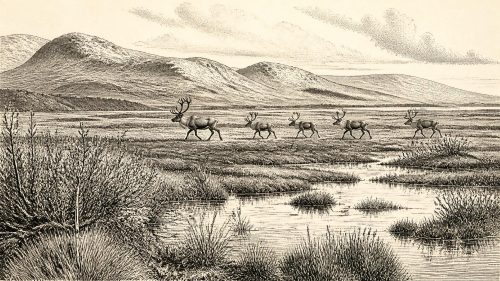
At 30,306 BCE, Ireland lay within the unstable cold conditions of Marine Isotope Stage 3, before the Last Glacial Maximum. Derryvree, County Fermanagh, preserves freshwater sediments between two glacial tills, dated broadly to 36,900–31,700 calibrated years BP. Plants and insects indicate an ice-free, treeless tundra wetland with pools, sedges, mosses and arctic-alpine vegetation. Castlepook Cave, County Cork, records diverse Pleistocene fauna, including mammoth, reindeer and predators, but its bones span different periods. A cut-marked reindeer bone may suggest Upper Palaeolithic human activity, yet no contemporary camps, tools or human remains confirm settlement. It documents environmental change before ice returned again.

Dateline
Modern calendar-year precision is not available for Ireland at 30,306 BCE. The number is a useful point on a modern timeline, not a date for which archaeology can identify a particular season, generation, event or community. In the dating language used by Quaternary science, it falls roughly 32.3 thousand calendar years before AD 1950. The closest major Irish environmental sequence, from Derryvree near Maguiresbridge in County Fermanagh, produced a conventional radiocarbon age of 30,500 years BP, with a substantial uncertainty of about a millennium. When calibrated, that determination belongs within a broad late-ice-age range, approximately 36,900–31,700 calibrated years BP. The nominated year can therefore be discussed only as part of that wider interval.
Ireland was then in the Late Pleistocene, within Marine Isotope Stage 3: a long, unstable cold phase before the fullest expansion of the last British–Irish Ice Sheet. It was not a time of Irish kingdoms, named peoples, diplomacy or written tradition. Nor can archaeologists responsibly reconstruct a permanent population, a settlement network, religion or political conflict. The evidence is geological and palaeontological: buried freshwater sediments, pollen and plant remains, insect fragments, animal bones, cave deposits and radiocarbon measurements. Its importance lies precisely in what it reveals about the conditions in which people and animals might, intermittently, have reached the far north-west of Europe.
Fresh Water Beneath a Drumlin
The strongest witness is the Derryvree deposit, exposed during road works in 1969 in a drumlin about two kilometres north-east of Maguiresbridge. A drumlin is a streamlined hill of glacial sediment. At Derryvree, investigators found a lower till, deposited by glacier ice, overlain by freshwater silts, fine sands and organic layers; a second, thick till later sealed the sequence. The order of deposits supplies a clear relative history. Ice had passed over the locality, then a wetland or shallow-water environment developed, and eventually ice returned. Later glaciation destroyed or disturbed much older evidence elsewhere in Ireland, but here it also helped to preserve a fragment of the earlier landscape.
The radiocarbon sample, known as Birm-166, dates the organic sediments rather than a dramatic occurrence. It does not mean that the wetland formed in one year, or that every fossil in the layer belonged to a single living community. Radiocarbon ages also differ from calendar ages because atmospheric carbon-14 concentrations have varied through time. Calibration is therefore essential, and at this depth of time the resulting ranges remain wide. Derryvree is exceptionally valuable not because it offers an exact anniversary, but because it gives a securely stratified glimpse of an Irish place between glacial episodes.
A Treeless Wetland Landscape
The plant and insect evidence indicates an open, treeless tundra or muskeg landscape under periglacial conditions: ground and water shaped by severe cold, seasonal thaw and frost. Grasses, sedges, mosses, dwarf willow, juniper and cold-adapted herbs formed much of the cover. Aquatic and wet-margin plants, including water-milfoil and bogbean, show that pools or slow water persisted locally. Mountain avens and other arctic-alpine elements point to exposed, chilly ground. This was not an evergreen forest or an unbroken white wilderness. It was a patchwork of shallow water, wet mossy margins, sedge-rich ground and open mineral soils, productive for a short summer but subject to long, hard winters.
Such evidence supports a local reconstruction, not a complete map of Ireland. The Derryvree basin was in south Fermanagh; coastlines, uplands and lowlands did not all experience identical conditions. Nevertheless, it decisively rules out the simple notion that Ireland was continuously entombed beneath ice throughout the whole later Ice Age. Around the broad interval represented by Birm-166, at least this part of Fermanagh contained an ice-free freshwater habitat. The presence of a lower and upper till also shows how precarious that opening was. A liveable wetland could be overtaken, buried and transformed as ice margins advanced again.
Ice, Sea and Changing Connections
The wider setting was one of accelerating climatic instability. The Last Glacial Maximum is generally placed later, broadly between about 26,000 and 20,000 years ago, when the British–Irish Ice Sheet reached its greatest extent. At 30,306 BCE, Ireland stood before that maximum, in a landscape already affected by earlier glaciations and vulnerable to renewed ice growth. Recent reconstructions emphasise that the ice sheet did not simply appear as one uniform cap. It expanded and retreated unevenly, with regional ice centres, shifting flow paths and changing margins across Ireland, Britain and the surrounding continental shelf.
Sea level was much lower than today because enormous quantities of water were locked in northern ice sheets. That altered the outlines of the Irish Sea basin and may at times have made animal movement from Britain or the European mainland more feasible than it is now. Yet lowered sea level must not be converted automatically into a known land bridge, a mapped road or a permanent migration corridor. The exact routes available at any particular moment remain uncertain. The evidence for large mammals in Ireland establishes that ecological connections existed during parts of the Pleistocene; it does not tell us how many crossings occurred, in which season, or whether humans travelled by precisely the same routes.
Castlepook’s Animal Archive
County Cork provides the other essential Irish archive. Castlepook Cave, near Doneraile and sometimes called Mammoth Cave, has yielded more than 2,000 animal remains from deposits accumulated across a long span of the Middle and Late Pleistocene. Its assemblage includes woolly mammoth, reindeer, giant deer, brown bear, Arctic fox, hare, lemmings and spotted hyaena. This is evidence for a diverse cold-stage fauna capable of living in, or repeatedly entering, Ireland before the Last Glacial Maximum. It also reveals a food web more complex than a picturesque herd of grazing animals: large herbivores, scavengers, predators and small mammals occupied connected habitats across changing climatic phases.
Care is essential, however. Cave bone collections are not ordinary snapshots of one valley on one day. Carnivores may have dragged prey inside; animals may have died naturally; water can move bones; and early excavations often removed deposits before modern recording methods existed. Re-dating has shown that some older Irish cave dates underestimated the true age of specimens, while individual animal bones from the same cave may belong to very different millennia. Castlepook demonstrates repeated animal presence and environmental possibility, not that mammoths, hyaenas and every other recorded species necessarily lived together in 30,306 BCE.
The Human Question
The same distinction governs the most tantalising evidence. A reindeer femur from Castlepook, held in the National Museum of Ireland’s Natural History collection, has been reported as bearing a deep mark consistent with cutting by a sharp stone tool and as dating to about 33,000 years ago. If the mark proves anthropogenic, it may indicate that people processed a reindeer in Ireland during the Upper Palaeolithic, vastly earlier than the well-established terminal-Pleistocene evidence from County Clare. It is an important claim, but it is not yet a basis for a detailed social history of Ireland at this date.
No securely contemporary Irish human bones, stratified stone-tool assemblage, hearth, house floor, burial, artwork or excavated camp has been published for this interval. The cautious conclusion is narrower and more powerful: a human visit or brief episode of animal processing is possible, perhaps even likely if the interpretation of the Castlepook incision is sustained, but permanent settlement and population continuity remain unproven. A sharp mark on a bone can raise a profound question; it cannot identify a language, kin group, leader, ritual or territory.
What Everyday Life Cannot Yet Tell Us
There is consequently no responsible evidence for political affairs, warfare, diplomacy, formal religion, trade institutions, farming or learning in Ireland at this point. There were no crops, domesticated livestock, metalwork, pottery, monuments or towns. If people did visit, they would have belonged to the wider hunter-gatherer world of Upper Palaeolithic north-west Europe and would have depended on mobile knowledge: reading weather, terrain and animal movement; making and maintaining portable equipment; securing food and shelter; and navigating a dangerous, seasonal landscape. That is an informed comparison with continental Europe, not a directly observed Irish fact.
Nor should the absence of a settlement be mistaken for proof of empty land. Ice-age Ireland was difficult terrain for preservation. Later glaciers eroded surfaces, reworked sediments and reshaped river systems; acidic soils are often hostile to bone and organic artefacts; and much of the relevant ancient landscape now lies beneath modern sea or later deposits. The archaeological silence may partly record genuine rarity of human visits, but it is also the result of what survived to be found.
A Narrow Window Before Ice Return
The most secure history of Ireland around 30,306 BCE is therefore environmental. Fermanagh contained cold freshwater pools and wet ground during a broad interval between ice advances. Tundra plants and insects recorded a severe but living landscape. Cave deposits in Cork show that reindeer, mammoths and predators were among the animals that reached Ireland during the wider late-Pleistocene world. One marked reindeer bone raises the possibility of human action, while the lack of a camp or tool assemblage defines the limit of certainty. Birm-166 is not a record of a single year. It is a rare, sealed archive of a changing island at the edge of the Ice Age world.
Primary Sources
- Middle Midlandian Freshwater Series at Derryvree, Maguiresbridge, County Fermanagh, Northern Ireland
- Middle Midlandian Freshwater Series at Derryvree, Maguiresbridge, County Fermanagh, Northern Ireland
- Figure 6.— The Subdivision of the Quaternary Period in Ireland
- Pleistocene Glaciations in Ireland
- A Reconsideration of the Radiocarbon Dating of the Marine Isotope Stage 3 Fauna from Southern Ireland
- Cork County Geological Site Report: Castlepook Cave
- The Irish Quaternary Fauna Project
- Irish Pleistocene Biostratigraphy
- Archaeology Research Excavation Grant 2022
- 2022:564 – Castlepook Cave, Castlepook South, Cork
- Heritage Artefacts of County Cork
- Archaeological Heritage of County Cork
- Castlepook Caves
- Mammoth Cave, County Cork
- Growth and Retreat of the Last British–Irish Ice Sheet, 31,000 to 15,000 Years Ago: the BRITICE-CHRONO Reconstruction
- The Timing and Magnitude of the British–Irish Ice Sheet Between Marine Isotope Stages 5d and 2
- Last Glacial Maximum Cirque Glaciation in Ireland and Implications for Reconstructions of the Irish Ice Sheet
- Stratigraphic and Palaeo-Geomorphological Evidence for the Glacial-Deglacial History of the Last British-Irish Ice Sheet in the North-Western Irish Sea
- The IntCal20 Northern Hemisphere Radiocarbon Age Calibration Curve (0–55 kcal BP)
- First Evidence of a Late Upper Palaeolithic Human Presence in Ireland
- New Insights on the Fauna of Ireland's Younger Dryas and Early Holocene from Alice & Gwendoline Cave
- The Colonization of Ireland: A Human Ecology Perspective