Bogbean Beneath Two Tills30356 BCE
30,356 BCE is a modern label, not a recoverable Irish historical year. Evidence from Derryvree, County Fermanagh, records a freshwater wetland sealed between glacial tills, dated broadly to 34,950–29,750 BCE. Its bogbean, sedges, mosses, dwarf willow and Arctic-alpine flora indicate treeless, periglacial tundra conditions during an ice-free interval. Castlepook Cave, County Cork, preserves cold-stage fauna including reindeer, mammoth, hyena, wolves and lemmings, demonstrating intermittent ecological connections with north-west Europe. A possibly cut-marked reindeer bone suggests human contact, not settlement. No political, cultural or social narrative is supported. These archives instead document environmental instability, local habitability and later profound glacial transformation.
Dateline
“30,356 BCE” is a modern chronological label, not a year that can be recovered from Ireland’s Ice Age record. No written calendar existed; no Irish settlement, political event or named individual can be assigned to this year. At this depth of time, responsible history works with dated deposits, fossil assemblages and broad calibrated probability ranges rather than anniversaries. The date falls approximately 32,300 calendar years before AD 1950, in the later Pleistocene and broadly within Marine Isotope Stage 3, an unstable interval before the Last Glacial Maximum.
The closest and most illuminating Irish evidence is not an event but a buried wetland at Derryvree, near Maguiresbridge in County Fermanagh. There, roadworks in 1969 cut through a drumlin and exposed freshwater silts, fine sands and organic material sealed between two thick layers of glacial till. The stratigraphic order is secure: glacier ice had occupied the locality; an ice-free or ice-distal interval allowed freshwater sediment and vegetation to accumulate; ice later returned and buried the deposit. Yet this sequence is a local environmental archive, not a diary of Ireland in a single year.
A Date Within a Wide Range
The Derryvree organic material produced the conventional radiocarbon determination Birm-166: 30,500 radiocarbon years BP, with a large uncertainty of +1,170 and −1,030 years. A radiocarbon age is not automatically a calendar date. Atmospheric carbon-14 levels changed through time, and calibration of such old determinations produces a broad interval rather than a narrow point. Using modern calibration approaches, the date is generally placed broadly around 36,900–31,700 calibrated years BP, approximately 34,950–29,750 BCE. Thus 30,356 BCE falls within the possible span associated with the deposit, but cannot be tied to a particular layer, season, generation or occurrence at Derryvree.
This distinction matters especially because the word “around” can conceal considerable uncertainty. The deposit may have accumulated over years, decades or longer, while the radiocarbon measurement represents carbon within sampled organic material, with laboratory uncertainty and calibration uncertainty added to the problem. The ice sheets themselves also expanded and contracted unevenly across the island and surrounding seas. Ireland at this time was therefore neither a fixed map of ice nor a timeless wilderness. It was a region of sharp environmental variation, in which a freshwater basin in Fermanagh could exist during a wider cold phase before later ice overwhelmed it.
Derryvree’s Treeless Wetland
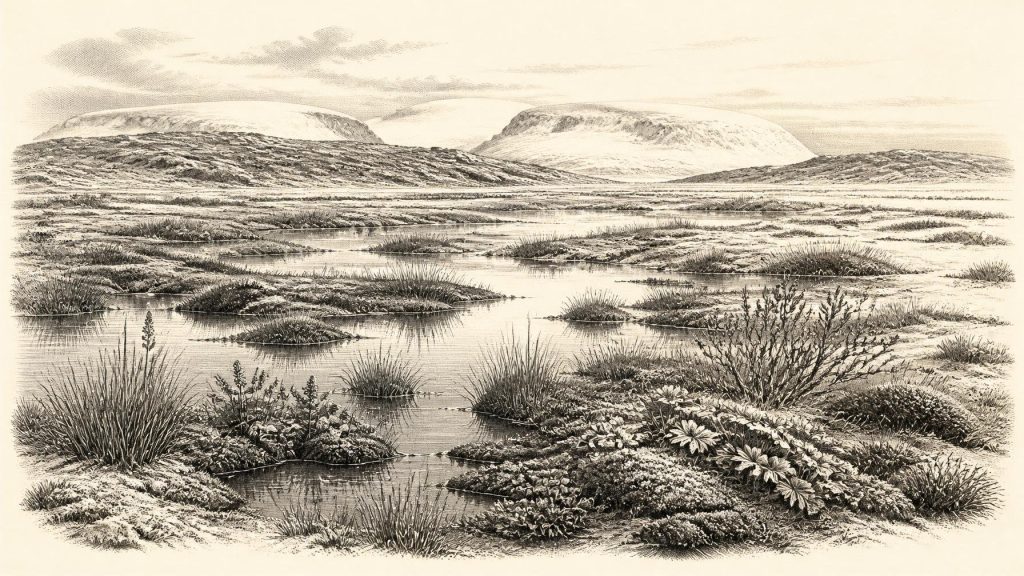
The Derryvree plants and small animal remains provide the clearest direct picture. Their assemblage indicates open tundra vegetation and a periglacial climate: conditions shaped by severe cold, repeated freezing and thawing, short growing seasons and little or no woodland. The evidence includes aquatic and wetland plants, notably bogbean (Menyanthes trifoliata) and water-milfoil, alongside dwarf willow, sedges, mosses and Arctic-alpine herbs such as mountain avens. These fossils show that the locality was not simply barren ground beside ice. Freshwater persisted long enough for plants to grow, die and enter accumulating silt.
That does not mean a comfortable landscape. Treeless vegetation implies exposure to wind, winter cold and a restricted summer season. Permafrost or seasonally frozen ground would have affected drainage. Shallow pools, sedge margins, damp mossy patches and stony open ground may have lain close together, rather than forming a uniform plain. The best reconstruction is therefore a mosaic: a low, wet basin supporting hardy plants, set within a cold open landscape whose soils and waterways were influenced by frost. Such a habitat could change rapidly as climate, snowfall and glacier margins changed.
Regional comparison is essential. Derryvree cannot stand for every part of Ireland. Much of the island’s older surface has been eroded, reworked or hidden beneath later tills, and surviving records are uneven. The very fact that Derryvree was sealed between tills makes it exceptionally valuable. It preserves a short environmental window precisely because later ice protected the deposits from complete destruction. Its lesson is not that all Ireland was an identical tundra wetland, but that at least part of Ulster supported this cold freshwater environment during the Middle Midlandian.
Animals in the Southern Caves
County Cork provides a different, though complementary, archive. Castlepook Cave near Doneraile, also known as Mammoth Cave, has yielded Ireland’s most important assemblage of mammals from the last cold stage. Its fossils include reindeer, woolly mammoth, spotted hyena, wolf, Arctic fox, brown bear, giant deer, hares and lemmings. Individual bones from the cave span many millennia, so they must not be treated as one herd, one food web or one moment in time. Nevertheless, they establish that cold-adapted and open-country animals reached Ireland during this part of the Pleistocene.
The presence of spotted hyena is particularly striking. Hyenas were not merely scavengers of a frozen emptiness: their bones, teeth and dung in caves can reflect denning, feeding and the movement of carcasses into shelter. Mammoth and reindeer indicate connections with the wider faunal world of north-west Europe, although the routes, seasons and exact timing of migration remain uncertain. The lower sea levels of the glacial period altered coastlines, but ice, water and changing terrain made the geography of movement complex. It is safer to say that Ireland was biologically connected, intermittently and in ways not yet fully reconstructed, to Britain and continental north-west Europe than to assume a simple permanent land bridge.
These animal records also caution against imagining an unchanging “mammoth-steppe” community. Cave deposits can mix bones left by carnivores, natural deaths, water movement and excavation disturbance. A mammoth bone and a hyena skull may be broadly contemporary in geological terms without proving that the animals met. What the evidence supports is an intermittently habitable cold landscape, sufficiently productive in some places and seasons for large herbivores and their predators, not a fully mapped ecosystem at 30,356 BCE.
The Human Question
Human history at this date is necessarily more tentative. A reindeer femur from Castlepook has been reported as bearing a mark consistent with fresh-bone cutting by a stone tool and has been associated with an age of roughly 33,000 radiocarbon years BP. If the modification is confirmed as human-made and contemporary with the animal’s death, it may record carcass processing by Upper Palaeolithic people far earlier than Ireland’s once accepted human record. It would be an important trace of contact or a brief visit.
It would not, however, establish a resident population, a camp, or a named Upper Palaeolithic culture in Ireland. No securely associated house, hearth, stone-tool assemblage, burial, human skeleton, workshop or rock art of this age is known from the island. Nor can one marked bone reveal group size, language, kinship, beliefs or the duration of any visit. The dated animal also need not have been handled in the same calendar year as the modern label used for this article. The evidence allows a carefully bounded possibility of human activity; it does not permit a populated, year-by-year prehistoric narrative.
What Cannot Be Written
For that reason, political affairs, diplomacy and warfare cannot responsibly be reconstructed for Ireland around this date. There is no evidence for polities, chiefs, territorial boundaries, alliances or organised conflict. Likewise, there is no Irish evidence for ritual practice, formal religion, artistic traditions, teaching, trade networks or domestic settlement in this particular period. Archaeology elsewhere in Upper Palaeolithic Europe demonstrates that humans were capable of sophisticated technology, long-distance relationships and symbolic culture, but those broader comparisons must not be converted into unsupported claims for Ireland.
The economy that can be discussed is ecological rather than social. Plants converted the brief growing season into forage; herbivores moved through suitable terrain; predators and scavengers followed them; caves accumulated bones. Freshwater at Derryvree and large mammals in Cork demonstrate that Ireland was not uniformly sterile before the Last Glacial Maximum. Yet resources were seasonal, habitats fragmented and climatic deterioration increasingly consequential. Later expansion of the British–Irish Ice Sheet would reshape the island, remove older deposits and leave the glacial landforms that still influence its terrain.
An Archive, Not an Anniversary
The most meaningful development around 30,356 BCE was therefore environmental instability. Derryvree records a cold, treeless freshwater world between advances of ice. Castlepook records a wider succession of animals that entered Ireland during the late Pleistocene, including reindeer, mammoth and hyena. Together they show an island at the north-western edge of European ecological networks, with life enduring in favourable places but vulnerable to a changing climate and advancing ice.
This is a rich history, even though it is not a conventional one. Its protagonists are a buried wetland, a bogbean seed, a hyena skull, reindeer bone and the layers of till above and below them. They give Ireland a past around this modernly numbered year, but not a precise event within it. The responsible conclusion is one of calibrated ranges and carefully separated interpretations: an open tundra landscape existed locally in Fermanagh; cold-stage animals reached Ireland, including Cork; people may have briefly handled a reindeer; and almost everything else remains beyond the present evidence.
Primary Sources
- A Middle Midlandian Freshwater Series at Derryvree, Maguiresbridge, County Fermanagh, Northern Ireland
- Exploring controls of the early and stepped deglaciation on the western margin of the British-Irish Ice Sheet
- The Irish Quaternary Fauna Project
- Spotted Hyena Skull
- The Archaeological Heritage of County Cork
- Heritage Artefacts of County Cork
- First evidence of a Late Upper Palaeolithic human presence in Ireland
- New Insights on the Fauna of Ireland’s Younger Dryas and Early Holocene from Alice & Gwendoline Cave
- The IntCal20 Northern Hemisphere Radiocarbon Age Calibration Curve (0–55 cal kBP)
- Radiocarbon Constraints on the Age of the Maximum Advance of the British–Irish Ice Sheet in the Celtic Sea
- BRITICE Glacial Map, Version 2: A Map and GIS Database of Glacial Landforms of the Last British–Irish Ice Sheet
- Pattern and Timing of Retreat of the Last British-Irish Ice Sheet
- Pleistocene Glaciations in Ireland
- New Data for the Last Glacial Maximum in Great Britain and Ireland
- The Problem of a Late Quaternary Landbridge Between Britain and Ireland
- Ireland: Submerged Prehistoric Sites and Landscapes
- Quaternary
- Geology of Ireland
- Figure 6.— The Subdivision of the Quaternary Period in Ireland
- BSBI: Menyanthes trifoliata
- BSBI: Dryas octopetala
- Occurrence of Mammalia Relicts at Site Castlepook Cave