Derryvree’s Buried Water-Meadow30518 BCE
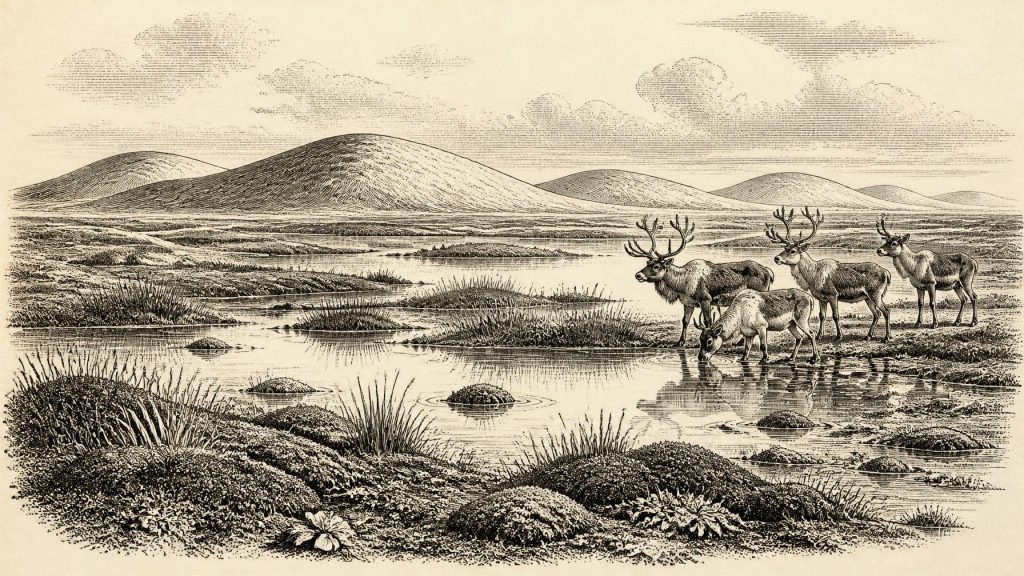
The modern label 30,518 BCE cannot denote a recoverable Irish year, but places Ireland in unstable MIS 3 conditions. At Derryvree, County Fermanagh, buried freshwater sediments between glacial tills show an ice-free interval, broadly dated to 36,900–31,700 calibrated years ago. Pollen, plants, insects and mosses indicate open tundra-like wetland, shallow pools and seasonal frost before renewed ice. Castlepook Cave, County Cork, preserves fossils of cold-climate fauna, including reindeer, mammoth and carnivores, from broadly comparable periods. A possibly tool-marked reindeer bone may indicate human butchery, but cannot prove settlement. Evidence therefore reveals changing environments, not securely known communities, events or institutions.
Dateline
“30,518 BCE” is a modern chronological label, not a recoverable year in Ireland’s past. No Irish calendar, written record, named community, settlement, burial or event can be attached to that twelve-month span. In archaeological terms, the date falls roughly 32,500 calibrated years before present, with “present” conventionally fixed at AD 1950: late in the Pleistocene, during Marine Isotope Stage 3 (MIS 3), a climatically unstable phase of the last Ice Age. The responsible history of Ireland at this depth of time must therefore be told through broad, calibrated ranges and physical traces rather than an annal of happenings.
The closest strong Irish evidence is not a human monument or camp, but a buried freshwater deposit at Derryvree, near Maguiresbridge in County Fermanagh. Roadworks in 1969 cut through a drumlin and revealed a remarkable sequence: a lower glacial till, fine sands and silts containing organic material, and a later upper till. The sequence records, in order, an earlier ice advance, an interval in which water and vegetation occupied the site, and the subsequent return or expansion of glacier ice. It gives Ireland around this notional date a landscape rather than a narrative: cold, exposed, watery and subject to profound environmental change.
Dating a Lost Interval
The principal Derryvree radiocarbon measurement, BIRM-166, returned an age of 30,500 radiocarbon years before present, with a substantial uncertainty of +1,170 and −1,030 years. A radiocarbon age is not a calendar age. Atmospheric carbon-14 varied over time, and early results must be calibrated against a changing international curve; at this antiquity the result is necessarily a range, not a pinpoint. Published discussion has placed the Derryvree organic layer broadly between about 36,900 and 31,700 calibrated years before present. The modern label 30,518 BCE lies within that large chronological neighbourhood, but it cannot identify a particular season, generation or moment represented by the sediments.
This distinction matters. Derryvree is powerful evidence that part of north-central Ireland was ice-free while the organic beds formed. It is not proof that every part of the island shared precisely the same conditions at the same time. Nor does it establish the exact extent of ice during any single century. The later till overlying the wetland shows that glacial conditions eventually returned to the locality. Regional ice-sheet reconstructions likewise indicate a changing, spatially uneven British–Irish Ice Sheet rather than a simple story in which Ireland was either wholly frozen or wholly open.
At roughly 32,500 calibrated years ago, Ireland had not yet reached the maximum expansion of the last ice sheet, which occurred much later in the last glacial cycle. Yet this was no mild prelude to a distant cold age. It was an Ice-Age world already shaped by frost, seasonal severity, low temperatures and changing ice margins. MIS 3 was marked across the North Atlantic by abrupt millennial-scale climatic shifts. Derryvree provides local evidence for one interval within that restless wider climate system, not a complete island-wide weather report.
Fresh Water Beneath the Drumlin
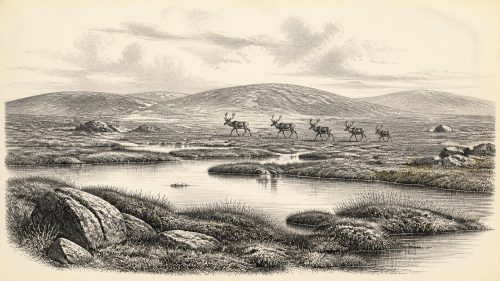
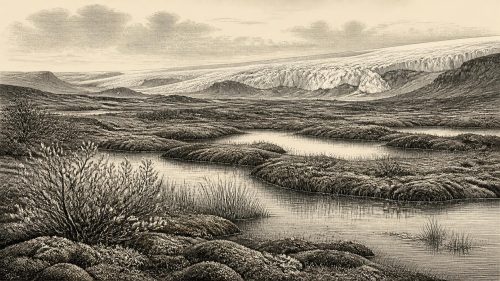
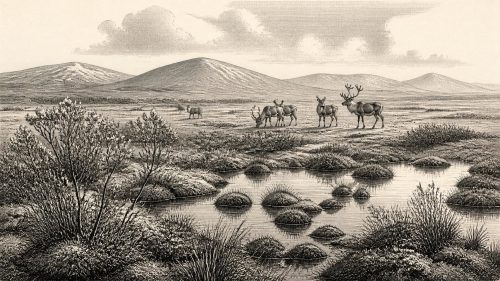
The Derryvree beds are especially valuable because they preserve organisms that normally vanish from the archaeological record. Fine freshwater sediments held pollen, plant macrofossils, mosses, insect remains and other organic material. Together, these support the interpretation of an open, treeless tundra or muskeg environment, with wet ground and shallow freshwater pools. Grasses, sedges, herbs and juniper pollen indicate sparse, low vegetation rather than closed woodland. Mosses and aquatic or wetland plants, including evidence reported for bogbean and water-milfoil, point to standing or slow-moving fresh water amid saturated ground.
The word “muskeg” is useful provided it is not made too picturesque. It denotes wet, peaty or moss-rich ground, often with pools and sedge-dominated margins. The Derryvree evidence suggests such a mosaic: patches of shallow water, mossy surfaces, muddy banks and open plant cover. It does not permit a reconstruction of a single permanent lake, nor an exact map of every pool. Permafrost-related processes, frost action and short growing seasons would have influenced the terrain, while summer thaw may have briefly made the wetland biologically productive.
This was a landscape in which mobility mattered. Water could collect in hollows between or beside glacial deposits; frozen ground could restrict drainage; and meltwater, snow and seasonal thaw could repeatedly alter the surface. The later glacier preserved the sequence by sealing it beneath till, but also demonstrates the fragility of habitable and vegetated intervals in Ice-Age Ireland. The most important development represented by Derryvree is therefore environmental: an ice-free freshwater refuge existed in Fermanagh before renewed glaciation covered its evidence.
Animals in a Cold Mosaic
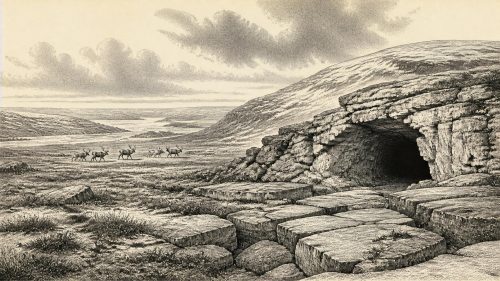
County Cork’s Castlepook Cave, also called Mammoth Cave, offers a complementary but different source of evidence. It is Ireland’s richest known Pleistocene vertebrate site, although its cave deposits accumulated over long spans and were affected by carnivores, water movement and early excavations. Its fossils must not be treated as a census from one year, or even as proof that every recorded species lived together. They do, however, show that Ireland supported or received a varied Ice-Age fauna during the broad period before the Last Glacial Maximum.
Castlepook has produced remains attributed to woolly mammoth, reindeer, giant deer, brown bear, wolf, mountain hare, stoat, lemmings and spotted hyaena. Radiocarbon dates from the older investigations include approximately 33,500 ± 1,200 radiocarbon years before present for mammoth and 34,300 ± 1,800 for spotted hyaena. These measurements overlap only broadly with the period under discussion after calibration and uncertainty are considered. They establish that north Cork was part of a wider cold-climate ecological zone capable of supporting large herbivores and formidable scavenging or hunting carnivores; they do not furnish an exact faunal list for 30,518 BCE.
Reindeer are particularly relevant to the open country indicated at Derryvree. Herding animals adapted to cold, exposed terrain could have moved across extensive seasonal ranges, while wolves and hyaenas followed opportunities created by herbivore movements and carcasses. Mammoths and giant deer, where present, would have required substantial forage and reveal that even a harsh landscape could contain productive pockets. But animal bones are evidence of animal presence, not automatic evidence of a stable human economy. Their findspots and dates are uneven, and the survival of bones is governed as much by caves and sediment traps as by the original abundance of animals.
The Human Question
The possibility of people in Ireland around this broad period rests on a single, important but limited clue. A reindeer femur from Castlepook, recovered from the cave’s old collections, has been interpreted by zooarchaeologist Ruth Carden as bearing a deep mark made by a sharp stone tool during the butchery of fresh bone. County Cork heritage material dates the object broadly to about 31,000 BC. If that interpretation is confirmed, it would indicate that people processed a reindeer in Ireland far earlier than the formerly accepted terminal-Pleistocene evidence for human activity.
That conclusion must remain cautious. The femur comes from a cave assemblage disturbed by natural processes and antiquarian excavation, not from a newly excavated, sealed living floor. No securely associated stone tools, hearth, dwelling, human bone or coherent butchery area of comparable antiquity has been recovered at Castlepook. A date on the bone establishes the approximate age of the animal, while identifying a surface incision as a human cut mark is a separate taphonomic judgement. The most defensible formulation is that the bone offers a potentially significant indication of human handling, not proof of a permanent or continuous Irish population.
Accordingly, no political affairs, diplomacy, territorial groups, leaders or warfare can responsibly be described for Ireland at this date. There is no evidence for farming, herding, trade networks, houses, pottery, burial rites, ritual monuments, language or formal learning. If people did visit, they may have travelled in small, mobile foraging groups and exploited animal resources, as Upper Palaeolithic populations elsewhere in north-west Europe did. That is an inference from the wider European context, not a fact demonstrated for Ireland. The Castlepook femur cannot tell us whether a person hunted the reindeer, encountered an already dead animal, or remained in the area for hours, days or longer.
An Island Before History
Even the word “island” needs care. Sea level was far lower than today during the Ice Age, and coastlines, estuaries and the Irish Sea basin were configured differently. Yet the available Irish evidence does not justify a simple claim that people could certainly walk into Ireland at this particular date. Routes between Ireland, Britain and the European mainland changed with ice, sea level and local topography. Any human arrival inferred from Castlepook would therefore raise questions about crossings and connections, but does not answer them.
For everyday life, the strongest evidence belongs to plants, insects, water and animals rather than people. A short summer growing season could support sedges, herbs, mosses and grazing animals in sheltered or wet ground. Winter conditions were probably severe, with exposed ground, frozen soils and reduced food availability. The recurrent reshaping of drainage and vegetation by climate was more historically decisive than any identifiable human institution. Derryvree’s buried water-meadow was not an agricultural landscape, a village territory or a ritual centre. It was a temporary ecological opening in an Ice-Age country whose later ice cover erased almost every surface trace.
Thus Ireland around 30,518 BCE is best understood not as a year of recorded events, but as an interval of evidence. Beneath the Fermanagh drumlins, freshwater silts preserve a cold, open wetland inhabited by plants and small creatures. In a Cork cave, bones reveal a wider fauna of reindeer, mammoth and carnivores, alongside a tantalising possible trace of human butchery. The evidence illuminates a changing Pleistocene environment and a major archaeological question. It does not yet allow historians to populate Ireland with a known people, culture or event. Its significance lies precisely in that restraint: the buried landscape is real, while much of the human story remains to be discovered.
Primary Sources
- A Middle Midlandian Freshwater Series at Derryvree, Maguiresbridge, County Fermanagh, Northern Ireland
- Trimlines, Blockfields and the Vertical Extent of the Last Ice Sheet in Southern Ireland
- The Irish Quaternary Fauna Project
- Irish Pleistocene Biostratigraphy
- Cork County Geological Site Report: Castlepook Cave
- Heritage Artefacts of County Cork 2021
- Castlepook Cave Excavation, County Cork, 2022
- New Insights on the Fauna of Ireland’s Younger Dryas
- Growth and Retreat of the Last British–Irish Ice Sheet, 31,000 to 15,000 Years Ago: the BRITICE-CHRONO Reconstruction
- Reconstructing the Last Irish Ice Sheet 2: a Geomorphologically-Driven Model of Ice Sheet Growth, Retreat and Dynamics
- Dimensions and Chronology of the Last Ice Sheet in Western Ireland
- Deglaciation Chronology of the Donegal Ice Centre, North-West Ireland
- Timing and Pace of Ice-Sheet Withdrawal Across the Marine–Terrestrial Transition West of Ireland During the Last Glaciation
- Figure 6: The Subdivision of the Quaternary Period in Ireland
- Environmental Statement for Northern Ireland: Deposits of the Last Glaciation
- Menyanthes trifoliata L. in Fermanagh: Fossil and Modern Record
- The IntCal20 Northern Hemisphere Radiocarbon Age Calibration Curve (0–55 cal kBP)
- IntCal Publications
- Dansgaard–Oeschger Events in Climate Models: Review and Baseline Marine Isotope Stage 3 Protocol
- Gulf Stream Variability During Marine Isotope Stage 3
- Vertical Dimensions and Age of the Wicklow Mountains Ice Dome, Eastern Ireland, and Implications for the Extent of the Last Irish Ice Sheet