Castlepook’s Hyena Hall30466 BCE
Around 30,466 BCE, Ireland’s evidence records shifting Late Pleistocene environments rather than dated events or societies. Dynamic glaciation created local ice-free intervals, illustrated by Derryvree, County Fermanagh, where freshwater sediments between tills preserve tundra plants, mosses, insects and wetland life. Castlepook Cave, north Cork, accumulated bones over millennia, documenting mammoth, giant deer, reindeer, bear, hyaena and later cold-adapted mammals within a carnivore-rich landscape. A modified reindeer femur may indicate human processing around 33,000 years ago, but lacks secure context or corroborating artefacts. No evidence establishes settlement, farming, institutions, language, conflict or occupation; Ireland was an intermittently habitable Ice Age frontier.

Dateline
30,466 BCE is a modern chronological label, not a year that people in Ireland could have named or recorded. It corresponds arithmetically to about 32,416 years before AD 1950, the reference point conventionally used in archaeological dating. At this depth in time, modern calendar-year precision is unavailable: radiocarbon determinations have statistical margins of error, must be calibrated against changing atmospheric carbon-14, and date organic material rather than a historical episode. The responsible question is therefore not what happened in Ireland in one exact year, but what the physical record can say about the island in the surrounding Late Pleistocene interval, within Marine Isotope Stage 3.
That record is fragmentary, locally preserved and frequently disturbed by later ice. It nevertheless shows an Ireland of severe environmental change: parts of the island supported cold-adapted plants and animals during ice-free or lightly glaciated phases, while glaciers repeatedly advanced, altered drainage and buried older ground surfaces. Nothing securely identifies a ruler, people, language, settlement, political boundary or religious practice. The most evocative evidence comes instead from a Fermanagh freshwater deposit and from the bone-rich limestone caves of north County Cork.
Dating a Vanished Landscape
The requested date lies near the onset of the last major phase of British–Irish Ice Sheet growth, but it would be misleading to picture a single, uniform ice cap covering every Irish landscape in the same way at the same moment. Recent reconstructions show that the ice sheet was dynamic, with advance and retreat varying between regions and sectors. Evidence for the pre-Last Glacial Maximum ice sheet is less secure than that for its better-dated maximum and later retreat; reconstructions must consequently retain uncertainty. The familiar Last Glacial Maximum itself belongs principally to later millennia, broadly about 26,500–19,000 years ago, rather than to 30,466 BCE.
The most useful Irish environmental comparison is Derryvree townland, about two kilometres north-east of Maguiresbridge in County Fermanagh. Roadworks in 1969 cut through a drumlin and revealed two thick sheets of till, the unsorted debris deposited by glacier ice. Between them lay fine sands, freshwater silts and organic sediments. The sequence establishes an important order of events: ice had occupied the locality; a non-glacial interval then permitted freshwater and wet ground to develop; eventually another advance of ice sealed the deposit. It does not prove that every part of Ireland was open at once, nor does it furnish an annual narrative. It does prove that a local, habitable wetland existed between phases of glaciation.
Organic material from Derryvree, laboratory sample BIRM-166, produced a conventional radiocarbon age of 30,500 years BP, with a substantial uncertainty of +1,170 and −1,030 years. That is a radiocarbon measurement, not 30,500 calendar years before 1950. Calibration using modern Northern Hemisphere curves turns such a result into a broad probability distribution rather than one date; it is best used here as evidence for the wider Middle Midlandian cold-stage environment, not as proof of conditions on 30,466 BCE itself. The distinction matters. The numbered year sits within the broad chronological neighbourhood illuminated by these deposits, but cannot be assigned to a particular Derryvree season, generation or sediment layer.
Fermanagh’s Cold Wetland
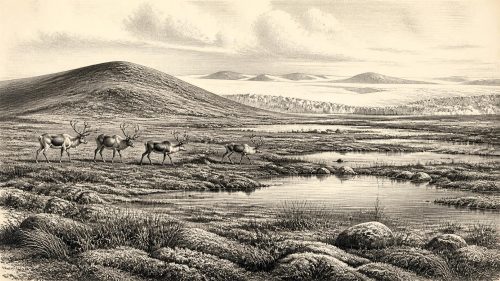
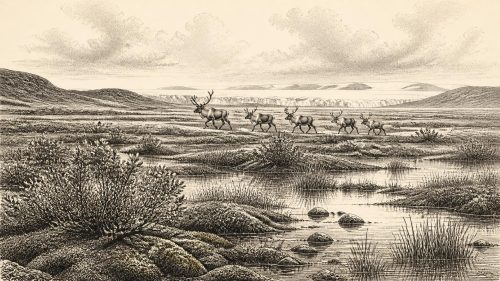
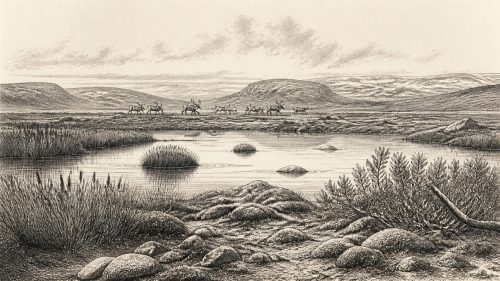
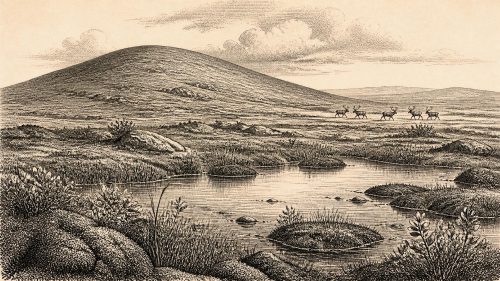
Derryvree offers a rare ecological portrait. Its pollen, mosses, plant macrofossils and invertebrate remains indicate open tundra vegetation and a periglacial climate: ground subjected to intense freezing and thawing near an ice margin, rather than a forested landscape. Grasses, sedges, herbs, juniper and mosses occurred amid wet margins and freshwater. Fossils include plants whose modern distributions readily evoke cold or Arctic-alpine settings, among them mountain avens (Dryas octopetala) and bogbean (Menyanthes trifoliata). Aquatic and waterside taxa show that cold did not mean lifelessness: shallow or slow-moving water, organic mud and mossy margins sustained a small but varied wetland community.
This was not the lush, continuously green Ireland of popular imagination. Trees, if present locally at all, were not the dominant structure of the Derryvree landscape. Long winters, short growing seasons and exposed ground would have limited plant cover away from sheltered, wet places. Yet open terrain could support herbivores and the predators or scavengers that followed them. The evidence also cautions against treating present-day counties as ancient environmental units: Fermanagh’s drumlin country is itself partly the result of glacial action, and the wetlands surviving beneath it were later entombed by ice. What is known comes from an exceptional accidental exposure, not from a complete map of Ireland.
Castlepook’s Bone Archive
Far to the south, Castlepook Cave near Doneraile in north Cork provides the island’s richest assemblage of vertebrate remains from the period leading towards the Last Glacial Maximum. The cave is a relict maze of narrow galleries and chambers, including places historically named Hyenahall and Elephant Hall. Excavations undertaken between 1904 and 1918 recovered more than 2,000 bones from two fossil-bearing strata. Individual bones span a long interval, roughly 45,700 to 19,950 years BP, so the cave must not be read as a photograph of one ecosystem or a single event. It was a repository into which remains accumulated across many thousands of years.
The Castlepook collection demonstrates that Ireland’s cold-stage fauna was richer than a simple image of an empty, frozen island suggests. Woolly mammoth, giant deer, reindeer, brown bear and spotted hyaena are all represented; later material includes Arctic fox, wolf, Norwegian lemming and collared lemming. The cave’s spotted hyaenas are especially significant. Carnivores could have transported carcass parts into shelter, while water movement and antiquarian excavation further mixed or obscured original contexts. Consequently, animal bones attest to the presence of species in the wider region, but rarely identify the exact season, hunting ground or manner in which an individual died.
For everyday life, then, the surest story is animal rather than human. Reindeer and other large herbivores would have moved through open habitats in search of forage; hyaenas, wolves and bears occupied the same wider food web. A cave might serve as a den, refuge or bone trap rather than a human home. There is no evidence for farming, domestic animals, crop-growing, permanent houses, pottery, metalworking, exchange networks or sea trade. Nor is there evidence from this time for social institutions, art, formal burial, sacred places or learning in Ireland. Silence on these matters is not proof that no person ever crossed the landscape; it is an acknowledgement that the surviving record does not support such claims.
The Reindeer Femur Question
The most consequential possible human trace near this wider period is a reindeer femur from Castlepook. Reassessment has associated it with an age of about 33,000 years, and zooarchaeologist Ruth Carden has interpreted a deep linear modification on the bone as a mark made by a sharp stone tool on fresh bone. If that diagnosis is confirmed, it would indicate that people processed a reindeer in Ireland during the Ice Age, dramatically earlier than the securely evidenced terminal-Pleistocene human activity often discussed in Irish archaeology. It would be a remarkable indication of a visit or episode of carcass processing, not evidence for a settled population.
The caveat is fundamental. A radiocarbon result dates the animal’s death, not automatically the instant the surface mark was made. The femur derives from an old collection formed before modern excavation standards, and no securely associated stone-tool assemblage, hearth, dwelling floor, burial or undisturbed occupation surface of comparable antiquity has been published from Castlepook. Nor can one bone reveal whether people killed the animal, encountered a carcass, removed meat, hide, sinew or marrow, or processed it somewhere else before carnivores carried the remains into the cave. The proper interpretation is therefore important but modest: Castlepook offers a promising possible sign of human action, still requiring corroboration.
A Frontier Without Frontiers
There can be no responsible account of diplomacy or warfare for Ireland in 30,466 BCE. No polities existed that archaeology can identify, and there are no named groups with whom to associate the land. “Conflict” is meaningful only in the ecological sense: animals competing for scarce seasonal resources, carnivores scavenging or hunting, and living things coping with cold, unstable ground and the return of glacier ice. If humans did enter Ireland, the most that the evidence presently permits is the possibility of highly mobile Upper Palaeolithic visitors equipped with sharp stone edges and familiar with exploiting large game. It does not establish their number, ancestry, route, language, duration of stay or descendants.
That uncertainty is itself the principal historical fact. Ireland around this notional year was neither a blank void nor a recognisable society awaiting a written past. It was part of a north-west European Ice Age world whose coastlines, ice margins and animal ranges were changing. Derryvree preserves cold freshwater life between glacial advances; Castlepook preserves the bones of mammals and the workings of a carnivore-rich cave system. Together they illuminate an exposed, intermittently habitable landscape—and set firm limits on what can be claimed about the earliest human story of Ireland.
Primary Sources
- A Middle Midlandian Freshwater Series at Derryvree, Maguiresbridge, County Fermanagh, Northern Ireland
- Middle Midlandian Freshwater Series at Derryvree, Maguiresbridge, County Fermanagh, Northern Ireland
- Irish Pleistocene Biostratigraphy
- The Irish Quaternary Fauna Project
- A Reconsideration of the Radiocarbon Dating of the Marine Isotope Stage 3 Fauna from Southern Ireland
- Castlepook Cave, County Geological Site Report
- Growth and Retreat of the Last British–Irish Ice Sheet, 31,000 to 15,000 Years Ago: the BRITICE-CHRONO Reconstruction
- The Timing and Magnitude of the British–Irish Ice Sheet Between Marine Isotope Stages 5d and 2
- Deglaciation Chronology of the Donegal Ice Centre, North-west Ireland
- Radiocarbon Constraints on the Age of the Maximum Advance of the British–Irish Ice Sheet in the Celtic Sea
- New Insights on the Fauna of Ireland’s Younger Dryas and Early Holocene from Alice & Gwendoline Cave
- Palaeoecology
- Heritage Artefacts of County Cork
- Ireland’s Palaeolithic Archaeology: Fleeting Footprints in a Frozen Land
- Menyanthes trifoliata L.
- Dryas octopetala L.
- The Mesolithic in Ireland: When Was It?
- The Colonization of Ireland: A Human Ecology Perspective
- OxCal
- IntCal History
- The IntCal20 Approach to Radiocarbon Calibration Curve Construction: A New Methodology Using Bayesian Splines and Errors-in-Variables