BIRM-166’s Buckbean Signal30452 BCE
Around 30,452 BCE, Ireland lay within Marine Isotope Stage 3, a fluctuating cold period preceding the Last Glacial Maximum. At Derryvree, Fermanagh, freshwater sediments buried between glacial tills preserve evidence of tundra-like wetland: mosses, sedges, aquatic plants and a buckbean seed. Their uncertain radiocarbon age cannot identify one calendar year. Castlepook Cave, Cork, yielded cold-stage fauna, including mammoth, reindeer and carnivores, accumulated over time. A possibly stone-tool-marked reindeer femur may suggest brief human activity, but no secure occupation evidence exists. The record instead depicts changing ice margins, open habitats and mobile animals, with human presence uncertain and documentary history absent.

Dateline
The label “30,452 BCE” is a modern chronological convenience, not a date that anyone in Ice Age Ireland could have recognised. No written record, annual event, named individual or securely dated occupation horizon can be assigned to that single year. At this depth of time, the responsible approach is to place the date within wider calibrated ranges. It falls broadly within the later part of Marine Isotope Stage 3, a fluctuating cold stage before the Last Glacial Maximum, and within the wide calibrated range associated with the important Derryvree freshwater deposits near Maguiresbridge, County Fermanagh. Those deposits have a conventional radiocarbon determination of 30,500 years BP, with substantial uncertainty; calibration produces a multi-millennial window rather than a single calendar year.
For Ireland, this is therefore a story of landscapes, plants, animals and the limits of the evidence. Around this remote point in time, parts of the island supported cold-stage habitats, while expanding ice and severe seasonal conditions made those habitats precarious. The most informative evidence comes not from settlements but from sediments sealed beneath later glacial deposits and from animal bones recovered in caves. It illuminates an Ireland that was neither the familiar green island of later millennia nor necessarily a country occupied continuously by people.
A Freshwater Layer Beneath the Drumlin
Derryvree is especially valuable because its evidence was found in context. Roadworks in 1969 cut through a drumlin about two kilometres north-east of Maguiresbridge. Between two thick sheets of glacial till lay freshwater silts, fine sands and organic material. This sequence matters: the lower till records an earlier advance of ice, the organic-rich layer records a period when freshwater and vegetation existed at the site, and the upper till shows that ice later returned. The deposit was not an ancient lake bed open for inspection today; it was a brief environmental archive eventually buried and compressed inside a glacial landform.
The dated sample, known as BIRM-166, produced a radiocarbon age of 30,500 +1,170/−1,030 BP. In modern calibration, such a result cannot be reduced honestly to one BCE year. The calibration curve is uneven at this age, and the original measurement itself has a large error range. Scholarship has consequently treated Derryvree as belonging broadly to a cold Middle Midlandian interval, not as evidence for a precisely dated episode. It is reasonable to say that 30,452 BCE lies within the kind of time represented by the deposit; it is not reasonable to claim that the plants grew there in that exact year.
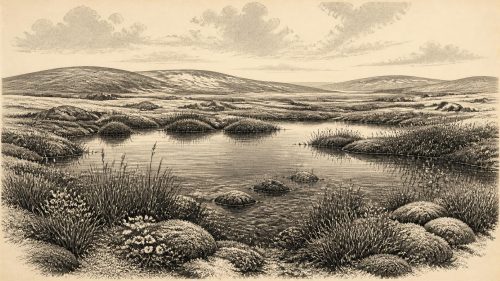
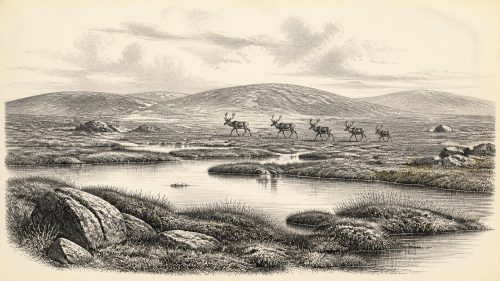
The sediment nonetheless gives a vivid, locally grounded picture. Pollen was poorly preserved, but it was mainly from herbaceous plants. Plant macrofossils included mosses and northern or arctic-alpine elements; a seed of bogbean, Menyanthes trifoliata, is among the most memorable finds. Aquatic and wet-ground plants show that meltwater, pools, marshy margins or shallow freshwater bodies persisted despite the cold. Mosses and sedges point to waterlogged ground, while the broader assemblage indicates sparse, treeless vegetation. Derryvree was not a forest clearing. It was an open, periglacial wetland set within a tundra-like landscape.
Cold Ground, Short Seasons
“Tundra” should not conjure a perfectly uniform white wilderness. The Derryvree evidence instead suggests a mosaic: wet hollows and open water beside sedgy ground, mossy surfaces, exposed mineral soils and scattered low vegetation. Snow cover, frost action and a very short growing season would have constrained plant growth. Summer warmth was enough for freshwater life and flowering plants to complete their cycles, but there is no evidence for the closed woodland familiar from later prehistoric Ireland. A few pollen grains from trees such as pine or hazel do not demonstrate nearby forest; they may have travelled far or derived from reworked material.
Such an environment was part of a changing glacial world. The British–Irish Ice Sheet did not expand and retreat as one simple, synchronous mass. Recent reconstructions show major differences between sectors and advances through the period from about 31,000 to 15,000 years ago. Around the date considered here, the ice sheet was growing towards its later maximum, but an ice-free or only seasonally ice-marginal Fermanagh could still contain the freshwater habitat preserved at Derryvree. The two tills at the site are powerful evidence that this respite did not last indefinitely.
Regional variation is crucial. A wetland in south Fermanagh cannot be used as a weather report for every part of the island. Nor do modern county boundaries describe the Ice Age terrain: shorelines were different because global sea level was lower, and ice, rivers and frost were reshaping the land. Yet Derryvree demonstrates conclusively that the northern interior was not simply an unbroken ice cap throughout this entire span. It contained, at least during the interval represented by the sediments, cold but living freshwater environments.
Castlepook and the Animal World
Far to the south, Castlepook Cave near Doneraile in County Cork supplies a complementary but more complicated record. The cave, also called Mammoth Cave, has yielded remains attributed to woolly mammoth, reindeer, giant deer, brown bear, wolf, Arctic fox, lemmings and spotted hyaena. Direct dating and reassessment place portions of its fauna broadly within the middle and later phases of the last glaciation, including Marine Isotope Stage 3. This establishes that Ireland was intermittently reachable by, and capable of supporting, a strikingly different animal community from the later historic fauna.
The cave should not be mistaken for a single moment frozen in time. Its fossils accumulated across a long interval, and carnivores could transport and scatter bones. Spotted hyaenas in particular may have used caves as dens, bringing prey remains underground; water movement, excavation practices and old museum collecting further complicate the picture. It would be wrong to place mammoth, hyaena, reindeer and every other identified species together in one herd-filled Cork valley in 30,452 BCE. The defensible conclusion is narrower: these animals belong to Ireland’s wider cold-stage record, and Castlepook was a repository for remains accumulated under changing conditions.
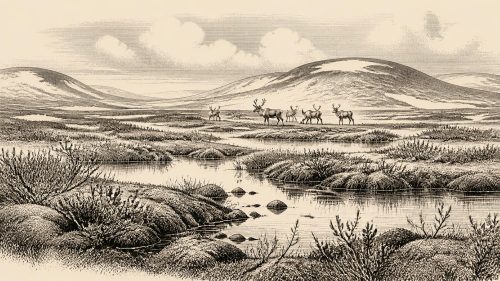
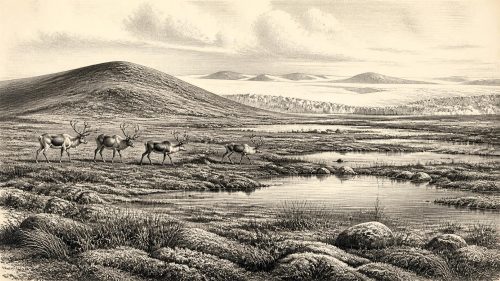
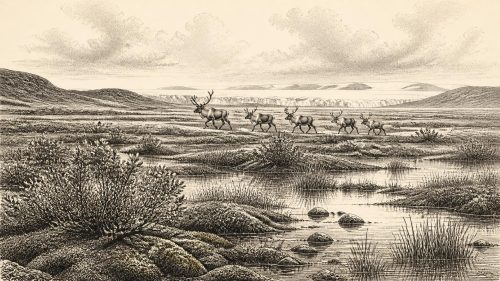
Reindeer are especially relevant to the Derryvree world. They are well suited to open northern habitats and may have moved through favourable corridors in response to changing snow, forage, ice margins and predation. Large herbivores would have depended on seasonally available vegetation, while carnivores and scavengers followed concentrations of prey. This was an ecology of mobility rather than a stable pastoral landscape. There were no domestic herds, fields, roads or managed woodland. Any movement across the island was governed by terrain, weather and food.
The Reindeer Femur Question
Castlepook also raises the most provocative question about people. A reindeer femur in the National Museum of Ireland’s natural-history collection has been interpreted by zoologist Ruth Carden as bearing a cut or chop mark made with a sharp stone tool during carcass processing. Public accounts have associated the bone with an age of roughly 33,000 years ago. If that interpretation is confirmed, it would indicate that humans handled a reindeer in Ireland much earlier than the long-established evidence for terminal Pleistocene visitors.
But it does not establish a settlement in 30,452 BCE. No securely associated stone-tool assemblage, hearth, dwelling, burial, human bone, occupation floor or art has been demonstrated at Castlepook for this period. A date on animal bone dates the animal’s death, not automatically the making of a surface mark; identifying a mark as human-made also requires careful taphonomic comparison with damage caused by carnivores, trampling, sediment and excavation. The femur is important evidence under investigation, not a licence to invent a resident Palaeolithic population.
If people did visit, the most restrained interpretation is a small and highly mobile party, probably exploiting animal resources during a brief opportunity. Such visitors would have needed cutting edges and knowledge of a dangerous, cold environment. They may have arrived from Britain or continental north-west Europe when lower sea levels altered routes and distances, but neither a permanent land bridge nor a specific route should be assumed without site-specific evidence. Their language, identity, kinship, beliefs and relationship to later inhabitants are unknown.
What Cannot Be Written
Political affairs, diplomacy and warfare leave no identifiable record for Ireland at this date. There are no kingdoms, leaders, treaties or territorial boundaries that can responsibly be described. Nor is there evidence for organised religion, formal burial, ritual monuments, art or learning on the island around this time. Caves may later acquire social or sacred meanings, but an animal-bone accumulation is not proof of ceremony. The absence of evidence is not proof that people had no beliefs; it means that the Irish record cannot reveal them here.
Likewise, trade cannot be inferred. No demonstrated imported tool, exchange network or sourceable material assemblage belongs to this horizon in Ireland. The nearest thing to an economy visible in the evidence is natural subsistence: the production of vegetation in wetland and tundra habitats, the movements of herbivores, and perhaps—if the Castlepook incision is accepted—the butchery of one reindeer. Settlement, if any, was ephemeral enough to have left no secure archaeological signature, or has not yet been found.
An Island Before Its Human History
The chief development appropriate to 30,452 BCE is environmental. Derryvree’s buckbean seed, sedges, mosses, pollen and cold-adapted insect evidence preserve a small but exceptionally eloquent sign of life between episodes of glaciation. Castlepook’s fauna shows that, in other favourable intervals and regions, large mammals and formidable carnivores entered the Irish landscape. Together they replace the tempting but misleading idea of an empty, uniformly frozen island with a more dynamic picture: an unstable territory of open ground, freshwater pockets, animal movement and encroaching ice.
That is not yet the continuous human history of Ireland. It is the deeper environmental setting from which that history would eventually emerge. At this date, modern calendar precision fails, documentary history is absent, and human presence remains at best tantalising. The surviving evidence is more modest—and more remarkable: a wetland sealed beneath a drumlin, cave bones preserved in limestone darkness, and the possibility that someone, briefly, once cut meat from a reindeer on Ice Age Ireland.
Primary Sources
- Middle Midlandian Freshwater Series at Derryvree, Maguiresbridge, County Fermanagh, Northern Ireland
- Middle Midlandian Freshwater Series at Derryvree, Maguiresbridge, County Fermanagh, Northern Ireland
- Palaeoecology: The Middle Midlandian Palaeoenvironment of South Fermanagh
- The Subdivision of the Quaternary Period in Ireland
- Early Midlandian–Middle Midlandian, Pleistocene, Northern Ireland
- Castlepook Cave: Cork County Geological Site Report
- A Reconsideration of the Radiocarbon Dating of the Marine Isotope Stage 3 Fauna from Southern Ireland
- The Irish Quaternary Fauna Project
- Occurrence of Mammalia Relicts at Site Castlepook Cave
- The Exploration of Castlepook Cave, County Cork
- Heritage Artefacts of County Cork
- Growth and Retreat of the Last British–Irish Ice Sheet, 31,000 to 15,000 Years Ago: the BRITICE-CHRONO Reconstruction
- Growth and Retreat of the Last British–Irish Ice Sheet, 31,000 to 15,000 Years Ago: the BRITICE-CHRONO Reconstruction
- The IntCal20 Northern Hemisphere Radiocarbon Age Calibration Curve (0–55 cal kBP)
- The IntCal20 Northern Hemisphere Radiocarbon Age Calibration Curve (0–55 cal kBP)
- The Timing and Magnitude of the British–Irish Ice Sheet Between Marine Isotope Stages 5d and 2
- First Evidence of a Late Upper Palaeolithic Human Presence in Ireland
- New Insights on the Fauna of Ireland's Younger Dryas and Early Holocene from Alice & Gwendoline Cave
- Our Ancient Landscapes: Hunter-Gatherers in Ireland
- Menyanthes trifoliata L.
- Deposits of the Last Glaciation
- Mammoth Cave