Castlepook’s Faunal Horizon30577 BCE
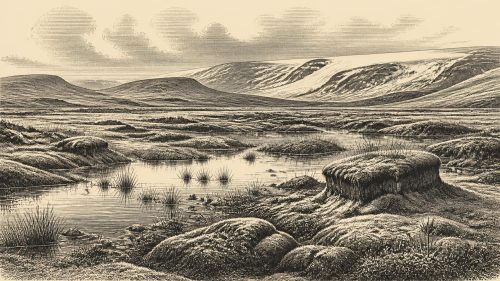
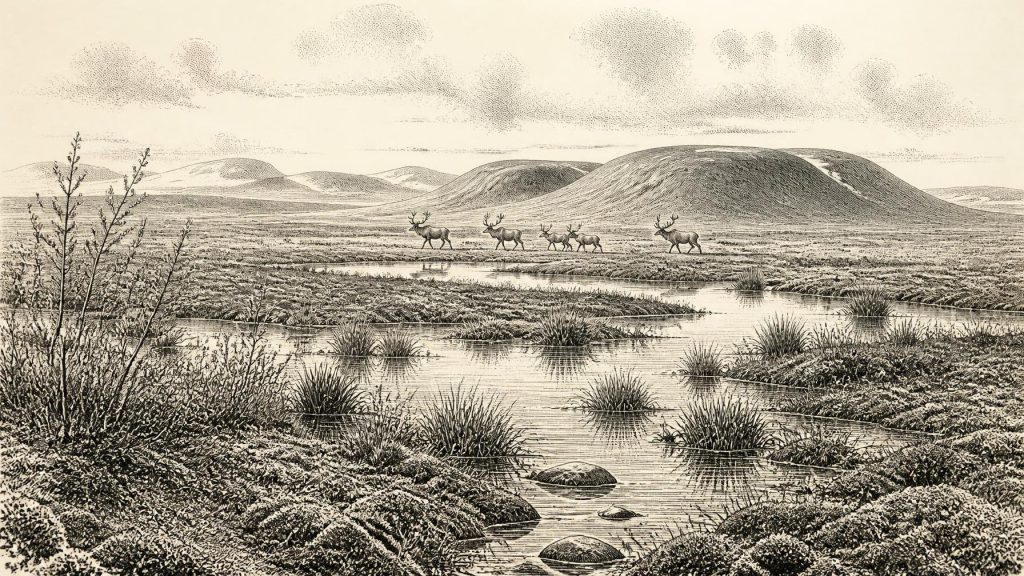
Around 30,577 BCE, Ireland lay within the volatile later Marine Isotope Stage 3 Ice Age, though no event can be dated to that precise year. Derryvree in Fermanagh preserves freshwater organic sediments between glacial tills, indicating cold, tundra-like wetlands during an ice-free interval. Castlepook Cave, Cork, yielded diverse fauna, including mammoth, reindeer, giant deer, hyaena and Arctic fox, demonstrating episodic connections with wider European animal ranges. Its mixed, imperfectly recorded deposits accumulated over time, so they are not a single landscape snapshot. A marked reindeer bone may indicate human butchery, but sustained settlement remains unproven. Evidence supports fragmentary environmental history.
Dateline
“30,577 BCE” is a modern calendar label, not a date at which an identifiable Irish event can be placed. No written record, named individual, political community or annually dated archaeological layer exists for Ireland at this depth of time. For the Late Pleistocene, archaeologists instead work with calibrated ranges, radiocarbon determinations, sediment sequences and broad climatic stages. The responsible setting is therefore Ireland in the later part of Marine Isotope Stage 3: a changeable interval of the last Ice Age, well before the fullest spread of the Last Glacial Maximum.
The number is nevertheless useful as a guide to scale. It falls broadly around 32,500 calendar years before present, using the radiocarbon convention in which “present” is AD 1950. That apparent precision must not be mistaken for certainty. Calibration curves at this age carry substantial ranges, and an individual Irish deposit cannot safely be tied to one modern year. The best evidence illuminates conditions across centuries or millennia around this point, not a single season in 30,577 BCE.
A Cold and Unsettled Ireland
Ireland was then part of the wider north-west European Ice Age world, but it was not a uniform white landscape frozen in one unchanging state. The British–Irish Ice Sheet expanded and contracted over long periods, while climate swung abruptly between colder stadials and relatively milder interstadials. Greenland ice-core chronologies register several such rapid shifts around 33,000–31,000 years ago. Their exact translation into local Irish weather, glacier margins and vegetation remains difficult. They provide a regional climatic framework, not a diary of conditions in any particular Irish valley.
At this stage sea level stood far lower than today, exposing wide shelves around Ireland and Britain. Yet lower seas did not automatically create a simple, permanent land bridge or an easy route for every animal and person. Ice, rivers, changing coastlines, marshy lowlands and the Irish Sea basin altered the practical geography repeatedly. The presence of animals in Ireland demonstrates that movement into the island occurred at some points in the Pleistocene; it does not by itself reveal precisely which routes were open in any one century.
The major ice-sheet maximum still lay ahead. The last British–Irish Ice Sheet reached its greatest overall extent later, principally between roughly 27,000 and 25,000 years ago, although different sectors advanced and retreated at different times. Around the date represented here, Ireland was approaching a severe phase of the last glacial cycle. Some regions may have supported ice, while others retained ice-free ground, lakes, river corridors or periglacial terrain. The evidence does not permit a single island-wide map for one calendar year.
Derryvree Beneath the Drumlins
The strongest Irish environmental clue for this broad period comes from Derryvree near Maguiresbridge, County Fermanagh. Roadworks in 1969 cut through a drumlin and revealed an extraordinary sequence: a lower till laid down by ice, freshwater silts and fine sands with organic material, and then a second till above. The order is clear. Ice affected the locality; an interval followed in which water, sediment and living matter accumulated; and ice later returned, burying and preserving that record.
The organic sediments produced radiocarbon determination BIRM-166, conventionally reported as 30,500 radiocarbon years BP, with a large uncertainty of about 1,100 years. A radiocarbon age is not a calendar age. When calibrated using modern northern-hemisphere curves, the result translates into a broad interval rather than a point, approximately 36,900–31,700 calibrated years BP. The modern label 30,577 BCE lies towards the younger part of that wide range. Derryvree can therefore responsibly illuminate the world around this date, but cannot be claimed as a deposit formed in that exact year.
Its fossil assemblage provides direct evidence for a cold, open freshwater setting. Plant remains, pollen and insects indicate tundra-like vegetation and a periglacial regime rather than woodland, farmland or settled countryside. Sedges, mosses and cold-adapted herbs occupied wet ground; aquatic plants show that standing or slowly moving fresh water existed. Such evidence supports a mosaic of shallow pools, muddy margins, damp hollows and exposed mineral ground. It does not demonstrate a village, a campsite or a stable human population at Derryvree.
This distinction matters. A buried wetland beneath two tills records a local interruption in glaciation, not proof that all Ireland was ice-free simultaneously. Nor should its fossils be assembled into an imagined landscape in which every species known from Irish caves grazed around one Fermanagh pool. The value of Derryvree is more exacting: it shows that, during a cold phase of the last Ice Age, freshwater ecosystems could persist in at least part of Ireland between episodes of ice advance.
Castlepook and the Animal Record
County Cork offers another, very different archive. Castlepook Cave near Doneraile, sometimes called Mammoth Cave, is Ireland’s richest known repository of vertebrate remains from the period leading towards the Last Glacial Maximum. Excavations between 1904 and 1918 recovered more than 2,000 bones from a complex limestone cave system that included galleries later named Hyenahall and Elephant Hall. The National Museum of Ireland preserves important parts of these collections.
Direct dating and later reassessment show that the cave accumulated animal remains over a long span, rather than during one moment of occupation. The recorded fauna includes woolly mammoth, reindeer, giant deer, brown bear, wolf, Arctic fox, spotted hyaena and lemmings. This is powerful evidence that Ireland was connected to, or repeatedly reached from, wider north-west European animal ranges during Marine Isotope Stage 3. It also reveals an ecological world unlike modern Ireland’s: large herbivores moved through open country, while cold-adapted small mammals and major predators formed part of the regional fauna.
But the cave is not a neat snapshot. Water movement disturbed some deposits, carnivores may have carried in or modified bones, and the original excavations pre-dated modern standards of stratigraphic recording. Recent redating has shown that several older radiocarbon results from Irish cave bones underestimated their true age, in some cases by thousands of years. Castlepook’s mammals were not necessarily contemporaries, and the cave cannot establish what stood outside its entrance in 30,577 BCE.
The cave nevertheless gives substance to the environmental interpretation. Mammoth and reindeer imply open forage landscapes, but not necessarily lush grassland; animals could have ranged widely through steppe-tundra, river margins and seasonally productive patches. Hyaena remains are particularly significant because they suggest a functioning predator-and-scavenger ecology, and because caves could serve as dens or bone-accumulating places. The Irish evidence is sparse, yet it decisively rejects the older picture of an Ice Age Ireland that was permanently empty of sizeable mammals.
The Question of People
A reindeer femur from Castlepook has attracted special attention because a deep mark on fresh bone has been interpreted as a possible stone-tool cut or chop made during butchery. Public heritage interpretation has associated the bone with an age of roughly 33,000 years ago. If the mark is securely confirmed as human-made and contemporary with the animal’s death, it would indicate that people handled a reindeer in Ireland during the Upper Palaeolithic, far earlier than the island’s long-established post-glacial settlement record.
That is an important possibility, not a licence to create an Ice Age Irish society. The specimen has no securely associated hearth, stone-tool assemblage, dwelling floor, human burial, artwork or occupation layer. Its cave context is complicated, and a radiocarbon result dates the animal bone rather than automatically dating the surface mark or proving a human presence. The appropriate conclusion for this period is deliberately narrow: a fleeting human visit or episode of carcass processing is possible, but sustained settlement remains unproven.
No Polities, No Proven Diplomacy
There is no evidence for political institutions, leaders, warfare, diplomacy, territories, ritual sites, formal religion, farming, trade networks or literacy in Ireland at this date. It would be misleading to fill those absences with later Celtic, medieval or even Mesolithic ideas. If people did enter Ireland, they would have belonged to mobile Upper Palaeolithic hunter-gatherer worlds known elsewhere in Europe, but neither their language, group identity, numbers nor routes can be recovered from the Irish record.
Everyday life can therefore be discussed only at the level of environmental possibility. A short-lived party travelling through open, cold terrain might have pursued or scavenged large animals and used portable stone technology; that is an inference from broader European archaeology, not a demonstrated Irish camp. Derryvree’s wetlands would have offered water and seasonal plant and animal resources, while Castlepook’s caves could have been dangerous carnivore spaces as well as sheltered geological features. Neither site proves routine habitation.
An Archive of Limits
The most important development around this notional year was not political or cultural but environmental: Ireland lay within a volatile Ice Age landscape in which ice, water, tundra vegetation and mobile animals repeatedly reshaped what survival and movement could mean. Derryvree records an ice-free freshwater interval sealed between glacier deposits. Castlepook preserves the traces of an unexpectedly rich fauna, and perhaps one tantalising sign of human butchery. Together they make Ireland visible at great antiquity while also showing why exact calendar storytelling is impossible.
For 30,577 BCE, then, the history is one of carefully bounded knowledge. The evidence supports cold, open habitats, freshwater refuges, episodic glaciation and a wider Pleistocene fauna. It allows a possibility of human contact, not a named population or a continuous settlement. Future excavation, microscopic study of the Castlepook mark, improved radiocarbon pretreatment and new dating of undisturbed deposits may sharpen the picture. Until then, the scientifically honest Irish story is compelling precisely because it remains fragmentary.
Primary Sources
- A Middle Midlandian Freshwater Series at Derryvree, Maguiresbridge, County Fermanagh, Northern Ireland
- Middle Midlandian Freshwater Series at Derryvree, Maguiresbridge, County Fermanagh, Northern Ireland
- The Irish Quaternary Fauna Project
- The Irish Quaternary Fauna Project
- A Reconsideration of the Radiocarbon Dating of the Marine Isotope Stage 3 Fauna from Southern Ireland
- Castlepook Cave, County Geological Site Report
- Heritage Artefacts of County Cork
- Growth and Retreat of the Last British–Irish Ice Sheet, 31,000 to 15,000 Years Ago: The BRITICE-CHRONO Reconstruction
- Growth and Retreat of the Last British–Irish Ice Sheet, 31,000 to 15,000 Years Ago: The BRITICE-CHRONO Reconstruction
- The Timing and Magnitude of the British–Irish Ice Sheet Between Marine Isotope Stages 5d and 2
- Dimensions and Chronology of the Last Ice Sheet in Western Ireland
- Trimlines, Blockfields and the Vertical Extent of the Last Ice Sheet in Southern Ireland
- Timing and Pace of Ice-Sheet Withdrawal Across the Marine–Terrestrial Transition West of Ireland During the Last Glaciation
- A Stratigraphic Framework for Abrupt Climatic Changes During the Last Glacial Period Based on Three Synchronized Greenland Ice-Core Records
- A Stratigraphic Framework for Abrupt Climatic Changes During the Last Glacial Period Based on Three Synchronized Greenland Ice-Core Records
- The IntCal20 Northern Hemisphere Radiocarbon Age Calibration Curve (0–55 cal kBP)
- IntCal20
- New Insights on the Fauna of Ireland’s Younger Dryas and Early Holocene from Alice & Gwendoline Cave
- Figure 6—The Subdivision of the Quaternary Period in Ireland
- Early Midlandian–Middle Midlandian, Pleistocene, Northern Ireland
- The Late Quaternary History of East-Central Ireland
- Irish Quaternary Association Publications
- Geological Survey Ireland Quaternary Data Services