Derryvree’s Coldwater Beetles30170 BCE
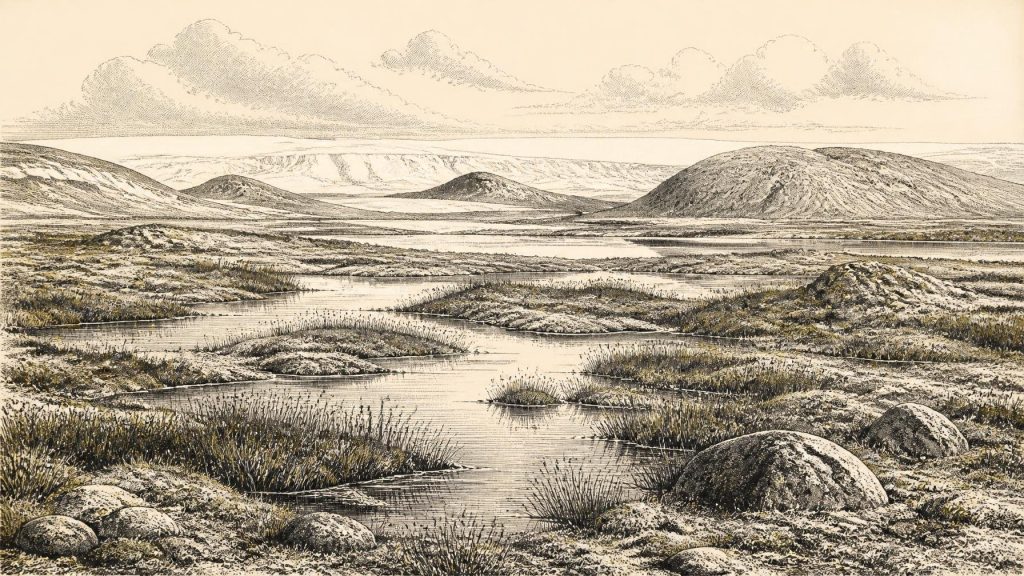
Around 30,170 BCE, Ireland lay in the Late Pleistocene, but no precise historical event can be reconstructed. Derryvree, County Fermanagh, preserves freshwater organic sediments between glacial tills, dated broadly to 34,950–29,750 BCE. Mosses, sedges, aquatic plants and cold-adapted insects indicate locally ice-free, treeless wetlands amid unstable periglacial conditions. Comparable Fermanagh deposits suggest intermittent open habitats, while advancing ice repeatedly transformed landscapes. Castlepook Cave’s animal remains, including reindeer, mammoth, bear and hyaena, demonstrate varied Ice-Age fauna but cannot represent one moment. A possibly tool-marked reindeer bone hints at early human presence, yet proves neither settlement nor occupation. Environmental evidence is strongest.
Dateline
30,170 BCE is not a year that can be recovered in the ordinary historical sense. It is a modern calendar label for a point roughly 32,119 years before AD 1950, the conventional reference point for “before present” dating. No Irish written record, annual environmental sequence, named settlement or securely dated human action can be assigned to it. Calendar-year precision is therefore unavailable. The responsible question is what archaeological and geological evidence can illuminate Ireland during the broad interval into which this notional date falls.
That interval belongs to the Late Pleistocene, during the last Ice Age. In Irish terminology it lies close to the boundary between the Middle and Late Midlandian phases; in the wider North Atlantic sequence it falls late in Marine Isotope Stage 3, before the fullest growth of the Last Glacial Maximum ice sheet. It was not a single, uniformly frozen condition. Climate, glacier extent, watercourses and vegetation changed markedly over millennia, while the evidence that survives is sparse, local and often disturbed by later ice.
A Date Within a Range
The closest important Irish chronological guide is the freshwater deposit discovered at Derryvree, near Maguiresbridge in County Fermanagh. Road excavations in 1969 cut through a drumlin and revealed a remarkable sequence: a lower layer of glacial till, freshwater silts and fine sands containing organic matter, then a second thick till above. Till is the unsorted debris deposited directly by moving ice. The order of these layers securely shows that ice had occupied the locality; that an interval followed when freshwater, sediment and living organisms accumulated on ice-free ground; and that later glacial activity buried the wetland beneath a further deposit.
Organic material from the intervening sediments yielded the radiocarbon determination BIRM-166, reported as 30,500 radiocarbon years BP, with a substantial uncertainty of +1,170 and −1,030 years. A radiocarbon age is not a calendar age, because atmospheric carbon-14 concentrations have changed through time. When treated with modern calibration, the Derryvree material is generally placed broadly at about 36,900–31,700 calibrated years BP, approximately 34,950–29,750 BCE. The nominal year 30,170 BCE sits within that wide window, close to its younger end. It cannot be attached to a particular sediment layer, season, animal lifetime or generation of people.
This distinction matters. The Derryvree organic beds accumulated over time, and the calibrated interval expresses probability rather than an exact duration of wetland formation. Nor can one protected Fermanagh basin stand for every Irish region. Yet the deposit is unusually valuable precisely because later glaciation erased, reworked or concealed so much of the earlier landscape. It provides firm evidence for a cold, locally ice-free freshwater environment during a period bracketed by glacier advances.
Water Between the Tills
Derryvree’s fossils describe an open, treeless wetland rather than woodland or a settled human landscape. Freshwater mosses, sedges and aquatic plants survived around standing or slow-moving water. The record includes water-milfoil, while insect remains are of cold northern aspect. These remains support an interpretation of shallow pools, saturated ground and short growing seasons in a periglacial setting: terrain shaped by severe cold and frost processes near, but not necessarily beneath, glacier ice. They do not establish an exact temperature, annual snowfall or the appearance of the landscape on one day in 30,170 BCE.
Other northern Irish deposits offer useful context. Organic freshwater muds at Hollymount, also near Maguiresbridge, and at Greenagho near Belcoo show that cold, open conditions occurred at more than one Fermanagh locality during the Middle Midlandian. Their dating is less decisive than Derryvree’s, and correlation from one exposure to another remains difficult. Together, however, these sites warn against imagining Ireland as continuously ice-covered throughout the whole preceding cold stage. At intervals, parts of the island contained water, vegetation and habitats capable of supporting animal life.
That did not make the country mild or stable. The lower and upper tills at Derryvree are physical evidence of major environmental change. Ice sheets could grow, redirect drainage and reshape ground with destructive force. Wider reconstructions of the British–Irish Ice Sheet show that its expansion towards the Last Glacial Maximum was dynamic rather than simple or simultaneous across all regions. Around this notional date, an Irish landscape could include locally open ground and wetlands while other districts were affected by advancing ice, permanent snowfields, meltwater or cold-steppe conditions. The precise position of an ice margin in any one year cannot be reconstructed.
Animals and a Cave Archive
Castlepook Cave near Doneraile in County Cork supplies the most vivid evidence for the animal world of Ice-Age Ireland. Its old collections include remains attributed to reindeer, giant deer, woolly mammoth, brown bear and spotted hyaena, among other animals. Such fauna demonstrate that Ireland was reached, at different times, by animals associated with open and often cold Late Pleistocene environments. Reindeer, for example, are consistent with sparse grazing country, while hyaena indicates that carcasses and caves could become part of a wider predator–scavenger system.
But Castlepook is not a scene preserved from one afternoon. Cave deposits collect bones over long periods, and the material was excavated mainly under early twentieth-century conditions. Bones may have been carried in by carnivores, water or other processes; different species need not have lived together; and dates from individual specimens cannot automatically date the whole assemblage. The cave therefore supports a broad picture of fluctuating Ice-Age fauna in Ireland, not a claim that mammoth, reindeer and hyaena all stood beside a Derryvree pool in 30,170 BCE.
The Human Question
A reindeer femur from Castlepook has made this distant period especially important for Irish archaeology. It has been publicly reported as about 33,000 years old and as bearing a deep linear modification that zooarchaeologist Ruth Carden has interpreted as consistent with cutting or chopping by a sharp stone tool while the bone was fresh. If that interpretation is confirmed, it would be evidence that one or more Upper Palaeolithic people handled a reindeer in Ireland far earlier than the long-established record of post-glacial settlement.
The necessary caution is substantial. The femur derives from an older cave collection, not a recently excavated occupation floor with securely associated tools, hearths, shelters, food refuse or human remains. A date on bone concerns the death of the animal, not necessarily the exact moment, place or agent of the mark. Assessing a possible cut mark requires differentiation from carnivore damage, breakage, abrasion, sediment movement and excavation damage. The specimen is an important lead, but it does not prove permanent settlement, a named hunting party, a population size or continuous occupation at Castlepook or elsewhere in Ireland.
Consequently, political affairs, diplomacy and warfare cannot responsibly be described for this date. There is no evidence for chiefs, territories, alliances or organised conflict. Nor is there evidence for houses, villages, burial rites, shrines, monuments, language, artwork or formal learning in Ireland at this time. Upper Palaeolithic communities elsewhere in Europe made sophisticated stone tools and art, but such achievements cannot simply be transferred across the sea to Ireland without an Irish artefact assemblage or occupation site.
No Recorded Economy
It is equally misleading to write of an Irish economy or trade network in 30,170 BCE. No local evidence identifies hunting territories, seasonal camps, exchange routes, boats, food-sharing practices or managed resources. If people did reach Ireland during this broader period, mobile hunting and scavenging would be a reasonable possibility in an open landscape rich enough to attract grazing animals. That is an interpretation based on ecology and comparison, not a fact demonstrated by a settlement deposit.
The strongest history available is therefore environmental. At Derryvree, freshwater plants, mosses, sedges and cold-adapted insects occupied a basin between episodes of glaciation. Elsewhere, animal remains show that large mammals and carnivores could reach Ireland during the Late Pleistocene. Later ice advances then obscured much of the terrain on which people or animals might once have travelled. Around 30,170 BCE, Ireland’s recoverable past is not one of recorded rulers or events, but of vulnerable wetlands, shifting ice, mobile fauna and a very small body of evidence that must be read with care.
Primary Sources
- A Middle Midlandian Freshwater Series at Derryvree, Maguiresbridge, County Fermanagh, Northern Ireland
- Early Midlandian–Middle Midlandian, Pleistocene, Northern Ireland
- Freshwater Organic Deposits and Stratified Sediments Between Early and Late Midlandian (Devensian) Till Sheets, at Aghnadarragh, County Antrim, Northern Ireland
- Irish Pleistocene Biostratigraphy
- Irish Pleistocene Biostratigraphy
- Figure 6.—The Subdivision of the Quaternary Period in Ireland
- The Irish Quaternary Fauna Project
- Pleistocene Vertebrates in the British Isles
- The IntCal20 Northern Hemisphere Radiocarbon Age Calibration Curve (0–55 cal kBP)
- Growth and Retreat of the Last British–Irish Ice Sheet, 31,000 to 15,000 Years Ago: the BRITICE-CHRONO Reconstruction
- The Timing and Magnitude of the British–Irish Ice Sheet Between Marine Isotope Stages 5d and 2
- Exploring Controls of the Early and Stepped Deglaciation on the Western Margin of the British Irish Ice Sheet
- The Colonization of Ireland: A Human Ecology Perspective
- Ireland: Submerged Prehistoric Sites and Landscapes
- First Evidence of a Late Upper Palaeolithic Human Presence in Ireland
- First Evidence of a Late Upper Palaeolithic Human Presence in Ireland
- New Insights on the Fauna of Ireland’s Younger Dryas and Early Holocene from Alice & Gwendoline Cave
- Heritage Artefacts of County Cork
- 2022:564 — Castlepook Cave, Castlepook South, Cork
- Archaeology Research Excavation Grant 2022: Final Report
- Myriophyllum Alterniflorum in Fermanagh: Fossil Occurrence
- A Uranium-Thorium Dated Late Eemian or Early Midlandian Organic Deposit from Near Kilfenora Between Spa and Fenit, Co. Kerry, Ireland