
BIRM-166’s Sedgewater World30634 BCE
About 30,634 BCE, Ireland lay within the volatile cold conditions of Marine Isotope Stage 3, not yet the Last Glacial Maximum. Derryvree, County Fermanagh, preserves freshwater silts and organic deposits between two glacial tills, indicating a temporary ice-free, treeless wetland of pools, sedges, mosses, cold-adapted plants and insects. Its BIRM-166 radiocarbon date calibrates broadly, precluding precision for any single year. Castlepook Cave, County Cork, records diverse Ice-Age fauna, including reindeer, mammoth, giant deer, predators and small mammals, though deposits are mixed. A cut-marked reindeer bone may indicate brief human activity, but no evidence confirms permanent settlement, society or economy there.
Dateline
The label 30,634 BCE is useful for arranging a modern chronology, but it must not be mistaken for a recoverable Irish calendar year. Nobody in Ice-Age Ireland recorded years, and no surviving layer can be assigned to this particular season, generation or event. The most responsible account therefore uses broad calibrated ranges and asks what physical evidence can illuminate the island at roughly this point in the Late Pleistocene.
In radiocarbon convention, this date sits about 32,584 years before AD 1950, within Marine Isotope Stage 3 (MIS 3), a climatically volatile stretch of the last glacial cycle. It was not yet the Last Glacial Maximum, when the British–Irish Ice Sheet attained far greater extent later, but it was part of the long deterioration towards it. Ice, sea level, vegetation and animal ranges were changing on millennial scales. Modern maps cannot responsibly show the condition of every Irish valley in 30,634 BCE.
A Date Within a Range
The closest unusually informative Irish record is Derryvree, near Maguiresbridge in County Fermanagh. Road-cutting through a drumlin in 1969 exposed a striking sequence: thick glacial till below, freshwater silts and fine sands with organic material in the middle, and another substantial till above. Till is the unsorted material laid down by glacier ice. The order of the deposits establishes something important and secure: ice occupied the locality; an interval followed in which open water, sediment, plants and small animals accumulated; then ice again covered or crossed the area.
Organic material from the central deposits yielded the radiocarbon determination BIRM-166, conventionally reported as 30,500 radiocarbon years BP, with a large uncertainty of plus 1,170 and minus 1,030 years. Radiocarbon years are not identical to calendar years, because atmospheric carbon-14 has varied through time. Calibration with the modern IntCal20 curve gives broad probability ranges rather than a single answer. Treatments of this determination place the Derryvree wetland broadly around 36,900–31,700 calibrated years BP, approximately 34,950–29,750 BCE.
The requested year falls within that broad interval, but it cannot be attached to a particular silt bed, pond-edge or plant remain. Derryvree is evidence for conditions at one northern locality over a lengthy episode, not an annual report for all Ireland. Its very survival is exceptional: later glacial erosion removed, mixed or buried many older landscapes, leaving few places where environmental evidence of this antiquity can still be read.
Fresh Water Between Ice Advances
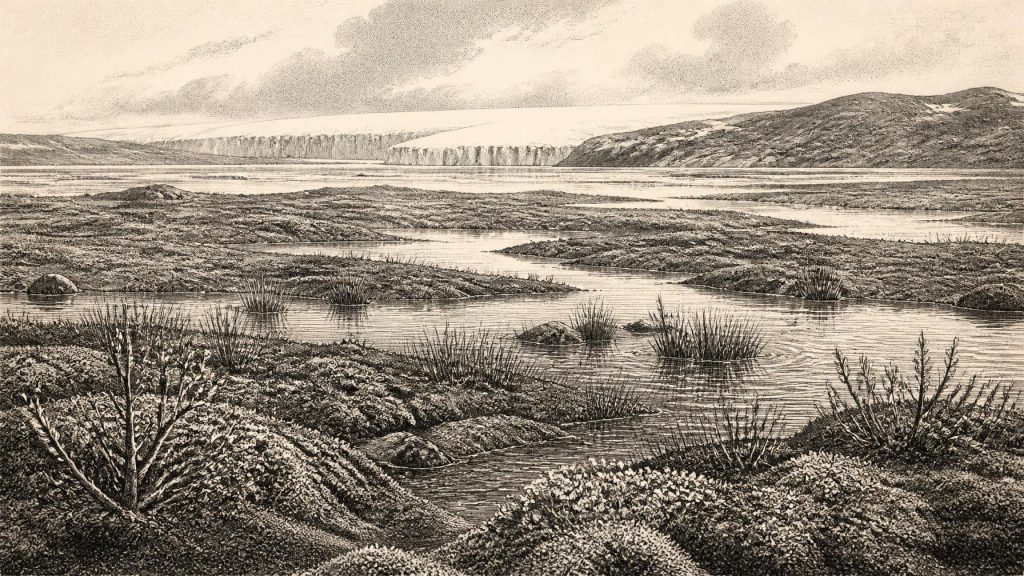
The Derryvree fossils show that the exposed ground was neither familiar green pasture nor an unbroken desert of ice. The evidence points to a cold, open, treeless and periglacial environment, often described as tundra or muskeg. These are useful ecological comparisons, not claims that a modern Arctic wetland was reproduced exactly in Fermanagh. Pools or slow water lay among saturated ground, silt, mosses, sedges and low-growing herbs. Freezing, thawing, sediment wash and waterlogging shaped the local terrain.
Plant macrofossils, spores and pollen include aquatic and wetland species alongside cold-adapted vegetation. Bogbean, water-milfoil, dwarf willow, mountain-avens, lesser clubmoss and mosses are among the informative remains associated with the deposit. Their combination demonstrates that freshwater habitats and plant cover persisted during a cold interval. It does not provide a complete species list for Ireland, still less an exact temperature for 30,634 BCE. Preservation favours organisms living beside water and filters out much of the wider landscape.
Insect remains sharpen the picture. Beetles and other small fossils are valuable because their ecological requirements can register ground moisture, exposed terrain, vegetation and summer warmth. At Derryvree they support the interpretation of harsh, open conditions, rather than woodland. Winters were severe and growing seasons short. Yet the wetland was biologically active: plants made sheltered margins, insects occupied the ground and water, and the broader landscape could support animals adapted to sparse, cold-country resources.
This was an environment in motion. The two tills enclosing the organic deposits are not merely geological background; they frame the central historical fact. Ireland’s landscape was being repeatedly reorganised by glacier growth and retreat. At the scale of a human lifetime, if people were present, routes, rivers, grazing grounds and coastlines could have altered. At the scale visible to archaeologists, the Derryvree sequence records an interruption between ice advances, not a settled climatic equilibrium.
The Cave Fauna of North Cork
Castlepook Cave near Doneraile, County Cork, provides Ireland’s other major window on this broad world. Excavations and collections from its limestone passages produced a rich Pleistocene fauna, including reindeer, woolly mammoth, giant deer, brown bear, wolf, Arctic fox, hare, lemmings and spotted hyaena. These remains show that Ireland, at different times during the Middle and Late Pleistocene, belonged to the wider north-west European world of cold-adapted herbivores and predators.
That list must be used carefully. Castlepook is not a single undisturbed occupation floor, and its bones did not all arrive on one day, in one climate phase or by one process. Carnivores could drag carcass parts into caves; animals could die naturally in fissures; water could move bones; and early excavations did not record deposits to the standards now expected. Improved radiocarbon methods have also shown that some older Irish cave determinations required reconsideration. A mammoth bone and a reindeer bone from the same collection do not prove that both animals stood together near Derryvree in 30,634 BCE.
Even so, Castlepook gives the Derryvree wetland a larger ecological setting. Reindeer suggest open country with seasonal grazing; lemmings and Arctic fox are consistent with cold conditions; hyaenas and wolves remind us that carcasses were contested resources. Mammoth and giant deer imply extensive landscapes capable, at favourable moments, of supporting large grazers or browsers. The exact distribution of such animals across Ireland remains uncertain, because the later ice sheet profoundly reshaped the evidence.
A Possible Human Trace
A reindeer femur from Castlepook has made the period especially important. It has been reported as about 33,000 years old and bears a deep linear modification interpreted by zooarchaeologist Ruth Carden as a mark made with a sharp stone implement on fresh bone. If that interpretation is confirmed through full specialist analysis, it could show that one or more people processed a reindeer in Ireland during MIS 3, much earlier than the long-established evidence for post-glacial human activity.
The distinction between a possible episode and permanent settlement is essential. The specimen came from an older collection rather than a newly excavated occupation surface. No securely associated hearth, dwelling, burial, stone-tool assemblage or repeatedly used butchery area of comparable age has been recovered at Castlepook. The date measures the animal’s death, not necessarily the exact instant when the mark was made. Nor does a marked limb reveal whether the reindeer was killed at the cave, scavenged elsewhere, or handled by a party that stayed for hours, days or longer.
Consequently, there is no firm evidence for an Irish population, named people, language, political authority, warfare, diplomacy or territorial boundaries in 30,634 BCE. There is equally no direct evidence for houses, farming, cultivated fields, pottery, textiles, boats, formal trade or religious monuments. Those are not missing details that can safely be supplied from later prehistory. They lie beyond what the Irish record presently supports.
Comparison with Upper Palaeolithic communities elsewhere in Europe can make a brief visit plausible. People in neighbouring regions used stone tools, depended on mobility and social knowledge, and exploited animal resources in demanding climates. But such comparisons remain interpretation, not Irish proof. Cave art in France or ornaments in continental Europe cannot be imported into Fermanagh or Cork as local fact. If people reached Ireland, their movements depended on altered sea levels, shifting ice margins and changing routes through a hazardous north-western landscape; no exact crossing route is known.
History Written in Sediment
The economy visible around this date is therefore principally ecological. Plants colonised damp ground; insects and animals used the available habitats; predators, scavengers, water and frost redistributed bones and sediment. There is no demonstrated human economy, although the Castlepook femur may eventually document one act of animal processing. Likewise, the only defensible ‘regional change’ is environmental: local ice-free wetlands existed within a wider period of growing glaciation, and subsequent ice expansion would erase or seal much of the evidence.
For 30,634 BCE, Ireland’s most important development was not a political event but a fragile environmental interval. Derryvree preserves a cold freshwater world between two episodes of ice, while Castlepook preserves the complex animal record of Ice-Age Ireland and a tantalising possible human intervention. The evidence is substantial enough to make the landscape vivid, but too limited to invent an Ice-Age Irish society. That restraint is not a lesser history. It is the essential discipline required by a past preserved in moss spores, silt, bone and ice-laid clay.
Primary Sources
- A Middle Midlandian Freshwater Series at Derryvree, Maguiresbridge, County Fermanagh, Northern Ireland
- A reconsideration of the radiocarbon dating of the Marine Isotope Stage 3 fauna from southern Ireland
- Growth and retreat of the last British–Irish Ice Sheet, 31,000 to 15,000 years ago: the BRITICE-CHRONO reconstruction
- Deglaciation chronology of the Donegal Ice Centre, north-west Ireland
- The deglaciation of the western sector of the Irish Ice Sheet from the inner continental shelf to its terrestrial margin
- The last Eurasian ice sheets – a chronological database and time-slice reconstruction, DATED-1
- Figure 6.— The subdivision of the Quaternary Period in Ireland
- Introduction to the Late Quaternary and Holocene of Northern Ireland
- The glacial deposits of the Maguiresbridge area
- Irish Pleistocene biostratigraphy
- The Irish Quaternary Fauna Project
- Cenozoic: Tertiary and Quaternary (until 11,700 years ago)
- BSBI: Selaginella selaginoides
- Castlepook Cave, Castlepook South, County Cork: Excavation Report 2022:0032564
- Ireland’s Palaeolithic Archaeology – Fleeting Footprints in a Frozen Land
- The Mesolithic in Ireland: when was it?
- Ireland Under The Ice
- The IntCal20 Northern Hemisphere radiocarbon age calibration curve (0–55 cal kBP)
- IntCal Publications
- Dansgaard–Oeschger events in climate models: review and baseline Marine Isotope Stage 3 protocol
- The marine δ18O record overestimates continental ice volume during Marine Isotope Stage 3
- Mid-to-late Marine Isotope Stage 3 mammal faunas of Britain: a new look