Castlepook’s Cold-Stage Fauna31996 BCE
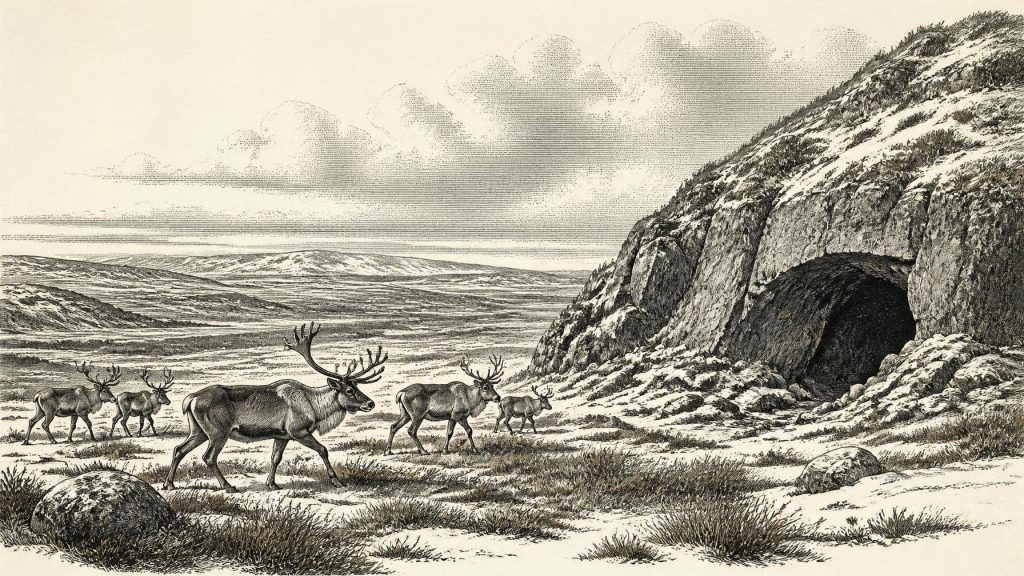
Circa 31,996 BCE, Ireland formed part of the climatically unstable MIS 3 cold stage, before the Last Glacial Maximum. Lower seas, shifting ice and treeless tundra-steppe environments shaped a landscape intermittently accessible to animals. Castlepook Cave in County Cork preserves bones of mammoth, reindeer, giant deer, bears, wolves, foxes, lemmings and hyaenas, demonstrating a varied cold-stage fauna, although deposits are mixed and cannot reconstruct a single ecosystem. A possibly butchered reindeer bone suggests transient Upper Palaeolithic visitors, but remains unconfirmed without securely stratified tools or settlements. Later glaciation and rising seas impoverished evidence. No settled human history can be inferred.
Dateline
“31,996 BCE” is a modern retrospective label, not a date anyone living then could have named or recorded. It corresponds only approximately to 34,000 calendar years before 1950, the reference point used by archaeologists for “BP” dating. No evidence can identify an event in a particular Irish year, season or generation. The responsible history of Ireland at this point is therefore a history of landscapes, animal remains, cave deposits and the limits of archaeological inference. It belongs to the Middle Upper Palaeolithic world of Marine Isotope Stage 3 (MIS 3), during the long approach to the Last Glacial Maximum.
A Date Beyond Calendar History
Modern calibrated radiocarbon chronologies are expressed as ranges because each result has a statistical uncertainty and because atmospheric carbon levels changed over time. A date such as 31,996 BCE cannot simply be matched to a single radiocarbon measurement. The evidence most relevant to Ireland spans broad intervals: especially roughly 40,000–30,000 radiocarbon years BP in cave-fauna studies, and larger calibrated ranges around them. Nor should “Ireland” be imagined as an unchanging island. Sea levels were lower than today, coastlines lay farther out, and the Irish Sea basin had a different physical geography. Yet water, changing shorelines and ice were formidable constraints on movement.
This was not the Last Glacial Maximum itself. The fullest expansion of the British–Irish Ice Sheet is generally placed much later, around 27,000–23,000 calibrated years BP, when ice covered Ireland and much of its continental shelf. Around the notional year in question, conditions were already glacial, cold and unstable, but the available evidence indicates a more varied MIS 3 landscape than the later ice-bound maximum. Any map for this time is a reconstruction, not a contemporary survey: the outlines of ice and sea shifted repeatedly over millennia.
A Cold, Changing Country
Ireland lay on Europe’s north-western Atlantic edge, exposed to rapid climatic swings recorded with much greater resolution in Greenland ice cores and North Atlantic sediments than in the Irish land record. Those distant archives establish that the last glacial period was not one uniform freeze. Abrupt warmer interstadials alternated with colder stadials. Their precise local expression in Ireland remains difficult to reconstruct, but the implication is important: habitats, animal ranges, snow cover and the viability of travel could all have altered far more quickly than a simple “Ice Age” label suggests.
At about this stage, parts of the island could support open cold-stage environments rather than later being wholly sealed below the maximum ice sheet. These were treeless or sparsely vegetated landscapes, broadly comparable to tundra-steppe mosaics elsewhere in north-west Europe, with grasses, herbs, sedges and low shrubs where soil, season and exposure permitted. They were not agricultural fields, native woodland or the familiar green pasture of later Ireland. Wind, frost action and seasonal meltwater shaped exposed ground; caves and fissures in the Carboniferous limestone of the south were traps and shelters for animals, and later repositories of the fragmentary evidence on which the period depends.
There is no basis for assigning a uniform temperature, snowfall total or vegetation cover to every region. Uplands, western Atlantic margins, river valleys and the limestone country of present-day Cork and Clare would have differed sharply. What can be said is that Irish environments were part of a wider north-west European cold-stage zone, while the growth of the British–Irish Ice Sheet increasingly narrowed the ecological and geographical opportunities available to plants, animals and any people who might have reached the region.
Castlepook and the Animal Record
The strongest evidence illuminating Ireland near this remote horizon comes from Castlepook Cave, near Doneraile in north County Cork. Excavations undertaken in the early twentieth century recovered a remarkably varied assemblage from cave passages and deposits: woolly mammoth, reindeer, giant deer, brown bear, wolf, foxes, mountain or Arctic hare, both collared and Norway lemmings, and spotted hyaena. Some material has been directly dated, and subsequent re-dating using improved collagen preparation has shown that earlier measurements could be substantially too young. The revised work places important elements of the southern Irish fauna in MIS 3 and indicates that giant deer and spotted hyaena may have disappeared locally before about 40,000 calibrated years BP.
These bones do not amount to a census of an Irish ecosystem. Cave deposits combine animals that died nearby, prey dragged in by carnivores, material moved by water or sediment, and finds whose original positions were disturbed by antiquarian excavation. Their dates need not all be contemporary. Nevertheless, the assemblage securely demonstrates that Ireland was intermittently accessible to an impressive cold-stage fauna before the Last Glacial Maximum. Mammoth and reindeer evoke open grazing country; lemmings reinforce the cold environmental signal; hyaena, wolf and bear show that predators and scavengers were also present.
In this setting Castlepook was probably more important as a carnivore den and natural bone-collecting place than as a human dwelling. Chewed bones and the distribution of remains are material clues to that distinction. The cave’s scientific value lies precisely in its warning against easy narratives: the survival of a bone proves that an animal occurred in, or was transported into, the region at some point; it does not automatically prove a herd, a breeding population, a hunting ground or a settlement immediately outside the entrance.
The Question of Human Presence
The possibility of people in Ireland around this time is one of the most significant, but also most unsettled, issues. A reindeer femur fragment from the historic Castlepook collections has been reported as bearing marks consistent with butchery by a sharp stone tool and as dating to about 33,000 years ago. If both the age and anthropogenic interpretation withstand further scrutiny, it would indicate a fleeting Upper Palaeolithic human presence in Ireland far earlier than the once accepted post-glacial colonisation. It would fit a wider European world in which mobile Homo sapiens hunter-gatherers tracked seasonally available game.
That conclusion must remain conditional. The bone derives from old excavations rather than a newly excavated, securely stratified living surface. No unequivocal contemporary Irish stone-tool assemblage, hearth, built shelter, burial or repeated occupation layer has yet been published to accompany it. Cut marks are assessed through their shape, placement and microscopic characteristics, but carnivore damage, excavation damage and other processes must be excluded carefully. For good reason, the National Museum of Ireland continues to state that clear evidence for Palaeolithic human presence has not yet emerged. The contrast between that cautious institutional position and the exciting Castlepook claim is not a contradiction to be concealed: it is the present state of research.
Thus it would be wrong to write of an Irish “people”, tribe or permanent settlement in 31,996 BCE. At most, the evidence permits a hypothesis that small, highly mobile hunting parties may have entered or passed through parts of the region during favourable MIS 3 conditions. Even that would describe episodes, not continuous occupation. Their identities, language, kinship, numbers, routes and duration are unknown. The later, better-supported evidence for human activity at Alice and Gwendoline Cave in County Clare dates to the terminal Pleistocene, around 12,800–12,600 calibrated years BP, many thousands of years after this article’s notional date.
No Polities, No Recorded Beliefs
Political affairs, diplomacy and organised warfare cannot responsibly be reconstructed for Ireland at this date. There were no states, chiefs, boundaries or written records identifiable in the evidence. Nor can religion, art, learning or language be recovered from a faunal assemblage. It is possible that Upper Palaeolithic visitors elsewhere in Europe had sophisticated social lives, symbolic practices and far-reaching exchange networks, but importing those characteristics into Ireland without Irish artefacts would turn analogy into invention.
The same restraint applies to economy and trade. If people did reach Ireland, hunting and scavenging large mammals would be plausible subsistence activities, and stone tools would have been vital equipment; neither proposition proves an Irish economy or a trade route. There is no evidence here for farming, livestock, metalworking, pottery, monuments, villages or long-term domestic life. The relevant economy visible in the record is ecological: herbivores converting sparse vegetation into animal biomass, predators exploiting prey and carrion, and cave systems preserving selected remnants of those relationships.
Regional Change and a Fragile Archive
The most important development was environmental rather than political: Ireland stood within a cold, fluctuating north-west European world moving towards far more extensive glaciation. Later ice would erode, transport and bury older surfaces, while rising post-glacial seas would drown many former lowlands and possible coastal routes. This helps explain why the archaeological record is so thin. Absence of discovered camps is not absolute proof that no person ever arrived, but it is powerful evidence against confident stories of established occupation.
For Ireland in 31,996 BCE, then, the history is one of possibility bounded by proof. Cave bones establish a real cold-stage fauna; glacial science establishes profound climatic and geographic change; a modified reindeer bone raises the prospect of human contact. None permits a year-specific drama. The honest picture is of a precarious landscape, intermittently inhabited by Ice Age animals, with the human story still waiting for securely excavated evidence.
Primary Sources
- Prehistoric Details
- A reconsideration of the radiocarbon dating of the Marine Isotope Stage 3 fauna from southern Ireland
- The Irish Quaternary Fauna Project
- Pleistocene vertebrates in the British Isles
- First evidence of a Late Upper Palaeolithic human presence in Ireland
- New insights on the fauna of Ireland's Younger Dryas and Early Holocene from Alice & Gwendoline Cave
- 2019:148 – Alice & Gwendoline Cave, Clare
- Archaeology Research Excavation Grant 2022: Final Report
- 2022:143 – Castlepook Cave, Cork
- Ireland: Submerged Prehistoric Sites and Landscapes
- Growth and retreat of the last British–Irish Ice Sheet, 31,000 to 15,000 years ago: the BRITICE-CHRONO reconstruction
- Pattern and timing of retreat of the last British-Irish Ice Sheet
- New data for the Last Glacial Maximum in Great Britain and Ireland
- Maximum extent and dynamic behaviour of the last British–Irish Ice Sheet west of Ireland
- The deglaciation of the western sector of the Irish Ice Sheet from the inner continental shelf to its terrestrial margin
- Timing and pace of ice-sheet withdrawal across the marine–terrestrial transition west of Ireland during the last glaciation
- Dimensions and chronology of the last ice sheet in Western Ireland
- Late Pleistocene chronostratigraphy and ice sheet limits, southern Ireland
- BRITICE Glacial Mapping Project
- Geology of Ireland
- High-resolution record of Northern Hemisphere climate extending into the last interglacial period
- Visual stratigraphy of the North Greenland Ice Core Project (NorthGRIP) ice core during the last glacial period