

Southern Irish Raised Beaches31952 BCE
Around 31,952 BCE, Ireland lay in the unstable Late Pleistocene climate of Marine Isotope Stage 3, as the British–Irish Ice Sheet expanded. Southern raised-beach and marine deposits reveal shifting relative sea levels, while Castlepook Cave in County Cork preserves remains of mammoth, reindeer, giant deer, bears, wolves, hyaenas and fauna, indicating varied open, cold habitats. Cave deposits are disturbed and span long periods, limiting precision. A reportedly cut-marked reindeer bone, dated near 33,000 years ago, suggests possible Upper Palaeolithic visitation, but lacks secure context. Settlement remains unproven. This date represents ecological richness and uncertain human possibility before later glacial maximum.
Dateline
The label 31,952 BCE is a modern chronological convenience, not a year that anyone living in Ireland could have named or recorded. It is roughly 33,900 years before the conventional radiocarbon baseline of AD 1950, but archaeological and environmental evidence cannot be assigned to a single calendar year at this depth of time. The responsible view is therefore regional and approximate: this point falls within the Late Pleistocene, during Marine Isotope Stage 3, a long and unstable phase of the last Ice Age. Evidence from Ireland is sparse, much of it recovered long ago from caves and later re-examined. It can illuminate the island’s changing climate, wildlife and possible human visitation; it cannot provide an annal of a particular year.
An Island in a Cold Age
Ireland at this time was not the familiar green, wooded island of later millennia. The climate was cold, variable and embedded in the larger North Atlantic world of advancing and retreating ice. The British–Irish Ice Sheet was growing during the later part of Marine Isotope Stage 3, but the exact extent and timing of ice across every Irish region remain subjects of continuing research. Reconstructions broadly place the decisive build-up of the ice sheet after about 35,000–32,000 years ago, with its maximum extent later, around 27,000–21,000 years ago. Thus 31,952 BCE belongs not simply to a moment when ‘Ireland was under ice’, but to a changing glacial landscape in which ice margins, exposed ground, sea level and habitats could differ considerably from place to place.
Southern Ireland preserves important clues to this complexity. Raised-beach and shallow-marine deposits demonstrate that parts of the south coast experienced changing relative sea levels during Marine Isotope Stages 4 and 3. Offshore geomorphology, sediment cores and dating programmes have transformed understanding of the ice sheet’s later expansion and retreat, but they do not yield a map precise enough to describe conditions in one valley in one year. The safest conclusion is that the Irish landscape was increasingly severe and unstable, yet still included habitable, at least seasonally accessible, terrain before the later glacial maximum overwhelmed much of the island.
Castlepook and the Fossil Record
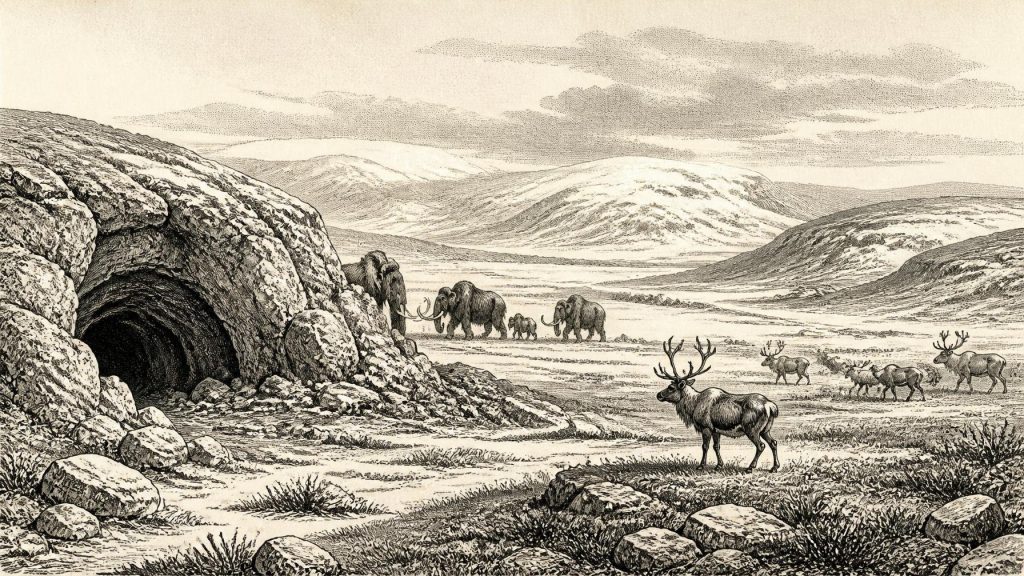
The most important Irish locality for imagining this period is Castlepook Cave near Doneraile in north County Cork. Excavated in the early twentieth century, its passages produced a remarkable assemblage of Pleistocene animal remains. Woolly mammoth, reindeer, giant deer, brown bear, wolf, Arctic fox, spotted hyaena, mountain hare, stoat and lemmings are among the animals identified from the cave deposits. This is compelling evidence that cold-adapted and open-country fauna reached Ireland during phases of the Ice Age. It also warns against picturing a uniform polar desert. At least in favourable intervals, Ireland contained enough food, shelter and connected terrain to support a varied large-mammal community.
Yet Castlepook must be handled with care. Its bone deposits were excavated before modern standards of sediment recording, and the cave system accumulated material over long periods. Some remains may have been moved, mixed or introduced from different phases of the Pleistocene; a few identifications and associations have been reconsidered by later researchers. A radiocarbon determination on a mammoth bone, published as 33,400 ± 1,200 radiocarbon years before present, placed part of the assemblage broadly in the Middle Devensian or Late Pleistocene. That is valuable chronological evidence, but it is not a date for every bone, every species or every episode represented in the cave.
The animal list nevertheless conveys an important ecological reality. Reindeer and lemmings point towards cold, largely open vegetation; Arctic foxes and mountain hares reinforce that impression. Mammoths would have needed extensive feeding grounds, while wolves and spotted hyaenas were predators and scavengers within that wider food web. Brown bears and giant deer remind us that Ice Age environments were mosaics rather than simple modern analogies. There may have been patches of grassland, herb-rich steppe-tundra, scrub and sheltered valley habitat, varying with local soils, exposure, seasons and the advance of ice. The evidence supports a landscape capable of sustaining animals; it does not allow a precise reconstruction of its trees, flowers or weather on 31,952 BCE itself.
The Question of People
The most consequential, and most tentative, question is whether people visited Ireland around this broad period. For much of the twentieth century, the accepted archaeological position was that Ireland had no convincing Palaeolithic human record and that sustained settlement began only in the Mesolithic, around 8000 BCE. The later discovery at Alice and Gwendoline Cave, County Clare, of cut marks on a brown-bear kneecap dated to about 12,810–12,590 calibrated years before present demonstrated earlier Late Upper Palaeolithic human activity. It proved that the search for Ireland’s first people could not be confined to later Mesolithic sites.
Castlepook has extended that debate further. A fragment of reindeer femur from the cave has been reported as bearing marks consistent with butchery by a stone tool and as dating to about 33,000 years ago. If the modification is confirmed as human-made and securely related to the bone’s age, it would indicate human activity in Ireland far earlier than the Clare bear bone and broadly near the era addressed here. It would be a major discovery: not evidence of a large settled population, but evidence that Upper Palaeolithic people reached, hunted or processed carcasses in what is now Ireland.
That conditional language matters. The reported Castlepook find comes from an old collection rather than a newly excavated, sealed occupation layer. No securely associated hearth, stone-tool assemblage, dwelling floor, human bone or repeated series of butchered animals has yet been published to establish a settlement at the cave. A cut-marked bone can show an encounter between people and an animal; it cannot on its own reveal how many people were present, whether they lived nearby, how long they stayed, or whether the animal was hunted rather than scavenged. Around 31,952 BCE, human presence in Ireland should therefore be described as possible and under investigation, not as a settled historical fact.
Movement, Not a Nation
If people did enter Ireland during this period, they would have been small, mobile Upper Palaeolithic hunter-gatherer groups, not members of any known Irish ‘tribe’, kingdom or nation. There is no evidence for rulers, political institutions, warfare, diplomacy, fixed territorial boundaries or named communities. Nor can archaeology identify a language, kinship system, gender roles or religious belief for Ireland at this date. Continental and British Upper Palaeolithic archaeology shows that contemporary Homo sapiens possessed sophisticated stone technologies, social networks and symbolic cultures, but it would be unsafe to transfer any particular tool tradition, artwork or ritual automatically across the sea to Ireland without an Irish context.
Travel itself is uncertain. Lower global sea level altered the geography of north-west Europe, exposing areas now submerged, while local relative sea level was affected by the weight and movement of ice. Possible land connections and ice routes between Ireland, Britain and continental Europe have long been debated. A mainland route cannot be assumed for every phase, nor can water crossings be excluded. The key point is that Ireland’s position at the Atlantic edge made arrival difficult but not impossible. Animal movements demonstrate that ecological connections existed at some stages; they do not by themselves demonstrate a human migration route.
Everyday Survival
For any visiting people, the practical economy would have centred on acquiring food, fuel, shelter and workable raw materials in a cold environment. Reindeer would have offered meat, fat, hide, sinew, antler and bone; mammoth, where encountered, represented an immense but risky source of food and materials. Predators would have demanded vigilance, and winter conditions would have placed a premium on local knowledge and mobility. Caves such as Castlepook could provide shelter or serve as natural traps and carnivore dens, but their very use by bears and hyaenas makes them ambiguous archaeological settings. No direct Irish evidence from this date demonstrates camps, clothing, boats, storage, exchange networks or the regular use of a particular route.
There is equally no securely Irish evidence for art, formal burial, ceremony or teaching at 31,952 BCE. That absence should not be confused with an absence of culture. Hunter-gatherer life depended upon learned knowledge: reading animal tracks, locating stone, anticipating weather, preserving food and passing skills between generations. Archaeology simply cannot recover those practices in detail here. The later glacial advance compounded the problem, eroding, burying and reworking many ancient surfaces. Coastal landscapes that might once have contained camps or travel corridors now lie beneath the sea, while surviving cave collections retain only a partial and often disturbed record.
What This Date Can Mean
The chief historical significance of 31,952 BCE is not an identifiable Irish event but a threshold of possibility. Ireland was entering the harsher trajectory that would culminate in the Last Glacial Maximum. Before that transformation was complete, parts of the island supported an Ice Age fauna of exceptional richness, documented especially at Castlepook Cave. A reported cut-marked reindeer bone raises the prospect that Upper Palaeolithic people were among those moving through this landscape, although the claim still requires stronger contextual confirmation. The evidence therefore supports a cautious, vivid conclusion: this was an Ireland of cold grasslands, caves, great animals and unstable horizons—one that may already have been visited by people, but whose human story remains largely beyond the resolution of modern dating.
Primary Sources
- First Evidence of a Late Upper Palaeolithic Human Presence in Ireland
- Palaeolithic Ireland – New Evidence Emerges from the Emerald Isle
- The Irish Quaternary Fauna Project
- New Insights on the Fauna of Ireland’s Younger Dryas and Early Holocene from Alice & Gwendoline Cave
- Advances in Irish Quaternary Studies
- Extent and Timing of the Last Glacial Maximum in Britain and Ireland: A Review
- Growth and Retreat of the Last British–Irish Ice Sheet, 31 000 to 15 000 Years Ago: the BRITICE-CHRONO Reconstruction
- Timing and Pace of Ice-Sheet Withdrawal Across the Marine–Terrestrial Transition West of Ireland During the Last Glaciation
- Late Pleistocene Chronostratigraphy and Ice Sheet Limits, Southern Ireland
- The Timing and Magnitude of the British–Irish Ice Sheet Between Marine Isotope Stages 5d and 2
- Character of Advance and Retreat of the Southwest Sector of the British-Irish Ice Sheet During the Last Glaciation
- Maximum Extent and Dynamic Behaviour of the Last British–Irish Ice Sheet West of Ireland
- Sedimentology and Chronology of the Advance and Retreat of the Last British-Irish Ice Sheet on the Continental Shelf West of Ireland
- The Island of Ireland: Drowning the Myth of an Irish Land-Bridge?
- Stoats (Mustela erminea) Provide Evidence of Natural Overland Colonization of Ireland
- Episodic Speleothem Deposition Tracks the Terrestrial Impact of Millennial-Scale Last Glacial Climate Variability in SW Ireland
- On the Cave of Castlepook, Near Doneraile, Co. Cork
- A Hyæna-Den in Ireland: The Exploration of Castlepook Cave, County Cork
- Castlepook Caves
- Guide to the National Museum of Ireland
- The Earliest Evidence for Anatomically Modern Humans in Northwestern Europe
- Pleistocene Vertebrates in the British Isles


