Maguirebridge’s Fading Wetlands31159 BCE
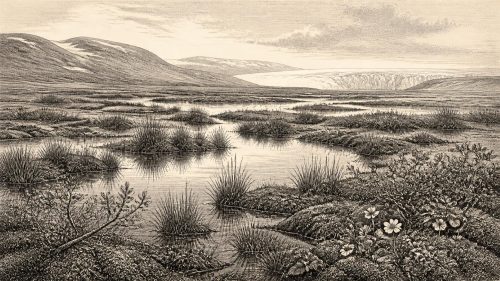
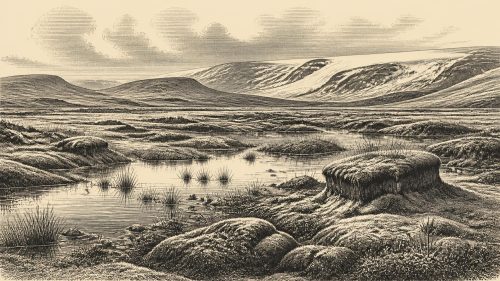
Around 31,159 BCE, Ireland lay within a fluctuating Late Pleistocene landscape, not a datable historical year. During Marine Isotope Stage 3, cold, largely treeless terrain included wetlands such as Derryvree near Maguiresbridge, whose organic sediments show freshwater, ice-free or ice-marginal conditions. Castlepook Cave in Cork preserves fauna including mammoth, reindeer, giant deer, hyena and Arctic fox, accumulated over extended periods. A marked reindeer femur may indicate butchery by Upper Palaeolithic people, but proves neither settlement nor continuity. No political, cultural or economic history is recoverable. The evidence instead records changing environments, animal movements and possible human visits before intensified glaciation.
Dateline
Modern calendar precision cannot be carried back to 31,159 BCE. No event, season, named person or community can be assigned to that numbered year in Ireland. It is best treated as a point within a broad Late Pleistocene interval, roughly 33,100 calendar years before AD 1950, during Marine Isotope Stage 3. Dates at this depth are expressed through radiocarbon measurements, calibration curves and geological sequences, each with uncertainty that may extend across centuries or longer. The evidence therefore illuminates changing landscapes and animal life, not an Irish annal for a particular year.
A Landscape Approaching Ice
Ireland was in the later part of the Midlandian glaciation, but this did not mean a single, static island buried continuously beneath one uniform ice sheet. Ice expanded and contracted repeatedly; climates shifted sharply; and local conditions differed between uplands, coasts, caves and lowland basins. Around the broad period represented by 31,159 BCE, the British–Irish Ice Sheet was building towards its later maximum, conventionally placed many millennia afterwards, around 28,000–20,000 calibrated years before present. Reconstructions of its earlier growth remain contested, especially in a landscape whose older deposits were repeatedly eroded, overridden or buried by later ice.
The cautious picture is of a cold, largely treeless country with open herb-rich ground, sedges, dwarf shrubs and patches of wetland wherever water could pond beyond or beneath ice margins. It was not a modern Ireland in winter. Sea level was lower, coastlines lay far beyond many present shores, and the outlines of the island and the Irish Sea world differed substantially from today. Yet lower sea level does not by itself prove a walkable land bridge from Britain, still less a particular route used by people or animals. The changing shelves, channels, glaciers and seas made connections possible at some times and difficult at others.
Fermanagh preserves an important reminder that Ireland’s Ice Age history was environmentally varied. Organic sediments at Derryvree, near Maguiresbridge, lay between glacial deposits and recorded freshwater conditions, mosses, aquatic plants and cold-adapted vegetation during an ice-free or ice-marginal interval. A conventional radiocarbon determination known as BIRM-166 was published at about 30,500 radiocarbon years BP, with a substantial uncertainty. Its calibrated calendar placement is broader and earlier than the raw radiocarbon figure suggests. It cannot date conditions precisely to 31,159 BCE, but it demonstrates why a simple story of uninterrupted Irish ice cover is inadequate.
The Evidence of Cave Fauna
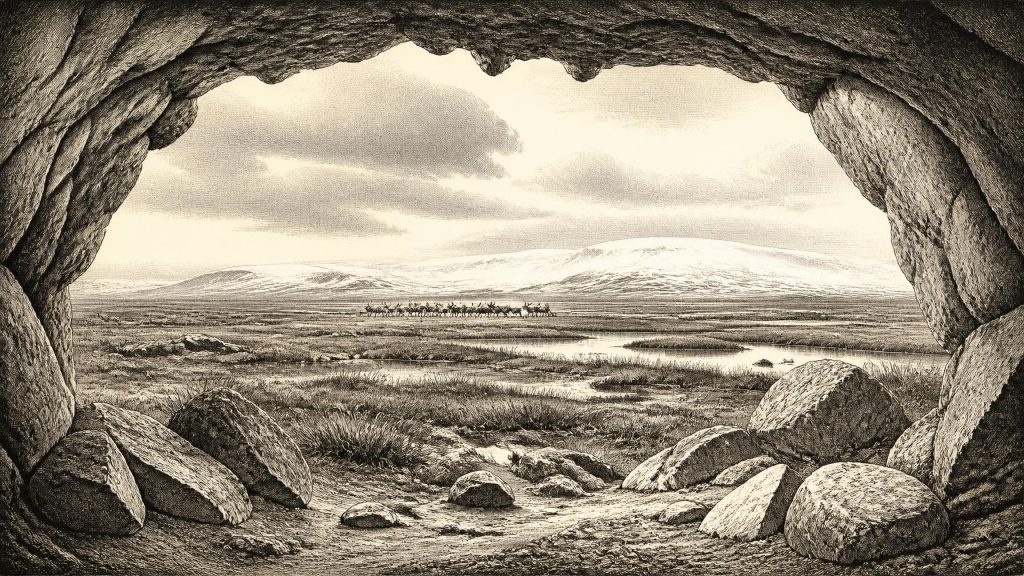
The strongest direct Irish evidence for the wider period comes from caves, particularly Castlepook Cave—also called Mammoth Cave—near Doneraile in north County Cork. Excavations from the late nineteenth and early twentieth centuries produced a remarkable collection of animal remains. Reassessment and accelerator radiocarbon dating have shown that parts of the assemblage belong to the Middle Midlandian, or MIS 3, rather than to one single occupation or one short-lived ecological episode.
Its recorded fauna includes reindeer, woolly mammoth, giant deer, brown bear, wolf, Arctic fox, mountain hare, lemmings and spotted hyena. This is powerful evidence for the kinds of animals that reached Ireland during cold-stage intervals. It also suggests an open and demanding mosaic of grazing country, rocky limestone terrain and sheltered cave spaces. But the list must not be converted into a single illustrated scene for one year. The animals were deposited over long spans of time; some entered caves through carnivore activity, natural death, water movement or collapse; and early excavators could not record stratigraphy to modern standards. Castlepook is a deep archive, not a frozen instant.
Spotted hyena is especially significant. The National Museum of Ireland describes Castlepook as the country’s most important site for mammal remains from the last cold stage, and notes that hyenas and other mammals probably reached Ireland from Britain during the broad interval c.45,000–30,000 years ago. Hyenas could carry bones into dens and disturb deposits, making them both inhabitants of the landscape and agents in the formation of the archaeological record. Mammoth and reindeer remains indicate that large herbivores could use Irish landscapes before the last glacial maximum, but neither proves that every species was present at the same time or in the same locality.
The Reindeer Bone Question
One Castlepook find gives this era exceptional importance for human history: a reindeer femur reported as about 33,000 years old and bearing a deep mark interpreted by zooarchaeologist Ruth Carden as damage made by a sharp stone tool during butchery. County Cork heritage material has accordingly presented the specimen as possible evidence of Palaeolithic people handling reindeer around 31,000 BCE. If the interpretation is confirmed, it would be by far the earliest indication of human activity in Ireland.
Its significance requires equally firm restraint. The radiocarbon result dates the death of the animal’s bone tissue within a statistical range; it does not independently date the surface mark, establish who made it, show where the animal was killed, or reveal how long anyone remained in Ireland. The femur came from an old collection rather than a newly excavated, intact living surface. No securely associated hearth, stone-tool assemblage, dwelling, burial, human skeleton, or repeated occupation layer of comparable age has yet been recovered at Castlepook. Recent work has identified surviving fossil-bearing deposits, which makes further investigation valuable, but it has not turned the cave into a demonstrated settlement.
The most responsible conclusion is therefore limited but important: a brief Upper Palaeolithic human incursion into Ireland is possible in the broad period around this date. A small party might have encountered or processed a reindeer, whether hunted, scavenged or found already dead. Reindeer could in principle provide meat, fat, hide, sinew, antler and bone; none of those uses beyond possible carcass processing can be demonstrated from this specimen alone. Permanent occupation, continuous population and descent into later Irish communities remain unproven.
Society Beyond the Evidence
There is no recoverable political history for Ireland at this date. No chiefs, territories, assemblies, diplomacy, warfare, laws or ethnic names can responsibly be inferred. Nor is there Irish evidence for farming, herding, trade goods, monuments, ritual deposits, art, formal learning or a language. Calling any possible visitors “Irish” would be anachronistic in every cultural and political sense.
Elsewhere in north-west Europe, Homo sapiens communities of the Upper Palaeolithic possessed sophisticated stone technologies, clothing and social networks, and in some regions made ornaments and cave art. That wider evidence provides a context for what a hypothetical visiting group might have known. It cannot fill Ireland’s evidential silence with invented camps, leaders or ceremonies. The absence of such traces may partly reflect sparse occupation, later glacial destruction, inundated former coastlines and the survival bias favouring caves; nevertheless, absence is not proof of a particular activity.
Everyday life can be described only at the ecological level. Reindeer, hares and lemmings were adapted to exposed cold environments; predators and scavengers followed prey and carcasses; people, if present, would have needed mobility, warmth, food and reliable knowledge of dangerous terrain. Caves offered shelter to animals and occasionally to people, but also accumulated complex deposits. They should not automatically be imagined as human homes. A limestone chamber could instead be a hyena den, animal trap, seasonal refuge, drainage route and bone archive at different times.
Connections, Not Trade Routes
The economy visible in the evidence was ecological rather than commercial: movements of animals through changing habitats, the circulation of nutrients through grazing and predation, and perhaps the opportunistic use of a carcass by humans. There is no basis for identifying a trade network, a maritime crossing, or regular exchange between Ireland and Britain. What can be said is that Ireland was not environmentally isolated from the wider north-west European world. Faunal arrivals required changing geographical connections, while the development of ice and sea barriers could later close them.
Thus the principal development around 31,159 BCE was not a recorded human episode but a transformation in the conditions under which life could persist. Wetlands like those represented at Derryvree, and faunal assemblages such as Castlepook’s, preserve fragments of an Ireland on the threshold of more severe glaciation. The possible reindeer butchery mark remains an arresting clue, but it is not a foundation for a populated prehistoric nation. This is a history of sediments, bones and calibrated probabilities: sparse evidence, carefully read, of a cold and changing island at Europe’s western edge.
Primary Sources
- The Irish Quaternary Fauna Project
- Spotted Hyena Skull
- Prehistoric Details: Mell Flint Flake
- Guide to the National Museum of Ireland
- First Evidence of a Late Upper Palaeolithic Human Presence in Ireland
- First Evidence of a Late Upper Palaeolithic Human Presence in Ireland
- New Insights on the Fauna of Ireland's Younger Dryas and Early Holocene from Alice & Gwendoline Cave
- The IntCal20 Northern Hemisphere Radiocarbon Age Calibration Curve (0–55 cal kBP)
- IntCal20 Northern Hemisphere Radiocarbon Age Calibration Curve PDF
- The Problem of a Late Quaternary Landbridge Between Britain and Ireland
- Dimensions and Chronology of the Last Ice Sheet in Western Ireland
- Trimlines, Blockfields and the Vertical Extent of the Last Ice Sheet in Southern Ireland
- Maximum Extent and Dynamic Behaviour of the Last British–Irish Ice Sheet West of Ireland
- Character of Advance and Retreat of the Southwest Sector of the British-Irish Ice Sheet During the Last Glaciation
- Pattern, Style and Timing of British–Irish Ice Sheet Advance and Retreat Over the Last 45,000 Years
- Figure 6: The Subdivision of the Quaternary Period in Ireland
- Quaternary Geology
- Archaeological Heritage of County Cork
- Heritage Artefacts of County Cork
- Castlepook Cave, County Cork, 2022 Excavation Report