Removing the Treaty Oath1933 CE
In 1933 Fianna Fáil secured a Dáil majority, enabling Éamon de Valera’s government to pursue a stronger interpretation of Irish self-government. The Constitution (Removal of Oath) Act ended compulsory parliamentary declarations involving the Crown and repealed the Treaty’s overriding constitutional status, though Ireland remained short of a republic. Anglo-Irish conflict over land annuities continued to damage agricultural exports during the Economic War. Protectionist measures promoted cereals, industrial credit and sugar production, while land reform and unemployment assistance expanded state intervention. Government suppression of Blueshirt mobilisation preceded Fine Gael’s formation. Meanwhile, Northern Ireland’s Unionist administration remained firmly entrenched, underscoring partition’s persistence.
Dateline
A New Mandate
In 1933 the Irish Free State moved decisively from the unsettled compromises of its foundation towards a more assertive interpretation of self-government. The defining act of the year was the removal of the oath required of members of the Oireachtas: a change whose legal wording was narrow enough to pass as legislation, but whose political meaning reached back to the Anglo-Irish Treaty, the Civil War and the bitter question of whether Irish representatives could fully serve the nation while making a declaration involving the Crown. The year also brought a general election, continuing conflict with Britain over land annuities and trade, a sharp confrontation over organised political uniforms, and new efforts to reshape agriculture, industry and social provision.
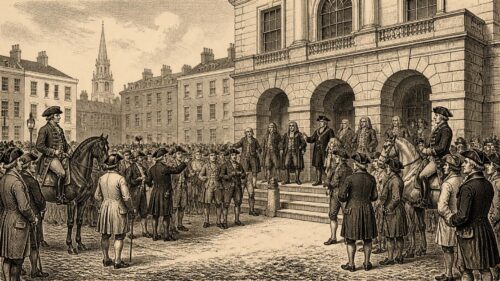
The firmly dated starting point was the general election of 24 January. Fianna Fáil, led by Éamon de Valera, won 77 of the 153 seats in the new Dáil, giving it an overall majority rather than the more precarious position it had held after taking office in 1932. Its 689,054 first-preference votes represented just under half of valid votes cast. The result strengthened a government elected on promises to challenge Treaty restrictions, retain land-annuity payments within Ireland, encourage native production and relieve hardship during the depression. The Eighth Dáil first met on 8 February.
That mandate did not remove disagreement. The state remained only a decade beyond civil war, and political loyalties were still frequently described in Treaty and anti-Treaty terms. Yet the election gave de Valera’s ministry a clearer parliamentary basis for change. It also made 1933 a year in which disagreements about constitutional theory, prices and trade could no longer be treated as separate subjects. For farmers facing a damaged export market, for workers seeking employment, and for politicians arguing about the Crown, the character and capacity of the Free State were practical matters as well as symbols.
The Oath Removed
On 3 May, the Constitution (Removal of Oath) Act 1933 became law. It removed the obligation on members of the Oireachtas and non-ministerial office-holders to take the oath previously demanded before they could take their places. More consequentially, it repealed constitutional and statutory provisions that had given the Anglo-Irish Treaty overriding force in the Free State’s constitutional arrangements. This was not a declaration of a republic, nor did it at once eliminate every constitutional connection with the Crown. It was, however, a deliberate assertion that the Oireachtas could alter the settlement inherited from 1922.
The delay before enactment mattered. The bill had been introduced in 1932, but the Seanad used its substantial delaying power and proposed amendments. The Dáil rejected those amendments, and the constitutional timetable meant that the measure did not reach the statute book until 1933. The episode demonstrated that the upper house could still obstruct a determined government, while also helping to intensify Fianna Fáil’s hostility towards it. Contemporary parliamentary debate reveals that opponents did not necessarily deny the oath’s unpopularity; rather, they disputed its legal significance, the wisdom of unilateral action and the effect on relations with Britain.
For supporters, the change removed an affront that had helped make the Treaty divisive from the beginning. The wording of the original oath required fidelity to King George V as well as true faith and allegiance to the Free State Constitution. For critics of Fianna Fáil, its removal threatened the Treaty settlement and seemed likely to worsen already fraught Anglo-Irish relations. The British government publicly considered the wider Treaty implications. Thus an oath that each deputy recited only once became a test of where final constitutional authority lay: in a binding Anglo-Irish agreement, or in the elected legislature in Dublin.
Trade War and the Countryside
The oath controversy unfolded during the continuing Anglo-Irish Economic War. The dispute had begun in 1932 after the Free State withheld payments to Britain connected with land-purchase annuities. Britain responded with duties on Irish imports, and Dublin retaliated with tariffs. The argument was therefore not simply about an old financial obligation. It struck at an economy still closely tied to the British market, especially through livestock and agricultural exports. Negotiations had failed over the proposed form of arbitration, leaving duties and counter-duties to shape commerce through 1933.
For many rural households, this was the most immediate national issue. Cattle raising for export had long linked farms, fairs, railways and ports to purchasers across the Irish Sea. The trade conflict made that dependence painfully visible. Later economic reconstructions show how sharply the value of Irish exports fell by 1933, while scholarship on the dispute emphasises the particular burden borne by the cattle trade. It would be wrong to attribute every rural difficulty to the Economic War alone: the international depression had already depressed demand and prices. But Britain’s penal duties and the Free State’s retaliatory policy made recovery still harder for an export-oriented agricultural economy.
The government nevertheless pressed a programme intended to make domestic production and state direction more important. The Agricultural Produce (Cereals) Act, enacted on 4 May, provided for regulation of milling and for measures to encourage cereal growing. The Industrial Credit Act of 31 July authorised the formation of a company to provide industrial credit, with the Minister for Finance acquiring share capital. The Sugar Manufacture Act followed in August and supplied the legal basis for the Irish Sugar undertaking, a conspicuous attempt to align beet cultivation, processing and protected domestic manufacture. These statutes did not instantly transform farms or factories. They do, however, mark 1933 as a year in which protection, credit and planned production were made instruments of national policy.
Land policy was equally active. The Land Act, passed on 13 October, reorganised and extended elements of land-purchase administration, revised annuities and addressed arrears. It also enlarged the Land Commission’s powers in areas including the acquisition of land and the relief of congestion. Its detailed provisions are a reminder that the politics of annuities were inseparable from the older work of breaking up estates, securing viable holdings and dealing with indebtedness. For families on smaller farms, the state’s decisions about arrears, purchase charges and land redistribution could be more tangible than the larger diplomatic argument with London.
Relief, Work and Everyday Security
Economic uncertainty was not confined to the countryside. In November the Oireachtas enacted the Unemployment Assistance Act 1933, a significant development in the state’s approach to joblessness. The Act created a framework for means-tested assistance, qualification certificates, unemployment assistance officers, appeals machinery and payments to eligible people who were unemployed, able to work and genuinely seeking suitable employment. It also differentiated between urban and non-urban areas. The legislation was enacted on 16 November, but applications for assistance were to begin later by ministerial order; it should therefore be seen as a framework laid down in 1933, not as an instant payment system operating nationwide that same day.
A committee examining national health insurance earlier in the year reported heavy pressure on insurance funds amid unemployment and noted that about 350,000 people were within unemployment insurance. Such figures do not capture all those in need, nor do they erase the continuing importance of families, local authorities, charitable bodies and emigration as responses to hardship. They do show why relief, insurance and employment were central public questions. The 1933 assistance legislation represented a further move towards direct state responsibility, albeit within a restrictive system that investigated means and imposed conditions on claimants.
Even a modest amendment to school-meals provision in the Gaeltacht belongs in this picture. The School Meals (Gaeltacht) Act 1933 extended an existing legislative scheme directed at children attending national schools in designated Irish-speaking districts. It was not a complete answer to poverty or language decline, but it joined welfare, schooling and regional policy in a practical intervention. The measure indicates that the western and north-western Gaeltacht was not merely an emblem of national culture: it was also a place where nutritional need and limited local resources required public attention.
Uniforms, Opposition and the North
Politics in the Free State became visibly more confrontational during the summer. Eoin O’Duffy’s National Guard, widely known as the Blueshirts, planned a major uniformed parade in Dublin in August. The Executive Council prohibited it under public-safety powers, judging that it endangered public order and parliamentary institutions. In December, the government declared the organisation styling itself the Young Ireland Association, also known as the Blueshirts, unlawful. These actions did not settle the argument about the movement’s nature: its adherents presented themselves as defenders of constitutional opposition and public meetings, while critics feared uniformed mobilisation and authoritarian politics. What is firmly clear is that the government treated the prospect of a mass political demonstration in uniform as a serious threat.
That crisis helped reshape the opposition. In September, Cumann na nGaedheal, the National Centre Party and the National Guard combined to form Fine Gael, also initially known as the United Ireland Party. The merger brought together former governing-party figures, agrarian interests and the controversial uniformed movement under one banner. It did not immediately resolve their differences, but it created the principal party that would oppose Fianna Fáil for decades. The formation showed that 1933 was not simply a year of de Valera’s advance: it was also a year in which opponents reorganised to meet a new political landscape.
Partition remained an inescapable limit to all claims of national transformation. In Northern Ireland, Lord Craigavon’s Unionist government retained its commanding position at the general election of 30 November. Earlier, on 18 July, Craigavon Bridge had opened in Derry/Londonderry, replacing the older Carlisle Bridge route and providing a two-level crossing of the Foyle. The bridge was a practical urban improvement, not a settlement of political division. Yet its opening, alongside the election, illustrates two distinct realities of the island in 1933: a Free State revising Treaty-era institutions in Dublin, and a Northern polity whose Unionist administration remained firmly embedded within the United Kingdom.
By year’s end, no single act had resolved Ireland’s central problems. The Economic War continued, unemployment endured, and the constitutional transformation was incomplete. But 1933 changed the direction of the state. A decisive election gave Fianna Fáil room to act; the Treaty oath disappeared from parliamentary life; protectionist and developmental legislation accumulated; and the risks of political mobilisation in uniform were exposed. The year’s durable importance lies in that combination: sovereignty was being asserted not only through constitutional language, but through the management of land, work, industry, food and public order.
Primary Sources
- Constitution (Removal of Oath) Act, 1933
- Irish Free State (Agreement) Act 1922
- Constitution (Removal of Oath) Bill, 1932—Second Stage (Resumed), Dáil Éireann, 28 April 1932
- Constitution (Removal of Oath) Bill, 1932—Second Stage (Resumed), Seanad Éireann, 1 June 1932
- Irish Free State Constitution (Oath), House of Lords debate, 11 May 1933
- Volume 4 – Documents on Irish Foreign Policy
- Ireland through the decades
- Electorate, valid votes and first preferences at general election, 24 January 1933
- Irish Statute Book: Chronological Table of the Statutes (1933)
- Agricultural Produce (Cereals) Act, 1933
- Industrial Credit Act, 1933
- Sugar Manufacture Act 1933
- Cómhlucht Siúicre Éireann, Teoranta
- Land (Purchase Annuities Fund) Act, 1933
- Land Act, 1933
- Unemployment Assistance Act, 1933
- Unemployment Assistance Act, 1933 – No. 46 of 1933
- Report – National Health Insurance Bill, 1933
- Commercial Policy and the Economic War
- ‘Our Cattle Problem’: Fianna Fáil, the Irish Cattle Trade and the Economic War, 1932–1938
- The Quiet Revolution
- De Valera bans Blue Shirts from marching in Dublin – archive, 1933
- Constitution (Declaration of Unlawful Association) (No. 2) Order, 1933, Seanad Éireann debate, 13 December 1933
- History of Fine Gael
- Craigavon Bridge
- Northern Ireland House of Commons, 1921–1972
- Northern Ireland: Parliamentary Election Results, 1918–2011