The Cyprus Contingent1964 CE
In 1964, Lemass’s government pursued industrial growth, exports and European integration, while emigration, rural change and dependence on British markets persisted. Ireland committed a voluntary battalion to the United Nations peacekeeping force in Cyprus, extending its international role after the Congo without abandoning neutrality. Domestic legislation addressed adoption, welfare, financial institutions, industry and regional development. Britain’s import charge exposed economic vulnerability, prompting talks between Lemass and Harold Wilson. Belfast’s Divis Street disturbances over an Irish tricolour revealed sectarian inequalities and policing grievances in Northern Ireland. Cultural life marked Seán O’Casey’s death and notable work by Brian Friel and Flann O’Brien.
Dateline
For Ireland, 1964 was a year in which the promise and strain of a more outward-looking state became unusually visible. Seán Lemass’s Fianna Fáil government, securely in office after the 1961 election, continued to pursue economic expansion, industrial development and a European future. Yet the country remained marked by emigration, a heavy reliance on the British market and the uneven transformation of rural life. Across the Border, a confrontation over an Irish tricolour in west Belfast demonstrated how quickly apparently symbolic disputes could expose the hard structure of Northern Ireland’s sectarian politics.
Peacekeeping Beyond Ireland
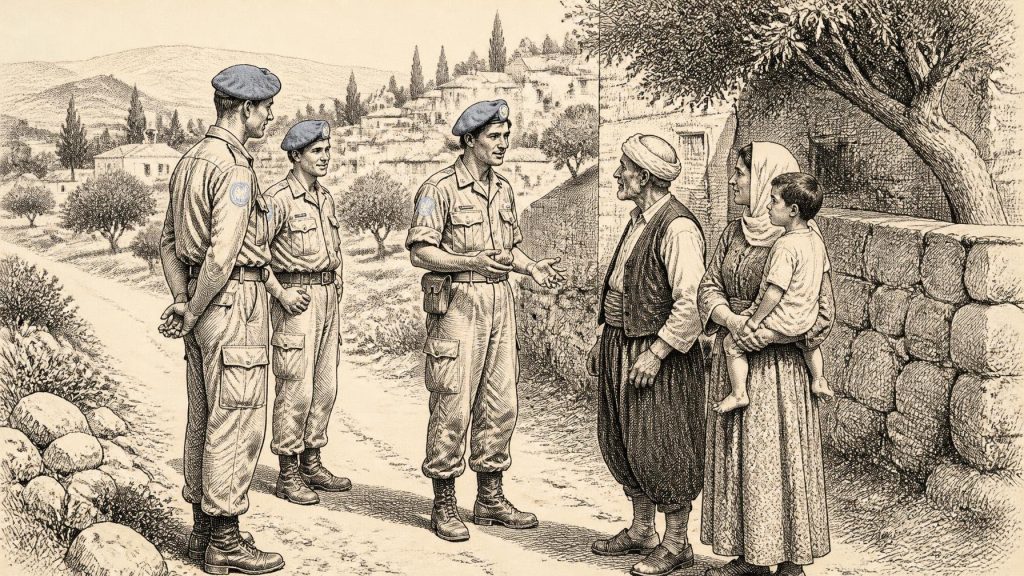
The year’s clearest firmly dated national decision came from the Cyprus crisis. Violence and political breakdown between Greek Cypriot and Turkish Cypriot communities had created an international emergency, with Greece, Turkey and Britain all directly involved under the island’s contested constitutional arrangements. On 4 March, the United Nations Security Council adopted Resolution 186, recommending the creation of a peacekeeping force. Ireland, already experienced in United Nations operations in the Congo, was asked to contribute.
The Irish government decided in principle on 6 March to offer a contingent, subject to Dáil approval. Its conditions reveal both the caution and the internationalism of Irish policy. Irish troops were to preserve peace while mediation proceeded, not impose a political settlement. The government also sought assurances against intervention by Britain, Greece or Turkey, especially intervention intended to force partition. On 7 April the Dáil debated and approved the despatch of a battalion. The proposed strength was raised from about 500 to 600 all ranks, and service was voluntary. Many of those who put themselves forward had served in the Congo, an experience that had given the Defence Forces practical knowledge of overseas operations but also a painful awareness of their risks.
The first Irish unit reached Cyprus in April. This was not a ceremonial foreign posting. Soldiers entered a tense, armed environment in which peacekeepers could be distrusted by both communities and where local conflict carried the danger of drawing in outside powers. In the Dáil, government and opposition speakers alike acknowledged that troops were not being sent on an easy Mediterranean assignment. They accepted, however, that membership of the United Nations brought an obligation to make a practical contribution when international peace was threatened.
Cyprus also connected Irish public life to a changing military institution. The Congo operation was ending in May 1964; the new mission immediately sustained the importance of overseas service. It encouraged improvements in pay, equipment and professional standing within the Defence Forces. Irish participation in the United Nations Force in Cyprus would continue until 2005, but that long association began with a decision made amid the immediate uncertainties of spring 1964. It gave neutral Ireland a visible international role without binding it to a military alliance.
Growth, Dependence and Emigration
At home, Lemass’s government was steering the Republic away from the economic protectionism of earlier decades. The policy direction was unmistakably towards exports, foreign investment and industrial growth. But modernisation did not remove older dependencies. An OECD survey published in 1964, using the latest available data, showed that the United Kingdom took 73 per cent of Irish exports in 1962. Live cattle alone accounted for 21 per cent of domestic exports; beef and veal, bacon and beer were also important. Agriculture still provided 23 per cent of gross domestic product and employed a very large share of the workforce.
Those figures help explain the concern generated late in 1964 when the new British Labour government imposed a temporary import charge. Ireland’s commercial relationship with Britain was unusually exposed, and the measure threatened significant Irish sales, including beer exports. Guinness pressed the Irish government to seek a way around the charge, even proposing that beer be treated as food for customs purposes. The episode was comic in one respect, but its underlying point was serious: Irish prosperity could be affected abruptly by decisions in London.
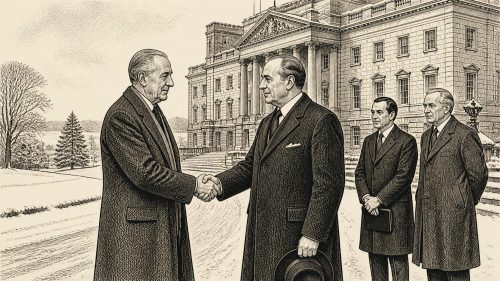
Lemass travelled to London in November for talks with Harold Wilson. The dispute did not create a diplomatic rupture, but it illustrated the limits of a development strategy dependent on access to Britain at a time when Ireland’s hoped-for entry to the European Economic Community remained blocked after the collapse of the first enlargement negotiations in 1963. The Republic was opening economically, but its route into Europe was neither direct nor secure.
For many households, the benefits of growth were real but incomplete. The OECD recorded average annual emigration of about 33,000 people between 1960 and 1962, equivalent to twelve people per thousand of population. Employment was increasingly diversified between industry, construction and services, yet agriculture, forestry and fishing still employed 368,000 people in April 1962. The figures describe a society in transition: more cars, telephones, factories and consumer goods than in the 1950s, but also continuing departures from farms, villages and small towns.
Government in Incremental Motion
The legislation of 1964 conveys the practical, piecemeal character of change. Forty public Acts were passed by the Oireachtas. They ranged across firearms, courts, patents, fisheries, transport, agriculture, housing in the Gaeltacht, industrial grants and local sanitary services. Rather than one great constitutional settlement, the year produced a busy programme of administrative and social adjustment.
Several measures concerned family life and welfare. The Adoption Act, passed on 5 February, amended and extended the 1952 adoption legislation. Among other matters, it enabled the adoption of certain legitimated children, altered time limits in particular cases and provided for interim orders. The Guardianship of Infants Act and the Social Welfare (Miscellaneous Provisions) Act likewise show the state engaging with domestic responsibility and support, although the assumptions of the period remained far from later ideas of equality, privacy and children’s rights.
Other Acts reflected the institutional machinery required by economic development. The Central Bank Act, a Broadcasting Authority amendment, the Control of Imports amendment and an Industrial Grants amendment belonged to a state seeking more effective financial, commercial and communications structures. The continuation of support for the Gaeltacht and measures concerning agriculture and fisheries also underline that the modernising programme had to operate across regions whose resources, language and employment patterns differed sharply from Dublin’s.
Divis Street and the Border
The most consequential disturbance on the island occurred not in the Republic but in Belfast. During the British general-election campaign, Billy McMillen’s Republican Party headquarters at the foot of the Falls Road displayed an Irish tricolour. Under Northern Ireland’s Flags and Emblems legislation, the authorities possessed wide powers to control displays considered likely to provoke a breach of the peace. In a strongly nationalist district, the flag’s display was an assertion of Irish identity; for hard-line unionists it became a target.
Ian Paisley threatened to remove the flag himself unless the Royal Ulster Constabulary acted. The confrontation developed across late September and early October. Rioting began on 28 September, and the RUC’s removal of the tricolour from the Divis Street office on 1 October was followed by the most serious Belfast disorder since the 1930s. Crowds confronted police, traffic was disrupted and the event became a prominent demonstration of nationalist anger at both the law and its enforcement.
The importance of the episode lay not in the cloth of a single flag but in what official action made it signify. A symbol that was routine and constitutional in the Republic could be treated as prohibited or provocative in Northern Ireland. Paisley emerged with greater public prominence as a militant Protestant leader, while a young Gerry Adams was among those present on the nationalist side. It would be misleading to describe 1964 as the start of the later Troubles: the sustained conflict of the late 1960s had not yet begun. Nevertheless, the Divis Street disturbances exposed grievances over policing, political representation and communal equality which the civil-rights movement would soon articulate more openly.
Stages, Novels and Departure
Irish cultural life in 1964 registered both continuity and departure. Seán O’Casey died at Torquay on 18 September, aged eighty-four. Although he had lived outside Ireland for much of his later life and had quarrelled fiercely with its cultural authorities, his Dublin plays remained central to modern Irish theatre. The Abbey Theatre closed in mourning after his death, an acknowledgement of the enduring force of a dramatist who had put working-class Dublin, revolution and civil conflict on the stage.
In the same year Brian Friel’s Philadelphia, Here I Come! appeared, becoming his breakthrough play. Its Donegal protagonist, Gar O’Donnell, prepares to leave for America, and the drama’s divided presentation of his public and private selves gave theatrical shape to the emotional cost of emigration. It was a contemporary story, but one rooted in a pattern familiar to thousands of Irish families.
Flann O’Brien also published The Dalkey Archive in 1964. Its comic, irreverent Dublin-and-Dalkey world, crowded with theological speculation and literary mischief, offered a very different response to Irish life. Together, Friel and O’Brien showed that a society often described through economics, religion and migration could also be examined through irony, fantasy and intimate family tension.
Thus 1964 joined distant Cyprus, Dublin policy-making and Belfast streets in a single Irish year. The Republic projected itself abroad through United Nations service while attempting to remodel its economy at home. Northern Ireland’s flag conflict showed how fragile relations remained on the island. In theatre and fiction, meanwhile, writers turned departure, memory and contested identity into lasting art.
Primary Sources
- Despatch of Army Contingent to Cyprus: Motion of Approval
- Defence Forces History
- UNFICYP Marks 60 Years in the Service of Peace
- Security Council Resolution 186 (1964) of 4 March 1964
- OECD Economic Surveys: Ireland 1964
- The Year Guinness Wanted to Reclassify Beer as a Foodstuff
- Chronological Table of the Statutes: 1964
- Adoption Act, 1964
- Guardianship of Infants Act, 1964
- Central Bank Act, 1964
- Broadcasting Authority (Amendment) Act, 1964
- Social Welfare (Miscellaneous Provisions) Act, 1964
- Housing (Gaeltacht) (Amendment) Act, 1964
- Industrial Grants (Amendment) Act, 1964
- Flags: Towards a New Understanding
- Holy War in Belfast
- Belfast Tricolour Removed
- The Plays: Philadelphia, Here I Come! (1964)
- Brian Friel Papers
- O'Casey, Sean
- Sean O'Casey Dies at Home in Torquay
- The Dalkey Archive
- Reports of the 1961 Census