Stormont’s January Handshake1965 CE
In 1965, Ireland cautiously embraced modernisation while enduring emigration, rural decline and cultural conservatism. Taoiseach Seán Lemass’s unprecedented Stormont meeting with Terence O’Neill opened limited North–South co-operation, followed by O’Neill’s Dublin visit. Casement’s repatriation symbolised improving Anglo-Irish relations. Fianna Fáil retained power in a television-covered election, while the Anglo-Irish Free Trade Area Agreement signalled departure from protectionism despite fears over employment. Legal reforms addressed land and inheritance; vernacular Mass and Galway Cathedral reflected changing Catholic life. Eurovision, the Young Scientist Exhibition and literary events demonstrated wider connections, although a newspaper strike and GAA restrictions exposed persistent constraints within Irish society.
Dateline
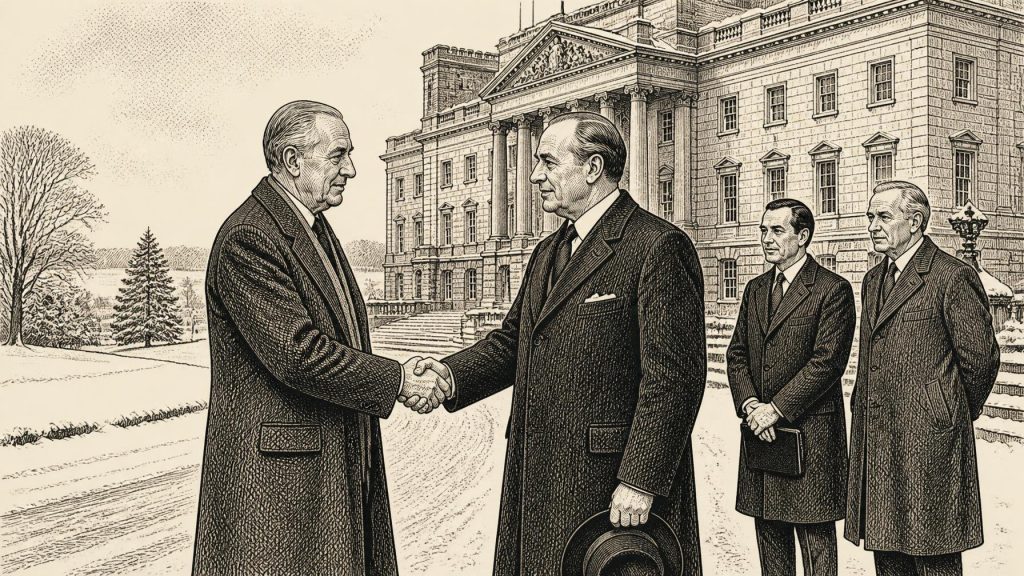
In 1965, the Republic of Ireland stood between two versions of itself. One was still marked by emigration, small farms, high unemployment and strong habits of deference. The other was being deliberately made: more industrial, more outward-looking, and increasingly shaped by television, technical education and international commerce. The year’s most striking image was a political one. On 14 January, Seán Lemass, Taoiseach since 1959, crossed the border to Stormont for official talks with Terence O’Neill, Prime Minister of Northern Ireland. It was an encounter without precedent in independent Ireland’s history, and it briefly made practical co-operation seem possible across a border long treated as an ideological frontier.
A Deliberate Northern Opening
The Lemass–O’Neill meeting was carefully prepared in secret by officials including T. K. Whitaker, the influential secretary of the Department of Finance. It did not settle the constitutional question of partition, nor did it produce a dramatic agreement. Its importance lay in the decision to meet at all. Lemass had concluded that repeated declarations against partition did little to improve the lives of people on either side of the border. O’Neill, meanwhile, sought economic modernisation and a less confrontational public style within Northern Ireland. Their discussions turned towards matters where cooperation might be useful, including trade, tourism and electricity.
O’Neill returned the gesture on 9 February, travelling to Dublin with his wife for talks and lunch at Iveagh House, the Department of External Affairs. The visit was announced only after it was under way, an indication of how politically sensitive it was. Lemass, Frank Aiken and Jack Lynch represented the Dublin government; the choreography was formal but deliberately cordial. These meetings did not alter Northern Ireland’s constitutional position or remove the inequalities faced by its nationalist minority. They did, however, establish official contact between the two administrations and encouraged further ministerial and official discussions. The cautious thaw mattered precisely because it was modest: it accepted the existence of separate governments while seeking limited common ground.
Relations with Britain also acquired a quieter but significant symbolic dimension. Roger Casement’s remains were repatriated from Pentonville Prison and given a State funeral in Dublin on 1 March. Casement, executed for treason in 1916 after involvement with German efforts to arm Irish separatists, had been buried in the prison grounds for almost half a century. President Éamon de Valera spoke at his reinterment in the republican plot at Glasnevin Cemetery. The return was a product of prolonged negotiation with the British government and of the approaching centenary of Casement’s birth. It joined commemoration, republican memory and improving Anglo-Irish relations in one highly public ceremony.
An Election on Television
Domestic politics were tested in the general election of 7 April. Fianna Fáil, led by Lemass, remained in office, while Fine Gael’s disappointing result prompted the resignation of its leader, James Dillon; Liam Cosgrave succeeded him. The election was also a landmark in political communication. Telefís Éireann, established only in 1961, provided the State’s first television general-election coverage from its Donnybrook studios. Counts, candidates and commentators now entered homes through a medium whose authority and immediacy were rapidly changing public life. Radio adapted as well, suspending ordinary programmes to follow the count as it unfolded.
The campaign occurred amid genuine confidence in planned development, but that confidence was qualified. Lemass’s government promoted economic expansion, industrial investment and a European orientation. Yet employment had not risen fast enough to match the loss of labour from agriculture, and emigration remained embedded in family and community life. Central Statistics Office estimates record net outward migration of about 20,000 in 1965. For many younger people, particularly from rural districts, the prospect of work in Britain remained a practical alternative to waiting for new opportunities at home.
Opening the Economy, Unevenly
The central economic development came at the end of the year. On 14 December, the governments of Ireland and the United Kingdom signed the Anglo-Irish Free Trade Area Agreement. It committed both states to the progressive removal of tariffs on industrial goods, while providing separate arrangements for agriculture. The agreement followed the failure of Ireland’s earlier hopes of entering the European Economic Community alongside Britain. It was therefore both a practical response to Ireland’s dependence on the British market and a declaration that protectionism could no longer be the principal framework for Irish industrial policy.
Its promise was accompanied by anxiety. Irish manufacturers had developed behind tariff walls and feared competition from larger British firms; supporters argued that protected industry would not become efficient without access to a wider market. Parliamentary debate in the following weeks showed that employment, regional survival and emigration were at the centre of the argument, not merely customs duties. The agreement was thus a major wager on the capacity of Irish industry to adapt. It did not erase the pressures already evident in 1965: economic growth had slowed, job creation was inadequate, and the targets of the Second Programme for Economic Expansion looked increasingly difficult to attain.
The Oireachtas also enacted measures revealing the practical concerns of a changing society. The Land Act of 1965 continued the long and complex work of land administration, including provisions affecting agricultural holdings and the Land Commission. The Succession Act, passed on 22 December, comprehensively reformed the law governing property on death. It removed distinctions between male and female inheritance in intestacy and gave the surviving spouse a defined position in an estate. It did not commence until 1 January 1967, so its immediate importance in 1965 was legislative rather than operative; nevertheless, its passage was a substantial alteration in the legal assumptions surrounding family property.
Faith in a Changing Public World
Religious life remained central to the Republic’s social fabric, but it too registered change. On 7 March, Catholics throughout Ireland used vernacular responses in the Mass for the first time, under the early liturgical reforms associated with the Second Vatican Council. Latin had not disappeared, and the full transformation of the Roman rite still lay ahead; nevertheless, the change made congregational participation more audible and altered the experience of worship in parish churches. It was a small but tangible sign that even an institution of immense authority in Irish life was entering an era of adjustment.
On 15 August, Galway Cathedral was dedicated to Our Lady Assumed into Heaven and St Nicholas. The ceremony brought together Cardinal Richard Cushing of Boston, Cardinal William Conway of Armagh, President de Valera and large local congregations. Built at a cost of more than £600,000, the vast new building was a conspicuous expression of Catholic confidence, local ambition and the enduring importance of the diaspora link with the United States. Its dedication, only months after the introduction of English responses at Mass, captured both continuity and transition within Irish Catholicism.
Culture, Science and Everyday Connections
The year also revealed a society becoming more connected to wider cultural circuits. Ireland made its Eurovision Song Contest debut in Naples on 20 March. Butch Moore, singer with the Capitol Showband, performed Walking the Streets in the Rain and finished sixth. The result was less important than the participation: a national broadcaster was now placing Irish popular music before a large European audience.
In January, the first Young Scientist Exhibition opened in the Round Room of Dublin’s Mansion House. Organised with Aer Lingus support, it attracted 230 entries; John Monaghan of Kildare won the first Young Scientist of the Year award. Lemass’s presence at the opening fitted the government’s belief that scientific and technical education were essential to economic development. The exhibition was modest in scale, but it gave school pupils and their teachers a new public arena for experiment, observation and invention.
Commemoration and literary culture were equally visible. On 13 June, crowds gathered at Drumcliff, County Sligo, to mark the centenary of W. B. Yeats’s birth. The occasion placed Yeats’s grave, poetry and complicated public legacy at the centre of a national cultural ceremony. In print, John McGahern’s The Dark appeared, while Dervla Murphy’s Full Tilt: Ireland to India with a Bicycle offered an unusually expansive Irish journey beyond Europe. Such work belonged to a literary culture less easily confined by older nationalist or clerical expectations.
Modern communications also exposed their own fragility. A printing strike closed Dublin newspapers for ten weeks during the summer, affecting 46 printing houses and leaving newsvendors without their normal trade. Some readers turned to British papers, while RTÉ’s radio and television services assumed greater importance as sources of current information. At the same time, the GAA Congress retained its ban on members participating in or attending designated ‘foreign games’, illustrating that cultural protectionism remained powerful even as television, trade and travel widened Irish horizons.
Thus 1965 was not a clean break with the past. Rural contraction, outward migration and inherited cultural boundaries persisted. Yet the Stormont meetings, the free-trade agreement, a televised election, vernacular worship and new scientific and popular-cultural institutions all made the direction of travel clearer. Ireland was beginning to negotiate its place beyond the island while reconsidering, cautiously and unevenly, the habits of life within it.
Primary Sources
- Lemass, Seán | Dictionary of Irish Biography
- O'Neill, Terence Marne | Dictionary of Irish Biography
- T.K. Whitaker Papers
- Northern Premier Goes South 1965 | RTÉ Archives
- The Building of the State
- Documents On Irish Foreign Policy | RTÉ Archives
- Graveside Speech for Roger Casement 1965 | RTÉ Archives
- What happened behind the scenes during Casement's homecoming?
- First General Election For RTÉ Television 1965 | RTÉ Archives
- A New Approach from Radio to Election Coverage 1965 | RTÉ Archives
- Migration Assumptions, Population and Labour Force Projections 2017–2051 | Central Statistics Office
- Census of Population of Ireland, 1966: Volume II, Commentary | Central Statistics Office
- Agreements between the Government of Ireland and the Government of the United Kingdom, 6 January 1966 | Houses of the Oireachtas
- Ireland and the EU: A History
- Ireland, 1949–73—a closet member of the Commonwealth? | History Ireland
- Finance Bill, 1965: Second Stage, 29 July 1965 | Houses of the Oireachtas
- Land Act, 1965 | Irish Statute Book
- Succession Act, 1965 | Irish Statute Book
- Succession Bill, 1965: Second Stage, 25 May 1965 | Houses of the Oireachtas
- Galway Cathedral Blessing 1965 | RTÉ Archives
- ‘Scrupulous and Timid Conformism’: Ireland and the Reception of the Liturgical Changes of Vatican II
- Butch Moore Represents Ireland at Eurovision 1965 | RTÉ Archives
- Young Scientists at the Mansion House 1965 | RTÉ Archives
- History | Young Scientist & Technology Exhibition
- A Memorial Sermon Preached at Drumcliffe on the Occasion of the Centenary of the Birth of William Butler Yeats | National Library of Ireland
- Dubliners Are Desperate For Newspapers 1965 | RTÉ Archives
- Evening Press | National Library of Ireland Catalogue
- ‘Home Rule in athletics’: Ray Burke on the GAA’s ‘ban on foreign games’ | The Irish Times