Whiddy, Warrenpoint and Phoenix Park1979 CE
In 1979, Ireland confronted industrial disaster, political change, social reform, European integration and Troubles violence. The Betelgeuse explosion at Whiddy Island killed fifty people, exposing risks associated with oil trade. Ireland joined the European Monetary System, elected its first directly elected MEPs and hosted the European Council. Jack Lynch resigned, succeeded by Charles Haughey, whose cabinet included Máire Geoghegan-Quinn. Legislation established Údarás na Gaeltachta and cautiously legalised family planning. IRA attacks killed Lord Mountbatten and eighteen soldiers at Warrenpoint. Pope John Paul II’s visit, altered by security concerns, included an appeal for peace, encapsulating a modernising, divided and unsettled Ireland.
Dateline
In 1979, Ireland experienced a sequence of events that placed very different versions of the island before the public: a modern trading state tied more closely to continental Europe; a society still deeply marked by Catholic authority; and an island divided by a conflict capable of killing across borders. Industrial catastrophe, political transition, unprecedented religious pageantry and the violence of the Troubles made this an unusually intense year. It was not a simple turning point, but it exposed tensions that would shape the difficult decade ahead.
Fire in Bantry Bay
The year began with a disaster on the south-west coast. Shortly before 1 a.m. on 8 January, the French tanker Betelgeuse exploded while discharging crude oil at the Gulf Oil terminal off Whiddy Island in Bantry Bay. The vessel broke apart and burned; emergency crews faced an immense fire at the offshore jetty, while families living on the island were evacuated. Fifty people died in the explosion and its immediate aftermath, among them French, Irish and British workers; a Dutch diver later died during the salvage operation.
Whiddy was an industrial catastrophe with local, national and international dimensions. Bantry Bay had been chosen for an oil terminal because its deep water could accommodate very large tankers, connecting a small island community to the circulation of Middle Eastern oil and European energy markets. The destruction of the Betelgeuse therefore brought the hazards of that trade dramatically into Irish view. For residents, the fire, smoke and recovery operation transformed familiar coastal waters into a scene of loss and prolonged disruption. Nationally, it raised urgent questions about industrial safety, marine regulation and the risks borne by communities beside strategically important installations.
Europe, Currency and Representation
Economic circumstances gave those questions added weight. The renewed international oil shock of 1979 threatened higher prices and uncertainty in a state already vulnerable to imported fuel costs. Yet the Republic was also taking a conspicuous step away from its older economic dependence on Britain. In March, Ireland joined the new European Monetary System. The Irish pound consequently ceased to be maintained at parity with sterling, ending a monetary link that had endured since the foundation of the state. The change did not make Ireland economically independent of Britain overnight: the United Kingdom remained a crucial neighbour and trading partner. It did, however, place Irish exchange-rate policy in a European framework and made the state’s participation in the European Communities more concrete in everyday commercial life.
That European orientation was also democratic. On 7 June, voters in the Republic elected fifteen representatives in the first direct elections to the European Parliament. The contest was held alongside local elections, bringing European institutions into constituency campaigns and familiar systems of preference voting. Fianna Fáil won five of the fifteen seats, while the result included a striking independent victory for Neil Blaney in Connacht–Ulster. The election was a setback for Taoiseach Jack Lynch’s party after its commanding 1977 general-election victory, and it sharpened dissatisfaction within Fianna Fáil.
Dublin’s European role was visible again on 29 and 30 November, when the European Council met in the city during Ireland’s presidency of the Communities. Heads of government gathered at Dublin Castle at a time when questions of Community finance, agricultural policy, monetary co-operation and Britain’s contribution to the European budget were contentious. Ireland was still a relatively poor member state, but the summit demonstrated that Dublin was no longer merely responding to decisions made elsewhere. It could host, chair and influence discussions among the nine member states.
Government Changes Course
The final weeks of the year brought a change at the centre of Irish politics. Lynch announced on 5 December that he would resign as leader of Fianna Fáil and Taoiseach. Charles J. Haughey defeated Tánaiste George Colley in the subsequent party leadership contest and became Taoiseach on 11 December. Fianna Fáil remained in office without a general election, owing to its Dáil majority, but the transition ended Lynch’s long leadership and opened a more combative phase in the party’s history.
Haughey’s new cabinet also marked a notable, if limited, advance in women’s representation. On 12 December, Máire Geoghegan-Quinn became Minister for the Gaeltacht, the first woman appointed to an Irish cabinet since Constance Markievicz’s revolutionary-era ministry. Her portfolio linked the change in political representation to an enduring regional concern: the viability of Irish-speaking districts, many of which faced restricted employment opportunities and continuing emigration.
Earlier in the year, the Údarás na Gaeltachta Act had supplied a new institutional framework for that concern. Dated 19 March, it provided for the dissolution of Gaeltarra Éireann and for the establishment, on a later appointed day, of Údarás na Gaeltachta. The new authority was to combine economic-development functions with a measure of elected representation: seven of its thirteen members were to be elected in Gaeltacht constituencies. The Act did not solve the pressures on Irish-speaking communities, but it recognised that language maintenance, local democracy, employment and settlement could not sensibly be treated as separate issues.
Family Planning and Public Morality
Another major legislative event revealed the distance between social change and the state’s cautious response to it. The Health (Family Planning) Act became law on 23 July. It authorised family-planning services and regulated the sale, importation, manufacture, advertising and display of contraceptives. Its language was deliberately restrictive: contraceptives were to be available only for bona fide family planning or adequate medical reasons, and the domestic sale of contraceptives required a doctor’s prescription.
The legislation was historic, because it accepted in statute that contraception could be legally available. It was also an expression of compromise rather than broad liberalisation. Parliamentary debate showed disagreement not only between parties but within Fianna Fáil, and opponents and advocates alike argued over the place of medicine, marriage, morality and personal privacy. The measure did not take effect immediately; the Act was commenced only in November 1980. In 1979, therefore, its importance lay chiefly in the decision to put this carefully controlled principle on the statute book. It illustrated a society in which Catholic teaching retained great public influence, even as the boundaries of law and private life were being renegotiated.
Violence Across the Border
The Troubles remained the most grievous reminder that Ireland’s political realities could not be confined within the Republic’s institutions. Republican prisoners continued their blanket protest in the Maze prison’s H-Blocks, rejecting prison uniform and seeking restoration of political status. The campaign had not yet entered the hunger-strike phase that would dominate the early 1980s, but the prison issue was already a potent source of mobilisation and a sign of the bitterness created by the withdrawal of special-category status.
On 27 August, the conflict produced one of its most consequential days. At Mullaghmore, County Sligo, an IRA bomb destroyed Lord Louis Mountbatten’s fishing boat, Shadow V. Mountbatten, his grandson Nicholas Knatchbull, Lady Brabourne and the teenage boatman Paul Maxwell were killed. The attack occurred in the Republic, where Mountbatten had regularly spent holidays, and its victims included civilians as well as a figure closely associated with the British royal family and military establishment.
Later that day, near Narrow Water outside Warrenpoint, County Down, the IRA detonated two remote-controlled bombs against a British Army convoy. Six soldiers were killed by the first explosion; twelve more died when the second device exploded as troops moved into the area. Eighteen soldiers were killed in all, the British Army’s greatest single-incident loss of the conflict. Firing from the Northern side of the border also killed a civilian in the Republic. The geography mattered: the attacks and their aftermath demonstrated how violence could cross, exploit and harden an international frontier while leaving neighbouring communities exposed to fear and military response.
A Pilgrimage Recast by Conflict
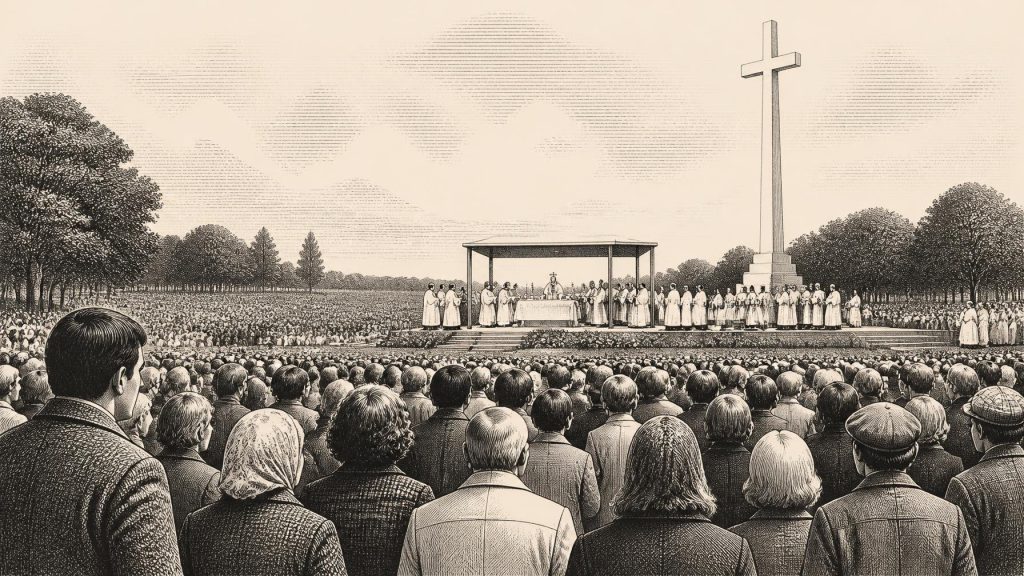
Only a month later, Pope John Paul II made the first papal visit to Ireland. From 29 September to 1 October, the Pope travelled to Dublin, Drogheda, Clonmacnoise, Galway, Knock, Maynooth and Limerick. The visit was a national undertaking on an extraordinary scale. At the Phoenix Park, organisers created an immense open-air setting, complete with the 116-foot Papal Cross, for a congregation of more than one million people. The event required transport planning, security arrangements, temporary services and extensive broadcasting capacity; it was both a religious gathering and an immense feat of public organisation.
The itinerary bore the imprint of August’s violence. Armagh, the primatial city, had originally been intended as a destination. Security concerns after the Mountbatten and Warrenpoint attacks led to its removal from the programme, and Drogheda became the northernmost major stop. There, the Pope issued his best-remembered intervention of the visit, pleading with those involved in violence to renounce its paths. His appeal could not end the conflict, but it gave the pilgrimage a direct political and moral resonance that went beyond ceremonial devotion.
For many Catholics, the crowds at Phoenix Park, Knock and Limerick seemed to affirm an Ireland defined by shared belief and public worship. Yet the same year contained reminders that no single image could encompass the country. The family-planning legislation complicated assumptions about religious and civic authority; the Gaeltacht Act emphasised regional and linguistic diversity; European elections and monetary change tied the Republic to a wider political world; and the Troubles made the island’s division impossible to overlook.
By December, with Haughey in office and Lynch’s era over, 1979 closed without resolving its central strains. The year had brought catastrophe at sea, political violence on land and a papal call for peace, while the state revised its relationship with Europe, reproduction and the Gaeltacht. Its significance lay not in one decisive event, but in the collision of these developments: Ireland was visibly modernising, but its social authority, economic security and constitutional future remained deeply unsettled.
Primary Sources
- RTÉ Archives | Worst Maritime Disaster In Irish History 1979
- Commissioner’s Speech for Official Opening of the Garda Water Unit Facility, November 7, 2025
- Central Statistics Office | Ireland and the EU at 50: Introduction
- EUR-Lex | Towards a Single Currency: A Brief History of EMU
- European Parliament | National Results Ireland, 1979–1984 Constitutive Session
- Dictionary of Irish Biography | Lynch, John Mary (‘Jack’)
- Department of the Taoiseach | Twenty-First Dáil
- Irish Statute Book | Údarás na Gaeltachta Act, 1979
- Department of Rural and Community Development and the Gaeltacht | Údarás na Gaeltachta Legislation
- Irish Statute Book | Health (Family Planning) Act, 1979
- Houses of the Oireachtas | Health (Family Planning) Bill, 1978: Second Stage, 29 March 1979
- Houses of the Oireachtas | Health (Family Planning) Bill, 1978: Committee Stage, 13 June 1979
- CAIN | Chronology of the Conflict 1979
- CAIN | Sutton Index of Deaths: 1979
- CAIN | Posters: Examples of Hunger Strike and Prisoners Campaign Posters
- The Holy See | Mass in Drogheda, 29 September 1979
- Irish Catholic Bishops’ Conference | September 1979: Pope John Paul II Pilgrimage to Ireland
- Office of Public Works | New Exhibition Chronicling the Visit of Pope John Paul II to the Phoenix Park in 1979
- RTÉ Archives | Itinerary For The Pope’s Visit
- OECD | OECD Economic Surveys: Ireland 1979
- Council of the European Union | European Council Conclusions, 1975–1992
- Council of the European Union | European Council on 29 and 30 November 1979 in Dublin
- Irish Statute Book | Acts of the Oireachtas Enacted in 1979