Kildare’s 280 Captives886 CE
In 886, Irish annals record political violence, raiding and destruction across several regions. In Ulaid, Éiremón son of Áed, one of two kings, was killed by Eolóir, probably a Scandinavian-connected leader; Fiachna son of Ainfíth subsequently died at the hands of his own associates. At Kildare, heathen raiders plundered the church settlement, taking 280 people, including vice-abbot Suibne, and its wealth to ships. The captives included the ecclesiastical community, not only clergy. Dún Tidill in Ara was also destroyed. These fragmentary records reveal divided kingship, maritime networks, ecclesiastical vulnerability and the limits of annalistic evidence amid farming, worship and learning.
Dateline
For Ireland in 886, the surviving record is stark: a killing in Ulaid, another killing among the Ulaid themselves, and the plundering of Kildare, from which 280 people were carried to ships along with the community’s wealth. These are not simply disconnected notices. Together, they show how political rivalry, seaborne violence and ecclesiastical power met in the later ninth century. They also demand care. Irish annals preserve events under differing year numbers, and later compilations do not always align with modern calendar dating. The events considered here can nevertheless be connected responsibly with 886 through the concordance of the principal chronicles.
A Violent Change in Ulaid
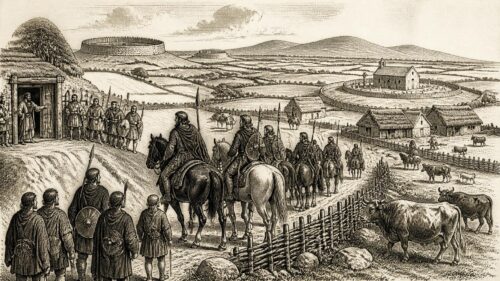
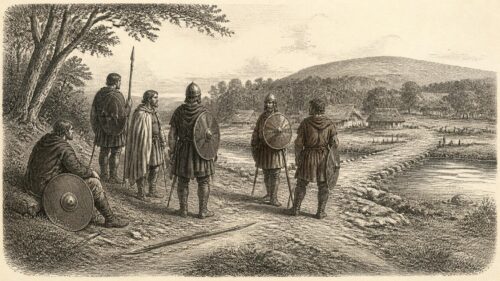
The first crisis lay in Ulaid, the eastern Ulster overkingdom centred broadly on modern County Down and adjoining districts. The Annals of Ulster and Chronicon Scotorum record that Éiremón son of Áed, described as one of the two kings of Ulaid, was killed by Eolóir son of Iergne. The wording matters. Ulaid was not a unitary state with an automatic succession: authority could be divided between rival branches, and the annalists’ phrase “one of two kings” preserves that political reality. Kingship was exercised through kin-groups, clientship, tribute, ecclesiastical alliances and military followings, rather than through an impersonal administration.
The identity of Eolóir also places the killing within a wider Irish Sea world. A later annalistic version explicitly identifies him as a Norseman, while the name of his father, Iergne or Iargni, belongs to a Scandinavian-associated family visible in Irish records. Modern scholarship therefore treats the episode as strong evidence of Scandinavian participation in an Irish dynastic conflict. That does not mean that “the Vikings” acted as a single invading force. Eolóir’s intervention appears instead as the action of a leader and followers able to operate within local rivalries, perhaps as allies, hired fighters or independent political actors pursuing advantage on the northern coast.
Éiremón’s death did not restore order. In the same year, Fiachna son of Ainfíth, king of Ulaid, was killed “by his associates” or “by his own people”. The brief notice leaves the immediate cause unstated. It would be irresponsible to invent a battle, a place or a conspiracy. Yet the sequence of killings is revealing in itself. Within a short period, a co-ruler was killed by a Scandinavian-connected adversary and another king died at the hands of men from his own political world. Such deaths exposed the fragility of a dynasty’s control over armed retainers and subordinate rulers.
The Annals of Inisfallen, compiled from a different regional tradition, records the death of “Uromun son of Áed, king of Ulaid” in its entry for 886. The name does not match Éiremón neatly, but the coincidence of father, kingship and year suggests that it may preserve a variant or corrupt form of the same northern upheaval. The discrepancy is a useful warning: annals are precious witnesses, not neutral transcripts taken at the scene. They were copied, rearranged and continued over centuries. Where independent records agree on the violence in Ulaid, confidence is greater; where their wording differs, the uncertainty should remain visible.
The Plundering of Cell Dara
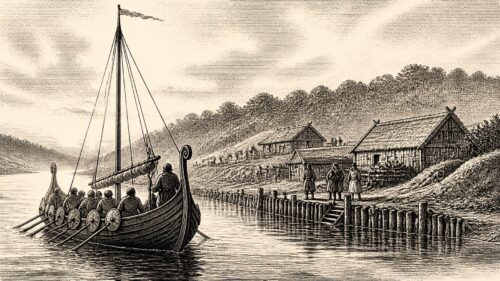
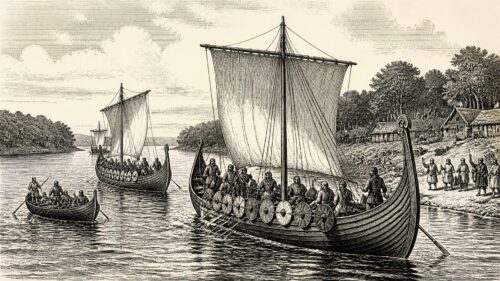
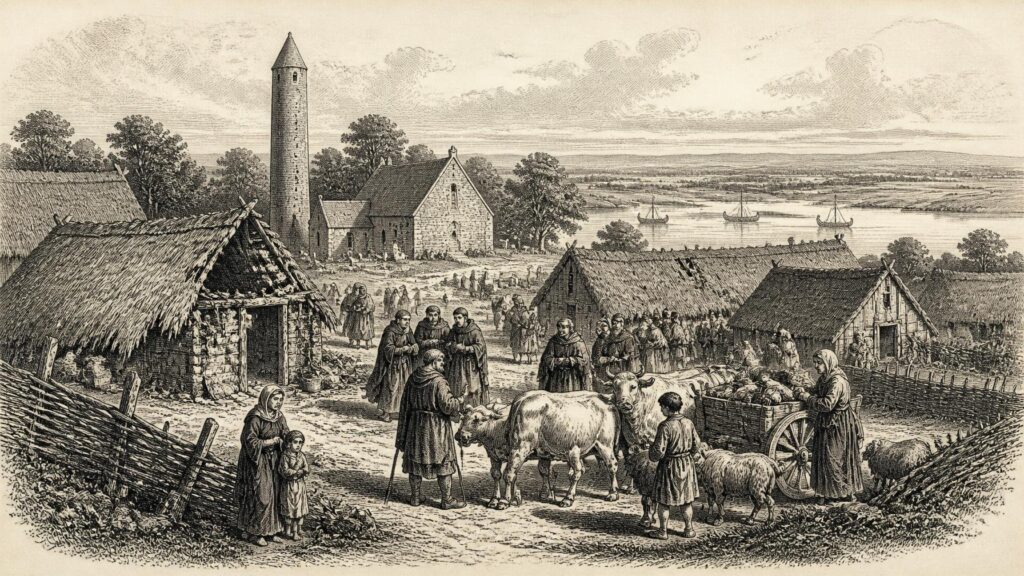
The year’s most vivid entry concerns Cell Dara, Kildare. Chronicon Scotorum says that “heathens” plundered the settlement and carried away fourteen score people, including Suibne son of Dub dá Boireann, identified as its vice-abbot. Fourteen score is 280. The Annals of the Four Masters, drawing on earlier annalistic material, adds that those seized were taken as booty to the raiders’ ships, together with other valuables. A much later rendering in the Annals of Clonmacnoise calls Suibne the old abbot, but the nearer chronicle’s more precise office of vice-abbot should be preferred.
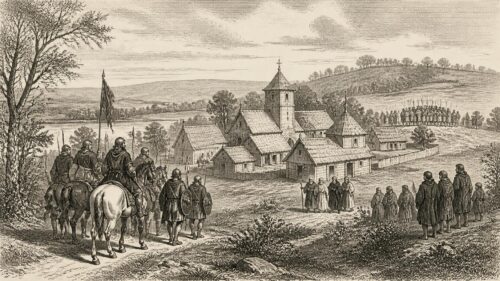
This was not a raid on an isolated church. Kildare was among the foremost ecclesiastical centres in Ireland, associated with Brigit and embedded in Leinster’s political landscape. Early medieval monasteries were communities of clergy, religious women, students, tenants, craftworkers, labourers and dependants, surrounded by lay settlement. Their churches, workshops, storehouses, fields and guest facilities concentrated movable wealth and people in one place. A raid could therefore yield metalwork, foodstuffs, livestock, textiles, books or vessels, as well as captives. The annals’ insistence on both people and valuables conveys the scale of loss more clearly than a generic statement that the site was “attacked”.
The 280 captives should not be imagined as 280 monks. The Latin and Irish terminology is broad enough to include members of the wider ecclesiastical household and settlement. Nor does the entry tell us where they were taken, whether all survived the voyage, or whether some were ransomed. It does show that the raiders had ships capable of receiving a large human haul and that captivity was central, not incidental, to the operation. Across the Viking Age Irish Sea, people could be seized, exchanged, ransomed or sold; but the fate of this particular group cannot be recovered from the sources.
Suibne’s capture carried a further symbolic weight. Senior church officers managed land, income, hospitality, legal relationships and sacred prestige. Removing one was not merely taking an individual hostage: it disrupted an institution’s ability to organise itself and negotiate with patrons. For local families who depended on Kildare’s lands, protection and employment, the raid may have meant lost relatives, disrupted worship, damaged stores and a sudden threat to subsistence. The annalists do not describe grief or rebuilding, but their choice to preserve the number of captives and Suibne’s name indicates that contemporaries judged the raid exceptional enough to remember.
Raiders, Ships and Inland Wealth
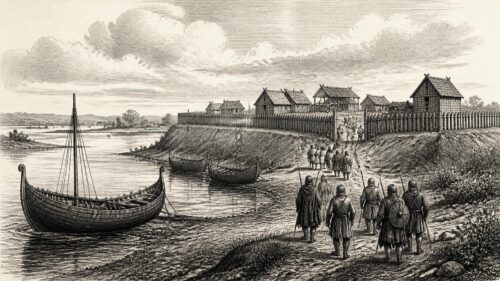
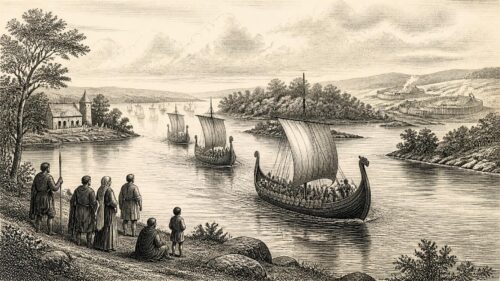
Kildare lay inland, yet the chronicle’s reference to ships is entirely credible. Ireland’s rivers, estuaries and coastal routes connected inland lordships and monasteries to the Irish Sea. Raiders did not need to establish a permanent town beside every target. They could strike from riverine or coastal bases, seize people and portable wealth, and return to vessels by routes known to local guides and allies. By the ninth century, Scandinavian groups in Ireland were not only seasonal raiders: archaeological evidence from Dublin and other sites points to increasingly settled communities, with houses, craft activity, defences and commercial connections.
That context must not flatten all violence into an inevitable Viking advance. Irish rulers also fought one another, plundered churches and used foreign forces in their own contests. The destruction of a community could be an act of warfare, a punitive raid, a bid for tribute or a profitable slave-taking expedition. The Kildare notice names the attackers only as heathens or foreigners. It does not name a commander, a fleet’s home port, a Leinster ally or a battle that preceded the assault. Its restraint is evidence of the limits of our knowledge.
A Destroyed Place in Ara
Munster’s annalistic tradition adds one more securely year-linked notice: the destruction of Dún Tidill in the territory of Ara. Ara lay in the region of the Aran lands around the modern Tipperary–Limerick borderlands, but the precise location and character of Dún Tidill are uncertain. Dún can denote a fort or stronghold, yet the entry gives neither attacker nor cause. It should not be turned into a named Viking raid without evidence. What can be said is narrower and important: destruction also touched an inland Munster locality in 886, reminding us that insecurity was not confined to the coast or to the better-recorded centres of the east.
The notice has a further value. It illustrates the unevenness of survival. Kildare’s raid receives a number, a named ecclesiastic and reference to ships; Dún Tidill receives only a terse statement of destruction. This difference need not measure the human severity of the two events. It measures what the annalistic networks chose, or were able, to transmit.
Life Beyond the Annals
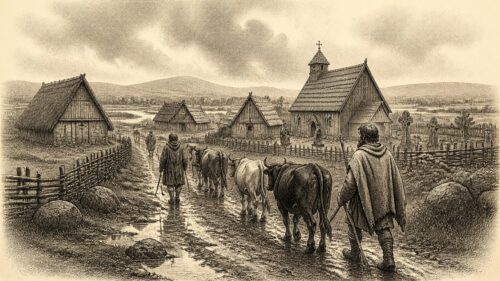
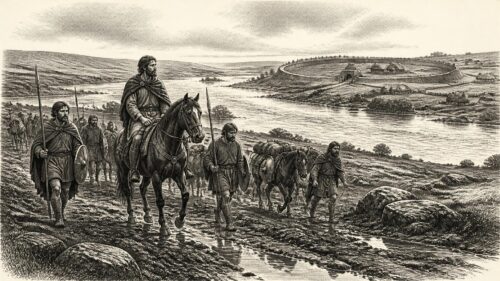
Most people in 886 did not appear in any chronicle. They lived in dispersed farmsteads and enclosed settlements, tending cattle, cultivating cereals, maintaining fences and managing household production. Archaeological synthesis suggests that mixed farming was increasingly important in the ninth century, with tillage taking a larger place alongside livestock. Watermills, cereal-drying kilns and storage practices supported the processing of grain. Such routines underpinned every kingdom and monastery: armies required food, churches required rents and hospitality, and raiders sought stores as well as prestige goods.
Religion and learning likewise continued despite violence. Kildare was part of a network of major churches that held land, attracted patrons and educated clergy. By the ninth century, substantial manuscript production was probably concentrated in leading centres such as Kildare, Armagh and Clonmacnoise because copying books required skilled labour, vellum, pigments and access to exemplars. Stone high crosses and other monuments expressed both devotion and political authority. None can be dated specifically to 886, but they describe the institutional world damaged at Kildare and defended by rulers who saw churches as sources of legitimacy.
A Year of Exposure
886 was not a year in which Ireland became suddenly unstable. Rather, its entries expose the mechanisms of instability already operating across the island. In Ulaid, divided kingship and Scandinavian-connected intervention ended in rapid political killing. At Kildare, a great church settlement proved vulnerable to a raid that removed people, leadership and wealth. In Ara, a place known only by name was destroyed. Behind these exceptional entries lay ordinary farming, trade, worship and learning, but also the constant necessity of protecting kin, cattle, stores and status.
The annals do not give a complete national narrative, and Ireland had no single government capable of recording every loss. Their fragments are enough, however, to show an island linked by rivers and sea-lanes, divided among competing rulers, and deeply shaped by the power of its churches. Kildare’s 280 captives make that reality painfully concrete.
Primary Sources
- The Annals of Ulster, U886
- The Annals of Ulster, U887
- Chronicon Scotorum, CS885–CS889
- Chronicon Scotorum: Introduction
- Annals of Inisfallen, AI880–AI889
- Annals of Inisfallen
- Annals of the Four Masters, M877–M886
- Annals of the Four Masters
- Vikings in Irish Chronicles, 794–902: Data
- The Vikings in Ninth-Century Ireland: Sources and Settlements
- Flann Sinna
- Early Medieval Dwellings and Settlements in Ireland, AD400–1100, Vol. 1: Text
- Early Medieval Ireland: Archaeological Excavations, 1930–2009
- The Economy of Early Medieval Ireland
- High Crosses
- Irish School of Illumination
- Brigit: The Goddess and The Saint
- Fragmentary Annals of Ireland
- Fragmentary Annals of Ireland, FA401–FA404
- Annals of Inisfallen to Go on Public Display in University College Cork