The Fifty-Three-Day Fast1980 CE
Ireland in 1980 faced inflation, unemployment, heavy borrowing and industrial closures, while Haughey’s government pursued fiscal restraint and national wage agreements. Northern Ireland remained politically deadlocked and violent, as constitutional proposals failed to reconcile unionist and nationalist demands. The central event was the fifty-three-day Maze hunger strike, begun by republican prisoners seeking recognition through five prison demands. It ended without deaths or settlement, leaving conflict unresolved. Dublin and London maintained dialogue through Haughey-Thatcher meetings and the Dublin Castle summit. Restrictive family-planning provisions commenced, and NIHE Dublin opened. Strumpet City, Johnny Logan’s Eurovision victory, and Gaelic games successes provided cultural landmarks.
Dateline
In 1980, Ireland entered a decade of strain without yet knowing how deep the strain would become. The Republic faced slowing growth, high inflation, rising unemployment and an alarming public borrowing requirement. Northern Ireland remained caught between constitutional deadlock, paramilitary violence and the coercive realities of prison protest. Yet the year was not defined only by crisis. A restrictive family-planning law finally came into operation; new higher-education provision opened in Dublin; Irish television turned to a grand dramatisation of labour history; and sport and popular music supplied occasions for collective celebration. The most consequential events, however, unfolded in the H-Blocks of Maze Prison, where a hunger strike lasting fifty-three days exposed the dangerous distance between British policy, republican prisoners, Irish public feeling and constitutional politics.
A Republic Under Economic Pressure
Charles J. Haughey, Taoiseach since December 1979, governed a Fianna Fáil administration confronting a difficult inheritance and a worsening international climate. The second oil-price shock, weak external demand and domestic fiscal imbalances bore heavily on an open economy dependent on imports and export markets. The OECD’s contemporary assessment found that real economic growth was sluggish in 1980, employment growth had slowed, unemployment was increasing and inflation had accelerated. Although the current-account deficit improved from its 1979 level, it remained substantial. The Exchequer borrowing requirement was still around 13 per cent of gross domestic product, an ominous measure of the gap between public spending and revenue.
Haughey sought to frame restraint as a national necessity. Shortly before the budget of 28 February, he told the public that Ireland was living beyond its means. Finance Minister Michael O’Kennedy’s budget brought conspicuous indirect-tax increases, including dearer petrol and sharply higher duties on soft drinks. Such measures were felt not in abstract fiscal tables but in household shopping, travel and small daily purchases. The political language of recovery sat uneasily beside the immediate experience of higher prices and insecurity about work.
Government, employers and trade unions nevertheless continued to pursue a negotiated approach to wages and social policy. The Second National Understanding, running from mid-1980, belonged to the late-1970s model in which pay, taxation, employment and public expenditure were discussed together. Its existence showed that organised labour, business and the state still sought a shared response to economic difficulty. But the framework could not remove the pressures created by falling domestic demand, expensive energy and rising joblessness. In Northern Ireland, industrial decline was particularly visible: announcements during the year of closures at major plants in Derry, Kilroot and Belfast carried the prospect of thousands of lost jobs.
Deadlock and Danger in the North
Northern Ireland’s political institutions remained unresolved. The British government’s constitutional conference at Stormont, involving the principal parties willing to attend, had adjourned in March after thirty-four half-day sessions. In July, the Northern Ireland Office published The Government of Northern Ireland: Proposals for Further Discussion. Its stated aim was to explore renewed devolution while protecting both communities and retaining Westminster responsibility for security, finance and other central matters. It presented alternatives rather than a settlement. Unionists rejected arrangements involving compulsory power-sharing, while nationalists and non-unionists could not accept a return to unqualified majority rule. By late November, Secretary of State Humphrey Atkins acknowledged that consensus and a devolved administration were remote.
Constitutional discussion took place amid continuing violence. On 5 May, the IRA bombed the north–south electricity interconnector at Crossmaglen, disrupting an infrastructure link that both governments had been trying to restore. In June, loyalists killed John Turnly, chairman of the Irish Independence Party, and murdered Miriam Daly, a prominent figure in the National H-Block/Armagh Committee. In October, the Ulster Freedom Fighters killed Ronnie Bunting and Noel Lyttle in Belfast. These were not isolated entries in a chronology: they indicated how political affiliation, activism and ordinary residence could bring lethal risk. The violence around the anniversary of internment in August, during which people were killed and injured, further demonstrated the capacity of commemorative dates to reignite confrontation.
The H-Blocks Hunger Strike
The year’s central drama grew from the prison conflict over special category status. The British government had ended automatic entitlement to the status from 1976 for people convicted of scheduled offences after that date. Republican prisoners who rejected prison uniforms and prison work had developed the blanket protest, later accompanied by the no-wash protest. In March 1980, the authorities announced that the remaining special-category privileges would end from 1 April, sharpening an issue already freighted with competing claims. Republican prisoners regarded themselves as politically motivated combatants; the British government insisted that convicted paramilitaries were prisoners under ordinary criminal law.
On 27 October, seven prisoners began a hunger strike in Maze Prison: Brendan Hughes, Raymond McCartney, Tommy McKearney, Tom McFeely, Leo Green, Seán McKenna and John Nixon. Hughes, a leading Provisional IRA prisoner, led the group; Nixon represented the Irish National Liberation Army. Their demands were commonly expressed as five points: the right not to wear prison uniform or do prison work; free association and the organisation of educational and recreational activity; one visit, letter and parcel each week; and restoration of remission lost during the protest. The dispute therefore concerned daily life in prison as well as the larger, irreconcilable question of political status.
The British position was firmly stated. Ministers declined to recognise political status, while maintaining that prisoners were medically monitored and that no forced feeding would occur. The European Commission of Human Rights had rejected a case connected with the blanket protest in June, finding the prisoners’ conditions self-inflicted, though it also criticised official inflexibility. Neither legal argument nor official presentation ended the political and moral force of the fast. The issue resonated far beyond the prison: in nationalist communities, in republican organising, in Catholic institutions and in the Republic, where it posed a severe test for Dublin’s relationship with London.
The protest widened in December. On 1 December, Mairéad Farrell, Mairéad Nugent and Mary Doyle joined in Armagh Prison. On 15 December, twenty-three further republican prisoners entered the strike, with more joining the following day. Seán McKenna’s deteriorating health made the prospect of a death acute. Cardinal Tomás Ó Fiaich, Catholic Primate of All Ireland, appealed publicly on 17 December for the strike to end and urged Margaret Thatcher to intervene. The prisoners ended their fast on 18 December, after fifty-three days, amid expectations that changes in prison conditions might follow. No agreed political-status settlement had been reached. The different understandings of what the British government had offered would soon prove crucial, but that later outcome should not obscure the position at the close of 1980: a grave confrontation had been suspended, not resolved.
Dublin Castle Diplomacy
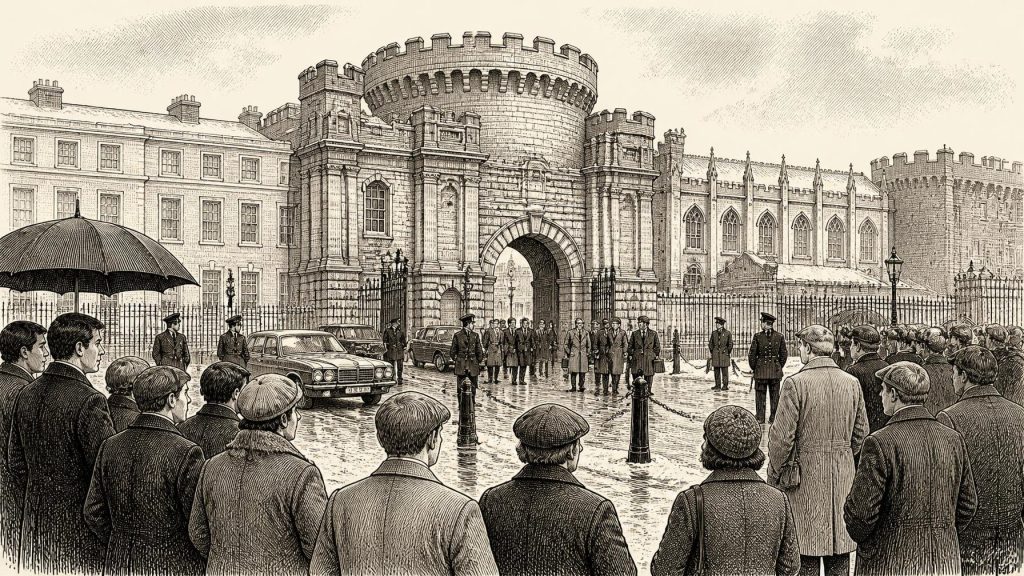
Haughey’s government combined public concern for the prisoners with renewed engagement with Britain. He met Thatcher in London on 21 May; their communiqué referred to the “unique relationship” between the two states and promised closer political co-operation on Northern Ireland. The more symbolically striking encounter came on 8 December, when Thatcher travelled to Dublin Castle with senior ministers including Lord Carrington, Geoffrey Howe and Humphrey Atkins. It was the first visit to Dublin by a British prime minister since partition.
The summit did not produce a breakthrough on sovereignty or a new Northern Ireland settlement. Its joint statement envisaged studies across institutional arrangements, rights, security, economic co-operation and mutual understanding. In that limited but significant sense, it preserved official contact at a time when the hunger strike and constitutional failure made relations exceptionally difficult. Dublin and London were beginning to construct habits of intergovernmental discussion, although their immediate positions remained far apart.
Changing Private and Public Lives
On 1 November, the Health (Family Planning) Act 1979 came into operation in the Republic. It was an important legal change, but a tightly bounded one. Contraceptives could be supplied only through a pharmacist on a doctor’s prescription and only for bona fide family planning or adequate medical reasons. The measure did not amount to unrestricted access, and its caution reflected the influence of Catholic social teaching, professional control and political conservatism. Still, its commencement made 1980 a definite landmark in the slow reshaping of Irish law and intimate life.
Education also acquired a modest but forward-looking marker. The National Institute for Higher Education, Dublin opened to its first students in early November. Later to become Dublin City University, it represented an effort to widen advanced technical and professional education beyond the older university structure. Its small initial cohort could not answer the economic crisis, but the institution pointed towards a future in which higher education, technology and urban expansion would matter increasingly to the Republic.
Broadcasts, Ballads and Crowds
Culture offered both escape and historical reflection. RTÉ began broadcasting Strumpet City on 16 March, Hugh Leonard’s seven-part adaptation of James Plunkett’s novel of Dublin during the 1913 Lockout. With an exceptional cast and large-scale recreation of the city’s streets and labour conflict, it brought a formative episode of working-class history into homes across the country. In an economically anxious year, its portrayal of poverty, solidarity and industrial power carried an obvious contemporary resonance without being a simple allegory.
On 19 April, Johnny Logan won the Eurovision Song Contest at The Hague with Shay Healy’s “What’s Another Year”. Ireland’s second Eurovision victory offered a widely shared moment of international visibility. Later in the year, Croke Park staged equally powerful regional celebrations. Galway defeated Limerick in the All-Ireland hurling final on 7 September, ending a wait for the county’s first senior hurling championship since 1923; Joe Connolly’s captain’s address and Joe McDonagh’s rendering of “The West’s Awake” became part of the occasion’s enduring memory. Kerry subsequently defeated Roscommon in the football final to secure a third successive title.
Thus 1980 closed with Ireland divided by jurisdiction, political allegiance and economic circumstance, but linked by shared institutions, broadcasts, sport and family life. Its most urgent lesson lay in the precariousness of unresolved conflict. The hunger strike ended before anyone died, yet the conditions that produced it remained. The following year would show how little distance there was between temporary respite and catastrophe.
Primary Sources
- CAIN: A Chronology of the Conflict – 1980
- CAIN: Events: Hunger Strike 1981 – Chronology
- Hughes, Brendan | Dictionary of Irish Biography
- Joint Communiqué, Dublin Summit, 8 December 1980
- Prisons (Hunger Strikes), House of Commons Debates, 27 November 1980
- Hunger Strike (Maze Prison), House of Commons Written Answers, 27 November 1980
- The Government of Northern Ireland: Proposals for Further Discussion (Cmnd. 7950)
- National Archives of Ireland Records on CAIN
- Health (Family Planning) Act 1979
- Health (Family Planning) Act 1979: Commencement Information
- OECD Economic Surveys: Ireland 1981
- OECD Economic Surveys: Ireland 1982
- Ireland, International Monetary Fund country study chapter
- RTÉ Archives: 1980 – Living Beyond Our Means
- RTÉ Archives: Strumpet City Television Adaptation 1980
- RTÉ Archives: Johnny Logan Wins with What’s Another Year 1980
- Dublin City University: About DCU
- Dublin City University: News Story Archive
- GAA: Flashback – 1980 All-Ireland SHC Final, Galway v Limerick
- RTÉ Archives: Galway Hurling Glory
- GAA: Roscommon–Armagh, A Rivalry Revisited
- Commission of the European Communities: European Economy, 1980
- Mná 100: 1980–89
- Cambridge University Press: Introduction – Contraception and Modern Ireland