
Ashe, Clare and Convention1917 CE
In 1917, electoral victories for Count Plunkett, Joseph McGuinness and Éamon de Valera weakened the Irish Parliamentary Party and demonstrated the appeal of abstentionist nationalism. Willie Redmond’s death at Messines underscored Ireland’s divided wartime experience. Lloyd George’s Irish Convention, meeting in Trinity College, pursued constitutional settlement without Sinn Féin, while unionist safeguards remained central. Thomas Ashe’s death following forcible feeding and his Glasnevin funeral transformed republican mourning into mass political mobilisation. October’s Sinn Féin Ard Fheis united separatist strands under de Valera, alongside Volunteer reorganisation. Wartime shortages, inflation, agricultural profits and state controls sharpened social pressures, making revolutionary crisis likely.
Dateline
In 1917, Irish politics moved from the aftershock of the Easter Rising towards an open contest over who could speak for the country. The constitutional nationalism of John Redmond’s Irish Parliamentary Party still possessed MPs, local organisations and a long record of pursuing home rule. Yet a looser coalition of republicans, former prisoners, Gaelic revivalists, activists and bereaved families was learning to turn the memory of 1916 into votes, public ritual and durable organisation. Meanwhile, the First World War continued to shape every calculation: Irish soldiers fought and died on the Western Front, food supply became an urgent domestic question, and British ministers sought an Irish settlement that would support rather than disrupt the war effort.
By-Elections Change the Mood
The electoral change began before Sinn Féin had become the mass, disciplined party it would later be. On 3 February, Count George Noble Plunkett won the North Roscommon by-election. Plunkett, father of the executed 1916 leader Joseph Plunkett, stood for an advanced-nationalist cause rather than simply as an old-style Sinn Féin candidate. His victory was nonetheless highly significant. It showed that a candidate associated with the Rising, committed to abstention from Westminster, could defeat the Irish Parliamentary Party in a contest decided by voters rather than by insurrection or imprisonment.
That lesson was reinforced in South Longford in May. Joseph McGuinness, imprisoned for his part in the Rising, was elected by a narrow margin of 37 votes. The slogan attached to his campaign, “Put him in to get him out”, made a prisoner’s confinement part of the appeal. These contests were not evidence that every Irish voter had become republican; unionist areas and many nationalist districts remained outside this new current. But they gave anti-parliamentary nationalism a practical method: local committees, public meetings, canvassing, transport, funds and an abstentionist candidate could turn reverence for 1916 into electoral pressure.
On 18 June, prisoners convicted after the Rising, including Éamon de Valera, returned from English prisons. Their release gave the movement organisers with public standing, experience of discipline and an immediate claim to sacrifice. De Valera had already been chosen to contest East Clare, where the death of Major Willie Redmond had created a vacancy.
Messines and East Clare
Willie Redmond’s death joined Irish parliamentary politics directly to the war. A Home Rule MP and younger brother of John Redmond, he was serving with the 16th (Irish) Division when he was wounded at the attack on Wytschaete on 7 June and died later that day. The battle of Messines involved both the 16th (Irish) and 36th (Ulster) Divisions, formations associated at home with sharply different political traditions. Their presence on the same Flanders battlefield did not dissolve Ireland’s divisions, but it remains a reminder that the island’s wartime experience cannot be reduced to one political allegiance.
In East Clare, the vacancy became a test of the Irish Parliamentary Party’s authority. De Valera campaigned after his release in June, aided by recently freed prisoners, Volunteers and local supporters. On 10 July he defeated Patrick Lynch, the Parliamentary Party candidate, by 2,975 votes. The result did more than elect a new MP who would not take his seat at Westminster. It made de Valera a national political figure and encouraged the building of Sinn Féin clubs and Volunteer companies in Clare and elsewhere. Contemporary recollections from the county describe meetings, bands, route marches and canvassing as mutually reinforcing activities: electoral mobilisation and paramilitary-style organisation grew alongside one another, though neither yet amounted to the later guerrilla campaign.
The Trinity College Experiment
British policy offered a different route. On 21 May, Prime Minister David Lloyd George announced that a convention of representative Irish people would be summoned to frame a constitution for Ireland within the Empire. The proposal followed earlier failed attempts to implement home rule and was designed to obtain an agreement from Irish interests themselves. Sir Horace Plunkett, the agricultural reformer and public figure, became chairman.
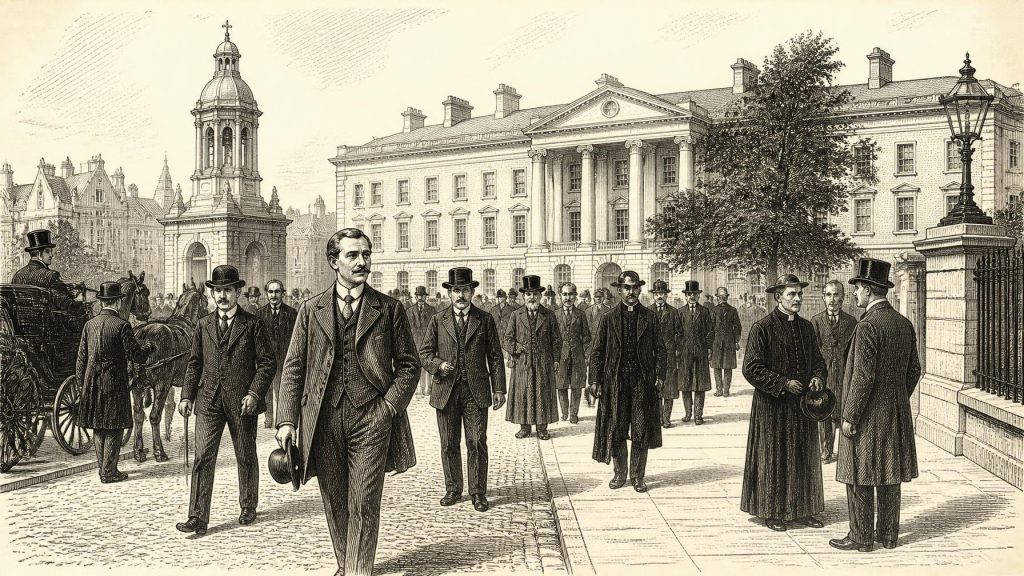
The Irish Convention first met at Regent House, Trinity College Dublin, on 25 July. Its composition was deliberately broad: parliamentarians, southern unionists, Ulster unionists, representatives of local government, labour and churches were included. For John Redmond, participation offered one more opportunity to secure self-government by constitutional agreement. Southern unionists such as Lord Midleton also saw compromise as preferable to political polarisation. Ulster unionists attended, but their central concern remained the protection of the unionist north-east from being placed under an all-Ireland parliament against its will.
Its greatest absence was Sinn Féin. The party rejected seats because the convention’s terms assumed that Ireland would remain within the British Empire and because its delegates would have been a small minority in an assembly convened by the British government. This refusal was politically consequential. The Convention could discuss finance, safeguards, representation and forms of devolution, but it did so without the movement that had just demonstrated its appeal in three by-elections. During 1917 it remained at work rather than reaching its eventual conclusion; it would be misleading to treat its later failure as an event already completed that year. What was clear by the autumn, however, was that constitutional negotiation and abstentionist republican politics were proceeding on separate tracks.
Thomas Ashe’s Funeral
The sharpest emotional turning point came in September. Thomas Ashe, a 1916 commander, teacher and Irish-language activist, had been imprisoned after a speech connected with the East Clare campaign. In Mountjoy he joined other prisoners in demanding recognition as political prisoners. He went on hunger strike and died on 25 September after forcible feeding. The circumstances of his death provoked outrage far beyond the circle of militant republicans, and the authorities soon conceded the prisoners’ demand for political-prisoner treatment.
Ashe’s funeral at Glasnevin on 30 September was a carefully organised nationalist demonstration. His lying-in-state, procession, wreaths and burial turned private bereavement into public politics. The event was not merely spontaneous grief: the Irish Republican Brotherhood and allied activists used ceremony, disciplined stewards, uniforms and symbols to project resolve. Yet its power rested on a widespread response to a young man’s prison death. Ashe became a martyr of the post-Rising movement, and the funeral supplied a model of commemoration that linked sacrifice, mass participation and republican legitimacy.
A Recast Sinn Féin
At the Sinn Féin Ard Fheis in Dublin on 25 and 26 October, the disparate advanced-nationalist forces were formally fused into a reconstituted party. The meeting accommodated competing traditions. Arthur Griffith’s earlier Sinn Féin programme had envisaged an Irish legislature and a dual monarchy on a Hungarian model; many Rising veterans insisted upon the republic proclaimed in 1916. The agreed formula sought international recognition for Ireland as an independent republic, after which the people could freely choose their form of government by referendum. It deferred a fundamental disagreement while giving the movement an unmistakably separatist objective.
De Valera was elected president, with Plunkett and Griffith as vice-presidents. On 27 October he was also elected president of the Irish Volunteers. These appointments connected party politics and the principal nationalist military organisation without making them identical bodies. Michael Collins and Cathal Brugha were among those elected to the Volunteers’ executive. Women were visible delegates at the Ard Fheis and four were elected to the new executive, although women still faced deep constraints in political life and full adult suffrage had not yet been secured.
The autumn reorganisation mattered because it created structures capable of expanding locally: clubs, conventions, funds, publicity and a national leadership. Sinn Féin’s programme also addressed social questions, adopting commitments that included equal rights for women, a living wage, food-export controls and abolition of the Poor Law. Such resolutions did not solve hardship, but they showed that national independence was being presented as relevant to the household as well as to constitutional theory.
Food, Work and Uneven Prosperity
For many people, the war was felt most immediately through food and prices. The severe winter of 1916–17 brought a potato shortage, particularly painful in a society where memories of the Great Famine gave food insecurity an exceptional force. Parliament heard warnings in March that supplies and prices were becoming dangerous. Ireland continued to export substantial quantities of food to Britain, while urban consumers faced dearer essentials. In Dublin, where wages did not keep pace with prices, poorer households encountered black or war bread and high potato prices even as farmers benefited from the wartime market.
That contrast was not absolute. Agriculture expanded, and high demand for cattle, butter, eggs, pork and grain brought many producers better returns. But more tillage also required labour, machinery and seed, while farm workers faced the rising cost of living. The 1917 Crop Restriction Order, introduced in August, aimed to control speculative dealing in grain and potatoes and formed part of the wider wartime attempt to regulate food production and distribution. Ireland’s countryside was therefore not outside the war economy: it supplied Britain, responded to state direction and experienced both profitable markets and labour strain.
By the close of 1917, no single future had been decided. The Irish Convention was still deliberating; the war continued; and the old Parliamentary Party remained a substantial force. But the year had produced a new political language and machinery. Votes in Roscommon, Longford and Clare, the funeral of Thomas Ashe, and the remaking of Sinn Féin gave republican separatism a public authority it had not possessed at the beginning of the year. Ireland had not yet entered its final revolutionary crisis, but 1917 had made that crisis far more likely.
Primary Sources
- Government of Ireland — Hansard, 21 May 1917
- Irish Convention — Hansard, 6 July 1917
- Death of Major Redmond, MP — Hansard, 11 June 1917
- Food Supplies (Ireland) — Hansard, 20 March 1917
- The 1917 Crop Order — Hansard, 2 August 1917
- 1912–1923 Timeline — UCD Decade of Centenaries
- Timeline of Events — UCD Decade of Centenaries
- Eamon de Valera Papers: Descriptive Catalogue — UCD Archives
- Eoin MacNeill Additional Papers: Descriptive Catalogue — UCD Archives
- Ashe, Thomas (Tomás Ághas) — Dictionary of Irish Biography
- De Valera, Éamon (‘Dev’) — Dictionary of Irish Biography
- Plunkett, Count George Noble — Dictionary of Irish Biography
- Redmond, William Hoey Kearney (‘Willie’) — Dictionary of Irish Biography
- Redmond, John Edward — Dictionary of Irish Biography
- Griffith, Arthur Joseph — Dictionary of Irish Biography
- Thomas Ashe Funeral, 30 September 1917: The Wreaths — National Library of Ireland Catalogue
- The Battle of Messines, June 1917 — Imperial War Museums
- Irish consequences of the Great War — Irish Historical Studies
- Irish Agriculture in 1916: Economics — Teagasc
- 100 Years Ago: The Irish Convention in Trinity College — History Ireland
- The First Dáil Éireann — History Ireland
- The League of Women Delegates & Sinn Féin — History Ireland
- Labour in Waiting: The After-Effects of the Dublin Lockout — History Ireland
- Brotherhood Among Irishmen? The Battle of Wijtschate-Messines Ridge, June 1917 — History Ireland
- Bureau of Military History Witness Statement 1288
- Bureau of Military History Witness Statement 1261