
O’Connell Takes His Seat1830 CE
In 1830 Daniel O’Connell took his Westminster seat, embodying Catholic Emancipation after the 1829 Relief Act, while its limitations remained stark. The raised £10 franchise disfranchised many former forty-shilling freeholders, and Ireland remained governed under the Union. O’Connell’s Waterford election followed William IV’s accession and a general election, amid emerging British reform debates. Resistance to tithes supporting the Church of Ireland intensified, particularly late in the year, reflecting religious inequality and rural hardship. Distress, insecure agricultural work and market grievances sharpened tensions. Belfast’s July Orange riots exposed northern sectarian divisions. Contemporary diaries and records reveal political life extending beyond Parliament.
Dateline
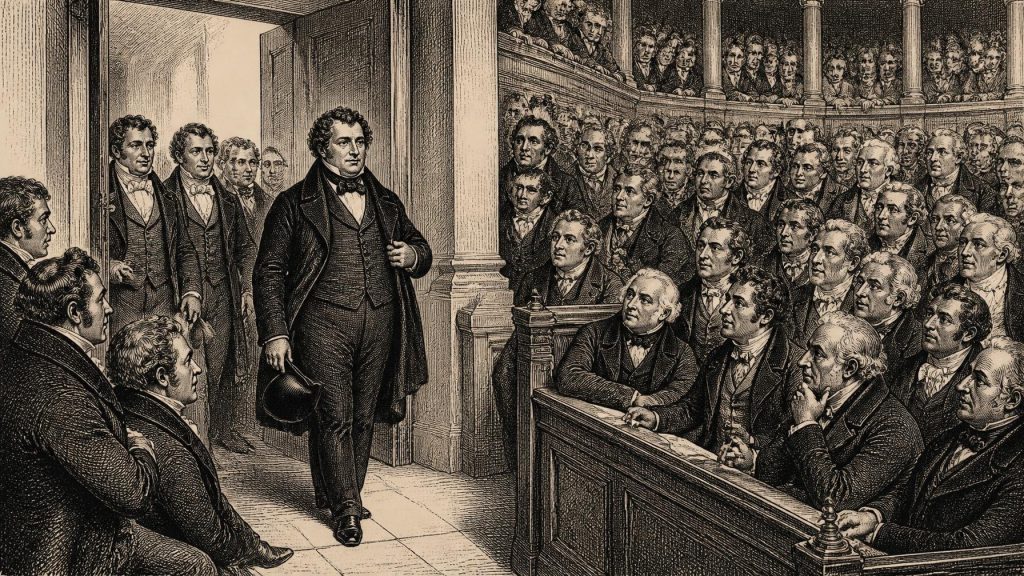
For Ireland, 1830 was a year in which the victory of Catholic Emancipation became visible in the working life of Parliament, yet its limits also became painfully clear. The most resonant firmly dated moment came on 4 February, when Daniel O’Connell took his seat in the House of Commons at Westminster. His arrival was the practical consequence of the Roman Catholic Relief Act passed in 1829, and made him the first Irish Catholic to sit under its provisions. The lawyer from Kerry had already demonstrated, through his Clare election victory of 1828, that a disciplined popular movement could compel a change in high politics. In 1830 he moved from being the celebrated architect of that pressure into the daily, often frustrating, business of imperial legislation.
A Catholic MP at Westminster
O’Connell’s admission did not mean that political equality had suddenly been achieved. The 1829 settlement allowed Roman Catholics to sit in Parliament and hold many civil offices, but it retained significant exclusions, particularly around the established church, the universities and certain great offices of state. Nor did it restore an Irish parliament: Irish representatives still travelled to Westminster under the Union of 1801. The importance of O’Connell’s seat was therefore symbolic as well as practical. It showed that the Catholic majority could no longer be wholly excluded from the legislature governing Ireland, while also concentrating hopes and grievances upon a small number of MPs in London.
Emancipation had come with a sharp political price for many of the people who had helped make it possible. The accompanying Irish franchise legislation raised the county qualification from the old forty-shilling freehold to a £10 freehold. The former voters had been overwhelmingly small tenants, often dependent on landlords but capable, as the Clare contest had shown, of defying them. A later Commons return used in the reform debates put the number displaced at about 190,000 and the new £10 electorate at only 19,264. Such figures require care: registration and voting were imperfect measures of political participation. But they convey the scale of the contraction. The first year in which Catholics could sit at Westminster was also the first in which many poorer Catholic voters found themselves shut out of county elections.
O’Connell’s position was consequently unusual. He spoke for a movement with roots in chapels, market towns, parish organisation and the former forty-shilling electorate, but he now had to work within a Parliament elected on a narrower Irish franchise. His recorded Commons activity began with the debate on the King’s Speech on 4 February. He did not enter Westminster as a solitary novelty: Richard More O’Ferrall of Kildare was another Catholic member. Yet O’Connell’s reputation, legal skill and command of mass meetings made him the figure upon whom friend and opponent alike fixed attention.
King, Election and Representation
The political setting changed again during the summer. George IV died on 26 June 1830 and his brother succeeded as William IV. Under the practice of the time, the new reign brought a general election; Parliament was dissolved on 24 July. In Ireland the contest tested the altered world created by Emancipation, though its limited franchise ensured that it was not a democratic election in any modern sense. O’Connell was returned for County Waterford in August, beginning a short parliamentary connection with that constituency which lasted until May 1831.
Waterford mattered because it was a politically alert county with a strong Catholic interest and a history of contested elections. O’Connell’s return confirmed that his influence had not vanished once the immediate emancipation struggle was over. But the election did not yield a united Irish parliamentary party or a settled programme. Candidates and electors could combine attachment to Catholic rights with local loyalties, landlord influence, demands for economy, concern over tithes, or interest in parliamentary reform. The fall of the Wellington ministry in November and the accession of Earl Grey’s Whigs opened a new British reform crisis, but the famous Reform Acts still lay ahead. In 1830, Ireland’s representation remained constrained by the recent disfranchisement of small freeholders and by the Union’s Westminster framework.
For ordinary people, national politics was encountered less through printed statutes than through priests, landlords, agents, magistrates, process servers, publicans, newspapers and the spectacle of elections. The National Library’s surviving newspaper collections, and the records of Dublin Castle’s Chief Secretary’s Office, suggest the breadth of that political world: local reports could turn a gathering, a sermon, a rent dispute or a threatened seizure into a matter for the state. Public life was not confined to Dublin or London, even though decisions made in those cities bore heavily on rural parishes.
The Tithe Question Hardens
The most consequential conflict gathering force in 1830 concerned tithes. These payments supported the Church of Ireland, the legally established Anglican church, although most of those assessed were Roman Catholic and many others were Presbyterian. Since the Tithe Composition Act of 1823, the levy had generally been converted from a claim on produce into a money payment assessed on agricultural holdings. The Tithe Applotment Books, compiled between 1823 and 1837, preserve part of the machinery of this system: names of occupiers, acreage and local assessments. They are not a census, and omit many people, but they reveal how closely church finance was tied to the geography of landholding.
Resistance to payment was renewed and became systematic in 1830. It was not merely an argument about doctrine. For occupiers facing rent, local charges and insecure employment, a compulsory payment to a church they did not attend was a tangible burden and a visible emblem of unequal authority. The composition system could make the demand more regular and legible, but it did not make it acceptable. Clergy and proctors seeking payment confronted refusal, social pressure and, increasingly, organised local opposition. Resistance often aimed to prevent distraint: if livestock or goods were seized, neighbours might refuse to buy them or impede the process by which they were sold.
The evidence should not be forced into a single national timetable. What later became known as the Tithe War developed unevenly, and the major lethal confrontations belonged to subsequent years. Still, contemporary official material places important activity firmly at the end of 1830. A Kilkenny police report covering 29 December 1830 to 7 January 1831 recorded anti-tithe assemblies at the homes of several Church of Ireland clergymen, alongside threatening notices and illegal timber-cutting around Castlecomer. It captures a moment of escalation rather than a finished rebellion: collective rural action was becoming sufficiently conspicuous to draw sustained attention from police and Dublin Castle.
Hunger, Work and the Rural Economy
The tithe conflict gained force in a society already marked by insecurity. Ireland in 1830 was overwhelmingly rural and agricultural, with a growing population, highly unequal access to land and limited alternatives for labourers outside a few industrial districts, most notably linen-producing parts of Ulster. Small plots and conacre agreements could provide a family with potatoes, while cash for rent, clothes, fuel and taxes depended on seasonal employment, selling produce, domestic industry or credit. This was not a uniform condition: commercial farmers, graziers, townspeople, cottiers and landless labourers faced very different prospects. But dependence on a narrow margin of food and work made a price rise or poor local crop exceptionally dangerous.
There was severe distress in parts of the country during the spring and summer. Local evidence from County Clare describes potatoes becoming dramatically dearer and relief committees attempting to respond. It would be misleading to describe every district as suffering the same crisis, or to turn 1830 into a rehearsal of the Great Famine. Yet parliamentary debate in November plainly registered Irish distress, unemployment and the weight of local taxation as urgent matters. The vulnerability exposed in 1830–31 belonged to the pre-Famine world: not one inevitable road to catastrophe, but a social order in which many households had little reserve against failure.
Markets and fairs were central to that order. They were places to sell animals and produce, seek labour, obtain necessities and hear political news. On 11 March, a Commons debate on the poor in Ireland criticised local restrictions and tolls affecting buyers and sellers at fairs and markets. The discussion did not solve the problem, but it illuminates a practical grievance: the regulation of trade could be experienced by poorer people not as an abstract economic issue but as a charge, delay or humiliation embedded in everyday exchange.
Belfast’s July Disorder
Political and religious strain also had a distinct northern expression. On 12 July, the customary Orange demonstration in Belfast was prohibited. Orangemen demonstrated nonetheless, and serious rioting followed in the town; disorder spread into parts of Counties Armagh and Tyrone. The episode is important precisely because Ireland in 1830 cannot be reduced to a simple Catholic-versus-state narrative. In and around Belfast, Protestant loyalist organisation, public commemoration and fears about constitutional change shaped political behaviour. The disturbances revealed how quickly disputed processions and restrictions on public assembly could intensify sectarian antagonism.
They also occurred amid wider uncertainty. The French July Revolution was being debated across Britain and Ireland, while the succession of William IV and the general election made reform a live question. Irish people did not respond as a single public. Catholics who celebrated emancipation, Protestant reformers, conservative landowners, Orangemen, Presbyterian commercial interests and rural labourers could all use the language of rights, constitution or order while imagining very different futures.
Voices Beyond Westminster
The year survives not only in official correspondence and parliamentary speeches. In Callan, County Kilkenny, the Irish-language diarist, schoolteacher and draper Amhlaoibh Ó Súilleabháin continued the journal now known as Cín Lae Amhlaoibh. Its entries for this period range across weather, prices, agriculture, local society and politics. His diary is a reminder that Irish remained a written as well as spoken language, and that educated Catholic life was not confined to the institutions of the state or the English-speaking press. It also restores texture to a year too easily dominated by great men and statutes.
By December, no comprehensive settlement had emerged. O’Connell had established himself at Westminster; a new king and a new ministry had altered the political weather; rural opposition to tithes had become a mounting challenge; and local distress sharpened every demand for relief and justice. The decisive reforms and confrontations of the early 1830s were still to come. But 1830 marked the point at which the promise of emancipation met the unresolved realities of franchise, church establishment, land, poverty and sectarian power.
Primary Sources
- O'Connell, Daniel
- Roman Catholic Relief Act 1829
- Mr Daniel O'Connell
- The Correspondence of Daniel O'Connell, Volume IV, 1829–1832
- William IV (r. 1830–1837)
- Qualification of Freeholders (Ireland) Bill
- Parliamentary Reform—Bill for Ireland—Committee
- The Registered Papers of the Chief Secretary's Office: 1821 State of Country
- The Tithe Applotment Books, 1823–37
- Tithe Applotment and Valuation Records
- The Tithe War; reports by Church of Ireland clergymen to Dublin Castle
- Tithes (Ireland), 2 May 1834
- The Poor of Ireland, 11 March 1830
- Distress in Ireland, 23 November 1830
- Pre-famine Clare — Society in Crisis
- Population and Poverty in Ireland on the Eve of the Great Famine
- ‘Wholesome regulation and unlimited freedom’: governing market space in southern Ireland before the Famine
- CAIN: Parades and Marches Chronology 2: Historical Dates and Events
- Ó Súilleabháin, Amhlaoibh (O'Sullivan, Humphrey)
- Cinnlae Amhlaoibh Uí Shúileabháin: The Diary of Humphrey O'Sullivan, Part II
- The Content of the Registered Papers, 1818–1833
- Newspapers