
Ballyporeen’s White Shirts1761 CE
In 1761, George III’s accession prompted Ireland’s first general election since 1727 and a new parliament, where Charles Lucas and other patriots challenged restrictions on legislative control of revenue. Yet the year’s most significant development began in southern Tipperary, where Whiteboys around Ballyporeen resisted enclosures, tithe demands and local exactions through nocturnal, disguised collective action. Initially called Levellers, they established methods later rural movements adopted. Galway’s Protestant corporation sought to restrict Catholic commercial activity through the Black Petition. Meanwhile, the Seven Years’ War brought naval impressment. The year exposed constitutional weakness, confessional exclusion and rural insecurity without producing national rebellion.
Dateline
In 1761, Ireland stood at a revealing junction. The accession of George III after the death of George II in October 1760 had required a new Irish parliament and therefore a general election, the first since 1727. Yet the year’s most consequential Irish development did not occur in Dublin’s chamber or at a formal electoral count. In the closing months, on the Tipperary side of the Knockmealdown Mountains, rural people began the night-time collective action that became known as Whiteboyism. Their shirts, worn over ordinary clothes as a crude disguise, gave the movement its enduring name. The incidents were initially local and their exact first dates cannot safely be fixed; nevertheless, contemporary testimony and later scholarship place their beginnings in late 1761.
A New Parliament, Not a New Democracy
The parliamentary election was an unavoidable result of the crown’s change, but it did not amount to a broad popular renewal. Ireland’s House of Commons represented counties and boroughs under a restrictive political order dominated by Protestant landowners, corporations and powerful families. There was no uniform polling day: returning officers set dates locally, and many seats were settled without contest. The election was nevertheless important because it followed more than three decades without a general election and occurred amid a growing argument that parliaments ought not to endure merely for the life of a monarch.
Charles Lucas’s election for Dublin City gave that argument a conspicuous spokesman. A physician, former civic campaigner and long-time critic of official influence, Lucas had returned from exile after receiving a pardon from the new king. His success expressed an increasingly articulate ‘patriot’ current: not a demand for national independence in the later sense, but an insistence that Ireland’s parliament should defend its own constitutional standing, public money and commercial interests. Lucas entered the Commons with a public reputation built through pamphlets and municipal politics rather than through great landed wealth.
The first parliament of George III met in Dublin on 22 October 1761. Its arrival exposed a constitutional weakness that frustrated those who wished the Irish Commons to control supply. Under Poynings’ Law, proposed Irish legislation passed through the Irish privy council and then required transmission to Britain before parliament could consider it. In 1761 Lucas, Lucius O’Brien, William Osborne, Edmond Sexten Pery and others pressed for rejection of a money bill prepared through that process, maintaining that control of revenue lay at the heart of parliamentary privilege. The contention mattered less for an immediate victory than for marking a sharpening dispute over who truly directed Ireland’s legislature.
Care is needed with legislation assigned the date ‘1761’. The parliamentary session begun that October ran into April 1762, and several statutes customarily labelled Acts of 1761 received their final assent in the following calendar year. They should not be represented as measures passed during 1761 itself. Their subjects, however, indicate the administrative world with which the new parliament was concerned: regulation of apothecaries’ medicines in Dublin, standards for gold and silver thread, municipal administration, Cork hackney vehicles and leasing arrangements for hospitals.
The Beginnings at Knockmealdown
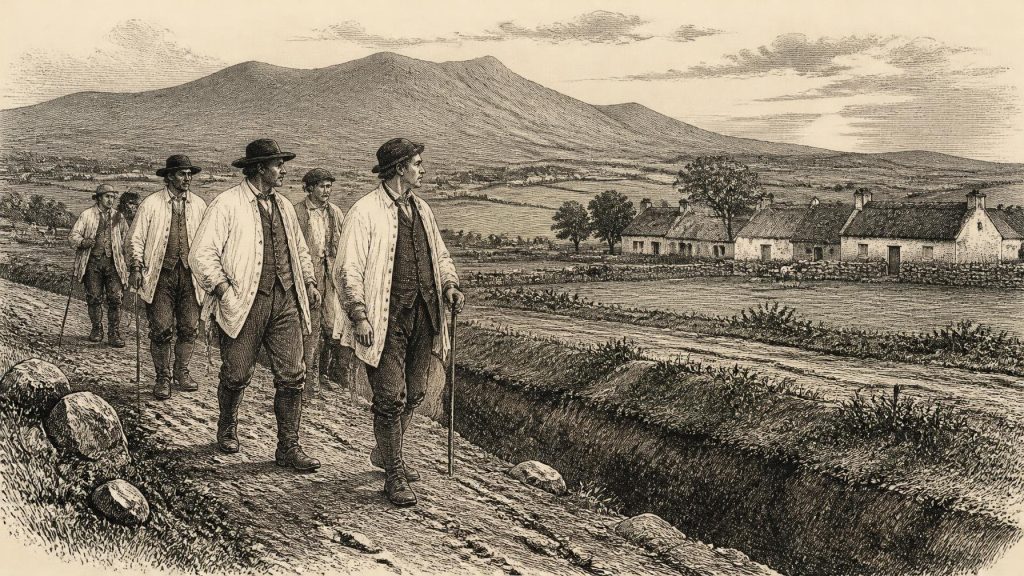
The Whiteboys’ emergence was the year’s decisive event from below. Their earliest known activity lay in the district between Clogheen and Ballyporeen, near the Knockmealdowns in southern Tipperary. The initial targets were not symbols of a distant national government but the immediate pressures of rural life: enclosures of common ground, demands associated with tithes, and the local power of those who collected them. Commonage was essential to smaller occupiers and labouring households, providing grazing and other customary resources. Its enclosure could narrow the margin on which a family survived, even when agriculture was commercially prosperous for landlords and larger farmers.
One flashpoint identified by contemporary evidence was a demand attributed to a recently installed tithe-farmer at Ballyporeen: Catholic couples marrying before a priest were allegedly required to pay five shillings. Tithes supported the established Church of Ireland, although most people in the affected districts were Catholic. The grievance therefore joined money, local authority and religious inequality. It would be misleading to reduce the movement to one fee or one official, since its causes were multiple and varied by district. But the episode explains why resistance could become communal and why the first actions concentrated on redressing particular exactions rather than advancing an abstract programme.
At first, the participants were also called ‘Levellers’, because they pulled down the ditches and walls that marked newly enclosed ground. Their operations took place at night and relied on oaths, anonymity and the intimidating spectacle of organised groups. Wearing white shirts over their clothing helped conceal identity in darkness, while giving observers and officials a memorable label. Such tactics offered people with little formal political influence a means of enforcing collective demands against individuals who controlled land, rents or church dues. The Whiteboys were not yet a single island-wide organisation in 1761; that wider history belongs to subsequent years. In this year, the evidence supports a small but growing Munster movement whose example would prove durable.
The contrast between College Green and the Knockmealdowns was stark. Parliamentarians debated the handling of public revenue and the procedures of legislation. Rural activists challenged the practical reordering of land and obligations at parish level. Both disputes concerned authority, but they were conducted in radically unequal settings. The first relied on speeches, patronage and constitutional precedent; the second on nocturnal assembly and direct action. Whiteboyism was consequently a landmark in the history of Irish popular protest, not because it suddenly united all social groups, but because it established a repertoire of collective rural resistance that later movements would adapt.
Galway’s Petition of Exclusion
Religious and economic exclusion was also displayed openly in Galway. On 10 November, the mayor, sheriffs and other Protestant burgesses and freemen signed what became known as the Black Petition. Addressed to the town’s members of parliament, it complained that Catholic shopkeepers and dealers were manufacturing and selling goods, employing journeymen and entering trades. The petition asked parliament to prevent this activity, presenting Catholic commercial participation as an injury to Protestant freemen and to the town’s corporate privileges.
The document is valuable precisely because it shows that confessional inequality was not only a matter of national statutes. In a port town with a long mercantile past, competition over shops, apprentices, crafts and retail trade could be framed in explicitly religious terms. The petitioners invoked charters and the Galway Act, treating corporate regulation as a means to defend Protestant economic advantage. Catholics, meanwhile, were not passive abstractions in the record: the complaint itself confirms their visible presence as traders, employers and competitors. No general prohibition resulted from the petition in 1761, but its language reveals the exclusions built into urban civic life.
War, Regulation and Daily Insecurity
Ireland remained connected to a much larger imperial war. The Seven Years’ War continued through 1761, and on 5 August the Dublin Gazette carried a proclamation requiring civil magistrates across the kingdom to assist naval officers impressing seafaring men for the king’s fleet. For coastal families and maritime workers, imperial conflict could thus arrive as a demand for labour rather than distant news. The same official record shows a government preoccupied with order: proclamations dealt with parliamentary prorogations, public mourning for George II, fast days, local violence, fireworks and the prevention of tumults in Dublin.
A proclamation of 19 January appointed 13 February as a general fast and public humiliation, a reminder of the religious language through which the state responded to war and uncertainty. Such observances reached parish churches more widely than parliamentary debate did. Meanwhile, the incidents recorded in official notices—threats, attacks on livestock and riotous behaviour—do not by themselves demonstrate a unified crisis, but they illuminate a society in which local coercion and insecurity were familiar realities. The new Whiteboy disturbances developed in that atmosphere, before the state had devised the more specific coercive responses of later years.
Thus 1761 should be remembered neither as a year of dramatic constitutional settlement nor as the fully formed beginning of a national rebellion. Its importance lies in beginnings and disclosures. A new king brought an election and a parliament in which reform-minded politicians tested the limits of Irish legislative authority. Galway’s Black Petition exposed the determination of Protestant corporate interests to police Catholic economic participation. Above all, the first Whiteboys around Ballyporeen showed how disputes over common land, tithes and local power could generate disciplined collective action. By year’s end, a small southern Munster disturbance had acquired a name that would echo through Irish rural history.
Primary Sources
- The Whiteboy movement, 1761–5
- Irish Secret Societies (1760–1762)
- A Chronology of Ireland
- Lucas, Charles
- O'Brien, Sir Lucius Henry
- The Dublin Gazette, Number 1077: Saturday, 3 January 1761 to Tuesday, 6 January 1761
- The Dublin Gazette, Number 1103: Saturday, 4 April 1761 to Tuesday, 7 April 1761
- Statute Law Revision Act 2015
- Royal College of Physicians Act 1761, Section 2
- Royal College of Physicians Act 1761, Section 7
- Gold and Silver Thread Act 1761
- City of Cork Act 1761
- Statute Law Revision Act 2007
- Short Titles Act 1962, Schedule 1
- Statute Law Revision (Pre-Union Irish Statutes) Act 1962, Schedule
- The Presentation Convent School
- The Whiteboys in 1762: a Contemporary Account
- The Militia in Eighteenth-Century Ireland: 1761–69: Reform Debated and Attempted
- Irish History Online: Whiteboys
- A Letter to That Truly Patriot-Candidate for the City of Dublin, Doctor Charles Lucas
- Dublin and Irish Politics in the Age of Charles Lucas
- Popular Protest and Policing in Ascendancy Ireland, 1691–1761
- County Galway: Constituencies and Elections
- Land and Conveyancing Law Reform Act 2009