American Privateers1777 CE
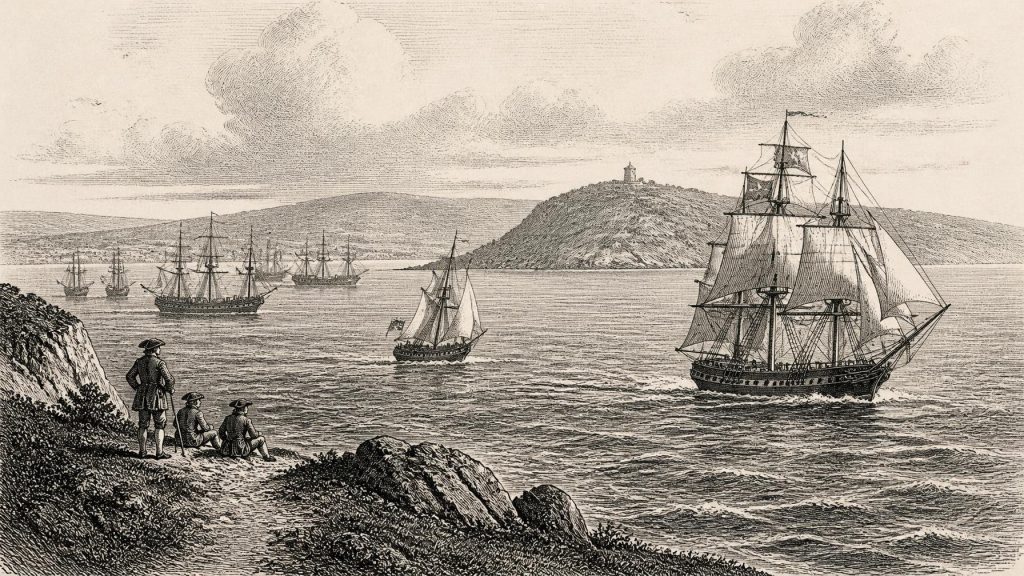
In 1777, Ireland felt the American war through disrupted markets, privateering and insecurity in the Irish Sea. Lord Buckinghamshire’s new Dublin Castle administration sought to preserve a system constrained by Westminster, franchises and Catholic exclusion. American privateers near Howth delayed linen shipping, threatening credit, employment and trade. Loss of colonial markets and provision embargoes exposed Ireland’s narrow, regulated economy. Thomas Campbell’s published survey criticised uneven development, inadequate institutions and penal exclusions, while advocating union rather than separation. Dublin’s theatre and print culture remained active. The year foreshadowed later Volunteer and free-trade crises, but did not deliver constitutional or commercial reform.
Dateline
In 1777 Ireland sat within a British Atlantic war whose pressures were becoming unmistakable at home. The American conflict had already narrowed markets, disrupted shipping and made the security of the Irish Sea a practical concern rather than a distant imperial question. Yet this was not the year of the Irish Volunteers’ great mobilisation, nor of the free-trade concessions that would follow in 1779. It was, rather, a year in which the vulnerabilities underlying those later developments were increasingly visible: an administration newly installed at Dublin Castle, merchants alarmed by privateers, and writers trying to explain Ireland’s poverty, potential and political exclusion to a British readership.
A New Administration at Dublin Castle
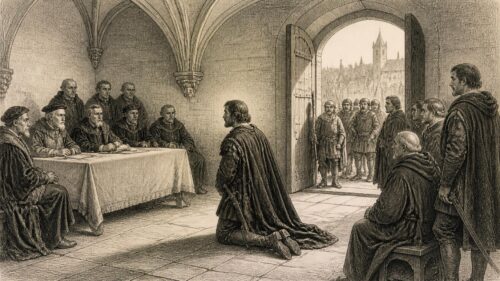
On 25 January John Hobart, second earl of Buckinghamshire, was sworn in as lord lieutenant of Ireland. Appointed the previous December, he arrived as the representative of George III and of Lord North’s ministry at a moment when governing Ireland required close attention to both Westminster’s war policy and Irish opinion. His chief secretary was Sir Richard Heron. The Irish executive was centred on Dublin Castle, but its authority depended on managing the interests of great landowners, office-holders, borough patrons and the Protestant political nation represented in the Irish parliament.
That parliament was not a national legislature in the modern democratic sense. Its franchise was restricted, many constituencies were under aristocratic influence, and Catholics could neither vote nor sit. Legislative initiative was constrained by Poynings’ Law and by the constitutional dependence created by the Declaratory Act of 1719, which asserted Westminster’s authority to legislate for Ireland. Nevertheless, the Dublin parliament mattered: it controlled supply, distributed patronage and offered a forum in which a growing Patriot interest criticised commercial restraints and the reach of British control.
Buckinghamshire’s arrival should not be mistaken for an immediate turning point. The spectacular crises associated with his viceroyalty—Volunteer pressure, free trade and arguments over constitutional independence—belonged chiefly to 1779 and 1780. In 1777 his significance lay in taking charge of an administration already exposed to the consequences of the American war. The task was less to create a new political order than to keep a fragile one functioning while trade, finance and security became steadily more difficult.
Privateers off Howth
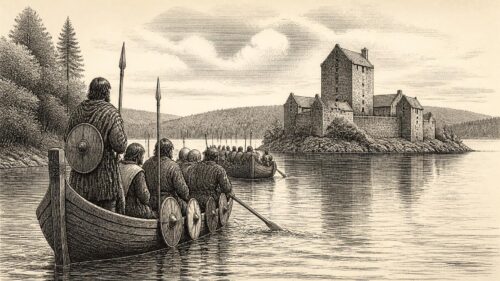
The Atlantic war reached the Irish coast in a sharply dated incident that summer. From Dublin Castle on 10 July, Buckinghamshire wrote to Lord Weymouth that merchants trading from Dublin and neighbouring ports were distressed by the appearance of three American privateers; a fourth had then appeared. The previous night, a revenue cruiser carrying Lieutenant Lambert Brabazon had sighted a French-built vessel of twenty guns off the Hill of Howth. It chased the cruiser, then bore away after other shipping and took a vessel within sight of it.
The lord lieutenant’s language shows what was at stake. Merchants had linen ships ready and laden, but believed they could not sail without convoy protection. Their detention, he warned, would interrupt the seasonal return of payments and have a severe effect upon the country’s commerce. This was not simply an encounter between warships. It was a threat to credit, cargoes, insurance, employment and the rhythm by which exporters, merchants, bleachers, weavers, spinners and farmers received income.
The episode also demonstrates that Ireland was not merely watching the American Revolution through newspapers or parliamentary speeches. American privateering could bring the war into the Irish Channel. A revenue cruiser was available, but the merchants wanted naval protection adequate for valuable merchantmen. The fear was especially acute because Irish commerce was concentrated in a limited range of exports and routes. A disruption to linen shipping therefore carried consequences far beyond the quays.
Linen, Provisions and a Narrow Economy
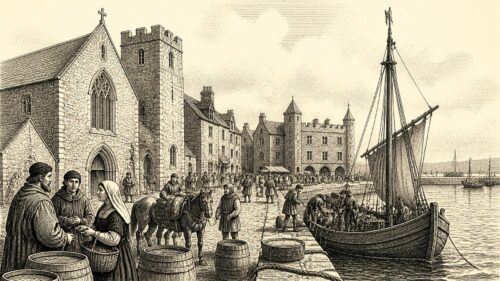
Ireland’s economic exposure had been worsening since the opening of the American war. Linen, especially the output of the northern and north-eastern countryside, was a crucial export; British America had been an important market. The colonial non-importation agreements and then war damaged that connection. At the same time, embargoes on the export of provisions had constrained a trade upon which many rural producers and port towns depended. The hardship was not evenly experienced, but the combination of weak demand, interrupted routes and commercial regulation affected agricultural, manufacturing and mercantile communities alike.
It is important not to project the later free-trade victory backwards. In 1777 the principal restrictions still stood. Ireland had its own parliament and executive, but did not possess equal freedom within the empire’s commercial system. Irish trade with the colonies and foreign markets was shaped by British navigation rules, parliamentary legislation and wartime priorities. The increasingly obvious mismatch between Ireland’s economic needs and the system imposed upon it would later provide Patriot politicians with a powerful cause. During 1777, however, it remained a grievance seeking an effective political force.
The war also connected Irish production with the wider coercive economy of the Atlantic. Coarse Irish linen had supplied colonial and Caribbean markets, including plantation societies dependent on enslaved labour. That connection neither made Ireland a major slave-trading centre nor insulated Irish producers from the moral and economic structures of empire. It meant that the loss of American markets was felt in districts where spinning and weaving were household work, often shared by women, men and children alongside farming.
A Survey Published in Wartime
One of the year’s most revealing cultural events was the anonymous London publication of Thomas Campbell’s A Philosophical Survey of the South of Ireland. Campbell, a Church of Ireland clergyman from Tyrone, had travelled through Ireland between July and November 1775. His book therefore does not report observations made in 1777; its importance for this year is that its 1777 publication brought a broad, argumentative portrait of Ireland into print at the very moment when British policy towards the island was under strain.
Campbell’s declared purpose was political. In his prefatory advertisement, dated London, 14 May 1777, he argued that Ireland’s agriculture, manufacture and commerce had failed to flourish because of poor information and narrow government policy. His remedy was not Irish separation. He advocated a closer political and commercial union of Britain and Ireland, believing it would enlarge Ireland’s markets and improve the empire. That prescription was contentious, but the diagnosis—of a country held back by restricted opportunity—spoke directly to contemporary debate.
The survey is valuable but must be handled critically. Campbell was a well-connected Anglican observer, not a neutral social investigator. He moved through gentlemen’s houses, inns, towns and landscapes, and his descriptions often judged places and people by elite standards of ‘improvement’. He admired Dublin’s scale, sociability and fashionable tables; he also described rough roads, poor inns, weak cultivation and the striking contrast between landscapes of villas and areas of deprivation. His image of Buttevant, with poor stone dwellings among ruined medieval monuments, was a traveller’s impression rather than a statistical survey. Even so, it captured inequalities that contemporaries could see plainly.
His comments on religion reveal the limits as well as the possibilities of reform-minded Protestant writing. Campbell recognised that Roman Catholics made up the great majority of the population and argued that people excluded from full legal protection and political advantage could not be expected to feel a reciprocal attachment to government. Yet he continued to imagine political security through Protestant command, including Protestant officers over Catholic soldiers. The book thus records a genuine criticism of the penal order while preserving assumptions of Ascendancy authority.
Campbell also assessed learning and institutions. He found Ireland’s educational and ecclesiastical provision inadequate for its population, contrasting Trinity College Dublin’s limited staffing with the larger university systems of England and Scotland. His numerical claims and broad judgements should not be accepted unexamined, but the argument itself matters. Published in 1777, the survey made literacy, schools, clerical resources, antiquarian study, agriculture and commerce parts of one question: why had a kingdom of evident resources developed so unevenly?
Crow Street and Public Culture
Dublin’s cultural life nevertheless remained lively. The performance record for Crow Street Theatre places John O’Keeffe, the Dublin-born Catholic actor and dramatist, in the principal role in Saint Patrick’s Day on 15 April 1777, with further performances recorded that April and May. O’Keeffe’s career connected Dublin stages to provincial touring circuits and, increasingly, to London. Theatre was commercial entertainment, but it was also a place where accents, class, national character and political feeling could be displayed before a mixed paying public.
That detail helps correct any picture of 1777 as only a year of high politics. Ireland contained a socially stratified but active urban culture of theatres, printers, booksellers, clubs, coffee houses and newspapers. Access to it was unequal, and the cultural world documented most fully is usually that of towns and the better-off. Still, the publication of Campbell’s survey and the Crow Street performances show that Irish experience was being observed, argued over and dramatised in public.
Dating the Evidence Carefully
Some familiar labels require caution. Several statutes conventionally called ‘1777’ belong to the parliamentary session of 1777–78; their short titles do not prove that they were enacted during the calendar year 1777. Most notably, the measure later known as the Leases for Lives Act or Catholic Relief Act 1777 received royal assent on 14 August 1778. It should therefore not be presented as a reform achieved in 1777. Likewise, the celebrated ‘Code Duello’ is often attributed to the Clonmel summer assizes of 1777, but the familiar text rests on later testimony rather than a securely contemporary printed record. It is safer to note the tradition than to treat it as a firmly documented event of that summer.
What can securely be said is that 1777 exposed the intersection of Irish constitutional subordination, commercial fragility and imperial war. Buckinghamshire’s new government faced a country whose trade required protection, whose largest religious community remained politically excluded, and whose writers were increasingly willing to identify structural defects. The events of the year did not yet resolve those problems. They made them harder to ignore.
Primary Sources
- Hobart, John
- Lord Lieutenant of Ireland to Lord Weymouth, July 10, 1777
- Ireland. Parliament. House of Commons debates
- A Philosophical Survey of the South of Ireland
- TEI Header for A Philosophical Survey of the South of Ireland
- Campbell, Thomas
- A Philosophical Survey of the South of Ireland, Letter 4
- A Philosophical Survey of the South of Ireland, Letter 11
- A Philosophical Survey of the South of Ireland, Letter 19
- A Philosophical Survey of the South of Ireland, Letter 31
- A Philosophical Survey of the South of Ireland, Letter 41
- History of the Commercial and Financial Relations between England and Ireland from the Period of the Restoration
- Ireland and the Making of America
- The Royal Dublin Society and the Legacies of Empire Project, 1731–1877
- The Handloom Weavers and the Ulster Linen Industry
- O’Keeffe (O’Keefe), John
- Theatre in Dublin, 1745–1820: A Calendar of Performances – Searchable Indexes
- The London Stage Database: The Shamrock
- Irish Statute Book: Pre-Union Irish Statutes, 1777–78
- Leases for Lives Act 1777, Section 6
- Short Titles Act, 1962, Schedule 1
- Statute Law Revision Act 2007, Schedule 2
- Select Documents XLIII: A Secret Return of the Volunteers of Ireland in 1784
- Clonmel Summer Assizes Dueling Code