
Carriganima’s Lament1773 CE
In 1773, the killing of Art Ó Laoghaire near Carriganima exposed the unequal legal position of Catholics in Ireland. His feud with magistrate Abraham Morris, involving a horse and penal legislation, inspired Eibhlín Dubh Ní Chonaill’s enduring Irish-language lament. Morris’s acquittal and the disputed burial reinforced perceptions of unequal justice. Nationally, Lord Lieutenant Harcourt’s unsuccessful absentee-tax proposal revealed financial strain, landlord influence and limits on Dublin’s parliament. Linen, woollen promotion and trade sustained a diverse but dependent economy, while volunteer corps reflected Protestant local society. Goldsmith’s success and Leland’s contested history illustrated Ireland’s contribution to, and disputes within, British culture.
Dateline
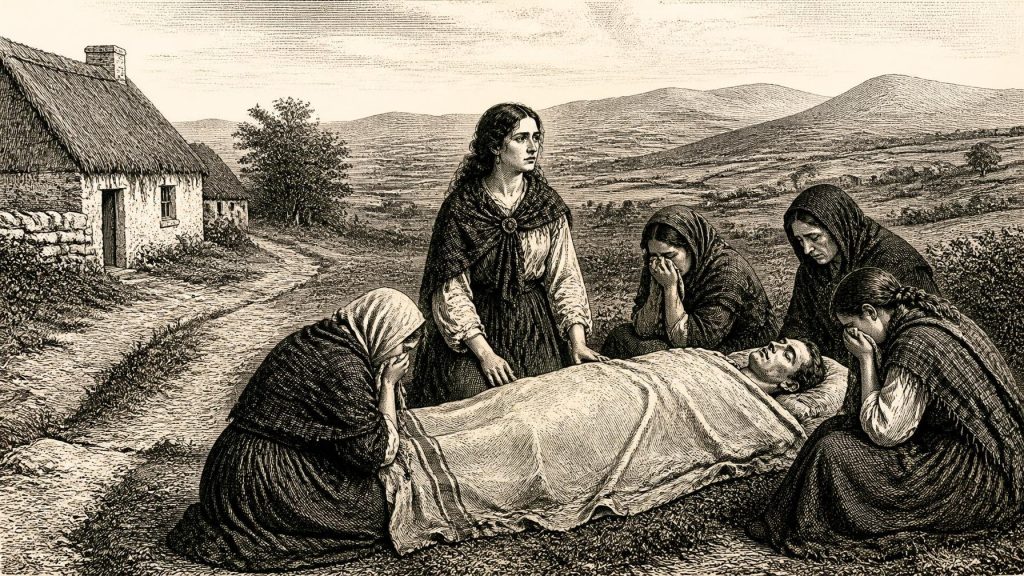
On 4 May 1773, Art Ó Laoghaire, a Catholic gentleman of the Múscraí district in County Cork and a former officer in the Hungarian Hussars, was shot dead near Carraig an Ime, or Carriganima. The killing was local in setting, but it exposed larger realities of eighteenth-century Ireland: a Protestant governing order, the uneven and sometimes personal enforcement of the penal laws, and the survival of a vigorous Irish-language culture among Catholic families. It also gave rise to Caoineadh Airt Uí Laoghaire, Eibhlín Dubh Ní Chonaill’s lament for her husband, a work that remains among the great poems of Irish oral tradition.
A Killing in Múscraí
Art Ó Laoghaire’s death is firmly dated; the route to it is less certain. Accounts agree that he had an entrenched feud with Abraham Morris, a Protestant magistrate and former high sheriff of Cork. They differ over the immediate circumstances in which Morris and an armed party encountered Ó Laoghaire. One version makes Art the intended ambusher; another makes him the victim of an ambush. What is secure is that he was killed near Carriganima on 4 May, aged about twenty-six, and that the quarrel had long involved questions of status, authority and a valuable horse.
That horse mattered because old law could still become a weapon. Under a penal statute of 1695, a Catholic was forbidden to possess a horse valued at £5 or more; a Protestant who followed the prescribed procedure could acquire such an animal by tendering £5 5s. The law was designed to prevent Catholics keeping horses fit for military service. By the early 1770s its application was far from automatic, but its continued presence on the statute book made it available to hostile local officials. The most familiar account holds that Morris demanded Ó Laoghaire’s prized mare under this provision and that Art refused. The details should not be overstated as settled fact, yet the episode plainly acquired its force from a legal disability that Catholics recognised as humiliating and dangerous.
Ó Laoghaire was no passive emblem. He had served abroad in the army of Maria Theresa, returned to Cork, married Eibhlín Dubh Ní Chonaill in 1767 and acquired a reputation for conspicuous self-confidence. Earlier conflict with Morris had brought accusations, advertisements in the Cork Evening Post and threats of prosecution. Art’s conduct could be read by Protestant neighbours as defiance; by Catholics, it could appear a refusal to accept an inferior place. His death consequently became more than a private tragedy, although it would be misleading to reduce it to a simple, pre-planned act of sectarian persecution. It arose from a volatile personal feud conducted within a deeply unequal legal order.
Grief Made Public
In the immediate aftermath, Eibhlín Dubh composed the lament conventionally known as Caoineadh Airt Uí Laoghaire, or The Lament for Art O’Leary. Its date of composition is closely tied to 4 May 1773, but the poem was created and transmitted orally, not issued as a finished printed text. The surviving versions were written down much later from performance and recollection. That distinction matters: the lament has a named poet and a particular bereavement at its centre, yet it belongs equally to the communal practice of caoineadh, the voiced mourning traditionally performed by women at death and burial.
Its emotional range is one reason for its endurance. Eibhlín addresses her dead husband directly, recalls his appearance and courage, condemns those held responsible, and speaks from the acute vulnerability of a pregnant widow with children. The poem preserves not merely sorrow but rank, family, place and grievance. It shows Irish as a living literary language in a society where English was increasingly dominant in administration, elite education and print. The later manuscript history of the lament makes it impossible to treat every line as a verbatim record of one moment in May 1773. Nevertheless, its core association with Eibhlín’s response to Art’s death is exceptionally strong.
The legal aftermath was divided. Morris was charged with murder, while retaliatory violence followed: in July an attempt was made on his life by one of Art’s brothers. Morris was subsequently acquitted. For his supporters among Cork’s Protestant elite, he had acted for law and order; for others, the result illustrated how difficult it was for Catholics to obtain equal redress within institutions from which they were largely excluded. Art was first buried at Kilnamartra. Later in 1773, his burial in consecrated ground was challenged and his remains were removed to land outside Kilcrea friary. Even in death, the episode demonstrated the precarious position of Catholic custom and memory.
Revenue, Absentees and Parliament
In Dublin, the year’s most revealing political issue was money. Simon Harcourt, lord lieutenant since late 1772, confronted serious pressure on Irish public finance. Earlier military expenditure, pensions and charges on revenue had left the administration with mounting arrears. A contemporary account prepared by the former chief secretary George Macartney treated government, trade and revenue as inseparable parts of Ireland’s condition; it is itself an important 1773 document, though written from the viewpoint of a senior official.
Harcourt’s proposed remedy was an absentee tax: a levy on rents received by Irish proprietors who lived outside Ireland. The idea could appeal to those who resented landlords drawing income from estates while spending it in Britain. Yet it disturbed powerful political interests on both sides of the Irish Sea. Absentee proprietors and their allies organised against it in London; Irish landholders feared that a supposedly limited tax might become a wider land tax. In November, freeholders at Nenagh included the danger of such an extension among their objections. By the end of the month the proposal had failed in the Irish Commons, and Harcourt’s government had withdrawn from actively sponsoring it.
The episode reveals the limitations of the pre-Union Irish parliament. Parliament met in Dublin on 12 October 1773, but executive authority rested with the lord lieutenant and was ultimately answerable to ministers in London. The electorate was narrow, Catholics could not sit, and borough influence and office-holding shaped much parliamentary behaviour. Still, the absentee-tax controversy was not meaningless theatre. It brought questions of Irish debt, landlord responsibility, taxation and the relationship with Britain into unusually direct public discussion. The proposal’s defeat showed both the strength of elite interests and the political sensitivity of absenteeism as an Irish grievance.
On 19 November, James FitzGerald, first duke of Leinster, died at Leinster House in Dublin and was buried four days later in Christ Church Cathedral. Leinster was the leading duke in the Irish peerage and head of an immensely prominent family. His death did not transform the year’s politics, but it marked a change in one of the great aristocratic houses whose estates, connections and parliamentary influence helped govern eighteenth-century Ireland. His son William succeeded as second duke.
Work, Manufacture and Local Defence
Economic life remained principally rural, but it was not isolated. Linen was Ireland’s leading export manufacture, linking flax growers, bleachers, spinners, weavers, merchants and ports to markets in Britain and the Atlantic world. Much spinning was undertaken in households, with women’s labour vital to the production chain. The scale of overseas demand also connected Irish cloth to colonial economies, including the supply of coarse linen to British America and the Caribbean. Such connections were commercially significant but unequally rewarding; they did not remove the dependence of many families on small holdings, seasonal work and credit.
In Dublin, the Dublin Society opened a woollen warehouse in 1773 to assist the sale of Irish-made cloth. The initiative was modest beside the dispersed linen trade, but it indicates the practical improvement culture of the period: premiums, warehouses, agricultural experiments and schemes intended to promote domestic manufacture. It also reminds us that Ireland’s economy was varied. Wool, linen, grain, livestock, provisions and imported goods all moved through different regional circuits, while public policy continued to favour some industries more than others.
Two locally raised armed bodies can also be placed in 1773. The First Magherafelt Volunteers were associated in June, and the Offerlane Blues in King’s County on 10 October. These were small, socially selective volunteer corps, not yet the extensive Volunteer movement that would become prominent after 1778 amid war and fears of invasion. Their formation nonetheless shows that drilling, uniforms and voluntary military association already had a place in local Protestant society. The Offerlane Blues, commanded by Luke Flood, wore scarlet faced with blue; the Magherafelt company was recorded in scarlet faced with black. Such details point to sociability and local prestige as well as defence.
Books, Stage and Historical Argument
Irish writing also made a conspicuous contribution beyond the island. On 15 March, Oliver Goldsmith’s She Stoops to Conquer was first performed at Covent Garden in London. Goldsmith, born in Ireland, had already established himself in the metropolitan literary world. The comedy’s success illustrates how Irish-born authors could participate in British cultural institutions while retaining associations that later readers would insist on recognising as Irish.
More directly concerned with Ireland was Thomas Leland’s The History of Ireland from the Invasion of Henry II, published in 1773. Leland, a Church of Ireland clergyman and scholar, offered a major English-language narrative of the island’s past. The book was contested, particularly by Catholic readers and scholars who believed that it mishandled Catholic experience and presented conquest and confessional conflict through a Protestant lens. That dispute is itself revealing. In 1773, history was not a neutral antiquarian exercise: arguments about the medieval and early-modern past bore upon contemporary claims to authority, loyalty and belonging.
Thus 1773 is best remembered not as a year of one national turning point, but as a year in which unequal authority became unusually visible. At Carriganima, a killing and a lament exposed the human consequences of inherited law. In Dublin, an absentee-tax proposal revealed the frailty of public finance and the power of connected property. In workshops, markets and newly formed volunteer companies, people continued to make, trade, organise and remember. The lament for Art Ó Laoghaire gave that unsettled year its most lasting voice.
Primary Sources
- Ó Laoghaire, Art
- Modern Irish – Caoineadh Airt Uí Laoghaire
- Caoineadh Airt Uí Laoghaire: The Contemporary Political Context
- Arthur O'Leary, the Outlaw
- The Seventh Year of William III, Chapter 4: An Act to Prevent Protestants Intermarrying with Papists
- The Penal Laws: Origins, Purpose, Enforcement and Impact
- Harcourt, Simon
- The Irish Absentee Tax Controversy of 1773: A Study in Anglo-Irish Politics on the Eve of the American Revolution
- A Letter from the Marquis of Rockingham to Sir William Mayne on the Proposed Absentee Tax of 1773
- History of the Commercial and Financial Relations between England and Ireland, Part 10
- Letters Written by Earl Harcourt During His Term as Lord Lieutenant of Ireland
- The Dublin Gazette, Number 2615: Saturday, 13 March 1773 to Tuesday, 16 March 1773
- An Account of Ireland in 1773
- Kings MS 106–107: An Account of Ireland in 1773
- International Trade
- The Royal Dublin Society and the Legacies of Empire Project, 1731–1877
- Silk and Wool
- The Volunteers 1778–1793: Iconography and Identity
- History of Magherafelt
- Fitzgerald, James
- Leland, Thomas
- The History of Ireland from the Invasion of Henry II
- Add MS 42515: Oliver Goldsmith Papers
- Pre-Union Irish Statutes