
Islandmagee and the Linen Board1711 CE
In 1711, Ireland experienced political division, legal persecution, economic initiative and insecurity. Under Queen Anne’s Tory administration, Lord Lieutenant Ormond and Lord Chancellor Phipps reshaped offices, while Dublin’s disputed mayoral succession exposed conflict between Castle authority and civic self-government. At Carrickfergus, eight Islandmagee women, and later William Sellor, were convicted of witchcraft, Ireland’s last known proceedings under the statute. Parliament appointed trustees for linen and hemp manufacture, formalising state support for an expanding export industry. Wartime proclamations addressed naval recruitment, privateers and quarantine. Late-year orders against cattle houghing, alongside Catholic disarmament, reflected rural conflict, property fears and confessional security policies.
Dateline
In 1711, Ireland’s public life was shaped by two very different kinds of authority. In Dublin, an increasingly bitter struggle within the Protestant governing elite played out through the Castle, parliament and the corporation. In County Antrim, a court accepted an accusation of witchcraft against eight women from Islandmagee. Meanwhile, the state took a small but consequential step towards encouraging linen manufacture, and rural violence against cattle prompted urgent proclamations late in the year. These episodes did not form one national crisis. Together, however, they reveal an Ireland in which power was unevenly distributed, economic change was encouraged from above, and insecurity could be interpreted through religion, law and property.
A Tory Administration
Queen Anne was monarch, and Ireland remained a separate kingdom with its own parliament, executive and legal system, though its political horizons were tightly bound to Britain. James Butler, second duke of Ormond, had been restored as lord lieutenant in late 1710 after a change of ministry at Westminster brought the Tory Robert Harley to prominence. Ormond’s return gave Irish Tories renewed confidence. Yet the administration he headed was not cohesive, and party labels carried heavy local consequences.
Sir Constantine Phipps, the new lord chancellor, had arrived before Ormond and was sworn as sole lord justice on 27 January 1711. He moved energetically to alter office-holding in favour of Tories, affecting the privy council, the courts and administrative posts. To supporters, this was a legitimate correction after Whig influence under the preceding lord lieutenant, the earl of Wharton. To opponents, it looked like an aggressive partisan purge, with troubling overtones of Jacobite sympathy. The Stuart claimant abroad and the continuing European war made suspicions of disloyalty unusually potent.
The conflict was especially visible in Dublin. A dispute over the city’s lord-mayoral succession, already developing in the spring, became a public test of authority during the summer. Robert Constantine, a high-Tory alderman, sought confirmation, while the corporation preferred another candidate, Alderman Barlow. Under the ‘new rules’ imposed on corporations after the Restoration, the Irish privy council could refuse approval to a municipal choice. The council’s determination to prevent the corporation bypassing Constantine gave Whig civic leaders a powerful grievance. What might appear a procedural quarrel was really an argument over whether a politically divided city retained meaningful self-government.
The episode damaged the administration’s position precisely when it needed cooperation. It alienated moderate Protestants as well as committed Whigs, while demonstrating that the Castle’s legal powers could be used to settle party scores. Dublin was not merely the seat of government: it was Ireland’s principal political arena, commercial centre and port. Contention in its corporation therefore mattered beyond the city walls.
Carrickfergus and Islandmagee
The year’s most haunting legal event occurred far from Dublin. On 31 March, at the Carrickfergus assizes in County Antrim, eight women associated with Islandmagee were tried for allegedly bewitching Mary Dunbar, a young woman staying in the household of James Haltridge. The background included the sudden death in February of Ann Haltridge, widow of a Presbyterian minister, and accounts of disturbances in the house: displaced bedding, thrown stones, vanished objects and frightening apparitions. Such reports were interpreted locally as signs of supernatural assault.
The women were convicted under the Irish Witchcraft Act of 1586. Contemporary reporting stated that they were sentenced to a year and a day in prison and to stand in the pillory on four occasions. The surviving documentation is incomplete and filtered through hostile witnesses, later pamphlets and newspaper accounts; it cannot substantiate the accusations themselves. What it does show is that a criminal court treated claimed malefic witchcraft as a real offence, and that the alleged victims’ experiences could be translated into legal testimony.
This was not a relic of a wholly separate ‘superstitious’ world. Islandmagee lay within a Protestant-settler community connected by sea and road to Carrickfergus and Belfast. Presbyterian religious culture, household tensions, local reputation and formal law all intersected in the case. The accused were women of modest standing, vulnerable to collective suspicion in a small community. The prosecution also illustrates the violence of social exclusion: imprisonment and public exposure in the pillory could mark families long after a sentence ended.
A further prosecution followed at the summer assizes in September, when William Sellor, husband and father of two of the women convicted in March, was found guilty of witchcraft. Mary Dunbar had died by then. Later accounts have suggested that Sellor may have faced the capital penalty because death had been attributed to witchcraft, but the surviving evidence does not securely establish his fate. It is safer to say that the 1711 proceedings were Ireland’s last known trials under a dedicated witchcraft statute, rather than to turn uncertainty into a definite execution narrative.
Parliament and Linen
The Irish parliament sat from 9 July to 9 November. Ormond entered the session with a Tory advantage, but the mayoral controversy and divisions over officials eroded it. Government and opposition finished remarkably close in Commons divisions, and significant measures failed. This was an important reminder that the Irish executive, even with strong constitutional tools, could not simply command a compliant parliament.
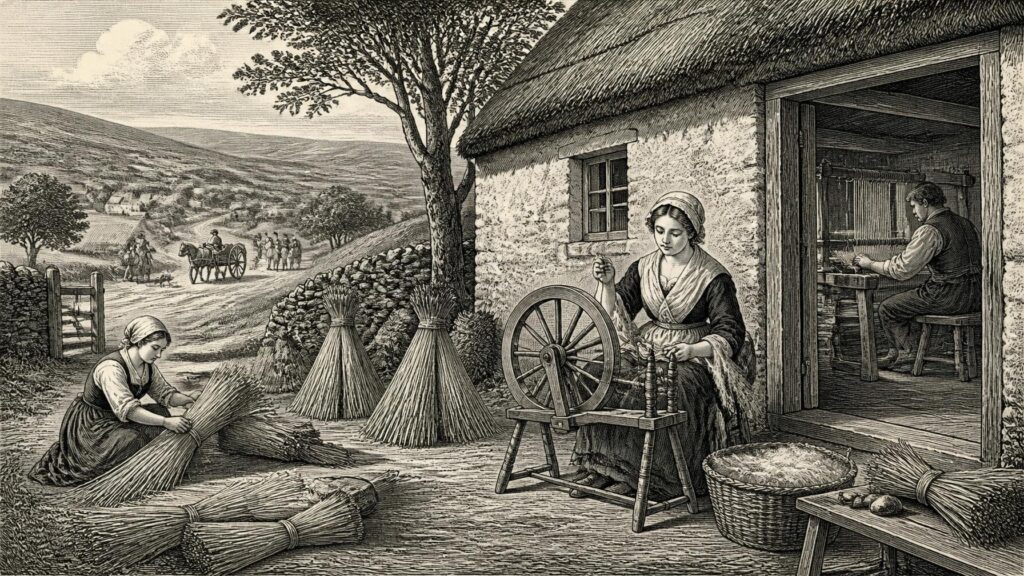
One durable development associated with 1711 was the establishment of trustees for the linen and hempen manufacture, commonly remembered as the Linen Board. Trustees were appointed in October to encourage, regulate and improve an industry regarded as especially suitable for Ireland. Linen had political value as well as commercial promise. English restrictions had damaged the Irish woollen trade, whereas linen could be promoted without presenting the same direct challenge to English producers. State encouragement therefore offered landlords, merchants and improving clergy a programme that joined Protestant settlement, rural employment and export growth.
The institution’s later work would include standards, inspection, technical improvement and assistance for flax cultivation and spinning. None of that transformation happened at once in 1711. Yet the appointment of trustees gave official form to ambitions already visible around Lisburn and other parts of Ulster, where Huguenot expertise, local capital and skilled labour had helped broaden the trade. Louis Crommelin, son of the influential linen promoter Louis Crommelin, died at Lisburn on 1 July 1711, a personal loss within a family closely identified with this expanding manufacture.
Trade figures underline both the industry’s promise and its uncertainty. Returns for the year ending 25 March 1711 recorded more than a million yards of linen cloth exported from Ireland, but less than in the preceding year. Such figures represent commercial flows rather than the experience of every spinner or weaver. Still, they point to a dispersed economy in which work on flax, yarn and cloth connected rural households to merchants, bleaching grounds, ports and markets across the Irish Sea and Atlantic world.
Ports, War and Precaution
Ireland’s coastal economy remained exposed to the wider War of the Spanish Succession. On 14 March, the government issued a proclamation encouraging naval recruitment. On 6 June it sought the capture of the crew of a French privateer. These notices indicate practical wartime concerns: men were needed for maritime service, and merchant shipping required protection from enemy raiders.
Health anxieties travelled by sea as well. A proclamation of 28 November 1710 had required ships arriving from the Baltic to undergo quarantine. Further orders on 17 August and 6 October 1711 renewed quarantine requirements for vessels from the Sound, the Baltic and other named places. The state was attempting to govern the movement of sailors, cargoes and vessels through Irish ports against the feared arrival of contagious disease. Such regulations affected merchants and mariners, but also the urban consumers dependent on imported goods.
Cattle and Rural Pressure
Late in the year, proclamations recorded another kind of insecurity. On 30 November the authorities acted to prevent the maiming and ‘houghing’ of cattle: cutting the hamstring so that an animal was crippled. On 13 December they issued a further order for enforcement against the ‘houghers’. Historians use that name for an early eighteenth-century wave of agrarian resistance, beginning in 1711 and affecting western counties including Galway, Mayo, Sligo, Roscommon and Clare.
The official language tells us most securely that cattle attacks were serious enough to attract central attention. It does not, by itself, prove the identity or motive of every attacker. Later interpretation has linked the movement to resentment of expanding grazing, landlord power and the displacement of small occupiers, particularly in parts of Connacht. That broader explanation is persuasive as context, but it should not obscure the limits of the surviving record for individual incidents. Cattle were capital, food, manure, hides and a basis of rent; crippling them was therefore an assault on property and on the economic order that protected it.
On 19 November, only days before the first cattle proclamation, the government also invalidated licences that had permitted Catholics to bear arms. This was part of the established penal framework and reflected official fears sharpened by war and confessional politics. It should not automatically be treated as a direct response to houghing: the proclamations addressed different problems and did not demonstrate such a link. Their close timing nevertheless shows how readily Dublin Castle framed security through both rural disorder and Catholic disarmament.
Thus 1711 left no single Irish national story. It brought a divisive Dublin administration, an appalling witchcraft prosecution in Antrim, a new instrument for linen improvement, maritime regulation in wartime and signs of agrarian conflict in the west. Each development was local in its immediate setting. Taken together, they show a kingdom governed through institutions whose reach was real, but whose legitimacy and effects were disputed from Islandmagee households to Connacht cattle fields and Dublin’s council chamber.
Primary Sources
- Butler, James
- Phipps, Sir Constantine
- Statute Law Revision Act 2015
- Irish Statutes Before 1922
- Possessed by the Devil: The Real History of the Islandmagee Witches and Ireland's Only Witchcraft Mass Trial
- Documents from the Trial of the “Islandmagee Witches” at Carrickfergus Assizes, County Antrim, Ireland, 1711
- History: Witches of Islandmagee
- The IslandMagee Witches
- Add MS 38160
- Monday Books
- Irish Legislation Database: Bill 0361, Session 1710
- The Crisis in Ireland and the Disintegration of Queen Anne’s Last Ministry
- The Trustees of Linen Manufacture
- History of the Commercial and Financial Relations Between England and Ireland from the Period of the Restoration
- Part 8: The Linen Manufacture
- The Kingdom of Ireland, 1641–1760
- The Irish Linen Board, 1711–1828
- Ormond Papers: Additional Collection List
- Letter of the Duke of Ormonde to the Earl of Oxford on the Election of the Lord Mayor of Dublin
- An Act for Preserving the Protestant Religion
- The Penal Laws: Origins, Purpose, Enforcement and Impact
- James Butler, 2nd Duke of Ormonde
- The Supernatural in Ulster Scots Literature and Folklore Reader