Moylurg’s Mortal Year1349 CE
During 1349, a pestilence remembered as the Black Death became an all-Ireland crisis, although its arrival and mortality cannot be dated or quantified precisely. John Clyn recorded contagion, deaths among clergy and households, pressure on burial and care, and costly imported goods in Kilkenny. Connacht annals reported heavy losses in Moylurg, while warfare, raiding and contested lordship continued across Connacht and elsewhere. Ecclesiastical vacancies exposed institutional vulnerability, though individual causes of death remain uncertain. Clyn’s final entries, ending amid violence and epidemic fear, symbolise the fragility of record-keeping. The year strained trade, worship, families and political authority without halting conflict.

Dateline
The year 1349 is one of the clearest turning-points in later medieval Irish history, yet it must be approached with unusual care. The plague’s first arrival was remembered differently by different writers: Friar John Clyn’s Kilkenny annals describe its appearance around Dublin, Howth, Dalkey and Drogheda under 1348, while his final notice states explicitly that the first pestilence in Ireland became severe in 1349. The Connacht annals, meanwhile, place a great plague in Moylurg and throughout Ireland in 1349. Rather than forcing these records into a falsely precise timetable, it is safest to see 1349 as the year in which an epidemic already reaching the island’s eastern towns became an all-Ireland crisis in contemporary memory.
Plague Across Uneven Landscapes
Modern readers call this epidemic the Black Death. Neither that name nor a medical certainty about every individual death belongs to the Irish evidence of 1349. What the sources do establish is a devastating, contagious pestilence, moving through communities already divided by language, lordship, settlement and access to trade routes. The English lordship was strongest in its towns, ports, manors and cultivated lowlands, particularly in the east and south-east. Gaelic lordships dominated or shared power across much of the west, north and interior. Those distinctions mattered because the disease travelled along human connections: ships, markets, roads, river routes, religious houses and households.
Clyn’s account, written from the Franciscan milieu of Kilkenny, conveys the terror of contagion more vividly than any statistical record could. He reported that people who handled the sick or dead were themselves infected; that confessor and penitent might be carried to burial together; and that families, servants and children often died together rather than one by one. His testimony should not be converted into a national death total. His famous figure for Dublin, and his descriptions of emptied towns and castles, are the language of a traumatised observer as well as historical evidence. Yet the force of the account lies precisely in its closeness to events: institutions responsible for care, burial and prayer were under exceptional pressure.
The chronology within Clyn’s manuscript is not perfectly simple. He places especially severe mortality at Kilkenny in Lent in the annal immediately preceding his 1349 entry, recording the deaths of eight Dominican friars between Christmas and 6 March. That evidence securely belongs to the epidemic’s first Irish phase, but cannot be assigned to a modern calendar year without qualification. What can be stated firmly for 1349 is that Clyn or a continuator identified it as the year when the first pestilence greatly intensified in Ireland. The disease did not respect the political map.
Moylurg Under Pressure
The annals of Connacht place the epidemic within a landscape already scarred by conflict. Moylurg, centred on the territory around modern north Roscommon, receives special emphasis: there was, the annalist says, a great plague in Moylurg and throughout Ireland, and many people died. Matthew, son of Cathal Ó Ruairc, was named among its victims. The naming of one casualty should not suggest that only prominent men suffered. Annals normally preserve names of rulers, clerics, poets and leading families; the anonymous dead were overwhelmingly more numerous.
Nor did warfare stop because plague had arrived. Hugh Ó Ruairc defeated Flaherty Ó Ruairc, Donnchad Ó Domhnaill and the people of Dartry. Several leaders and many others were killed. In Connacht itself, Fergal Mac Diarmata and Ruaidhrí mac Cathail fought a struggle that drew in Gaelic and Anglo-Irish allies: the annalist explicitly names the Galls and Gaels of Connacht, the Cenél Conaill and Clann Muircheartaigh. Ruaidhrí was driven to Clann Fhearmaighe but could not be captured; after his opponents withdrew without hostages or pledges, he burned, plundered and wasted much of Moylurg.
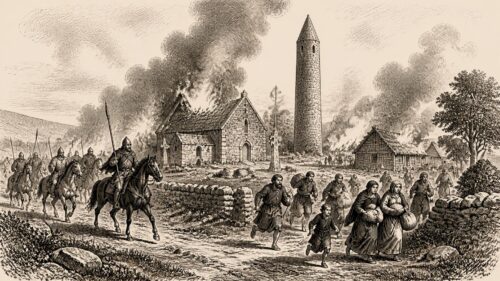
These entries matter because they prevent a misleading picture of a society frozen in place by disease. Armed followings still moved, cattle and supplies remained prizes of war, and alliances crossed cultural categories when advantage required it. Such movement may also have made conditions still harder for ordinary households: raiding destroyed food, livestock and shelter, while epidemic disease disrupted families and labour. The sources do not allow us to measure how far one crisis worsened the other in 1349, but they plainly show both operating in the same region.
Other deaths registered the fragility of lordship. Risdeard Ó Raghallaigh, king or lord of East Breifne, died that year. The annals also record the death of the unnamed grandson of an earl, following a failed foray into Connacht in which Mac William Burke and Mac Feorais defeated his party, captured him and killed or captured many of Clanricarde. These were not consequences of the plague demonstrably; they are evidence instead that succession, raiding and territorial rivalry continued amid it.
Churches, Pilgrimage and Absence
Religious communities stood close to the sick, the dying and the dead. Clyn’s description of priests and penitents being taken together to the grave captures the pastoral danger faced by clergy, friars and lay people alike. It also explains why the epidemic threatened the practical life of towns: confession, burial, charity and hospitality depended on people who could themselves fall ill. The striking pilgrimage to the water at Taughmolin, associated with St Moling, belongs to the epidemic’s earlier recorded phase, but it illuminates the religious response that shaped the crisis of 1349. Clyn had seen thousands gather there, some in devotion and many more in fear of pestilence. Faith offered ritual action where medicine offered little certainty.
In 1349 the institutional Church also lost senior figures. Alexander de Bicknor, Archbishop of Dublin since 1317, died on 14 July. His long career had linked the archbishopric with royal administration, diplomacy and the contested ambitions of the Dublin church. Only days before his death, a record associates him with grants of houses and gardens opposite St Sepulchre’s to canons of St Patrick’s Cathedral. The detail is a reminder that even in a year of extraordinary mortality, property, endowment and cathedral administration continued to matter.
The episcopal succession at Meath was also disrupted. William de Paul, the Carmelite bishop, died in July, and William St Leger was appointed in October. John de St Paul was provided to the Dublin archbishopric in September. These changes should not automatically be labelled plague deaths: the evidence does not prove that Alexander de Bicknor or William de Paul died of the disease. But the clustering of vacancies during a severe epidemic highlights the vulnerability of religious government, which relied on a limited number of trained office-holders and on communications with the papal court.
Clyn’s Last Entries
John Clyn’s own chronicle is among the year’s most important survivals. His final dated annal records a different kind of insecurity: the killing of Sir Fulk de la Freigne on the feast of St Moling. Fulk was a Kilkenny knight and administrator, recently prominent in defending and restoring the Ormond lordship’s position around Nenagh. Clyn praised him extravagantly as a lifelong soldier and defender of the commonwealth, but also stated that he was killed treacherously after trusting promises made by Irishmen. The phrasing is Clyn’s, shaped by an Anglo-Irish Franciscan observer’s loyalties; it should not be treated as a neutral account of the encounter.
Fulk’s death nevertheless demonstrates that military politics in Leinster and Munster remained dangerous at the highest level. The crown’s authority in Ireland rested not merely on distant royal commands but on local men able to hold castles, lead armed retainers, bargain with neighbouring powers and protect roads. Losing such a figure during a plague emergency could compound local instability, even though no source states that this was the immediate result.
After Clyn’s entry on Fulk, a copyist observed, “Here it seems the author died.” It is tempting to make him another certain victim of the plague. He may indeed have died in 1349, and the end of his work comes amid the mortality he described. But certainty is not possible: no contemporary notice identifies plague as his cause of death. What survives is more important than conjecture. Clyn deliberately left parchment so that someone might continue the work if any descendant of Adam escaped the pestilence. The unfinished chronicle is itself a record of fear, literary discipline and the precariousness of learning.
Prices, Ports and Material Strain
Clyn’s 1349 annal begins with a brief but revealing market notice: brass and imported spices were costly, with pepper and ginger commanding particularly high prices. The entry is too narrow to prove a general inflation rate or a complete collapse of commerce. It does, however, show that Kilkenny remained connected to overseas trade, since such goods had to reach Ireland through commercial networks already badly affected by mortality around the Irish Sea and beyond. In a year when disease had ravaged port towns and disrupted households, the price of metal and spices was worth recording.
There is no responsible basis for claiming a universal Irish harvest failure in 1349. Clyn had described the preceding plague year as fruitful despite its sickness and mortality, while the Connacht annals emphasise plague and warfare rather than weather. This silence matters. The catastrophe was not simply hunger caused by failed crops. It was a public-health shock imposed upon societies that depended on labour, seasonal cultivation, pastoral wealth, local markets, clerical services and fragile political protection.
A Year Remembered in Layers
By the end of 1349, Ireland had not become one uniform realm of plague victims. The evidence is geographically uneven, socially selective and chronologically difficult. Urban and port communities are unusually visible in Clyn’s testimony; Moylurg is unusually visible in the Connacht annals; many rural people appear only as an uncounted multitude. Yet the overlap of sources is decisive. A severe pestilence affected Ireland; it reached beyond the eastern towns; it struck Moylurg hard; it coincided with war, ecclesiastical vacancies and pressure on trade; and it brought one of medieval Ireland’s finest annalists to the edge of silence.
That is why 1349 deserves to be remembered not merely as the year of a disease, but as a year in which the routines that bound together lordship, family, worship, writing and exchange were exposed to exceptional strain. The later consequences—vacant land, altered settlements, labour shortages and renewed outbreaks—belong to subsequent years. In 1349 itself, the surviving record preserves the immediacy of loss: named lords, unnamed households, anxious pilgrims, dead friars, expensive spices and a sheet of parchment left for a survivor.
Primary Sources
- Annalium Hiberniae Chronicon ad annum MCCCXLIX
- Part 172 of Annalium Hiberniae Chronicon ad annum MCCCXLIX
- Annála Connacht
- CELT project: Annála Connacht
- Part 152 of The Annals of Ulster
- Annala Uladh: Annals of Ulster otherwise Annala Senait, Annals of Senat
- Part 18 of Annals of the Four Masters
- CELT project: Annals of the Four Masters
- A Tract on the Plague
- A Tract on the Plague
- Clyn, John
- Freigne (Frene, Fraxineto), Sir Fulk de la
- ‘Unheard-of Mortality’….The Black Death in Ireland
- Two Nations, One Order: The Franciscans in Medieval Ireland
- The Identification of Some Pestilences Recorded in the Irish Annals
- The Annals of Ireland by Friar John Clyn, ed. Bernadette Williams
- Annals Of Loch Ce Vol II
- The Dignitas Decani of St Patrick’s Cathedral Dublin
- Fasti Ecclesiae Hibernicae: The Succession of the Prelates and Members of the Cathedral Bodies in Ireland
- Swords Castle Conservation Plan
- A History of the Franciscan Order in Ireland
- Annales Hiberniae