Editorial — Tuathal son of Augaire — Death
Welcome to the Emerald Archives Gazette. In today’s issue we look back at the latest additions to the archive. Tuathal’s Death — In 958, Ireland’s annalists recorded no single battle that reordered the island, no spectacular raid on a famous monastery, and no weather disaster on the scale sometimes preserved in their terse notices. Yet the year mattered. It marked the death of Tuathal son of Augaire, overking of Leinster, at a moment when authority in the province was being contested between rival Irish dynasties and negotiated under the shadow of Viking Dublin. It also brought a cluster of deaths among abbots, bishops and church administrators.
Dateline
The Day in Irish History
Welcome to the Emerald Archives Gazette. In today’s issue we look back at the latest additions to the archive.
Tuathal’s Death — In 958, Ireland’s annalists recorded no single battle that reordered the island, no spectacular raid on a famous monastery, and no weather disaster on the scale sometimes preserved in their terse notices. Yet the year mattered. It marked the death of Tuathal son of Augaire, overking of Leinster, at a moment when authority in the province was being contested between rival Irish dynasties and negotiated under the shadow of Viking Dublin. It also brought a cluster of deaths among abbots, bishops and church administrators. Taken together, these entries reveal an Ireland in which political succession, ecclesiastical office and regional power…
Armagh Succession — For Ireland, 957 is best understood not as a year of a single recorded battle or royal assembly, but as a year in which several important offices changed hands through death. The surviving annals are terse, and their notices overwhelmingly concern kings and ecclesiastical leaders. Yet the pattern is revealing. Within a recently altered political order, the deaths of the king of Caisel, the king of Cenél Conaill, the successor of Patrick at Armagh and the superior of Glendalough touched four regions whose influence reached far beyond their immediate territories. Dating a Sparse Year The Annals of Ulster explicitly place…
Congalach’s Death — A King Killed in Leinster The decisive Irish event conventionally placed in 956 was the killing of Congalach Cnogba, king of Ireland, at Tech Giurann in Leinster. The Annals of Ulster name his attackers as the foreigners of Áth Cliath—Dublin—and the Laigin, or Leinstermen; they also record the death of Áed son of Aichid, king of Tethbae, and “many others”. Chronicon Scotorum makes the disaster still more explicit: Congalach fell with his royal household, and names Matudán son of Áed son of Máel-mithig and Cormac son of Cathalán, king of Fir Arda, among the dead. This was not a routine…
Waterway Expedition — In the annalistic record, 955 was a year in which control of Ireland’s waterways mattered as much as control of its roads and plains. Domnall son of Muirchertach, of Cenél nEógain in the northern Uí Néill, led a force with ships through a remarkable sequence of lakes and waterways: from Tuag Inbir to Lough Neagh, along the Daball, across Airgialla, on Lough Erne and finally on Lough Oughter. From there, the expedition struck Bréifne and took hostages from Ua Ruairc. The journey is one of the most vivid military notices surviving for the year. It also reveals an Ireland in…
Cattle Pestilence — The year 954 is remembered in the Irish annals less for one decisive battle than for a convergence of loss: a cattle murrain reported across the island, killing in the central midlands, pressure on the authority of the king of Tara, the death of Munster’s most conspicuous Éoganacht ruler, and the passing of senior churchmen attached to major ecclesiastical federations. The surviving notices are brief, and their chronology is not always identical from one annalistic compilation to another. Yet the entries securely assigned to 954 offer an unusually revealing view of how warfare, livestock, kingship and churches were bound together…
Clonmacnoise Raid — The clearest Irish event that can be placed in 953 is a raid on Clonmacnoise, the great ecclesiastical settlement beside the Shannon. The Annals of Ulster, under an entry calibrated as AD 952/953, says that Cluain Moccu Nóis was plundered by the men of Munster “accompanied by foreigners”. Chronicon Scotorum, whose chronological framework differs, specifies that these foreigners were from Limerick. The agreement on the raid is more important than the disagreement in annal headings: modern chronological work conventionally places the episode in 953, though no surviving source supplies a day, season or narrative of the attack. A Raid at…
Amlaíb’s Return — The Irish evidence for 952 is not dominated by one great battle or royal assembly. Instead, it records a series of deaths among kings, heirs and ecclesiastical leaders, while events across the Irish Sea transformed Dublin’s political prospects. That combination makes the year important. Amlaíb Cuarán, the Hiberno-Norse ruler who had spent much of the 940s competing for York, was expelled from Northumbria in 952. Modern reconstructions place his return to Dublin in the same year, though no Irish annal supplies a day, landing-place or narrative of his arrival. His renewed presence marked a decisive reorientation: Dublin’s king could no…
Cennétig’s Death — The evidence for 951 CE is unusually revealing, but it must be handled with care. The Annals of Inisfallen, whose entries are arranged under the calendar year 951, record a Munster foray that struck both Clonfert and Clonmacnoise, and the death of Cennétig son of Lorcán, a leading ruler of north Munster. Other annals preserve closely related material under differently aligned year-headings. The Annals of Ulster, for example, explicitly label their U951 section “AD 950 alias 951”. They cannot therefore be treated as proof that every event placed there occurred within the modern calendar year 951. This article distinguishes the…
Muine Brócáin — The year 950 was decisive not because it produced a settled ruler of Ireland, but because it destroyed the most formidable challenger to one. Ruaidrí ua Canannáin of Cenél Conaill, a northern Uí Néill dynast, had spent months pressing into the midlands and Brega. By the year’s end he was dead at Muine Brócáin, together with his kinsman Niall, after a counterstroke by the foreigners of Dublin. The immediate winner was Congalach Cnogba, ruler of Brega and claimant to the kingship of Tara. Yet the annals show a country in which victory remained provisional: kings were killed by relatives, churches…
Flaithbertach’s Death — For Ireland in 949, the surviving record is brief, regional and unusually revealing about the limits of certainty. The most secure cluster of notices comes from annals whose year-headings do not align perfectly. The Annals of Inisfallen place the death of Flaithbertach, son of Muirchertach and grandson of Niall, under 949. The Annals of Ulster record that Ua Canannáin raided Fir Lí and killed Flaithbertach ua Néill under an entry labelled “948 alias 949”. The later Annals of the Four Masters place a corresponding killing under 947. This is not a reason to dismiss the event; it is a reason…
Blacair’s Death — In 948, a sharp reversal in the struggle for Dublin ended the life of Blacair, a leading ruler of the town’s Scandinavian dynasty. The Annals of Ulster record that Congalach mac Máel Mithig killed Blacair, described as ‘king of the foreigners’, and that 1,600 of Blacair’s people were killed or taken captive. Chronicon Scotorum also records Blacair’s death at Congalach’s hands, though it gives the lower figure of a thousand and says that he was killed ‘by cunning’. The entries do not supply a day, a battlefield or a full narrative. The event should therefore be understood as a campaign…
Sláine Battle — The most consequential recorded clash connected with Ireland in 947 occurred at Sláine, beside the Boyne in the heart of Brega. The Annals of Ulster state that Ruaidrí ua Canannáin led an army there, where he was met by a coalition of “foreigners and Irish”: Congalach son of Máel Mithig and Amlaíb Cuarán. The Dublin contingent was defeated, and many of its men were killed or drowned. No day, season or detailed battlefield narrative survives. Yet the entry is unusually revealing. It places the struggle for pre-eminence in Ireland at a river crossing and political centre close to Tara, and…
Tara Rivalry — The year 946 sits in a difficult but revealing stretch of Irish history. It was a time when the claim to be king of Ireland was real enough to inspire campaigns, alliances and tribute, but not strong enough to make the island a single kingdom. Power rested in regional dynasties, church federations and the new Hiberno-Scandinavian town of Dublin. In the midlands and north-east, two Uí Néill contenders, Congalach Cnogba of Brega and Ruaidrí ua Canannáin of Cenél Conaill, were testing one another’s strength. Dublin’s ruler, Amlaíb Cuarán, was not an outsider to that contest: his forces could be allies,…
Lough Neagh — For Ireland, 945 is a year best approached through a small but unusually revealing group of annalistic notices: a hard freeze, the destruction of a Scandinavian fleet on Lough Neagh, a change of ruler in Dublin, a clash involving the leading claimant to wider Irish kingship, and the deaths of rulers and churchmen. The evidence is concise and its chronology requires care. The Annals of Ulster place these reports under their annal U945, though their heading itself gives “AD 944 alias 945”; other annal compilations sometimes shift related events by a year or more. No source supplies dates within the…
Dublin Plunder — In 944, a changing of rulers at Tara coincided with a forceful attack on Dublin. The two developments were closely connected. Donnchad Donn, king of Tara and the leading figure among the Southern Uí Néill for a generation, died after twenty-five years of rule. In the same annal-year, Congalach son of Máel Mithig of Brega, allied with Braen son of Máel Mórda, king of Leinster, plundered Áth Cliath, the settlement known in Old Norse as Dyflinn and later as Dublin. The annals present these events compactly, but together they reveal a country in which claims to lordship, access to portable…
Irish Immigration — Ireland’s history cannot adequately be told as the story of a people who only left. Emigration is undeniably central to Irish memory, family history and political imagination, but the island has also long received settlers, soldiers, artisans, refugees, students, labourers, spouses and returning descendants. Immigration has repeatedly tested, enlarged and sometimes hardened ideas of who could belong. The resulting history is neither a simple tale of tolerance nor one of permanent exclusion. It is a record of changing power, law, religion, language, class and race, in which Irish identity has been made and remade rather than inherited unchanged. Historical Approach…
Muirchertach Killed — In 943, a sudden northern catastrophe altered the balance of Irish politics. Muirchertach mac Néill, king of Ailech and one of the foremost members of the Northern Uí Néill, was killed by a force from Viking Dublin. The loss was more than that of a successful war leader. Contemporary annalists styled him rígdamna Érenn, a man eligible for the kingship of Ireland, and the Annals of Ulster mourned him in a short verse as though the land of the Irish had been left bereft.The year’s evidence is concentrated, violent and uneven. It records clashes around Strangford Lough, the killing of…
Blacair’s Raids — A Year of Raids and RetaliationThe Irish annals place a concentrated sequence of events in 942, though their year-headings do not always align neatly with modern calendar reckoning. The Annals of Ulster label this section “AD 941 alias 942”, while the related Chronicon Scotorum enters comparable material under 942. Modern historical reference works accordingly treat the raid on Dún Lethglaise, now Downpatrick, and Blacair’s attacks on Clonmacnoise and Kildare as events of 942. No source supplies a day or month for these incidents. What can be said securely is that this was a year in which the Norse rulers and…
Cashel Submission — The winter that opened 941 was severe enough to enter the historical record before any king or battle did. The Annals of Ulster note a great frost that made lakes and rivers passable; Chronicon Scotorum adds a vivid local consequence: ‘foreigners’ crossed the ice to plunder Inis Mochta, the ecclesiastical island now known as Inishmot in Meath. This was not merely colourful weather reporting. Frozen waterways temporarily became roads, altering the reach of raiders, messengers and armed parties, while hard weather placed extra strain on livestock, fuel supplies and winter food stores. In a year of movement and violence, Muirchertach…
Aralt’s Death — The record for 940 is brief, but it catches Ireland at a moment when authority had to be made visible by movement: armies crossing provincial boundaries, rulers taking hostages, a Scandinavian leader dying in Connacht, and churches remaining important enough to be named among the year’s losses. The evidence is chiefly annalistic, and it requires care. The Annals of Ulster label their section ‘AD 939 alias 940’, reflecting a known difficulty in the annals’ chronology; Chronicon Scotorum and the Annals of Inisfallen place closely related notices under 940. It is therefore responsible to connect these events to 940 while avoiding…
Ailech’s Ransom — The evidence for 939 is unusually vivid, but it must be handled with care. Irish annals do not provide a modern diary of the year: entries are brief, their chronological headings can drift, and later compilations sometimes place the same episode under a different year. The Annals of Ulster, whose heading explicitly acknowledges an overlap between 938 and 939, supplies the firmest framework. Chronicon Scotorum preserves closely related notices, alongside material absent from Ulster. Taken together, they show an Ireland in which kingship, church wealth, captive-taking and seaborne power were tightly entangled. The year’s defining event was the attack on…
Dublin Siege — The year conventionally labelled 938 in modern histories was a sharp, unsettled year in Ireland. Its surviving notices are brief, but they cluster around an unusually revealing sequence: a change of ruler in the northern kingdom of Ailech; an avoided war between two great Uí Néill rivals; the return of Amlaíb son of Gothfrith to Dublin; a devastating raid on Cell Cuilinn; and a joint expedition against the Dublin Norse. These were not isolated incidents. Together, they show how authority, religion, land and people could all become stakes in the struggle around Dublin and Leinster. Dating a Difficult Year Early…
Conaing’s Heirship — For Ireland, 937 is best understood through a small but unusually revealing cluster of annalistic notices. The record does not offer a single national narrative: it reports deaths, killings and a storm in several provinces, while also preserving Ireland’s connection to one of the most consequential battles of tenth-century Britain. Its most striking Irish political notice is the death of Conaing son of Niall, described in the Annals of Ulster as rígdamna Érenn, ‘heir designate of Ireland’. The phrase did not mean that a settled succession would automatically follow. Rather, it signalled that Conaing stood within the narrow, competitive circle…
Clonmacnoise Raided — In 936, the River Shannon was both Ireland’s great inland road and a dangerous frontier. At Clonmacnoise, the famous ecclesiastical settlement on its eastern bank, the annals record an episode that their writers regarded as extraordinary: the foreigners of Áth Cliath, or Dublin, plundered the site and remained there for two nights. The Annals of Ulster add that this was something “unheard of from ancient times”. The phrase should not be read as a literal claim that Clonmacnoise had never before been attacked. It had suffered raids in earlier generations. Rather, it conveys the shock that a raiding force from…
Amlaíb’s Raids — The clearest contemporary Irish annalistic dossier for 935 is short, but it is unusually revealing. It records a concentrated assault by Amlaíb, son of Gofraid and grandson of Ímar, on two important places in the Boyne valley; the killing of a Leinster ruler by Norsemen; several notable ecclesiastical deaths; and an exceptional abundance of oak mast. Read together, these notices show an Ireland in which violence, rulership, monastic organisation and the seasonal economy were inseparable. They also require care. Irish annals do not always align their year-numbers: the Annals of Ulster place this dossier under 935 while noting an alternative…
Gofraid’s Death — A Sparse but Consequential Record The surviving Irish record for 934 is unusually brief, but it captures a meaningful change in the politics of the Irish Sea. The most securely dated development is the death from illness of Gofraid, grandson of Ímar, king of the foreigners. In modern historical terms, he was the Hiberno-Scandinavian ruler of Dublin and a leading member of the Uí Ímair dynasty, the kindred whose power linked Dublin to northern Britain, the Isles and, intermittently, York. The Annals of Ulster, under its entry for 934, calls Gofraid “a most cruel king of the Norsemen” and says…
Armagh Plunder — The evidence for 933 CE presents Ireland not as a single kingdom but as a densely connected field of local powers, ecclesiastical centres and armed fleets. The year is unusually revealing because several annals preserve a chain of northern conflicts involving Muirchertach son of Niall, Conaing son of Niall, the Ulaid, men described as “foreigners”, and Armagh. Yet it also requires care. The annals’ year-numbering is not wholly uniform: the Annals of Ulster label their relevant section “AD 932 alias 933”, while Chronicon Scotorum places much the same sequence under 933. The discussion below therefore treats the northern episodes as…
Aengus’s Death — For Ireland in 932, the surviving record is unusually spare but still revealing. One annal names the death of Aengus son of Aengus, identified by its modern editor as chief poet of Ireland. Another records the killing of Flann son of Máel Sinna, king of Brega, and the deaths of Loingsech, king of Dál Araide, and Colla, king of Limerick. These short notices do not describe a single national drama. Instead, they preserve fragments from several political worlds: a poet’s standing across Ireland, violent competition in the central east, a change of ruler in north-east Ulster, and succession in the…
Ciarán’s Crozier — For Ireland in 931, the surviving record is unusually revealing precisely because it is not dominated by a single battle or royal expedition. It preserves a cluster of deaths among rulers and churchmen, a Scandinavian movement onto Lough Ree, and a remarkable mishap involving the crozier of St Ciarán. Taken together, these notices show a country in which political authority, ecclesiastical wealth and control of waterways were closely entwined. Yet they must be handled carefully. Irish annals did not all reckon years in precisely the same way, and later compilations sometimes place an event one or more years apart. The…
Derc Ferna — The surviving record for 930 is unusually revealing not because it describes one island-wide war, but because several annals catch armed Scandinavian groups operating at three inland waters: Loch Bethrach in Osraige, Lough Neagh in the north, and the routes connected with the Shannon and Limerick. The sharpest event was the assault on Derc Ferna in Osraige. The Annals of Ulster say that Gofraid, grandson of Ímar, came with the foreigners of Dublin and ‘razed’ the place, an act presented as extraordinary even by the standards of earlier devastation. Chronicon Scotorum calls it a siege and capture, adding a grave,…
Céile’s Pilgrimage — For Ireland in 929, the surviving record is unusually revealing precisely because it is so spare. There is no securely dated island-wide battle, harvest failure or royal inauguration to dominate the year. Instead, the principal annalistic notices follow people in motion: a celebrated Irish churchman dies at Rome; a king of Tara leads an armed expedition against a northern rival; a fleet appears on Lough Corrib; and senior ecclesiastics and regional leaders pass from the scene. Taken together, these entries show an Ireland whose political and religious life extended far beyond any single kingdom or monastery. The evidence also requires…
Lake Raiding — In the annalistic record conventionally assigned to 928, the most vivid Irish event is neither a pitched battle nor an inauguration, but a fleet moving across Lough Neagh. The Annals of Ulster report that “Ailche’s son” entered the lake with a force of Gall, or foreigners, and ravaged its islands and surrounding territories. The brief notice gives no tally of ships, casualties or booty. Yet it reveals how a large inland waterway could become a route of attack, joining the military politics of the Irish Sea to communities in the northern interior.The year also records royal deaths, dynastic killing, ecclesiastical…
Kilmallock Battle — For Ireland, 927 is best approached as a carefully bounded annalistic year rather than as a neatly documented twelve-month story. The surviving chronicles do record significant events under this date, but they do not always agree on placement. The Annals of Inisfallen, compiled within a Munster-centred tradition, place two matters firmly beneath 927: the death of Máel Brigte son of Tornán, abbot of Armagh and of Í Coluim Chille, and a victory at Cell Mo-Chellóc over the foreigners of Waterford. Other annals attach related political news to headings whose year-counts can differ by one year. The differences are not a…
Alpthann’s Rout — For Ireland, 926 is unusually well illuminated by terse but connected annalistic notices. They place a Scandinavian force from Loch Cuan, modern Strangford Lough, in violent motion across the north-east; they record two successes by Muirchertach son of Niall; and they preserve the death of Colmán son of Ailill, head of both Clonmacnoise and Clonard. A Munster annal also notes the striking movement of Waterford’s fleet to Loch Gair. These are not ingredients for a continuous campaign narrative: medieval annals preserve outcomes, not dispatches. Yet together they show how coasts, lakes, river crossings, monasteries and royal networks made Ireland’s politics…
Tadc Usurpation — The most securely dated Irish development of 925 was a change of kingship in Connacht, brought about not by a public battle but by death, kin-killing and succession within one ruling family. Cathal son of Conchobar, king of Connacht since about 900, died “in penitence”, according to the Annals of Ulster. His death was followed by the treacherous killing of his son Domnall and other prominent Connacht men by Cathal’s kinsman Tadc. Tadc then became king. The bare annalistic notices are unusually compressed, but their combination makes 925 a consequential year: a long-established provincial ruler died, his apparent successor was…
European Membership — Ireland’s relationship with the European Union is among the decisive stories of the modern State. It cannot be reduced to grants, motorways or Brussels regulations, although all became visible features of membership. It is the history of a country seeking room for independent action while tied economically to Britain; of voters repeatedly asked to authorise international commitments; of farmers, workers, officials and students whose opportunities changed; and of an island whose border acquired a new significance after the United Kingdom chose to leave the Union. Island Economy When Ireland entered the European Economic Community on 1 January 1973, it joined…
Erne Raiding — In 924, Ireland’s waterways became theatres of prolonged violence. The most securely associated annalistic record, the Annals of Ulster entry conventionally cited as U924, describes a foreign naval force operating on Lough Erne, raiding its islands and the districts around the lake before withdrawing only in the following summer. Other entries place raiders in Strangford Lough, report a catastrophic wreck at the entrance to Dundrum Bay, and record an unsuccessful expedition sent from Dublin towards Limerick. Taken together, these notices show an island in which ships could bring danger far inland, but also one in which Viking leaders competed sharply…
Ellen Hanley — ‘The Colleen Bawn’ is not the name Ellen Hanley was born with, but the name through which her death became one of the most persistent stories of nineteenth-century Ireland. Behind it stands a young woman from County Limerick, killed in 1819, two men tried and executed in 1820, and a long afterlife in fiction, melodrama, opera, tourism and local remembrance. The historical record is substantial but incomplete. It establishes a violent crime and the legal pursuit of those held responsible; it does not justify every picturesque detail repeated in later retellings. To recover Ellen Hanley’s history, it is necessary to…
Cell Shléibe — The record for 923 is concentrated in the north and east of Ireland, but its implications reach much further. It shows a country in which religious communities remained centres of learning, wealth and local authority; in which kingship depended on vulnerable family lines; and in which Scandinavian fleets could use sea-loughs and river approaches to strike deep into settled districts. The year’s clearest episode was the plundering of Cell Shléibe, now Killeavy in south Armagh, by raiders operating from Snám Aignech, the Carlingford Lough area. During the attack Duiblitir, a priest of Armagh, was killed.There is an important chronological caution.…
Border Policing — Cross-border policing on the island of Ireland is a history of institutions learning to work across a line that was politically charged, legally consequential and, in ordinary life, often highly permeable. Organised crime did not create that problem, but it has made its persistence unusually clear. The history is neither a simple tale of two police services overcoming old enmities nor a story of criminals effortlessly exploiting an “open border”. It is, rather, the record of practical cooperation growing unevenly out of partition, conflict, legal difference, personal contact and constitutional change. Historical Setting The modern subject begins with partition. The…
Edwardian Ireland — Edwardian Ireland was neither a tranquil prelude to revolution nor merely a provincial extension of Britain’s Edwardian age. Between the accession of Edward VII in 1901 and his death in 1910, Ireland remained governed from Westminster and administered through Dublin Castle, yet its social order, political vocabulary and public culture were changing rapidly. Tenant purchase weakened the old landlord system; emigration continued to drain communities while remittances sustained many households; Belfast’s factories and shipyards displayed industrial confidence beside sharp inequality; and cultural, feminist, labour and constitutional movements each proposed competing futures. The decade did not make the upheavals after 1912…
Peace Process — The peace process in Ireland did not emerge from a single dramatic revelation, nor can it be reduced to the signatures placed on the Belfast Agreement on 10 April 1998. It was made through years of public argument, private contact, official memoranda, draft texts, constitutional calculation and painstaking record-keeping. State papers are indispensable to that history, but they are neither neutral nor complete. They show how governments understood the conflict, how they sought to manage risk and how British-Irish co-operation became central to a settlement; they do not, by themselves, contain the full experience of violence, bereavement, political mobilisation or…
RTÉ Broadcasting — When 2RN began broadcasting from Dublin on 1 January 1926, it gave the young Irish Free State a new instrument of public address. Its centenary is therefore not simply an anniversary in media history. It is an occasion to examine how sound, and later television, helped make a national audience; how that audience remained divided by class, geography, language and politics; and how a broadcaster created by the State gradually acquired a more complicated public identity as Raidió Teilifís Éireann. Centenary Meaning The label “RTÉ centenary” needs a little care. RTÉ, in the legal and corporate sense, did not exist…
Culture Night — Culture Night, or Oíche Chultúir, is a recent institution rather than an ancient custom, yet its history already reveals much about Irish public life. Begun in Dublin in 2006 as a single evening of free, late opening by forty cultural venues, it became a recurring national occasion in which museums, theatres, libraries, archives, heritage sites, streets, studios and community spaces invite people to enter, look, listen and take part. Its success was not inevitable. It depended upon civic partnerships, public subsidy, voluntary labour, a changing urban night-time economy and a persistent belief that culture should be encountered as a common…
Oisín Journey — Tír na nÓg, conventionally translated as the Land of Youth, is not a recoverable prehistoric place, nor a single unchanging ‘Celtic myth’. It is a powerful Irish imaginative tradition formed across many centuries: through medieval Irish accounts of the Otherworld, Fenian stories of Oisín, early modern and eighteenth-century poetry, nineteenth-century print, and twentieth-century oral recollection. The familiar tale of Niamh, Oisín and the fatal return to Ireland belongs to that long history, but its best-known narrative shape must be distinguished carefully from the much older body of Irish literary evidence that helped to make it possible. Names Matter The Irish…
Irish Foodways — Food in Ireland has never been merely a catalogue of dishes. It has been a means of survival, an expression of rank and hospitality, a commodity shaped by landholding and export, and a field in which women’s domestic labour was especially consequential. The potato is indispensable to this history, and the Great Famine made it inseparable from Ireland’s historical imagination. Yet an Irish history of food is much broader: it begins with grain, cattle, milk and shore-gathering; includes butter preserved in bogs, fish supplied through religious and commercial networks, ale and bread at feasts, and the work of gardens, hearths…
Irish Politics — Irish politics has never been a single, uninterrupted story of national advance. It has been shaped by overlapping systems of lordship, colonial administration, parliamentary privilege, popular mobilisation, religious division, revolutionary government, partition and constitutional democracy. Its most enduring disputes have concerned a deceptively simple question: who possesses the legitimate authority to make law for the people of Ireland? The answers have varied sharply according to period, place and political allegiance. They have also been conditioned by unequal access to property, votes, office, education and force. A historical account therefore needs to resist both the comforting idea that present institutions were…
Tomrair’s Raid — What Can Be DatedThe year conventionally labelled 922 is unusually revealing, but it demands care. Ireland’s surviving annals do not always align their year-numbers exactly: the Annals of Ulster head their relevant notice “921 alias 922”, while the Annals of Inisfallen place the principal campaign under 922. The broad sequence is nevertheless secure. A fleet based at Luimnech, or Limerick, penetrated the Shannon system, attacked major ecclesiastical communities and carried its operations into the midlands. This was not a single isolated robbery. It showed how a well-led Scandinavian force could use Ireland’s waterways to turn western access into a threat…
Parliamentary Ireland — Parliamentary history in Ireland is not the story of one uninterrupted national institution. It is the history of successive assemblies, claims of authority and systems of representation which operated under changing conditions of conquest, colonial rule, religious division, union, revolution, partition and constitutional democracy. From medieval gatherings within the English lordship to the contemporary Oireachtas and Northern Ireland Assembly, the word “parliament” has carried different meanings for different communities. Its buildings, rituals and laws have endured in public memory; its franchises and exclusions reveal how restricted political power often was. Early Assemblies Parliament in Ireland developed within the political order…
Gofraid’s Raid — The events conventionally placed in 921 reveal an Ireland in which political authority, religious prestige and sea power were tightly entangled. The year is unusually well illuminated by the Irish annals, but it also demonstrates why their dates must be handled carefully. The Annals of Ulster labels its section “920 alias 921”, while the related annalistic traditions sometimes distribute the same events under neighbouring years. This article therefore treats the sequence as belonging to 921 in modern historical convention, while avoiding claims for exact dates except where an annal itself supplies one. A New Ruler in Dublin At the centre…
Irish Warfare — Ireland’s military past is neither a simple tale of resistance nor a continuous national tradition. It is a long, contested history of armed communities, foreign and domestic armies, local lordships, imperial institutions, revolutions and state forces. Its evidence lies in bronze weapons, ruined fortifications, annals, government papers, regimental records, oral testimony and graves. These sources reveal changing methods of war, but also a constant truth: military power repeatedly altered landholding, political authority, migration, memory and civilian life. Evidence Limits “Military” is an especially broad subject in Irish history. It can mean the organised violence of early communities, the household forces…
Dublin Infrastructure — Dublin’s housing history cannot be separated from its infrastructure. Water mains, drains, streets, canals, railways, trams, fire services and public transport have determined where homes could be built, how healthy they were, and whether their inhabitants could reach work, school, markets and one another. Equally, successive housing crises exposed the limits of civic provision. The city’s celebrated Georgian fabric, its notorious tenements, its garden suburbs, its high-rise experiments and its later regeneration schemes form not a simple story of progress, but a record of recurring conflict between land, finance, public health, class and democratic responsibility. Urban Foundations Dublin developed at…
Irish Dinosaurs — Yes, dinosaurs almost certainly lived in the region that later became Ireland, and two confirmed dinosaur bones from County Antrim provide the island’s direct fossil evidence. Yet the fuller answer is necessarily cautious. Ireland has yielded no dinosaur skeleton, no certain dinosaur trackway and no rich dinosaur-bearing formation comparable with those of southern England. Its record is thin not because dinosaurs avoided the land, but because the rocks most likely to preserve them are largely absent, buried, eroded or marine in origin. Direct Answer The question “were there ever dinosaurs in Ireland?” seems at first to demand a simple yes…
Cormac’s Death — Events conventionally placed in 920 show Ireland in a hard, unsettled interval: a newly established overking at Tara was testing his authority; Dublin’s Scandinavian ruler departed; a major church at Cenannas (Kells) was violently attacked; and, in the south-east, a king who was also a senior churchman was killed. These are not parts of one recorded campaign. The annals preserve them as separate notices, and their early medieval chronological systems do not always align perfectly. Yet together they reveal how closely warfare, kingship, religious institutions and control of strategic settlements were bound together. A Year Recorded with Caution The principal…
Constitutional Ireland — Ireland’s constitutional history is not a single march towards a finished national settlement. It is a record of competing sovereignties, changing ideas of representation and citizenship, and recurrent arguments over the relationship between law, religion, territory and democratic authority. From the eighteenth-century parliament in Dublin to the popular referendum that approved Bunreacht na hÉireann in 1937, constitutional documents were both products of political struggle and instruments through which later struggles were conducted. Constitutional Meaning A constitution may be understood in two connected senses. It can mean the broad arrangement of political power: who makes law, who administers it, who judges…
Irish Houses — A house is never only a roof over a family. In Ireland its changing forms preserve evidence of farming and inheritance, conquest and landlordism, craft and climate, migration and poverty, aspiration and public policy. From excavated timber dwellings to Dublin tenements, whitewashed cottages, suburban semis and council estates, the Irish house records how people made homes within unequal distributions of land, labour and security. Its history is therefore not a simple procession of architectural styles. It is a history of ordinary life, told partly by surviving walls and plans, partly by archaeology and official surveys, and partly by documents whose…
Niall’s Defeat — In 919, the struggle for Dublin produced one of the most consequential defeats of early medieval Irish politics. Niall Glúndub, king of Tara and leading figure of the northern Uí Néill, was killed when an Irish coalition attacked the Scandinavian rulers of the reoccupied settlement at Áth Cliath. The annals’ stark notice of a battle conceals a disaster of unusual scale: regional kings, royal heirs and noblemen from several northern dynasties died alongside him. Dublin’s rulers, led by Sitriuc Cáech, survived the assault. Their success did not make Ireland a Scandinavian kingdom, but it secured a major coastal power at…
Housing Governance — Housing, planning and local government in Ireland developed together because none could be separated from the others. A dwelling required land, roads, water, drainage and finance; its condition raised questions of health and property; its location determined the shape of towns, cities and rural settlements. The institutions that dealt with these matters were never merely technical. They expressed changing ideas about poverty, citizenship, public duty, private ownership and the authority of the State. Ireland’s record is therefore not a simple ascent from slum to suburb, nor a tale in which legislation automatically became lived improvement. It is a history of…
Holocaust Remembrance — Holocaust remembrance in Ireland is not the history of a country in which the Nazi extermination programme was carried out. It is, rather, the history of how a small neutral state, its Jewish community, refugees, survivors, diplomats, teachers, artists and public institutions came to recognise that geographical distance did not amount to moral detachment. The Irish record contains generosity and courage, particularly in individual lives, but also exclusion, restricted refuge and long silences. Its later commemorative culture has therefore acquired meaning not only by recalling crimes committed elsewhere in Europe, but by confronting the ways Ireland was connected to those…
Ragnall’s Expedition — The evidence for 918 is unusually revealing precisely because it is narrow. Ireland’s annalists did not preserve a general chronicle of weather, harvests, markets or household life for this year. Instead, the Annals of Ulster set down a sequence of deaths, a continuing war around Dublin and Brega, and the departure of a major Scandinavian force from Waterford Harbour. Taken together, those notices show an island whose political balance remained unsettled after the Scandinavian return of 917. They also show that Ireland was not on the edge of events: fleets raised or based on its coasts were shaping the struggle…
Eugene Sheehy — Limerick Origins Father Eugene Sheehy was neither a conventional parish priest nor a dependable spokesman for any one Irish political camp. From the Land War of the early 1880s to the Easter Rising of 1916, he repeatedly crossed boundaries that churchmen were expected to observe: between pastoral duty and agitation, constitutional nationalism and separatist sympathy, local Limerick life and the Irish-American world. His career illuminates the political uses of clerical authority in modern Ireland, but it also demonstrates its limits. Admired by parishioners and radicals, he was distrusted by bishops and never wholly absorbed by the organisations with which he…
Dublin Recaptured — For Ireland, 917 is conventionally remembered as the year in which Sitriuc, grandson of Ímar, regained Dublin for the Scandinavian dynasty later called the Uí Ímair. It was also a year of hard weather, losses among livestock and wildlife, sharp regional fighting, and a disastrous defeat for Leinster. Yet the evidence needs careful handling. Medieval Irish annals do not always place events under identical year-headings: the Annals of Ulster label this sequence “916 alias 917”, while the later Annals of the Four Masters place much of it under 915. Modern synchronised chronology conventionally assigns the campaign to 917. One date…
Tailtiu Renewal — In 916, Ireland’s political centre of gravity shifted with unusual clarity. On 25 May, Flann Sinna, king of Tara and the dominant ruler of the southern Uí Néill for nearly four decades, died. His death was not merely the passing of an elderly king: it ended a long personal regime which had held together the kingship of Mide, influence in Brega, alliances with major churches, and a contested claim to island-wide precedence. Niall Glúndub of Cenél nÉogain succeeded to the kingship of Tara, renewing the Fair of Tailtiu in an emphatic public demonstration of authority. Yet, at the same time,…
Niall’s Ascendancy — The year 915 was not marked by a single battle that settled Ireland’s affairs. Instead, it exposed how precarious authority could be: an elderly king of Tara faced revolt from his own sons; a northern ruler intervened to restore a family peace; two important dynastic figures died within weeks; and Scandinavian forces based around Waterford Harbour continued to menace the south. The Irish annals offer unusually sharp glimpses of these developments, but their chronology must be handled with care. The Annals of Ulster places its material under a heading reading ‘AD 914 alias 915’, while Chronicon Scotorum gives the same…
Changing Ireland — Changing Island Ireland’s history cannot be reduced to a single uninterrupted national story. It is the history of an island shaped by migration, Atlantic connections, local lordships, religious change, colonial conquest, famine, diaspora, competing constitutional loyalties and repeated efforts to reconcile identities. The names Ireland, Éire and the island itself have held different political meanings at different times. A responsible account therefore distinguishes the geographical island from the modern Republic of Ireland and Northern Ireland, and distinguishes documentary evidence from later patriotic memory and folklore. Situated at Europe’s western edge, Ireland was never isolated in the absolute sense sometimes implied…
Limerick Remade — Limerick’s history is inseparable from the River Shannon: its islands, fords, tidal waters and bridges made the place a meeting point, a port, a defensive position and, repeatedly, a battlefield. The city’s distinctive character was made not by one founding moment but by successive communities—prehistoric settlers, Gaelic dynasties, Viking traders, Anglo Norman colonists, merchants, soldiers, labourers and migrants—who adapted a strategically difficult landscape to their own needs. River Landscape Limerick stands at a decisive point on Ireland’s longest river. Here the Shannon, broadening towards its estuary, divides around King’s Island and meets the Abbey River. The position offered access inland…
Waterford Fleet — In 914, Ireland’s political map was still dominated by provincial dynasties and by the competing branches of the Uí Néill, but a new force arrived on the southern coast. The year is best remembered for the appearance of a large Scandinavian fleet in the Waterford harbour region, known in the Irish annals as Loch dá Caech and associated in other evidence with Port Láirge. Its arrival marked more than another passing raid. It opened the second major phase of Viking activity in Ireland after the long interruption that followed Dublin’s expulsion from the Irish record in 902. A Fleet at…
Umall Defeat — The year conventionally assigned to 913 was marked less by a single island-wide turning point than by hard campaigning, regional bloodshed and the vulnerability of sea routes. Its most substantial recorded Irish action was Niall son of Áed’s expedition into north Connacht, where the king of Ailech defeated the Uí Amalgada and the men of Umall. Yet the surviving annals also preserve an assault on a north-eastern king, a battle involving Brega and Leinster, an Irish naval reverse on the English coast, the ransom of a Welsh pilgrim, and a bleak notice of rain and darkness. Together these terse reports…
Armagh Sanctuary — For Ireland, 912 is a year best approached through a small but unusually revealing group of annal entries. They do not offer a single national narrative, and their year-numbering is not perfectly uniform between chronicles. Yet Chronicon Scotorum and the later annalistic tradition preserve a firmly associated episode at Armagh: Cernachán son of Duiligén violated the sanctuary of Patrick’s church by removing a captive, who was then killed at Loch Cerr. Niall son of Áed, king of Ailech, subsequently had Cernachán drowned in the same lake. The incident brings law, kingship, church privilege and violence into sharp focus. A Violation…
Ailech Succession — In 911, a change of ruler in the northern kingdom of Ailech took place without a recorded battle. Domnall son of Áed Findliath, king of Ailech, “assumed the pilgrim’s staff”: in the language of the annals, he withdrew from secular rule for a religious life. His brother Niall then took the kingship. The notice is brief, but its consequences were considerable. Ailech was the leading kingship of Cenél nÉogain, one of the two great branches of the Uí Néill, and Niall would soon become one of the most forceful figures in Irish politics. For 911 itself, however, the dependable story…
Irish Universities — The history of the university in Ireland is not the story of one continuous national institution steadily becoming more inclusive. It is a history of rival foundations, religious disputes, imperial policy, regional ambition, intellectual endeavour and constitutional change. From medieval schools and monastic libraries to Trinity College Dublin, the Queen’s Colleges, the National University of Ireland and Queen’s University Belfast, higher learning repeatedly became a means by which competing authorities sought to define Ireland’s future. Learning Before University education, in the strict corporate sense familiar in later European history, was a late arrival in Ireland. Medieval Ireland possessed notable centres…
Bréifne Defeat — The securely dated core of 910 is not a Viking landing or a famous royal death, but a hard-fought assertion of power in Ireland’s central and western midlands. Flann Sinna, king of Tara and leading ruler of the southern Uí Néill, defeated the men of Bréifne with the help of his sons. The encounter, recorded in the Annals of Ulster and more fully in Chronicon Scotorum, cost the life of Flann son of Tigernán, king of Bréifne, as well as other nobles. It was a severe reverse for a kingdom situated on Mide’s north-western approaches, and a reminder that Flann’s…
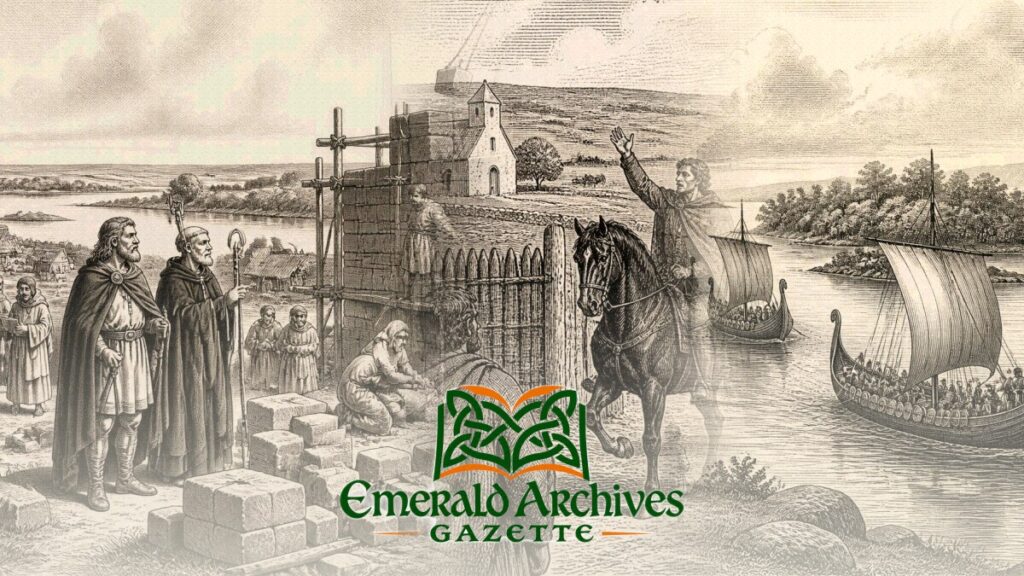
Clonmacnoise Church — A Recorded Building Campaign The most substantial Irish development securely attached to 909 was not a battle but a building. Chronicon Scotorum records that the oratory, or stone church, of Clonmacnoise was made by Flann son of Máel Sechnaill—Flann Sinna, king of Tara—and Colmán Conaillech. Modern examination of the surviving fabric supports the importance of that notice: much of the earliest work survives in the north wall of the church now conventionally called the Cathedral. The building was of brown sandstone, with deep antae—projecting side-walls at the gable ends—and putlog holes left by the scaffolding. It was a striking investment…
Thank you for reading today’s Gazette. Follow any of the links above to read the full article and explore its sources.