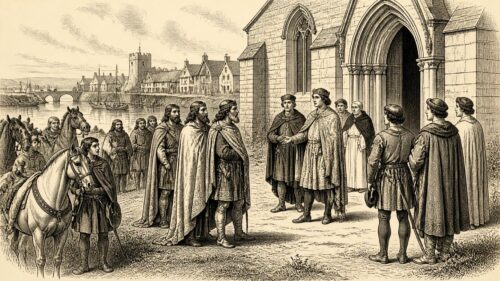
Aodh Reamhar’s Succession1364 CE
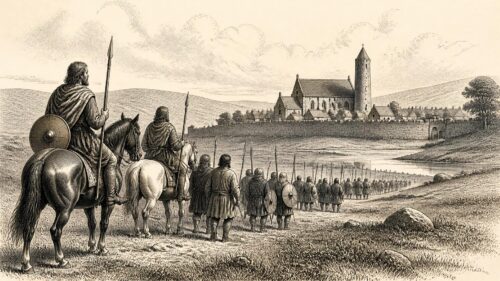
In 1364, Ireland experienced interconnected transitions rather than a single crisis. Aodh Reamhar Ó Néill, influential king of Tír Eoghain, died and was succeeded by Niall Mór, whose position rested on dynastic support and military power. Diarmait Ó Briain of Thomond and several regional lords, heirs, women and learned figures also died, altering local networks. Lionel of Antwerp campaigned in Laois before returning to England; James Butler of Ormond governed temporarily amid tensions between English-born and Irish-born settlers. Annals, some uncertainly dated, record raids, alliances and mercenary warfare in western regions, revealing power sustained through lordship, kinship, resources and learning.

Dateline
Two great lordships marked 1364 with the deaths of established Gaelic rulers, while the English administration in the east underwent an abrupt change of hands. The year is best understood not as a single island-wide crisis but as a sequence of transitions: Aodh Reamhar Ó Néill died in Tír Eoghain; Diarmait Ó Briain, formerly lord of Thomond, also died; and Lionel, duke of Clarence, temporarily left Ireland after campaigning in the midlands. At the same time, the annals preserve a vivid, though chronologically difficult, record of violence in the north-west and Connacht borderlands. Taken together, these notices show an Ireland governed through competing local lordships, mobile warbands, inherited claims, churches and learned families, rather than through any uniform national authority.
Dating a Difficult Year
Medieval Irish annals do not always align neatly with the modern calendar. The Annals of Loch Cé and the Annals of the Four Masters place the death of Aodh Reamhar under 1364, but do not supply a day or month. The surviving Annals of Ulster entry headed U1364 is explicitly calendrically uncertain in its modern edition, which associates it with 1364–7. Its accounts of raids, battles and deaths are therefore valuable evidence for the political world of these years, but should not be represented as securely datable to a particular month of 1364. This distinction matters: the sources can establish major developments and sequences, but not always the exact moment at which they occurred.
The Death of Aodh Reamhar
The clearest Gaelic political turning-point was the death of Aodh Reamhar Ó Néill, king of Tír Eoghain, or Tyrone. The Annals of Loch Cé described him as the finest king who had appeared in his own time; the later Four Masters made him “the best of the Gaels” of his age, praising his humanity, hospitality, valour and renown. Such obituary language was conventional in form, but it is still significant. It records the standing of an acknowledged provincial ruler whose authority reached far beyond his immediate household.
Aodh’s career explains the strength of that reputation. A younger son of Domhnall Ó Néill, he had emerged from a divided dynasty and, by the mid-fourteenth century, recovered the kingship for the line descended from Brian Catha an Dúin. His power was neither inevitable nor uncontested. He had fought the Clann Aodha Buidhe branch of the Ó Néills, campaigned against the Ó Domhnaills of Tír Chonaill, and made or renewed relationships with neighbouring rulers including the MacMahons and Maguires. Force, diplomacy, marriage connections and the ability to command fighting men all mattered. His later years were comparatively peaceful, a notable achievement in a political landscape where successions often invited armed intervention.
His son Niall Mór succeeded to the leadership of Tír Eoghain. That succession should not be imagined as a simple hereditary transfer in the modern sense. Gaelic lordship was shaped by kin-group politics, eligibility within a ruling dynasty, the support of leading kindreds and the capacity to defend a claim. Yet Niall Mór inherited a substantial platform: a Tyrone lordship strengthened by his father’s recovery of the kingship and by connections extending across central and eastern Ulster. Later developments should not be projected backwards as if they were already complete in 1364, but Aodh’s death plainly opened the reign during which Niall Mór would enlarge Ó Néill influence.
Thomond and the Weight of Mortality
The annals also record the death of Diarmait Ó Briain, identified as lord of Thomond. His death did not by itself settle the kingship of the region west of the lower Shannon. Thomond’s politics had long been contested within the wider Ó Briain dynasty, and Diarmait himself had earlier been displaced and restored. By 1364 he was no longer the uncontested ruler of the whole lordship. Nevertheless, his passing removed a man with a long record in the struggles that shaped northern Munster. It is a reminder that a medieval obituary might register not only the end of a current office-holder but the disappearance of a claimant whose alliances and family connections still carried political weight.
Other notices bring the scale of lordship down from kingship to regional power. Mael Sechlainn, lord of Anghaile in what is now south Longford, died; so did Domhnall Mag Uidhir, chief of Clann Fearghail, a territory associated with Longford and Westmeath. Domhnall son of Ruaidrí Ó Ceallaigh, described as heir apparent to the lordship of Uí Maine, also died. These were not peripheral names. Their deaths affected local balances of power, rights to land and cattle, obligations of protection, and the networks through which marriage, fosterage and military service were organised.
The notices also include women whose identities reveal the political importance of marriage. Derbail, daughter of an Ó Domhnaill and wife of a Maguire, and Mairgreg, daughter of Walter de Burgh and wife of Aodh son of Feidhlimidh Ó Conchobair, are named among the dead. Mairgreg’s parentage in particular crosses the conventional Gaelic–Anglo-Norman divide. Families of different linguistic and legal traditions were not sealed communities. They could fight one another fiercely, but marriage and service joined their interests in practical ways.
Lionel’s Absence and Ormond’s Charge
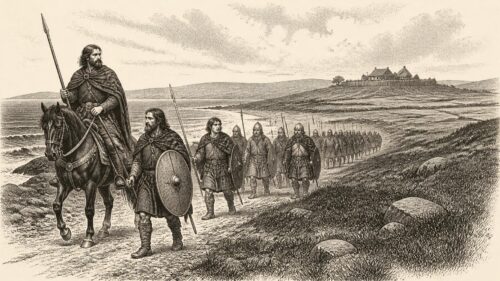
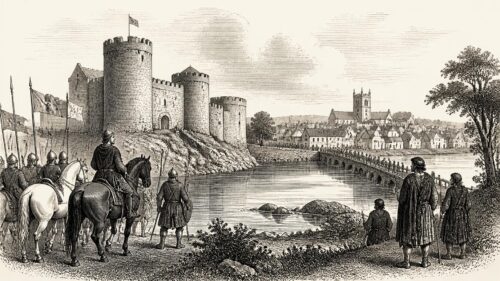
In the English lordship, 1364 was a year of interruption rather than a fresh beginning. Lionel of Antwerp, duke of Clarence and earl of Ulster through his wife Elizabeth de Burgh, had been Edward III’s lieutenant in Ireland since 1361. In February and March 1364 he campaigned in Laois, an exposed zone between the Dublin-centred lordship and powerful Gaelic neighbours. The evidence does not justify a detailed reconstruction of the operations, but the campaign itself shows that royal government still relied on armed movement and the presence of a high-status commander to uphold authority on the frontier.
Lionel returned to England in April. James Butler, second earl of Ormond, then acted as chief governor until Lionel’s return in December. Ormond was an especially consequential choice. He was a major landholder in south-central Ireland, experienced in royal service and one of the magnates who had pressed Edward III for stronger intervention. His temporary charge illustrates a basic feature of the lordship: its government depended on the cooperation of powerful resident aristocrats, whose own estates, affinities and regional interests could not be separated from their public responsibilities.
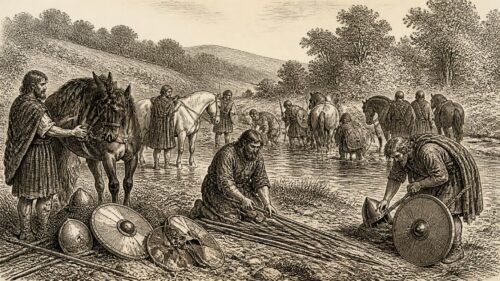
Records from early 1364 show the material machinery behind this government. Royal orders dealt with subsidy, the Irish treasury and money for the wages of men-at-arms, hobblers and archers. A hobbler was a lightly equipped mounted soldier, useful for rapid movement in difficult country; archers and mounted troops were equally part of the mixed forces maintained for service. Such administrative entries are dry, but they point to the burdens borne by towns, taxpayers, landholders and office-holders. Campaigning required cash, provisions, horses, weapons and local intelligence as well as proclamations from Dublin or Westminster.
Division within the Lordship
Lionel’s absence coincided with serious tension among the English population of Ireland. A royal communication of June 1364 referred to “dissensions and debates” between those born in England and those born in Ireland, warning that harm had already resulted and more was feared. The surviving evidence does not reveal a single incident that caused the quarrel, and it would be unsafe to invent one. But the wording exposes a real political fault-line. English officials and retainers newly sent from across the Irish Sea could be resented by the established English-speaking landholding community of Ireland, who had their own local ties, military needs and expectations of office.
This was not a neat division between an English world and an Irish one. Many residents of the lordship had long-standing dealings with Gaelic neighbours; Gaelic soldiers also served in royal and aristocratic forces. The distinction was instead about birth, patronage, access to authority and the distribution of resources. It helps explain why the attempt to reinforce royal administration did not automatically create unity among those supposedly defending the same lordship.
War on the Western Marches
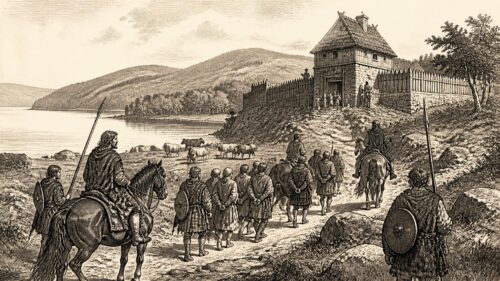
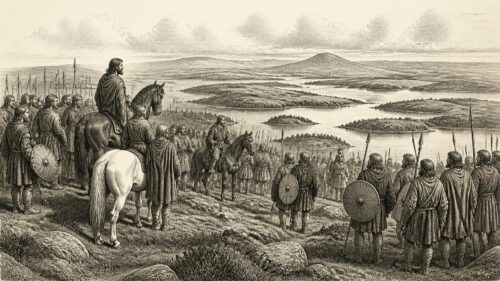
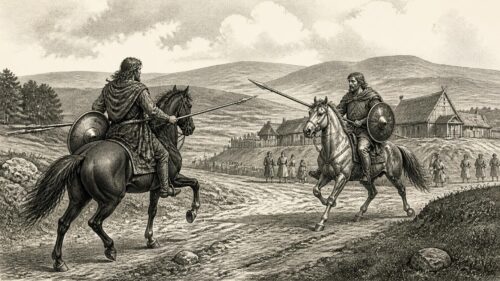
The U1364 sequence in the Annals of Ulster, although not securely fixed to the modern calendar year, records the kind of warfare contemporaries associated with this period. Clann Muircheartaigh, joined by Tadhg son of Ruaidrí Ó Conchobair, Fergal Mac Tigernáin and Diarmait Mac Raghnaill, entered Magh Nissi and attacked Magh Luirg, the Mac Diarmata lordship around modern north Roscommon. Their force included Gaels and gallóglaigh, heavily armed mercenaries of Scottish Hebridean origin or descent. A stronghold of Aodh Mac Diarmata was burned; a cavalry encounter at Áit Tighe Mic Coise ended in a severe defeat for the men of Magh Luirg, with twelve leading men killed and Aodh wounded.
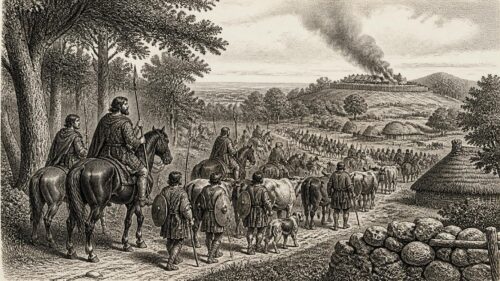
Another entry records the defeat of Tadhg son of Maghnus at Tráigh Eothail by a coalition including Domhnall son of Muirchertach, the Uí Ruaircs, Mac Donnchaidh and Theobald de Burgh. It says 190 gallóglaigh were killed, naming their captains and prominent dead. Whether or not every figure can be checked independently, the detail conveys what was at stake: professional infantry were expensive assets, and their destruction could alter a lord’s capacity to impose terms. Raids on Fermanagh and the pillaging of islands and lakeside places further show that livestock, valuables, boats and food stores were integral targets of war.
Learning, Law and Memory
1364 was not recorded solely through warfare and lordly succession. The annals note the deaths of Giolla na Naomh Ó Duibh Dá Bhoireann, an ollamh or learned master in law for Corcomroe, and Giolla na Naomh Mac Gobann na Scél, called a sage of history. Diarmait Ó Sgingin, learned in the history of Cenél Conaill, and Bran Ó Brain, a master timpanist, are likewise commemorated. Their appearance beside kings and chiefs is important. Law, genealogy, historical learning and music were skilled occupations embedded in patronage. Learned families preserved precedents, pedigrees and reputations that could support legal claims and political legitimacy.
The year’s obituaries therefore offer a social map as well as a list of deaths. Kings, heirs, regional chiefs, married women, jurists, historians and musicians all belonged to the ordering of late medieval Ireland. In 1364, the deaths of Aodh Reamhar and Diarmait Ó Briain signalled changes at the summit of Gaelic politics; Lionel’s departure exposed tensions in the English lordship; and the annalists’ attention to warfare and learning reveals the institutions through which power was defended, remembered and passed on.
Primary Sources
- The Annals of Ulster, Year U1364
- The Annals of Ulster, AD 1202–1378
- Annals of Loch Cé, Annal LC1364
- Annals of Loch Cé, Irish text, Annal LC1364
- Annals of the Four Masters, Annal M1364
- Annals of the Four Masters, Irish text, Annal M1364
- Annales Breves Hiberniae
- A Chronology of Ireland
- O'Neill (Ó Néill), Aodh Reamhar (Aodh Mór)
- Lionel (‘of Antwerp’)
- Butler, James (1331–82), 2nd earl of Ormond
- ‘Hobbes’, ‘Dogs’ and Politics in the Ireland of Lionel of Antwerp, c. 1361–6
- Lordship and Principality: Colonial Policy in Ireland and Aquitaine in the 1360s
- Richard II and the Wider Gaelic World: A Reassessment
- The Rise and Fall of the Clann Éinrí Aimhréidh Uí Néill: Dynastic Feuding and Geopolitics in the Late Medieval Irish Sea World
- Ireland, in The New Cambridge Medieval History
- Close Rolls, Edward III (1364 to 1368), page 461
- Patent Rolls, Edward III (1348–1364)
- Calendar of the Patent Rolls Preserved in the Public Record Office: Edward III, Vol. XII, AD 1361–1364
- Calendar of the Patent Rolls Preserved in the Public Record Office
- The Viceroyalty of Lionel, Duke of Clarence, in Ireland, 1361–1367
- A Bardic Miscellany