Trian Chongail’s Spear Charge1383 CE
In 1383, fragmented Ireland experienced renewed royal administration, northern warfare and serious disease. Richard II appointed Sir Philip Courtenay lieutenant, who arrived at Waterford in September, while Ralph Cheyne served as chancellor. In Ulster, Niall Mór Ó Néill’s coalition burned and plundered territories associated with English lordship. During the campaign, his son Aodh Óg and Raibilin Savage fatally wounded one another, provoking further killing among the Bissets. Annalists reported widespread plague throughout Ireland, including the death in captivity of Art Magennis. Deaths, killings and successions among secular and religious leaders reveal local instability, while hospitality remained an important lordly ideal.
Dateline
In 1383, Ireland’s political map was not governed by a single chain of command. King Richard II was lord of Ireland, but his government’s effective authority was concentrated in towns, castles, shires and lordships, especially in the east and south-east. Beyond and across those areas, Gaelic rulers, Hiberno-Norman magnates, churchmen and local communities negotiated power through lordship, tribute, kinship, warfare and accommodation. The year brought a change in royal administration, a destructive northern campaign led by Niall Mór Ó Néill, and a grave outbreak described in one major annalistic tradition as plague throughout Ireland.
What Can Be Dated
The evidence for 1383 is uneven. Royal records permit unusually firm dating for the appointment of Sir Philip Courtenay as lieutenant of Ireland on 1 July and for his arrival at Waterford in September. The Irish annals preserve a sequence of deaths, killings and a major Ulster raid, but commonly give no month. They are indispensable evidence, though they were compiled in different places and at different dates. The Annals of Ulster provide the fullest near-contemporary northern record; the seventeenth-century Annals of the Four Masters, drawing on earlier material, add the striking notice that plague was widespread. Its wording should not be treated as a modern statistical survey or as proof of an exact medical diagnosis.
A New Lieutenant at Waterford
On 1 July, Richard II appointed Philip Courtenay lieutenant of Ireland, replacing Roger Mortimer, fourth earl of March. Courtenay was an English knight with service at sea and in France behind him, but no previous Irish connection. His appointment was therefore not a solution to the lordship’s deeper problems: a thinly funded administration, magnates with strong regional interests, and expanding Gaelic powers in several frontier zones. It nonetheless mattered. The lieutenant exercised royal authority in the king’s name, led military responses, administered revenues and worked with the Irish chancery, judiciary and local landholders.
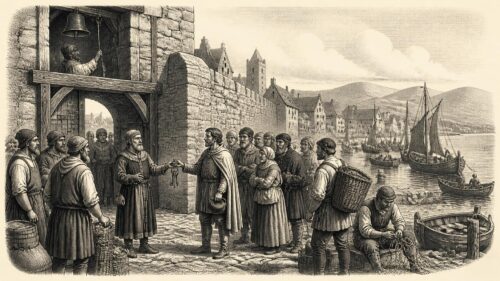
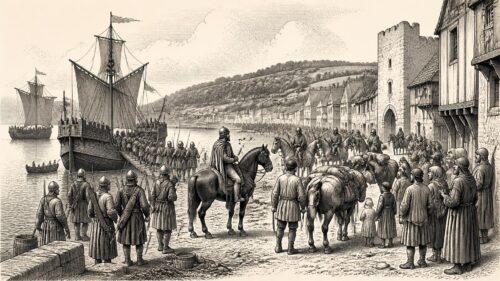
Courtenay landed at Waterford in September. The choice of port was practical as well as political. Waterford was a fortified urban centre, a major point of contact with Bristol and the wider Irish Sea world, and one of the towns through which royal officials, soldiers, merchants, horses, supplies and correspondence could enter the lordship. Yet the new lieutenant came not as the commander of an irresistible conquest. His office depended on local co-operation and on money raised within a politically contested colony. His later resort to taxation and demands for service soon alienated Anglo-Irish interests, but that developing conflict belongs chiefly to 1384 and later. In 1383, the significant fact is the arrival of an outsider tasked with defending a lordship whose borders were neither fixed nor secure.
Ralph Cheyne also served as chancellor of Ireland in 1383–84. The chancellor’s role connected high politics to daily government: the custody of the great seal, the authentication of royal business and the operation of chancery administration. Cheyne had previous experience in Ireland, having acted as deputy justiciar a decade earlier. His appointment alongside Courtenay underlines that the royal administration was being renewed at the top, even while much of Ireland remained beyond direct governmental reach.
Niall Mór’s Northern Raid
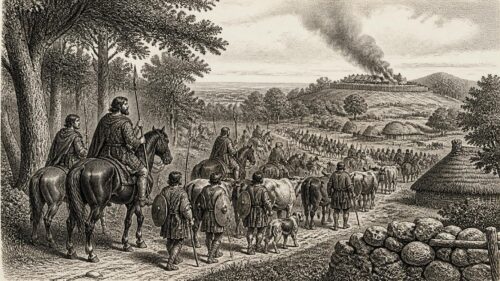
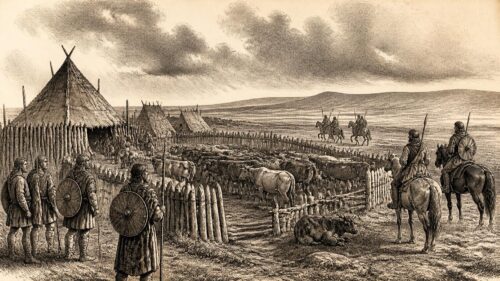
The most dramatic military episode assigned to 1383 occurred in the north. The Annals of Ulster records a great hosting by Niall Mór Ó Néill, king of Tír Eógain, accompanied by his sons and the leading men of the Fifth of Ulster. The annalist’s language is emphatic: the north was burned and plundered. The Annals of the Four Masters places the campaign in Trian Chongail, against “the English”, and says that towns were burned and thoroughly despoiled. Neither source gives a precise date within the year, so it is safest to regard this as a campaign of 1383 rather than assign it to a season.
Niall Mór was no marginal raider. Since the collapse of the de Burgh earldom of Ulster in 1333, the O’Neills had enlarged their influence. Mortimer’s Irish lieutenancy from 1380 had briefly checked that advance: Niall had submitted at Coleraine after skirmishing, but relations deteriorated sharply when Mortimer seized Art Magennis of Iveagh, an Ó Néill subordinate. That background helps explain the intensity of 1383. The campaign was part of a contest for dominance in Ulster between Ó Néill power, surviving colonial lordships and the interests associated with the Mortimer earls.
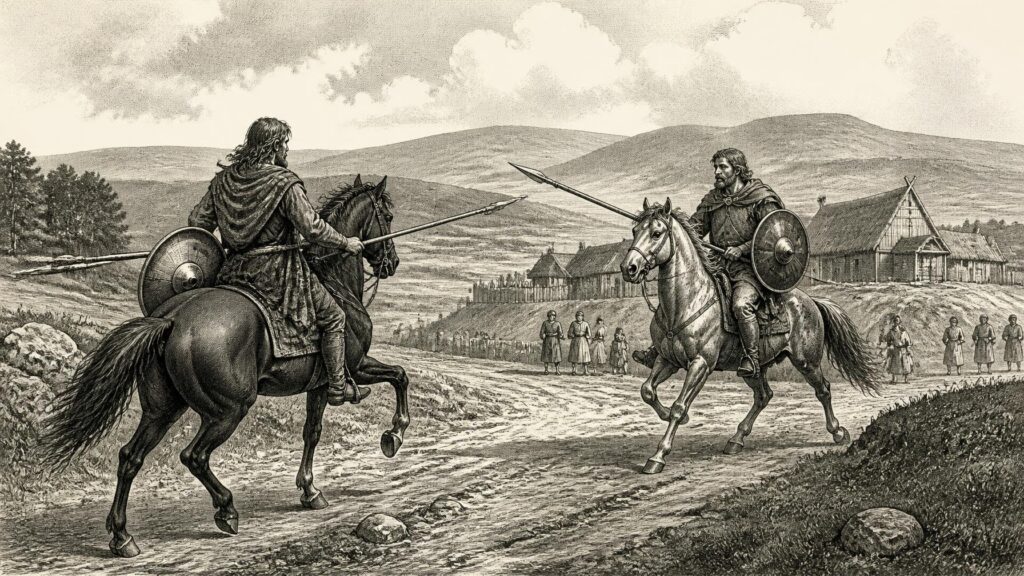
Its remembered climax was an encounter between Aodh Óg Ó Néill, Niall’s son, and Raibilin Savage. The annal describes the two men giving each other spear thrusts. Savage, mortally hurt, reached a Bisset house, where a member of the Mac Eoin Bisset family killed him; Aodh Óg died shortly afterwards among the Bissets. Raibilin’s followers then killed Seinicin Finn Mac Eoin Bisset in revenge. This was not a clean victory commemorated by one side alone. It was a spiral of violence linking the O’Neills, the Savages and the Gaelicised Bisset lordship of the Antrim Glens.
For people in the affected settlements, the larger campaign meant more than elite combat. Burning and plunder threatened stores, livestock, buildings, tenancy arrangements and the movement of goods. The annals do not allow a precise reconstruction of particular households or losses, and it would be wrong to invent one. They do make clear, however, that warfare could move through populated territory and that towns as well as rural resources were targets. The episode also complicates any simple division between “English” and “Irish”: the Savages were a long-established colonial family deeply enmeshed in Ulster politics, while the Bissets, of colonial ancestry, fought within Ó Néill’s coalition.
Plague, Captivity and Hospitality
The Annals of the Four Masters states that a “great and virulent plague” raged throughout Ireland in 1383. The wording is powerful, but the entry must be handled carefully. It supplies no case totals, no sequence of transmission and no symptoms. Modern historians identify repeated late-medieval epidemics in Ireland, and the years 1382–85 are recognised in the Anglo-Irish Annals of Ross as a phase of plague. Even so, the surviving evidence does not permit certainty about the disease experienced by every community, nor a national calculation of mortality. What can responsibly be said is that contemporaries and later annalists remembered 1383 as a year of serious, geographically extensive sickness.
The named dead give the notice human scale. Art Magennis, lord of Iveagh, died of plague at Trim, where he was being held prisoner by the English administration. His death joined captivity, disease and high politics. Art’s seizure by Mortimer had been a major source of tension in Ulster, and the annal’s account of his death shows the continuing consequence of that policy. A lord who had been an important element in northern alliances died not at home but in the administrative and military centre of Trim.
The same annal names women of major ruling families among the victims: More, daughter of Murchadh Ó Madden and wife of Richard de Burgh, Mac William of Clanricarde; and Joanna, daughter of the earl of Ormond and wife of Tadhg Ó Carroll, lord of Ely. Such notices do not reveal the full social reach of disease, but they demonstrate that rank offered no complete protection. They also expose the web of marriage joining Gaelic and colonial political worlds. The loss of a noblewoman could affect household management, inheritance, fosterage, alliance and the ceremonial hospitality on which lordly status rested.
Hospitality itself is a recurrent value in the year’s obituaries. The Four Masters praised Art Magennis as a foremost support of Ireland’s hospitality; it called Tadhg Mac Donnchaidh, lord of Tír Oilella, generous and hospitable. Tadhg died on Good Friday, and his son Tomaltach succeeded him. These formulas are not casual compliments. A successful lord was expected to maintain a household capable of feeding followers, clients, travellers and learned dependants. In a year of warfare and sickness, that ideal had particular weight, although the annals do not tell us how far ordinary provisioning was disrupted.
Local Successions and Religious Loss
Political continuity was maintained through succession even amid loss. Tadhg Mac Donnchaidh’s son took over in Tír Oilella, while the annals mark the death of Diarmait Mac Diarmata, described as a man expected to become king of Magh Luirg. In Fermanagh, Ruaidrí Maguire was killed by Domnall, son of Donnchadh Maguire, in an entry dated 28 December by the Ulster annalist. Other recorded deaths and killings included Muirchertach Ó Flannagáin, chief of Tuath Ratha, Cormac Maguire, and John Mac Caffrey and Manus Mac David. These notices show lordship as personal and vulnerable: succession, feud and homicide could reshape a district quickly.
Religion and learning likewise appear chiefly through death notices. The abbot Mac David of Boyle was remembered for charity and humanity; Bishop Ó Mocháin died; and John, kinsman of the abbot of Lisgoole, was among those killed on 5 April. Their brief commemoration points to a church embedded in local society, with monasteries, bishops and clerical kindreds participating in networks of patronage and memory. The sources do not record a major ecclesiastical foundation or reform for this calendar year. Their silence is important: 1383 was not necessarily a year of dramatic institutional change, but it was one in which religious communities endured the same mortality and insecurity as lay lordships.
An Island of Interlocking Crises
Viewed together, the evidence for 1383 does not describe an island moving in one direction. At Waterford, royal government acquired a new lieutenant and chancellor. In Ulster, Niall Mór Ó Néill demonstrated the reach of his military coalition, but lost a son in a bloody encounter that triggered retaliation. At Trim, a captive lord of Iveagh died during a severe epidemic. Across Connacht, Leinster and the midlands, obituaries and successions recorded the passing of rulers, clerics and prospective heirs. The year’s defining feature was therefore not a single national event but the overlap of administration, armed competition and disease in a politically fragmented Ireland.
Primary Sources
- The Annals of Ulster: English Translation, U1383
- Annala Uladh: Irish Text, U1383
- Annals of the Four Masters: English Translation, M1383
- Annals of the Four Masters: Irish Text
- Annales Breves Hiberniae
- Courtenay, Sir Philip | Dictionary of Irish Biography
- O’Neill (Ó Néill), Niall Mór | Dictionary of Irish Biography
- Mortimer, Edmund | Dictionary of Irish Biography
- Sweteman, Milo | Dictionary of Irish Biography
- Calendar of the Patent Rolls, Richard II, 1381–1385
- Calendar of the Close Rolls, Richard II, 1381–1385
- Calendar of the Fine Rolls, Richard II, 1377–1383
- Calendar of the Fine Rolls, Richard II, 1383–1391
- The ‘Calculus of Faction’ and Richard II’s Duchy of Ireland, c. 1382–9
- The ‘Calculus of Faction’ and Richard II’s Duchy of Ireland, c. 1382–9 (Trinity College Dublin copy)
- Richard II and the Wider Gaelic World: A Reassessment
- Climate, Disease and Society in Late-Medieval Ireland
- ‘Unheard-of Mortality’: The Black Death in Ireland
- The Lordship of Ireland in the Middle Ages
- Crisis and Survival in Late-Medieval Ireland
- Medieval Ireland
- The Hospital in Medieval Ireland, 1170–1540: An Archaeology
- Glenarm Friary and the Bissets
- CELT Project: The Annals of Ulster
- CELT Project: Annals of the Four Masters