Maguire Murder1481 CE
In 1481, Ireland’s annals recorded conflict, patronage and administration across politically fragmented lordships. On 5 October, Toirdelbach Mag Uidhir was treacherously killed by kinsmen in his Fermanagh castle, alongside several companions; his learning, hospitality and bardic generosity were widely mourned. Tír Eógain endured warfare among O’Neill factions, producing raids, killings, captures and the mutilation of Patrick Savage. Other deaths commemorated aristocratic patrons, poets and clerics, demonstrating the importance of learning, pilgrimage and religious institutions. Killings in Wexford reflected local rivalries, while the English lordship’s 1481–82 business addressed lands, castles, church property, revenues and urban privileges, revealing uneven but governmental authority.
Dateline
A Year Recorded in Fractures
The surviving Irish annals make 1481 feel at once unusually intimate and stubbornly incomplete. They preserve several deaths, a precise killing, raids and captures, but rarely the wider deliberations that brought people to violence. The clearest date belongs to a Fermanagh catastrophe: on 5 October, the day after the feast of St Francis, Toirdelbach Mag Uidhir was killed by kinsmen in his own castle. Around that event stand other signs of a politically divided island: open war within Tír Eógain, retaliatory killings in Ulster, a Cavanagh death in Wexford, and legislative business in the English lordship centred on Dublin and Louth. Ireland was not governed as a single political unit. Its peoples lived within overlapping lordships, ecclesiastical jurisdictions, towns and Crown institutions, each with its own networks of obligation and conflict.
That distinction matters. The annals are not a complete national chronicle, and the entry for 1481 does not permit a modern reconstruction of every region’s weather, harvest, prices or daily routines. What it does reveal exceptionally well is the value attached to lordly protection, hospitality, learning, religion and kinship. In the language of the annalists, those qualities were not ornamental virtues. They were measures of authority. A ruler who fed guests, protected pilgrims and supported poets demonstrated that he could sustain a household, command followers and provide a social centre in a world where formal state institutions were limited or distant.
Toirdelbach Mag Uidhir Killed
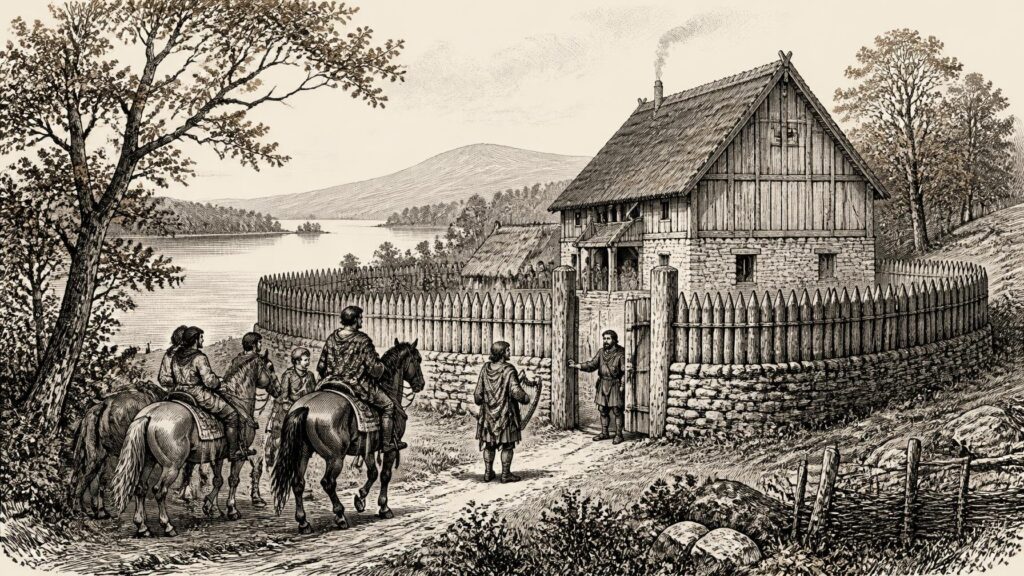
The most fully dated event occurred in Fermanagh. The Annals of Ulster state that Toirdelbach, son of Philip, son of Thomas Mag Uidhir, was slain “in treachery” in his own castle by Donnchadh Óg, son of Donnchadh, son of Aodh Mag Uidhir, on 5 October. The annalist also names victims killed with him: the son of the lord called Hay, and Toirdelbach, Donnchadh and Ludar, three sons of Colla Mac Domnaill. The detail suggests a lethal seizure of a lordly residence rather than a solitary murder. Yet the source does not explain the immediate motive, identify the castle, or provide a reliable narrative of the struggle. Those gaps should remain gaps.
Its judgement of the dead man is unmistakable. Toirdelbach is described as outstanding in hospitality and leadership, highly learned, intelligent, and especially generous in payment for bardic composition. The annalist says that learned men and ollamna—masters of learning—throughout Ireland mourned him. Such praise followed established conventions, but it is still historically revealing. The household of a successful Gaelic lord was a political and cultural institution: it received dependants and visitors, retained professional poets and learned families, and projected status beyond its immediate territory. Toirdelbach’s body was buried at the monastery of Donegal, a choice which also points to the religious and cultural connections linking Fermanagh to Tír Chonaill.
The same year’s notices show that the Maguire country was not insulated from a wider northern world of rival kindreds and shifting alliances. Cú Chonnacht, son of John, son of Cú Chonnacht Mag Uidhir, died on 7 January. Feidhlimidh Mag Uidhir, from another learned and prominent branch of the family, died around the feast of the Holy Cross; Cormac, son of the Abbot Mag Uidhir, also died. These were not necessarily political turning-points, but they show how clerical office, inherited standing and lordly kinship intertwined. The terse record of Toirdelbach’s killing, followed by notices of other Maguire deaths, conveys a society in which the stability of a lordship could be affected abruptly by losses within an extended ruling family.
War Among the O’Neills
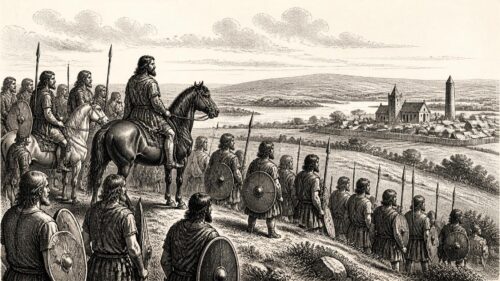
Further east, the annalist reports a “great war” in Tír Eógain between O’Neill and John O’Neill the Tawny. The wording is important: this was not presented as a war between neatly bounded nations, but as a struggle inside the political world associated with the O’Neill name. The sons of Art O’Neill and the sons of Feidhlimidh O’Neill opposed O’Neill; both sides conducted raids. In one pursuit, Aodh, son of Cathal Ua Conchobuir, a son of Gilla-Pádraig Mac Cathmhaoil and unnamed others were killed. The entry records conflict as a chain of raids, counter-raids and pursuits, where cattle, people, prestige and local control were all likely at stake, though only the deaths are explicitly stated.
Other northern incidents underline the human costs of this competition. Feidhlimidh Ua hAnluain, called an eminent leader, was killed by the sons of Aodh O’Neill. Conn, son of Henry O’Neill, was captured by the Clann Aodha Buidhe O’Neills and handed over to O’Donnell. Patrick Savage, the son of a prominent Anglo-Irish family of the north-east, was captured by Conn, son of Aodh O’Neill the Tawny, and was blinded and emasculated in captivity. Such mutilation was an extreme form of political violence, disabling a captive and publicly marking defeat. It should not be treated as ordinary experience for everyone in Ulster; rather, its inclusion indicates the seriousness with which the annalist viewed a high-status prisoner’s fate.
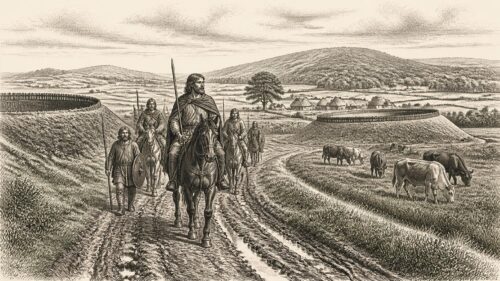
Tír Eógain’s political structure helps explain why kinship was central rather than incidental. Lordship rested on a ruling lineage, subordinate kindreds, client relationships, military followings and claims of seniority. Succession was not automatically settled by the eldest son’s inheritance. Contenders mobilised relatives and allies, and the authority of “the O’Neill” depended on recognition as well as force. The events of 1481 cannot prove every aspect of a particular succession dispute, but they offer a close contemporary illustration of how competition within an elite family could draw in neighbouring lineages and turn local landscapes into theatres of raiding and reprisal.
Patrons, Pilgrims and Poets
Three deaths recorded in 1481 give the year a different character. Brian, son of Feidhlimidh Ua Raighilligh, was remembered as a protector of bardic companies and pilgrims, distinguished for learning, hospitality and his guesthouse. Concobur Ruadh Mac Conmidhe died; he was described as a poet, scholar and teacher. Slaine, daughter of Ua Briain and wife of Mac William of Clann Ricaird, was praised as a protector of bardic companies from Ireland and Scotland, and as a woman of exceptional charity and humanity. The Annals of Loch Cé, independently preserving several of these notices, likewise calls her a general patron of learned companies and pilgrims.
These are formulaic memorials, not account books, and they do not tell us what meals were served, how many travellers were lodged, or which poets Slaine supported. Nevertheless, the repeated language is meaningful. It identifies travelling learned people and pilgrims as groups entitled to protection and provision; it acknowledges women as active figures in aristocratic patronage; and it suggests cultural traffic across the North Channel. Bardic poetry was a disciplined, public art, created within institutions of education and aristocratic support. Poets praised martial ability, generosity and ancestry, but their work also carried political messages to an audience wider than the patron’s household. To be a patron of poets was therefore to participate in the making of reputation.
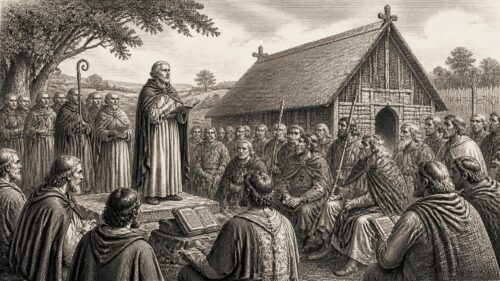
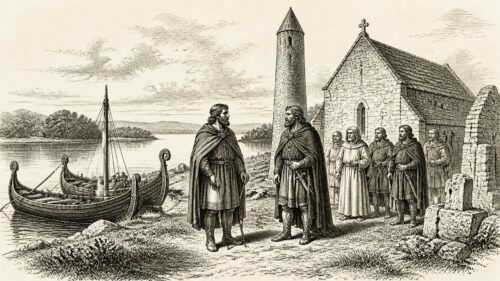
Religion and learning were interwoven with that culture rather than separate spheres. The annals mark people as dying after penance or unction, name an ecclesiastical rural dean, and note Toirdelbach Mag Uidhir’s burial at Donegal monastery. Their language reflects Christian ideals of a good death, charity and care for pilgrims. It also demonstrates that monasteries and churches remained important destinations, burial places and centres of learned connection in late medieval Ireland. The evidence does not justify calling 1481 a year of ecclesiastical reform or religious crisis. It does show religious institutions and obligations operating within the social world of lordship.
Wexford and the Lordship Towns
Violence was not confined to Ulster. Cathair Cavanagh, son of Mac Murchadha, was killed by the men of County Wexford, while James, son of Meyler Mac Herbert, was killed “in treachery” by Garret, son of Edmund Mac Herbert. Neither entry supplies a date or an explanation. They are reminders that south-eastern Ireland also contained layered local rivalries: descendants of Gaelic dynasties, old English landholders, townsmen and ecclesiastical interests did not stand on opposite sides of a simple ethnic frontier.
At the same time, the surviving statutory record points to continuing activity within the English lordship. Measures assigned to 1481 included a royal resumption of lands, provision concerning Cookstown in County Louth, assistance for Viscount Gormanstown to build a castle at Ballymadun in County Dublin, and arrangements involving rents, offices and customs. A measure of 1481 licensed the Priory of Holy Trinity, Dublin—Christ Church—to retain and acquire lands. Other business catalogued to the 1481–82 session concerned the town of Ardee’s privileges and customs, a pilgrimage licence for William, bishop of Meath and chancellor of Ireland, and restitution to the prior of Athassel after robberies and unlawful imprisonment.
These are securely associated with the regnal sessions labelled 1481 or 1481–82, but the surviving catalogue does not provide a day-by-day legislative timetable. They should therefore be read as evidence of business conducted in this period, not as events to which an invented calendar date can be attached. Together they reveal an administration concerned with property, revenue, fortification, church rights and urban privilege. Its reach was real but geographically uneven. The same year that Dublin-centred government handled charters and land matters, the annals recorded castle killing, kin-war and captive-taking elsewhere on the island.
An Island of Connected Lordships
1481 was not defined by one island-wide battle, parliament or proclamation. Its surviving evidence instead captures Ireland as a connected but politically plural landscape. Gaelic lords and Gaelicised magnates competed through kinship and force; poets, scholars, pilgrims and clerics travelled through networks of patronage; monasteries offered burial and institutional continuity; while the lordship government maintained legal and fiscal machinery in and around the towns of the east. The murder of Toirdelbach Mag Uidhir gives the year its sharpest image, but the annals’ tributes to hospitality and learning are equally important. They show what contemporaries believed had been lost when a lord, a poet or a charitable patron died: not simply an individual, but a node of protection, memory and social provision.
Source References
Hover over a number to see the source. Select it to open the source.

- [1] The Annals of Ulster, Year U1481
- [2] The Annals of Ulster
- [3] CELT Project: The Annals of Ulster
- [4] Annals of Loch Cé A.D. 1014–1590
- [5] CELT Project: Annals of the Four Masters
- [6] Irish Statute Book: Pre-Union Irish Statutes Affected, 1481
- [7] Statute Law Revision Act 2007, Schedule 1
- [8] Statute Law Revision Act 2007
- [9] Irish Statute Book: Pre-Union Irish Statutes Affected, 1478
- [10] Medieval Ireland: Ireland c. 1500, Map 5
- [11] Tudor Policy and the Kildare Ascendancy in the Lordship of Ireland, 1496–1534
- [12] Bardic Poetry and the Analysis of Gaelic Mentalities
- [13] Gaelic Ireland: Land, Lordship and Settlement, c.1250–c.1650
- [14] An Tulach Tinóil: Gathering-Sites and Meeting-Culture in Gaelic Lordships
- [15] Gaelic Lordship and Tudor Conquest: Tír Eoghain, 1541–1603
- [16] Richard II and the Wider Gaelic World: A Reassessment
- [17] Patronage Networks in Gaelic Ireland ca. 1541–ca. 1660
- [18] From Kingdom to Colony: Framing the English Conquest of Ireland
- [19] The Irish Constitutional Revolution of the Sixteenth Century: Ireland about 1530
- [20] Upward Mobility in Later Medieval Meath
Primary Sources
- The Annals of Ulster, Year U1481
- The Annals of Ulster
- CELT Project: The Annals of Ulster
- Annals of Loch Cé A.D. 1014–1590
- CELT Project: Annals of the Four Masters
- Irish Statute Book: Pre-Union Irish Statutes Affected, 1481
- Statute Law Revision Act 2007, Schedule 1
- Statute Law Revision Act 2007
- Irish Statute Book: Pre-Union Irish Statutes Affected, 1478
- Medieval Ireland: Ireland c. 1500, Map 5
- Tudor Policy and the Kildare Ascendancy in the Lordship of Ireland, 1496–1534
- Bardic Poetry and the Analysis of Gaelic Mentalities
- Gaelic Ireland: Land, Lordship and Settlement, c.1250–c.1650
- An Tulach Tinóil: Gathering-Sites and Meeting-Culture in Gaelic Lordships
- Gaelic Lordship and Tudor Conquest: Tír Eoghain, 1541–1603
- Richard II and the Wider Gaelic World: A Reassessment
- Patronage Networks in Gaelic Ireland ca. 1541–ca. 1660
- From Kingdom to Colony: Framing the English Conquest of Ireland
- The Irish Constitutional Revolution of the Sixteenth Century: Ireland about 1530
- Upward Mobility in Later Medieval Meath