Áed’s Devenish Council1259 CE
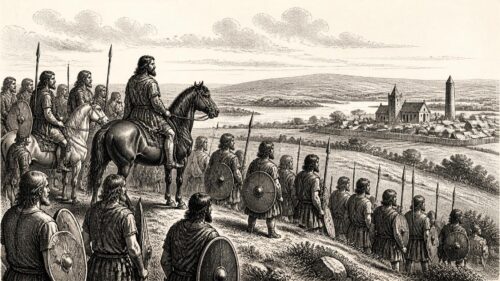
In 1259, Áed Ó Conchobair of Connacht asserted authority in Breifne by replacing rivals, taking hostages, raiding opponents and ordering blinding. At Devenish, he and Brian Ó Néill restored Domnall Ó Ruairc, demonstrating northern alliance politics and Brian’s wider influence. Áed’s marriage at Derry to Dubgall Mac Somairle’s daughter linked Connacht with the western seaways and armed support. Ulster, Thomond and Desmond saw raids, conflict and attacks affecting churches and communities. Tomaltach Ó Conchobair returned from Rome as archbishop of Tuam, while the deaths of Bishop Cormac Ó Luimlín and poet Gilla Cam marked losses to learning and ecclesiastical life.

Dateline
The events securely recorded for 1259 CE place Connacht at the centre of Irish politics, while also revealing how closely the island’s regions were connected by lakes, sea routes, marriages, hostages and church institutions. The surviving annals do not provide a continuous diary of the year, and several were compiled later from earlier materials. They nevertheless agree on a striking cluster of developments: Áed Ó Conchobair, king of Connacht, strengthened his position in Breifne; met Brian Ó Néill at Devenish on Lough Erne; made a marriage alliance at Derry with a daughter of Dubgall Mac Somairle; and imposed harsh penalties upon rivals and hostages. Meanwhile, churchmen returning from Rome and the deaths of a bishop and a poet remind us that power in thirteenth-century Ireland was not exercised only with armed followers.
Connacht’s King on the Move
Áed Ó Conchobair was an energetic and formidable ruler, and 1259 shows him operating far beyond the Connacht heartland. His concern was Breifne, the large and politically divided region around modern counties Leitrim and Cavan. Control there mattered greatly. Breifne linked Connacht with Ulster and the midlands, contained valuable pastoral country and routes through difficult terrain, and was contested between branches of the Ó Ruairc kindred as well as the rising Ó Raghallaigh, or O’Reillys.
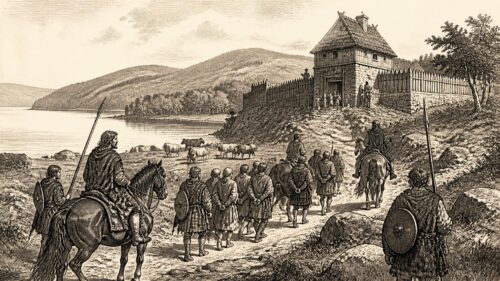
Early in the year, Áed replaced Amlaíb, son of Art Ó Ruairc, with Art Bec, another son of Art. He also captured Art, son of Cathal Riabach Ó Ruairc. Such statements are terse, but their meaning is clear enough: kingship within a Gaelic lordship was not automatic inheritance by the eldest son. It depended on support among leading kin, military capacity and the approval—or coercion—of a more powerful overlord. By deciding who should occupy the “place” of an Ó Ruairc ruler, Áed asserted Connacht’s authority over Breifne.
The accompanying violence was severe. The annals record that Áed blinded Cathal Mac Consnamha, chief of Muintir Chínaith, and also ordered the blinding of two hostages of Domnall Ó Ruairc, Niall son of Donnchad and Brian son of Niall. Blinding was a calculated political punishment. A physically impaired man could be excluded from kingship under prevailing ideas of a ruler’s bodily fitness, while the act also announced the captor’s power over the hostage-giver. It was neither an incidental crime nor evidence of an impersonal state justice system; it was lordship made public through the bodies of dependants and rivals.
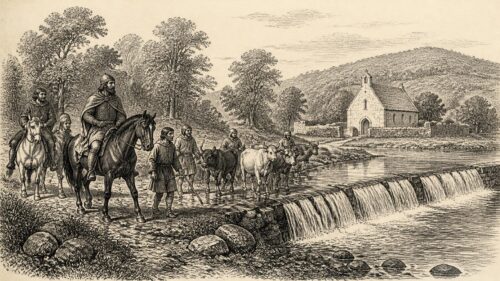
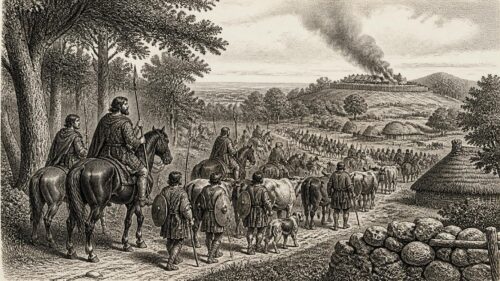
The same year brought campaigns within Connacht itself. Áed captured Gillibert Mac Goisdelb, plundered all Sliabh Luga, and released him only after taking his three sons as substitutes in custody. He also seized Flann Ruad Ó Flainn, chief of Síol Máelruain, alongside Donnchad Ó Flainn, and plundered their territory. Cattle, food stores, movable goods and captives were the immediate objects of such operations. Raiding damaged an opponent’s capacity to feed followers and reward allies; hostages converted a temporary victory into leverage. For farming households, the result could mean the loss of livestock, grain and security at precisely the time when seasonal labour and stored provisions determined survival.
Devenish on Lough Erne
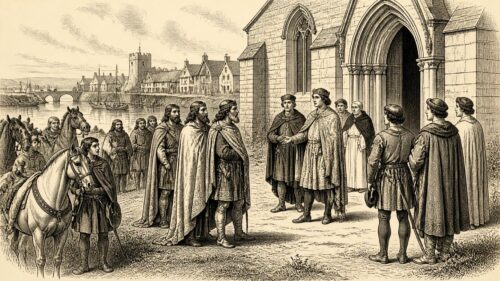
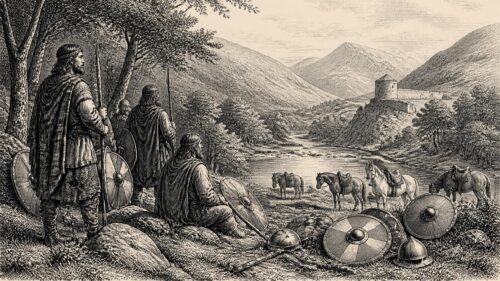
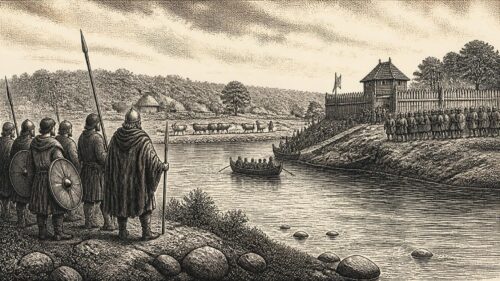
The political high point of the year was a meeting between Áed Ó Conchobair and Brian Ó Néill at Devenish, on Lough Erne. There, according to Annála Connacht, peace was made for Domnall Ó Ruairc and the kingship of Breifne was restored to him. This was no minor local arrangement. Brian Ó Néill, king of Tír Eógain, had been recognised by important Gaelic rulers in 1258 as an aspirant high king; Áed was his principal Connacht ally. Their intervention on Domnall’s behalf demonstrates that Breifne’s succession had become part of a larger alliance system reaching from Connacht to Ulster.
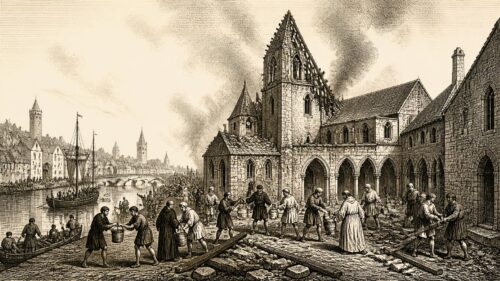
Devenish was an especially apt setting. The island was an old ecclesiastical centre amid the waterways of Lough Erne, accessible by boat and standing within a landscape of islands, shores and lordly territories. Its monastic reputation lent a meeting a measure of sacred and political gravitas, while the lake itself was a route rather than a barrier. The surviving fabric visible today should not be simply projected back onto 1259: buildings on the site belong to several periods. Yet Devenish was already a long-established religious place, and the annal’s choice to name it shows its importance as a recognised venue.
The settlement did not end coercion. Áed had earlier displaced and imprisoned another Ó Ruairc contender, and Domnall’s restoration depended on the agreement reached between the two greater kings. In this sense, the Devenish council was a negotiated settlement imposed from above, not a constitutional reconciliation among equals. Still, it reveals political flexibility. Rival branches could be removed, restored or recognised when wider interests required it. The compact also showed that Brian’s claims to island-wide pre-eminence had practical consequences: he could influence the settlement of a kingship outside Tír Eógain.
A Marriage at Derry
In another firmly dated entry for 1259, Áed travelled to Derry to marry a daughter of Dubgall Mac Somairle. The annals add that eight score warriors—160 men—came with the party. The source does not explain every term of the arrangement, so it would be unsafe to describe the contingent with certainty as a dowry or to assign it a precise military status. But the marriage plainly connected Connacht with the Gaelic-Norse world of the western seaways and the Isles. It joined dynastic strategy to maritime mobility.
This was important at a moment when the political map was not bounded by the Irish coastline. Derry was a major Columban church and a northern gateway; sea-going warriors, ships and kinship could move between Ireland and the Hebrides more readily than later national maps suggest. Áed’s marriage therefore strengthened his position not merely through a prestigious bride but through a demonstrable armed connection. The 160 accompanying warriors gave the alliance an immediate, visible force.
The marriage also belongs beside the Devenish agreement. Áed was cultivating a northern network while co-operating with Brian Ó Néill. The partnership was powerful but not uncomplicated. Brian faced resistance within Ulster, while the leading dynasties of Donegal, Tír Eógain, Connacht and Breifne pursued their own interests. Later events should not be read backwards as inevitable, but the manoeuvres of 1259 help explain why the following year could bring a major confrontation between Brian and the English of Ulster. In 1259, however, the evidence is of alliance-building, settlement and preparation rather than a single decisive battle.
Ulster and Thomond Under Pressure
Conflict elsewhere underlines the instability behind these negotiations. A reliable modern synthesis, drawing on the annalistic record, places an attack in 1259 in which Áed Buide Ó Néill joined Domnall Óc Ó Domhnaill against Brian Ó Néill. They burned extensively in Tír Eógain, then attacked the Mac Mahons of Airgíalla and took hostages. This was a direct challenge to Brian’s authority in his own northern power base. It also demonstrates that the Gaelic political world was never a simple opposition between “Irish” rulers and the English colony. Dynastic competitors made alliances across regions, and their wars could be as destructive as conflicts with settler lordships.
In Thomond, the Annals of Inisfallen report that “the foreigners” entered Tuadmumu again. The annalist says they committed no harm there except against churches and clerics, before recording that the Gaels plundered Ardrahan. The phrasing is revealing. It neither presents warfare as orderly nor treats ecclesiastical persons as ordinary targets; the reported injury to churches and clergy was exceptional enough to be singled out. Yet communities around Ardrahan also experienced retaliatory plunder. The practical distinction between raid, campaign and punishment could be very thin for those whose land lay on a military route.
Another Munster entry records that Fíngen Mac Carthaig and Uí Chairbrí killed Mac Raith Ó Mathghamhna and other nobles around him. Donnchad, son of Cormac, raided Ciarraige Luachra, where he was wounded and his followers suffered a defeat at Móin Cradáin. These notices are too brief to reconstruct a full war, but they show local lordship being fought over in Desmond as well as in the north and centre. The death of Tadc Ó Briain, described as an eligible prince of Munster, removed a politically significant figure. Tadc had been associated with the wider Gaelic alliance formed in 1258, so his death weakened one of Brian Ó Néill’s southern connections.
Rome, Tuam and Learned Men
Church affairs gave the year a different scale. Tomaltach Ó Conchobair arrived from Rome after consecration at the papal court as archbishop of Tuam, bringing a pallium. The pallium, a woollen vestment sent by the pope to metropolitan archbishops, was a tangible sign of authority and communion with Rome. His return linked the western province of Ireland to the institutional life of Latin Christendom. It also illustrates how a member of the Connacht ruling dynasty could occupy a major ecclesiastical office: political kinship and church leadership were deeply intertwined, even as canon law and papal procedure shaped episcopal appointments.
The annalists greeted Tomaltach’s return as bringing “great profit for the Church at large”. That judgement should be understood as contemporary praise, not as a detailed financial account. It nevertheless indicates that his Roman journey was seen as beneficial to the province’s churches. Travel to the papal court required resources, connections, clerical literacy and passage through Britain and continental Europe. The archbishop’s return was consequently a public event, meaningful in a year when kings were also forging distant alliances by marriage and armed escort.
Two deaths mark the intellectual and pastoral world alongside politics. Cormac Ó Luimlín, bishop of Clonfert, died in advanced age and was praised as one of Ireland’s most learned men. Gilla Cam Mac Gilla Chiaráin, called “the Crooked Lad”, died as a distinguished poet and scholar. Annalistic praise is conventional, but it confirms the social value placed on learning. Bishops, poets and scholars preserved legal, genealogical, religious and literary knowledge; their households and networks formed part of the infrastructure of lordship. Their recorded deaths belong in the history of 1259 not as decorative details, but as losses to institutions that helped communities remember, negotiate and govern.
A Year of Connections
For Ireland, 1259 was not defined by one island-wide victory or royal decree. Its significance lies in the connections exposed by the record. At Devenish, two powerful kings reshaped Breifne’s leadership. At Derry, Áed Ó Conchobair’s marriage joined Connacht to the sea-facing world of Mac Somairle. In Breifne and Connacht, captives and blinded hostages showed the human cost of enforcing power. In Thomond and Ulster, raids and counter-raids disturbed churches, settlements and agricultural resources. And through Tuam’s new archbishop, Rome remained present in Irish religious life. Taken together, these developments show a politically fragmented Ireland whose rulers nevertheless acted within wide, deliberate networks of water, kinship, war and worship.
Primary Sources
- Annála Connacht: Annal 1259
- Annála Connacht
- The Annals of Ulster
- Annals of the Four Masters: Annal M1259
- Annals of the Four Masters
- Annals of Inisfallen: Annal AI1259
- Annals of Inisfallen
- Annals of Loch Cé A.D. 1014–1590
- O'Neill (Ó Néill), Brian
- O'Neill (Ó Néill), Aed Buide
- O'Brien (Ó Briain), Conchobar
- O'Rourke (Ó Ruairc), Cathal Riabach
- O'Rourke (Ó Ruairc), Conchobar
- Burgh, Richard de
- Devenish Ecclesiastical Site
- St Molaise, Devenish Island
- Devenish Island Monastic Site
- A Study of Irish Crannogs: Devenish and Annalistic Evidence
- Notes on the Early History of the Dioceses of Tuam, Killala and Achonry
- Divided Gaels
- Medieval and Monastic Derry
- A Primer of Irish Metrics