Boyle’s Four Nights1296 CE
In 1296, Connacht suffered a violent Ó Conchobair succession struggle. Áed son of Eógan was deposed for Conchobar Ruad, whose supporters seized hostages and ravaged Cairbre, including churches. Backed by Uilliam and Theobald Burke, Áed assembled at Boyle Abbey, plundering grain and livestock, before alliances shifted again. Conchobar was killed at Cend Ceti, restoring Áed; his rival’s son was later blinded. Ecclesiastical deaths and burials stressed Boyle and Ballintober’s importance. Meanwhile, Irish magnates and troops joined Edward I’s Scottish invasion, criticised by annalists for sacrilege. Reports of weather and cattle disease illustrate insecurity surrounding food, livestock, lordship and religious institutions.
Dateline
In 1296, the sharpest recorded crisis in Ireland unfolded not in Dublin but across Connacht, where a disputed Ó Conchobair kingship brought raids, negotiations, the seizure of hostages and a decisive killing. The year also demonstrated how closely Irish affairs were connected to wars beyond the island. Magnates and troops from the English lordship crossed the North Channel for Edward I’s Scottish campaign, while Irish annalists watched that expedition with attention and moral alarm. The surviving evidence is unusually rich for Connacht, but it must be read carefully: the annals preserve particular events, not a complete survey of every region or every household.
A Connacht Kingship Overturned
The principal sequence is firmly placed under 1296 in Annála Connacht, the Annals of Loch Cé and the Annals of the Four Masters. Áed, son of Eógan Ó Conchobair, was removed by his own council or kin-group. In his place, Clann Muirchertaigh secured the lordship for Conchobar Ruad, son of Cathal Ruad Ó Conchobair, and handed over the district’s hostages. This was not a ceremonial alteration at the top of a settled state. Hostages were a practical guarantee of submission and alliance; possession of them signalled who could demand obedience from lesser rulers and communities.
The annalists depict the deposition as immediately destructive. They say that the country, both ecclesiastical and lay, was despoiled, and that Clann Muirchertaigh burned and ravaged Cairbre, attacking its churches. Such language has a moral purpose as well as a factual one. The writers condemn violation of churches by invoking God, Mary and Columba as the eventual avengers. Yet the detail that churches were attacked is important in itself. Religious sites held land, livestock, food stores and people; in a conflict over lordship, they could be exposed to the same coercion as secular settlements.
Four Nights at Boyle
Áed did not accept his removal. He gathered what the Connacht annalist calls a large force of Galls and Gaels. In this context, Galls meant members of the English or Anglo-Irish political world, rather than a single homogeneous ethnic army. The named allies were Uilliam Burke and Teboit, or Theobald, Burke, members of the powerful de Burgh connection in Connacht. Their presence shows that a Gaelic dynastic struggle was also entangled with the interests of landed families whose power rested in the lordship of Ireland.
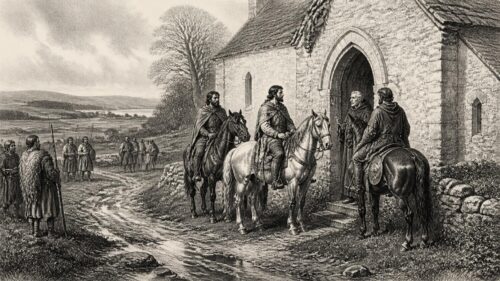
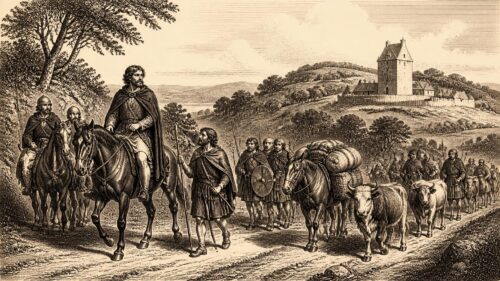
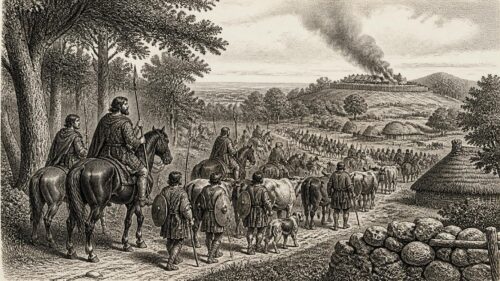
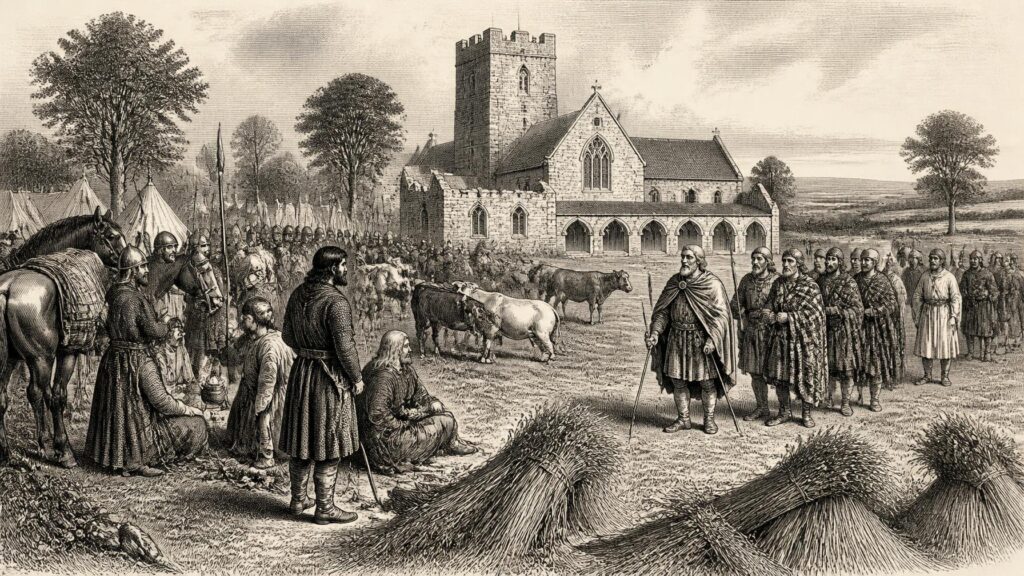
The force came to the monastery at Boyle and remained for four nights. During that stay it spoiled the corn and stock of the surrounding country. The record does not permit a calculation of losses, nor does it demonstrate a general famine. It does, however, offer a direct view of what warfare threatened in 1296: stored grain, animals and the productive security of the communities that depended upon them. Boyle Abbey was a major Cistercian house, and its precinct offered a conspicuous place for an army to assemble. Its religious standing did not place the wider district beyond the reach of armed requisition and plunder.
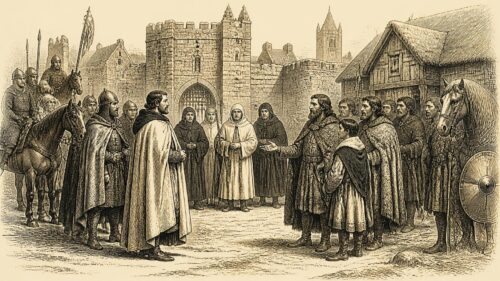
Local chiefs then submitted to Áed’s party and were taken to the earl’s household to make peace with him. The earl was Richard de Burgh, earl of Ulster and lord of Connacht, whose influence made his court an obvious venue for settlement. This episode is a useful corrective to any simple division between a supposedly Gaelic Connacht and an English lordship beyond it. The rival Ó Conchobair factions, the Burkes, local chiefs and the earl’s authority all operated in the same political field. Peace was negotiated through personal submission, hostages and access to a magnate’s household, not through an impersonal state machinery.
Cend Ceti and the Return of Áed
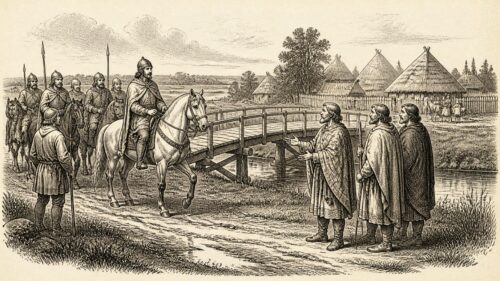
The agreement failed quickly. The chiefs who had apparently made peace with Áed returned to Clann Muirchertaigh. Áed then entered the Tuatha with Ó Fergail and Mag Ragnaill and their followings, and sent envoys to Mac Diarmata and Ó Flannacáin. The annal’s wording makes diplomacy part of the campaign rather than an alternative to it: envoys carried offers and pressure between armed groupings, and changes of allegiance altered the balance of power.
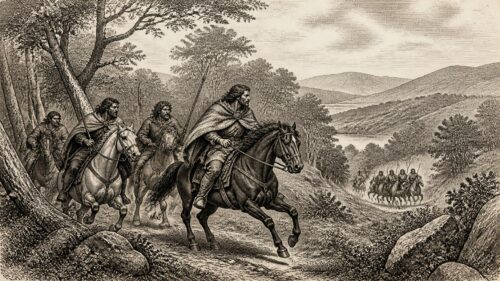
Conchobar Ruad responded by pursuing and raiding his opponents. They turned back while following the prey and caught up with it at Cend Ceti in Tír Tuathail. There Conchobar was killed. His son Lochlainn and another man of rank, Magnus son of Tomaltach’s son, were captured, while a small number of others died. The same day, Áed and his allies made a punitive raid upon Clann Muirchertaigh. The Annals of Inisfallen summarise the outcome still more starkly: Conchobar was slain and Áed took the Connacht kingship without opposition.
That final phrase should be understood as an annalistic judgement on the immediate outcome, not proof that political contention vanished. The sequence itself reveals how contingent authority was. Áed had been deposed by a council, restored through a coalition, and assisted by allies whose loyalties were shaped by local interests and by the de Burgh lordship. Lochlainn’s subsequent blinding, after which he died from the resulting illness, was a cruel but politically intelligible act in a culture where bodily integrity could matter to eligibility for high status and rule. The annals record no formal trial or legal process; they record the elimination of a dangerous claimant.
Churches, Burials and Local Memory
Warfare was not the only concern recorded in Connacht. Gilla Íosa, son of Liathánach Ó Conchobair, bishop of Elphin, died at Roscommon three weeks before May Day and was buried at Boyle. The relative date is supplied by the annalist, but no modern day should be imposed upon it. His burial at Boyle underlines the abbey’s regional importance: it was not merely a convenient military stopping place but a religious institution capable of receiving a bishop of Elphin for burial.
The death of Derbforgaill, daughter of Ó Flainn of Ess, is also noted, with burial in the monastery of canons at Ballintober. Medieval annals often preserve elite deaths because burial places, kinship and religious patronage mattered to their compilers. Taken together with the attacks on Cairbre’s churches, these notices show religious houses in several roles during the year: vulnerable holders of property, places of refuge or encampment, and enduring centres of commemoration.
Ireland and Edward’s Scottish War
While Connacht was convulsed, Edward I’s invasion of Scotland drew directly on Ireland. The Connacht annalist states that the king of England led a great expedition to Scotland with the leading Galls of Ireland, naming Richard de Burgh and John fitz Thomas FitzGerald. Administrative and biographical evidence allows the movement to be placed more closely. John Wogan, the king’s justiciar in Ireland, led a substantial Irish contingent across in late April; de Burgh’s force joined Edward at Roxburgh on 13 May and accompanied him towards Stirling in June. John fitz Thomas also served in the campaign.
This was not a minor overseas adventure. Ireland supplied men, commanders and resources to Edward’s war effort. The personnel were drawn from a lordship already marked by magnate rivalry: Wogan was working to contain the feud between de Burgh and FitzGerald even as both men entered royal service in Scotland. Their participation illustrates a central condition of late thirteenth-century Ireland. The Irish Sea connected political arenas rather than separating them. Service in the king’s army could bring patronage and royal favour, while also removing armed men and leading magnates from local affairs.
The Irish annals did not celebrate the Scottish expedition simply as a triumph. They acknowledged its success, but stressed the despoiling of secular land and churches, the destruction of a Dominican friary, and the killing of clergy and women. This is not a neutral campaign report. It is an Irish religious writer’s judgement on conquest and sacrilege, shaped by the same concern for church protection seen in the Connacht narrative.
Weather, Livestock and Uncertainty
An entry in the Annals of Inisfallen associated with 1296 reports stormy weather, wind, snow and lightning, followed by a great murrain of cattle and loss of life. Its chronological apparatus in this section is difficult, with adjacent entries carrying conflicting calendrical notes. The report can therefore be connected to 1296, but it should not be turned into a precisely dated island-wide disaster or used to claim a measured demographic collapse. It nevertheless fits the year’s other evidence in one important respect: cattle and grain were basic resources, and their loss—whether through raiding, disease or weather—had immediate consequences for households and lordships.
Thus 1296 was a year in which political power in Ireland was visibly dependent on control of people, food, animals and sacred places. At Boyle, armed coalitions consumed and seized the produce of the countryside while a contested kingship was decided at Cend Ceti. Across the sea, Irish lords and soldiers helped Edward I impose his will on Scotland. The records do not justify a story of one Ireland moving in a single direction. They instead reveal overlapping worlds: Gaelic lordship, Anglo-Irish magnate power, monastic influence and royal military service, all meeting in a turbulent and closely documented year.
Primary Sources
- Annála Connacht: Annal 1296
- Annals of Loch Cé: Annal LC1296
- Annals of the Four Masters: Annal M1296 (English translation)
- Annals of the Four Masters: Annal M1296 (Irish text)
- Annals of Inisfallen: Annals AI1295–AI1304
- Annala Uladh: Annals of Ulster, Year U1296
- Annála Connacht: CELT project record and edition information
- Annals of Loch Cé: CELT project record and edition information
- Annals of the Four Masters: CELT project record and edition information
- Annals of Inisfallen: TEI header and manuscript information
- Annala Uladh: Annals of Ulster, edition and manuscript information
- Burgh, Richard de | Dictionary of Irish Biography
- Wogan, John | Dictionary of Irish Biography
- FitzGerald, John fitz Thomas | Dictionary of Irish Biography
- Butler (le Botiller), Theobald | Dictionary of Irish Biography
- MacCarthy (Mac Carthaig), Domnall Ruad | Dictionary of Irish Biography
- O'Neill (Ó Néill), Henry | Dictionary of Irish Biography
- An Irish army in Scotland, 1296 | Irish History Online
- Government, War and Society in Medieval Ireland: table of contents | National Library of Ireland
- From Boom to Bust: The Lordship of Ireland and the European ‘Commercial Revolution’
- The Crusades to 1291 in the Annals of Medieval Ireland
- A Plea Roll of Edward I’s Army in Scotland, 1296
- School of the West | Heritage Ireland
- Heritage Sites of Ireland Guide 2021 | Heritage Ireland