Ceann Maghair1461 CE
In 1461 Ireland experienced famine, warfare and contested lordship rather than a unified national event. At Ceann Maghair, Aodh Ruadh Ó Domhnaill, aided by the Mac Suibhnes of Fanad, defeated and mutilated Toirdhealbhach Cairbreach Ó Domhnaill, securing recognition as ruler of Tír Chonaill. Connacht saw deaths, captures, ransoms and inauguration rituals amid Ó Conchobair rivalries. Raids devastated districts across the Midlands, Meath and Connacht, worsening the recorded nationwide dearth. Annals also commemorated poets, scholars and clergy, revealing learned and ecclesiastical networks dependent on patronage. English dynastic upheaval brought Edward IV’s accession and weakened Butler connection through Ormond’s execution and attainder.
Dateline
In 1461 Ireland’s annalists recorded no single national event, because there was no single Irish state to experience one. Instead, their entries trace a country of competing lordships, disputed successions, raiding armies and learned households, all overshadowed by a terse but grave notice: there was “great dearth throughout Ireland”. The year is best understood through the sharp local crises that the surviving annals place within it, above all the decisive overthrow of Toirdhealbhach Cairbreach Ó Domhnaill in Tír Chonaill.
Ceann Maghair and Tír Chonaill
The most consequential conflict of the year occurred at Ceann Maghair, during the long civil struggle within the Ó Domhnaill kindred. Aodh Ruadh Ó Domhnaill, together with his brothers Eoghan and Conn, entered Tír Chonaill from Tír Aodha. They had support in Fanad from Muimhneach Mac Suibhne, whose position had been threatened by Toirdhealbhach Cairbreach Ó Domhnaill and the sons of Neachtan Ó Domhnaill. The Annals of the Four Masters describe the quarrel as one of allegiance as well as inheritance: Fanad’s friendship with the sons of Niall Garbh Ó Domhnaill had brought retaliation from the ruling faction.
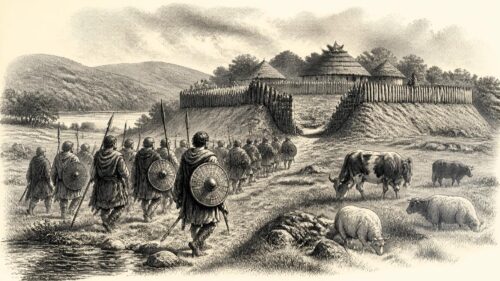
Toirdhealbhach marched against them with his brothers, troops and a body of Scots in his service. The opposing force of Aodh Ruadh, the Mac Suibhnes and their Fanad adherents resolved not to surrender the pass at Ceann Maghair. There they fought what the annals call a fierce and stubborn battle. Toirdhealbhach’s party was beaten; his brother Maghnus was killed and Toirdhealbhach himself was captured. The accounts agree that he was subsequently maimed, losing a hand and a foot. This was a calculated political act as well as a personal brutality: a visibly mutilated captive could no longer plausibly embody the physical fitness expected of a war-leader and lord.
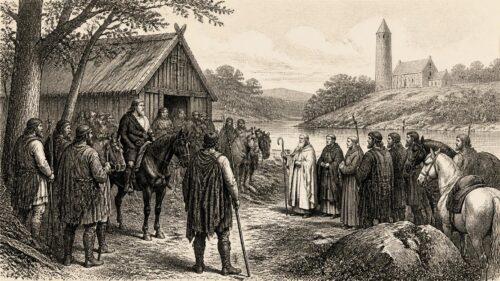
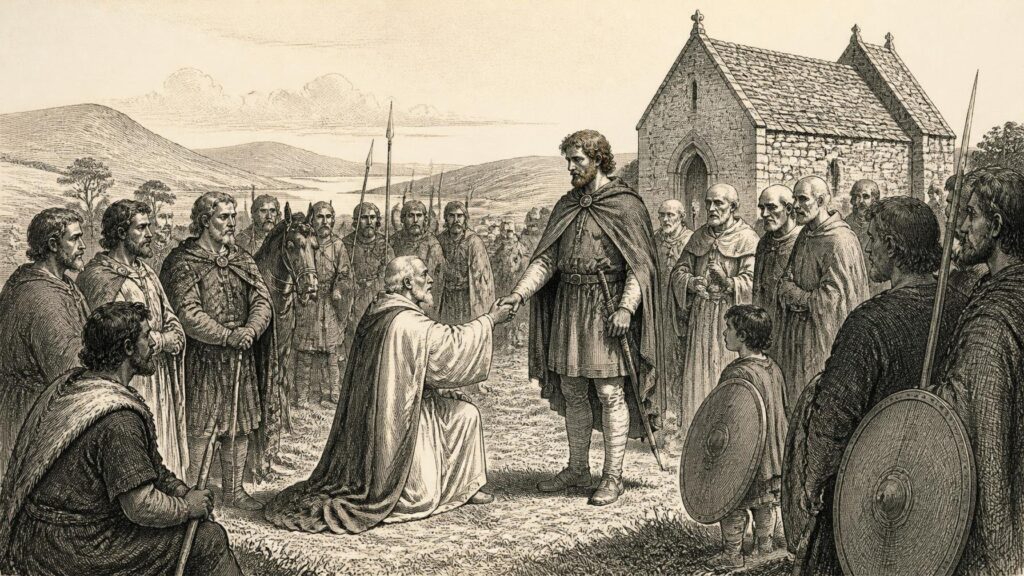
The settlement that followed mattered as much as the battle. Aodh Ruadh was installed as king of Tír Chonaill. The Annals of Ulster say that O’Neill and the religious superiors of Tír Chonaill assented to his elevation; the Annals of Loch Cé likewise attribute it to the counsel of God and men. Such phrases are not neutral minutes of a constitutional assembly, and their claims of unanimity should not be taken literally. Yet they show that a durable lordship required more than victory in the field. Senior allies, churchmen and recognised ritual all helped turn a military success into accepted rule. At Cill Mhic Nénáin, according to the Four Masters, Aodh Ruadh was styled lord in due form, while Muimhneach was confirmed as Mac Suibhne of Fanad.
The outcome did not end competition in the north-west, but it was a real turning point. Aodh Ruadh, born in 1429, had only been released from captivity in 1460. His success in 1461 restored the line of Niall Garbh to the head of Tír Chonaill and gave its new ruler a platform from which to contend with neighbouring powers in later decades. For people in Fanad and the surrounding districts, however, the immediate reality was more prosaic: the movement of armed retinues, the danger of seizure and the burden of maintaining men and animals during a campaign.
Connacht’s Fractured Kingship
Connacht was also divided by rival claims. On 15 May, Aodh, son of Toirdhealbhach Óg Ó Conchobair, died at Ballintober, aged sixty-two or sixty-three according to the annalistic reckonings. He was described as a half-king of Connacht in opposition to Tadc Ó Conchobair, and was buried at Roscommon after unction and penance. The praise attached to his obituary is revealing. The annalist commended not only his appearance and courage but his hospitality to the scholars of Ireland. In Gaelic political culture, generosity towards learned people was a public measure of lordly standing, not merely a private virtue.
His death came amid an acute contest within the wider Ó Conchobair family. Feidlim Finn Ó Conchobair was captured by the sons of Brian Ballach and by Ruaidhrí, son of Ó Conchobair Donn. Tadc Ó Conchobair, meanwhile, was seized by his own brothers and Ó Conchobair Donn. The overlapping claims make clear why the title of Ó Conchobair could not be treated as automatic inheritance from father to eldest son. It was won and defended among an extended ruling lineage, through force, alliances and the taking of hostages.
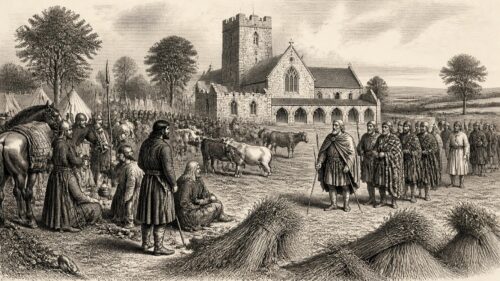
Mac William Burke intervened with a large host in Machaire Connacht to secure Feidlim Finn’s release. The captors accepted the guarantees demanded for his ransom, supplied by Connacht’s leading men. The record then says that Mac Diarmata “put on his shoe” and that hostages were received. The phrase preserves the language of an inauguration rite: amid warfare and bargaining, lordship still depended on recognised ceremonial acts. Tadc was later released for the ransom of half the townland of Ballyclare, and the rival forces clashed again near Cregga. The annalist judged neither side dishonourable in the fighting, an unusually restrained verdict on a conflict whose chief victims included communities exposed to requisition, plunder and displaced livestock.
Dearth, Raids and a Vulnerable Countryside
One short entry gives the year its widest significance: “Great dearth throughout Ireland.” The annalist did not specify its cause, duration, food prices or death toll, so none should be supplied by guesswork. It nevertheless establishes a countrywide shortage serious enough to deserve notice beside dynastic wars. Dearth made every demand for cattle, grain, labour or hospitality more difficult to meet, and it made local conflict more dangerous. That connection is an inference from the coexistence of shortage and warfare, not an explanation offered by the source itself.
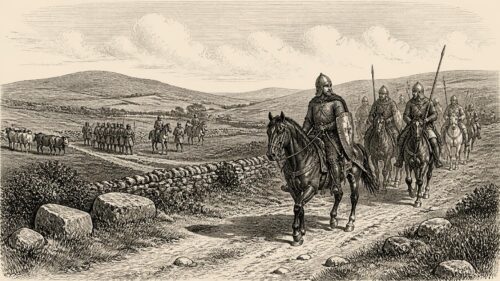
The chronicles record no pause in violence. In the north Midlands, forces of Oriel and the sons of Ruaidhrí Mac Mathghamhna defeated men described as Meath Galls together with part of Muintir Raigillig. Elsewhere, Ó Raigillig and Pilib Mag Uidhir defeated rivals from the Mag Uidhir kindred and took high-born prisoners. In the Irish midlands, Ó Conchobair Fáilghe fought the Meath and Leinster Galls in a war said to have devastated much of Meath. His mounted force, numbering a thousand or more helmeted horsemen in the annalist’s account, raided widely before concessions were made for peace.
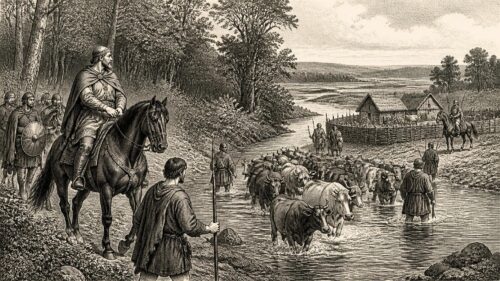
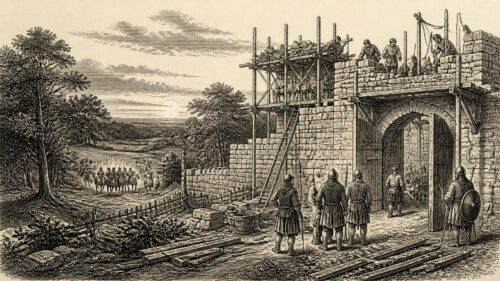
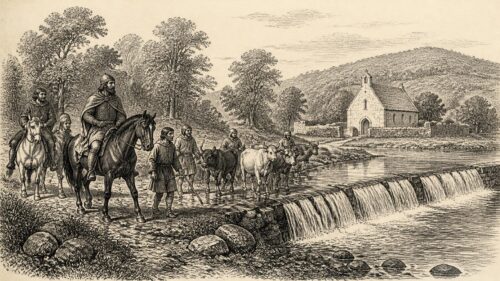
Raiding was likewise reported around Delvin, the River Inny and Portloman. Mag Eochacáin plundered the baron of Delvin and the Ledwiches, later burning Rathwire. In Connacht, the Mac Diarmatas and their kinsmen took great preys from rivals; opponents withdrew into the woods of the Curlew Mountains, while both sides devastated the district. “Prey” usually meant movable wealth, especially cattle, but its seizure also disrupted dairying, transport, cultivation and household security. In a year of dearth, these were not remote aristocratic quarrels.
Learning, Clergy and Patronage
Even in a troubled year, the annals insist on the value of learning. Feidlim, son of Eoghan and grandson of Niall Óg Ó Néill, died suddenly in his bed. He is praised as hospitable and valiant, a protector of poets, pilgrims and exiles, and as a man who had acquired more poetry and learned compositions than anyone of his time. The Annals of Ulster call him Ireland’s greatest rhymer and say that the bardic companies mourned him. This language indicates an active world of professional poets, scholars and travellers sustained by elite households.
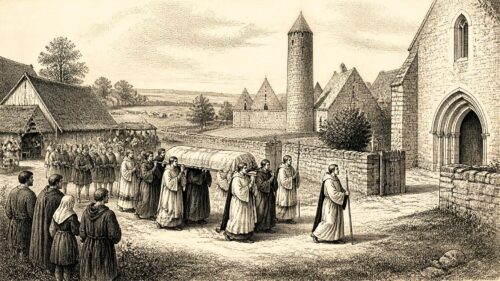
Other deaths marked losses within that world: Aengus Mac Craith, called an eminent poet, and Niall Ó hUiginn, of a family associated with learned verse. The dean Ó Máel Eóin, described as a sage of Ireland, died at Clonmacnoise. A priest and canon of Elphin also died, while the church connected with him was burned; the notice does not identify those responsible or explain the fire. At Killala, a bishop named Ó Conaill was killed by the son of Maghnus Ó Dubhda. These entries show ecclesiastical institutions embedded in the politics of lordships rather than standing outside them.
England’s Civil War, Ireland’s Horizon
The English succession crisis also entered Irish annals, though not always with precise chronology. They report the ruin of the English lordship, the death of the duke of York and the displacement of Henry VI by York’s son. Richard, duke of York, had in fact been killed at Wakefield on 30 December 1460; his son became Edward IV on 4 March 1461 after the Yorkist victory in England. The Irish notice compresses the connected upheavals into the year in which their consequences were felt and understood.
For Ireland, the fate of James Butler, fifth earl of Ormond, was especially relevant. A committed Lancastrian, he was captured after Towton and executed at Newcastle on 1 May 1461. In November, Edward IV’s parliament attainted both James and his brother John, and the crown seized the earldom’s English lands. This did not suddenly reorder every Irish lordship, but it weakened a major aristocratic connection at precisely the moment when authority across the Irish Sea was contested. In 1461, as at Ceann Maghair and in Connacht, political security depended on who could command allies, recognition and resources under pressure.
Source References
Hover over a number to see the source. Select it to open the source.

- [1] Annála Connacht, Annal 1461
- [2] The Annals of Ulster, Year U1461
- [3] Annals of the Four Masters, Annal M1461
- [4] Annals of Loch Cé, Annal LC1461
- [5] Annals of Loch Cé A.D. 1014–1590, Annal LC1461 (Irish text)
- [6] Annála Connacht
- [7] TEI Header for Annála Connacht
- [8] CELT Project: The Annals of Ulster
- [9] CELT Project: Annals of the Four Masters
- [10] Annals of Loch Cé: Background Details and Bibliographic Information
- [11] O'Donnell (Ó Domhnaill), Aodh Ruadh
- [12] Butler, James
- [13] Irish Script on Screen: MS 23 P 6 (The Annals of the Four Masters)
- [14] Versions: Annals of the Four Masters
- [15] The Later Middle Ages
- [16] Castles / Caisleán
- [17] Moymlough
- [18] 1400–1600
- [19] List of Published Texts at CELT
- [20] The Annals of Loch Cé
Primary Sources
- Annála Connacht, Annal 1461
- The Annals of Ulster, Year U1461
- Annals of the Four Masters, Annal M1461
- Annals of Loch Cé, Annal LC1461
- Annals of Loch Cé A.D. 1014–1590, Annal LC1461 (Irish text)
- Annála Connacht
- TEI Header for Annála Connacht
- CELT Project: The Annals of Ulster
- CELT Project: Annals of the Four Masters
- Annals of Loch Cé: Background Details and Bibliographic Information
- O'Donnell (Ó Domhnaill), Aodh Ruadh
- Butler, James
- Irish Script on Screen: MS 23 P 6 (The Annals of the Four Masters)
- Versions: Annals of the Four Masters
- The Later Middle Ages
- Castles / Caisleán
- Moymlough
- 1400–1600
- List of Published Texts at CELT
- The Annals of Loch Cé