Fear, Fire and Reform1096 CE
In 1096 Ireland remained politically fragmented despite Muirchertach Ua Briain’s southern overlordship, as Domnall Ua Lochlainn challenged him and regional rulers fought, raided and died in feuds. Muirchertach rebuilt Kincora, restoring Ua Briain prestige after its 1088 destruction, while Irish Sea links were marked by death of his nephew on Man. Fear of a calendrical omen, intensified by recent mortality, prompted island-wide fasting, almsgiving and church grants. Lightning burned Limerick. Waterford’s Malchus was consecrated by Anselm of Canterbury, establishing an urban bishopric connected to ecclesiastical reform. The year combined dynastic consolidation, insecurity, clerical authority and growing international religious maritime ties.
Dateline
For Ireland, 1096 was not defined by one great battle or a change of ruler. Its importance lies instead in a revealing combination of royal consolidation, regional violence, religious anxiety and institutional change. Muirchertach Ua Briain strengthened the ceremonial heart of his dynasty at Kincora, while rival kings and local kindreds continued to fight across the island. A widely feared calendrical omen prompted collective fasting and gifts to churches. At Waterford, meanwhile, the consecration of a new bishop connected an Irish port directly with Canterbury and the wider movement for reform in the western Church.
Reading a Fragmentary Year
The surviving annals do not provide a complete national record, and their dates do not always agree. Entries were copied, combined and sometimes shifted by later scribes. Events reported independently by several chronicles can usually be treated with confidence; details appearing only in the much later Annals of the Four Masters require greater caution. The evidence is also socially uneven. Kings, bishops, abbots, battles, fires and extraordinary signs were considered worth recording, whereas the work of farmers, craftworkers and sailors usually entered the written record only indirectly.
A Kingdom Built on Overlordship
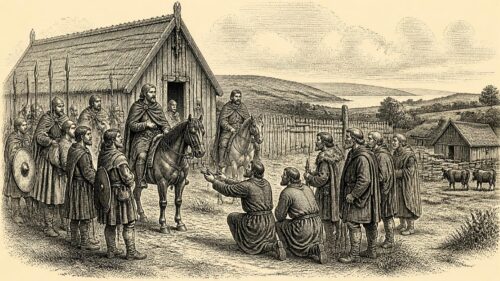
The most powerful ruler in southern Ireland was Muirchertach Ua Briain, king of Munster and a great-grandson of Brian Bóruma. He claimed a wider kingship of Ireland, but this did not mean government through a single permanent administration. Power rested upon military reputation, personal alliances, hostages, tribute and the submission of lesser kings. Muirchertach had recently imposed his influence upon Dublin, Mide and much of Connacht. Domnall Ua Lochlainn of Cenél nEógain remained the principal northern counterweight, however, and possessed his own claim to supremacy. Ireland in 1096 therefore had a dominant southern overking, but not an uncontested monarch.
The relative absence of a major campaign between these two rulers during the year should not be mistaken for settled peace. Their rivalry shaped political decisions even when their armies did not meet. Muirchertach’s authority depended upon retaining the obedience of provincial and local rulers whose loyalty could change rapidly. Domnall, secure in the north, could wait for resistance to Munster rule to revive. The more intensive northern expeditions associated with Muirchertach began in 1097, making 1096 something of a year of preparation and consolidation.
Kincora Rebuilt
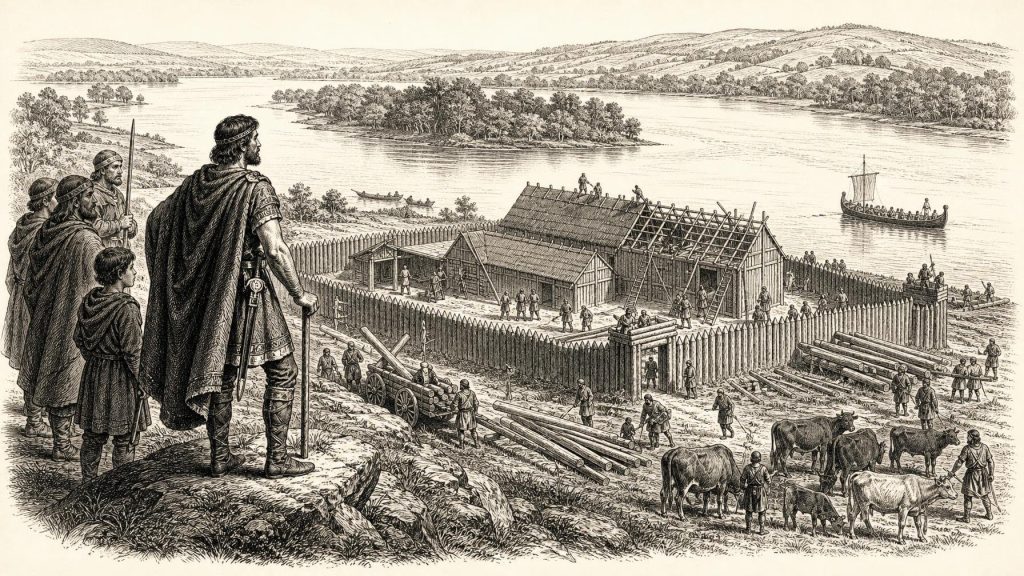
The clearest expression of that consolidation was the rebuilding of Ceann Coradh, or Kincora, at Killaloe. The Annals of the Four Masters place its restoration in 1096, after its earlier destruction by the forces of Leth Cuinn, the northern half of Ireland. Domnall Ua Lochlainn and his Connacht allies had devastated the Ua Briain centre during their invasion of Munster in 1088. Re-edifying it eight years later was consequently more than routine construction. It restored a dynastic residence closely associated with Brian Bóruma and proclaimed that the Uí Briain had recovered from that humiliation.
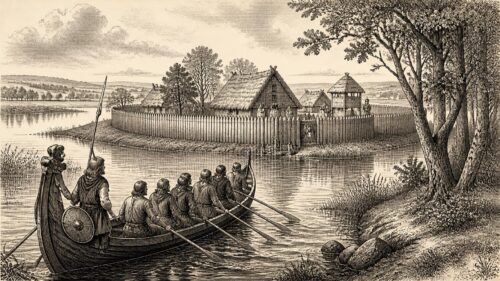
Kincora should not be imagined as a later stone castle. It was a royal complex in a commanding Shannon landscape, probably containing halls, dwellings, enclosures and defensive earthworks constructed substantially from timber. Such a residence accommodated the king’s household, warriors, guests, craftsmen and stores. Its position near the head of the lower Shannon linked the Dál Cais heartland with Lough Derg, Limerick and routes into the midlands. Rebuilding the site enhanced Muirchertach’s ability to receive dependants, distribute gifts and display the hospitality expected of a successful king.
Regional Wars and Fragile Kingships
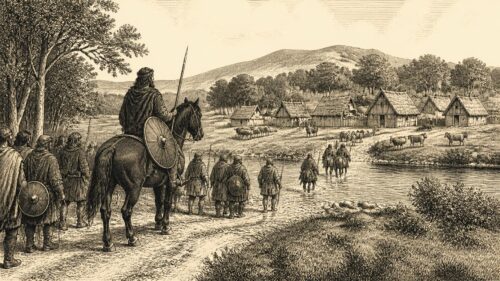
Violence continued below the level of the great overkings. The northern annals record that Conchobar Ua hAiniarraid, king of Ciannacht, and the king of Uí Meic Cairthinn fell against one another in combat. Cú Ulad Ua Ceilecáin, designated heir of Airgialla, was killed by the Ulaid. In another northern episode, a force of Uí Méith raided Uí Echach Ulad and drove away cattle, only to be overtaken and heavily defeated. These were not random disturbances. Raiding transferred livestock, punished rivals and tested the strength of neighbouring lordships, while the death of a king or intended successor could transform a local balance of power.
Western politics were equally unstable. Muirchertach Ua Dubda, ruler of Uí Amalgaid and, in some accounts, wider territories of northern Connacht, was killed by his own people. The wording suggests an internal betrayal or dynastic revolt rather than conquest by a foreign army. Matudán Ua Matudán, king of Síl Anmchada, also died during the year. Farther south, the annals record the deaths of rulers associated with Corcu Duibne, Múscraige Mittaine and Uí Liatháin. Some may have died peacefully, but their concentration in the record underlines how much government depended upon individuals and negotiated relationships between ruling families.
A particularly informative entry concerns Gilla Oissén Mac Coirtéin, ruler of Delbna Mór. According to the Four Masters, Muirchertach Ua Briain delivered him to the Uí Laegaire, who killed him, after receiving thirty ounces of gold, one hundred cows and eight hostages. As the detail survives in a late compilation, it should not be treated as a verbatim contemporary transaction. Nevertheless, it illustrates the recognised currencies of politics: precious metal, livestock and human sureties. Hostages guaranteed agreements, while cattle remained the foundation of wealth, military provisioning and royal tribute.
Across the Irish Sea
Irish affairs extended beyond the island. The Four Masters report that Amlaíb, son of Tadc Ua Briain and nephew of Muirchertach, was killed on the Isle of Man. The entry is brief and does not explain why he was there. It belongs, however, to a period of strong Ua Briain involvement in Dublin, Man and the Isles following the expulsion of Gofraid Méránach from Dublin in 1094 and his death in 1095. Amlaíb’s presence on Man may reflect dynastic ambitions, military service or a struggle among competing island factions. More definite conclusions would exceed the evidence.
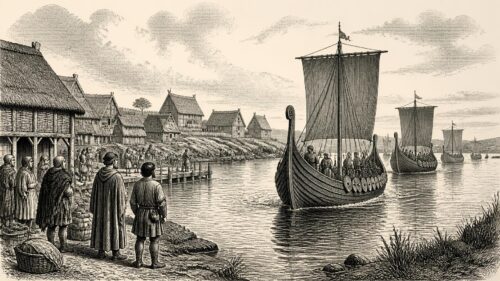
The report nevertheless shows that the Irish Sea was a political corridor rather than a frontier. Dublin, Waterford and Limerick connected Irish kings with Britain, Man, the Hebrides and continental markets. Norse-Gaelic families crossed the sea, and fleets could carry warriors as readily as merchants or churchmen. Although 1096 was also the departure year of the First Crusade in continental Europe, there is no firm evidence that an identifiable Irish force joined it. Ireland’s demonstrable overseas connections that year lay principally within Britain and the Irish Sea world.
The Great Fear
The most widely remembered event of the year affected people far beyond royal courts. Several annals describe a great fear before the feast of St John, commonly understood as the feast of the Beheading of John the Baptist on 29 August. In the leap year 1096, the feast fell on a Friday, a calendrical conjunction associated in Irish religious tradition with threatened catastrophe. Anxiety must have been sharpened by the severe mortality that had begun in 1095 and, according to one chronicle, continued into the following May.
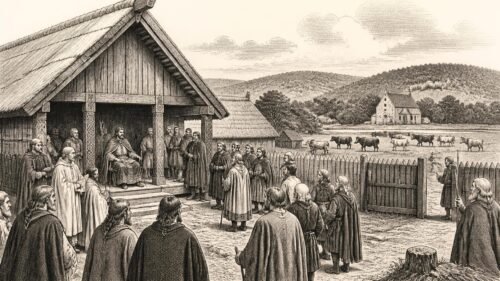
The response was organised by the successor of Patrick at Armagh together with other Irish clergy. Accounts differ in detail, but they agree upon fasting, abstinence, prayer and almsgiving. The fullest version says that periods of abstinence were to be observed each month, with restricted meals continuing through the year except on Sundays and major feasts. Kings and chieftains made offerings, granted lands and released churches from burdens or tribute. The episode reveals a society in which natural disaster, disease and unusual calendar patterns could be interpreted morally, but also one capable of coordinated action across political boundaries.
It would be misleading to present this simply as an irrational panic or as the beginning of Irish church reform. Modern scholarship has questioned attempts to connect every eschatological text with the events of 1096. What can be said securely is that leading churchmen transformed fear into penitential discipline and material support for religious communities. Their ability to influence rulers demonstrates the authority of Armagh and of the wider clerical network. The Church could mediate in war, protect certain places and persons, and call communities to common observance even when no king commanded the whole island.
Waterford and Canterbury
A more institutional religious development occurred at Waterford. Máel Ísu Ua hAinmire, known in Latin as Malchus, had lived as a Benedictine monk and priest at Winchester. Chosen for the new urban bishopric by the clergy and people of Waterford with the support of Muirchertach Ua Briain and prominent bishops, he was consecrated by Archbishop Anselm at Canterbury on 28 December 1096. The surviving documentation makes this one of the year’s most firmly dated Irish events.
Malchus’s consecration reflected Waterford’s character as a Christian Norse-Irish port with close maritime connections to England. His profession of obedience to Canterbury introduced a relationship different from the older Irish pattern of churches centred upon saints’ communities and hereditary ecclesiastical interests. It did not instantly replace that system, nor did Canterbury acquire control over Ireland. It did, however, establish an urban diocese with a bishop trained in a continental-style monastic environment. Muirchertach’s sponsorship also shows how royal ambition and religious reform could reinforce one another.
Fire, Work and Daily Life
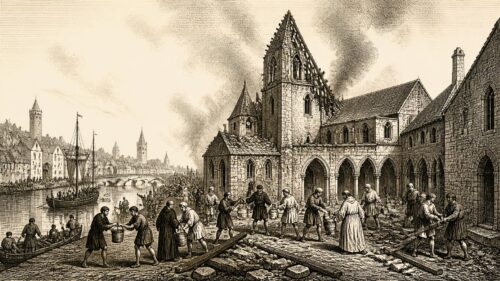
The Annals of Inisfallen state that Limerick was burned by lightning on 31 March. Timber, thatch and closely grouped buildings made fire a constant danger in Irish settlements, whether caused by warfare, accident or weather. The record does not describe the scale of destruction, so a complete devastation should not be assumed. Rebuilding would nevertheless have required wood, labour and supplies from the surrounding countryside, reminding us of the dependence of towns upon rural producers.
Most people lived by mixed farming, particularly cattle husbandry and grain cultivation. Seasonal insecurity was real after the frost, livestock losses and pestilence recorded in 1095. In the ports, daily life also involved fishing, shipping, metalworking, woodworking, textile production and commerce. Silver pennies circulated in Dublin, although cattle, measured silver and payments in kind remained crucial elsewhere. The annals’ references to gold, cows, tribute and church lands offer brief glimpses of an economy in which royal extraction, local production and overseas trade existed side by side.
Learning remained concentrated in ecclesiastical communities. The deaths recorded in 1096 included bishops, superiors, priests and a chief poet of Dál Cais. Such notices preserve the outline of a literate professional world of clerics, poets, jurists and teachers. Manuscripts, oral learning and finely worked reliquaries carried historical, legal and religious knowledge between major churches and royal courts. The Hiberno-Norse artistic fusion visible in eleventh-century metalwork likewise reflects continuing exchanges between Irish traditions and the Scandinavian-influenced towns.
A Year of Transition
Ireland ended 1096 without political unity, but with Muirchertach Ua Briain in a stronger position than he had occupied eight years earlier. Kincora stood renewed, his influence reached the principal southern ports, and his involvement in the appointment of Waterford’s bishop linked kingship with emerging ecclesiastical reform. Yet local rulers continued to die by feud, raid and betrayal, while Domnall Ua Lochlainn remained unbroken in the north. The year’s most striking contrast is therefore between fragmentation and collective action: many competing kingdoms, but a clerical appeal capable of moving rulers and communities throughout Ireland.
Primary Sources
- The Annals of Ulster: Year U1096
- Annals of the Four Masters: Annal M1096
- Annals of Inisfallen: Annal AI1096
- Chronicon Scotorum
- Annals of Loch Cé: Annal LC1096
- Annals of Tigernach: Annal T1096
- Ua Briain, Muirchertach
- Ua Lochlainn (Mac Lochlainn), Domnall
- Ua hAinmire, Máel-Ísu (Malchus)
- Ua Briain, Domnall
- High-Kings with Opposition, 1072–1166
- Ireland in the Middle Ages
- Emerging from the Mist: Ireland and Man in the Eleventh Century
- Seán Duffy: Department of History
- The Medieval Irish Kings and the English Invasion
- The Rhetoric and Reality of Reform in Irish Eschatological Thought, c. 1000–1150
- The Rhetoric and Reality of Reform
- Time Is Short: The Eschatology of the Early Gaelic Church
- Reform in the Twelfth-Century Irish Church: A Revolution of Outlook?
- Malchus, Monk of Winchester and First Bishop of Waterford
- Viking
- Early Medieval
- 950–1450: Vikings, Normans and Medieval Mints
- Guide to the National Museum of Ireland
- Brian Boru’s Fort
- County Clare Urban Archaeology Survey