Ballindoon’s Breached Defences1352 CE
In 1352, annals from Connacht and later Four Masters record violent contests for lordship across Connacht, Breifne and Tír Chonaill. Aodh mac Toirdelbach Ó Conchobair forcibly recovered Connacht’s kingship against Gall and Gael, amid associated killings, and breached Baile an Dúin, destroying cattle and sheep. In Breifne, Aodh Ó Ruairc and his Clann Suibhne gallóglaigh were killed, while further deaths exposed unstable leadership. Aengus Ó Domhnaill’s treacherous killing triggered disputed succession in Tír Chonaill. Notices of captains, nobles and patrons reveal intertwined warfare and cultural support. Recent plague formed the background, but evidence does not establish a 1352 nationwide outbreak.
Dateline
In 1352, the most clearly dated Irish evidence points towards a violent reordering of power in Connacht, Breifne and Tír Chonaill. The year’s annalists do not provide a continuous national narrative: they record claims to lordship, killings, the breaking of a defended place and the destruction of livestock. Yet those compressed notices reveal a great deal. Authority was personal and contested, warfare could reach the resources on which communities depended, and a lord’s position was secured not by a fixed constitutional office but through kinship, alliances, armed followings and the capacity to reward supporters.
Reading a Difficult Year
The best evidence for 1352 is the annal entered under that year in Annála Connacht. It begins with a calendrical heading placing 1 January on a Sunday, then lists events without days, months or locations in most cases. The later Annals of the Four Masters preserves a closely comparable sequence. This makes the year unusually well supplied with narrative notices, but it does not licence more precision than the sources give. None tells us when during 1352 Aodh mac Toirdelbach moved, when Baile an Dúin was breached, or where several killings occurred.
This caution matters especially because annalistic year headings can differ between chronicles. The Annals of Ulster, for example, place the death of Maurice fitz Thomas, earl of Desmond, under a heading rendered “1352–5”; modern biographical evidence establishes that he died on 25 January 1356. His death therefore belongs to 1356, not to this calendar-year article. The secure story of 1352 lies principally in the Connacht-centred sequence, whose political horizons nevertheless stretched from Donegal to Breifne.
Aodh’s Return in Connacht
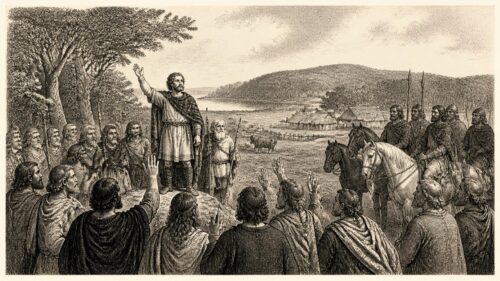
The leading event was the forcible recovery of the kingship of Connacht by Aodh, son of Toirdelbach Ó Conchobair. The annalist’s wording is revealing: Aodh “seized” the kingship, and did so “in spite of Gall and Gael”. In this context Gall could designate English or Hiberno-English interests, while Gael denoted Irish-speaking political society; the phrase is not a census of ethnicity, but a declaration that opposition crossed established political boundaries. Connacht was not governed by a single settled bureaucracy. A provincial kingship remained a prize within the extended Ó Conchobair dynasty, contested among branches and dependent on the support, acquiescence or hostility of other regional powers.
The record of Aodh’s accession stands beside the killing of Aodh Ó Maelbhrenainn and his two sons by Aodh, son of Feidlim Ó Conchobair. The bare notice does not explain motive, place or the victims’ political alignment. It does, however, show that the struggle was not merely an abstract dispute over a provincial title. It involved lethal action among men embedded in rival lordly networks. Aodh mac Toirdelbach’s success should therefore be understood as a recovery achieved through force and coalition, rather than as a peaceful succession.
The title “king of Connacht” should not obscure the fractured reality beneath it. The province contained powerful dynasties, including Mac Diarmata in Magh Luirg, Ó Cellaigh in Uí Maine, Burke lordships and several Ó Conchobair lines. The year’s annals do not demonstrate that Aodh commanded all of them in practice. They show instead that he could assert a superior claim against opponents described collectively as both Gall and Gael. In medieval Irish politics, that was a consequential achievement even when its permanence was uncertain.
Breifne’s Bloody Frontier
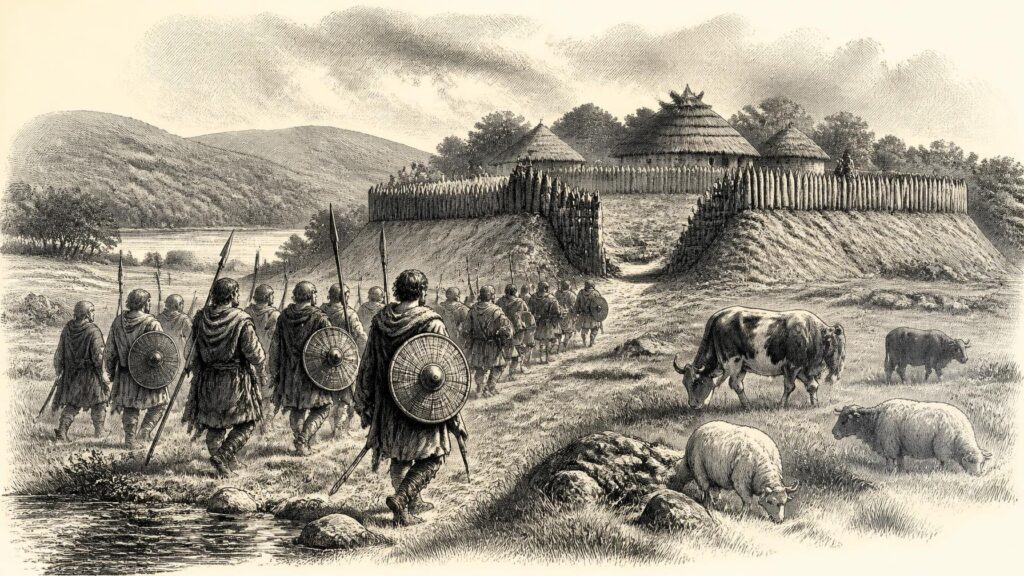
Conflict in Breifne, the broad lordship covering much of modern Leitrim and Cavan, was equally stark. Aodh Ó Ruairc, called king of Breifne, was killed by Cathal, son of Aodh Breifneach Ó Conchobair, together with Clann Muircheartaigh. The annals add that the gallóglaigh of Clann Suibhne were slaughtered with him. This is an important indication of the military character of lordship. Gallóglaigh were heavily armed professional fighting men, drawn from kindreds with strong links across the North Channel world; their service gave an Irish ruler a formidable household force, but also made them an expensive and politically significant element in war.
The killing of an Ó Ruairc ruler and the destruction of his accompanying gallóglaigh did not simply remove one commander. It weakened a military following and altered the bargaining power of competing families along the Connacht–Ulster frontier. Later in the same annal, Flaithbertach Ó Ruairc, also styled king of Breifne, died. The sources do not explain the relationship between the two men, nor explicitly narrate a succession. Still, two such notices in one annual entry underline how unstable leadership could be in a territory whose rulers had long negotiated pressure from Connacht, neighbouring Breifne kindreds and English lordship to the east.
Another death, that of Matha Mag Dorchaidh at the hands of Clann Muircheartaigh, reinforces the impression of a conflict extending beyond a single encounter. The annals do not permit a map of campaigns, but they do record a connected political landscape in which kin-groups fought for survival, land, status and the right to lead dependants.
Tír Chonaill’s Violent Succession
Farther north-west, Aengus Ó Domhnaill, king of Tír Chonaill, was killed by Magnus or Manus Ó Domhnaill “by treachery”. The phrase is the annalist’s judgement, and should be retained as such rather than expanded into an imagined assassination scene. It signals, nevertheless, that the death was regarded as an unlawful or clandestine betrayal within the ruling kindred rather than an ordinary battlefield loss.
The Four Masters adds that Feidhlim Ó Domhnaill took Aengus’s place, while John, son of Conchobhar Ó Domhnaill, contested the lordship. That additional detail makes clear what the Connacht annal’s concise notice already suggests: the killing opened, rather than settled, a succession crisis. Tír Chonaill was a major northern lordship, and its internal divisions mattered well beyond Donegal. Its rulers commanded routes between Ulster, the western seaways and the Gaelic world of Scotland; dynastic instability there could therefore reshape alliances across a much wider region.
Baile an Dúin and the Cost of War
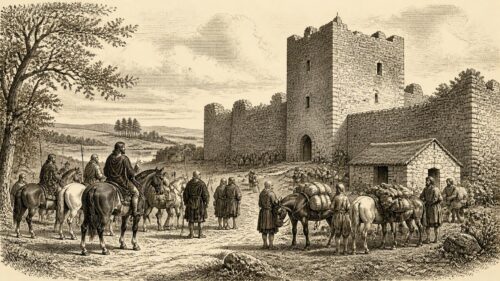
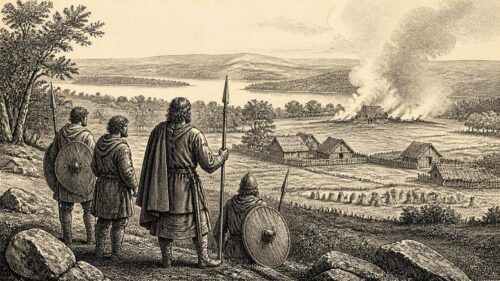
Aodh mac Toirdelbach’s most tangible act in the record was the breaching or demolition of Baile an Dúin, followed by the destruction of its cattle and sheep. The Irish wording indicates the breaking of a defended place, but does not describe its walls, attackers or method. Nor should this entry be automatically equated with surviving later monuments carrying the Ballindoon name. The annal provides a place-name and an assault, not an archaeological plan.
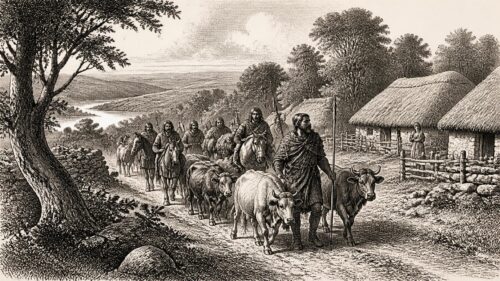
Its mention of livestock is especially valuable. Cattle and sheep were not incidental spoils. They represented food, dairying, breeding stock, wool, hides, rent and portable wealth. To destroy them was to attack a household’s future productive capacity as well as its immediate subsistence. The notice does not tell us how many animals were lost or whether the wider district suffered famine. It does show that warfare in 1352 was directed at resources on which ordinary dependants, tenants and labourers relied. A breached enclosure and ruined herds were a political message, but they were also a blow felt far beyond a lord’s fighting retinue.
Patronage, Learning and a Shadowed Recovery
The annals also preserve quieter deaths. Dabacc Dillon, son of Uilliam of Umhaill, is called leader of the Connacht ceithern, a term for a body of fighting men. Conchobhar, son of Muirgius Mac Donnchada, Nuala daughter of Mac Diarmata, Tomás Mag Raghnaill and Tadhg son of Siacas Ó Cellaigh also died. Such entries are reminders that aristocratic women, military captains and members of established learned and lordly families all belonged to the political fabric of a province.
The Four Masters particularly commemorates Conchobhar, son of Maurice Mac Donnchada, as a general patron of people skilled in every art. It is an honorific, not evidence for a named school or surviving manuscript commissioned in 1352. Even so, it points to the social expectation that high-status households should sustain poets, historians, lawyers, musicians and other learned practitioners. Warfare and cultural patronage were not opposites: the same networks that raised armed men also supported the expertise through which pedigree, law, memory and reputation were maintained.
The Black Death had been recorded in Ireland in 1349 and was still feared in scribal testimony around 1350–51. It forms an essential background to the early 1350s, but no reliable annalistic entry allows us to claim a fresh nationwide plague outbreak in 1352. The year should therefore be seen as one of political struggle in a society recently damaged by epidemic, not inaccurately labelled a plague year itself. What the surviving evidence securely shows is a hard contest for lordship, conducted through killings, armed service and attacks on defended places and herds.
Primary Sources
- Annála Connacht, Annal 1352
- Annála Connacht: Irish Text, Annal 1352
- Annals of the Four Masters, Annal M1352
- Annals of the Four Masters, Annals M1342–M1344
- The Annals of Ulster, Year U1352
- Annals of Loch Cé
- FitzGerald, Maurice fitz Thomas
- A Tract on the Plague
- The Identification of Some Pestilences Recorded in the Irish Annals
- Plagues, Pandemics and Epidemics in Irish History Prior to COVID-19
- The Resurgence of Gaelic Power in Ireland and Scotland and its Wider Impact, c.1350–1513
- The Galloglass of Thomond: Gallóglaigh Thuadhmhumhain
- O'Rourke (Ó Ruairc), Conchobar Buide
- O'Rourke (Ó Ruairc), Ualgarc
- O'Rourke, Conchobar
- Decline of the Norman Colony
- The Norman Conquest
- Ballindoon
- Visit Ballindoon Abbey with Discover Ireland
- Annales Hiberniae
- CELT Project: Annales Hiberniae
- The Middle Ages: Kilkenny 400