Cáeluisce’s Contested Crown1258 CE
In 1258, Brian Ua Néill secured recognition at Cáeluisce from Connacht and Thomond leaders as king of the Gaels of Ireland, though this alliance neither unified Ireland nor ended regional rivalries. Hostage arrangements and conflict in Breifne exposed unstable lordship. English pressure prompted defensive destruction of ecclesiastical sites, while war in the south devastated settlements and crops. Hebridean raiders defeated Connacht’s sheriff after seizing valuable maritime cargo. Separate Gaelic-English peace talks demonstrated pragmatic local politics. Church life continued through episcopal changes, Armagh’s papal pallium, Dominican commemoration and a Franciscan foundation at Clane, amid enduring political and economic uncertainty across Ireland.
Dateline
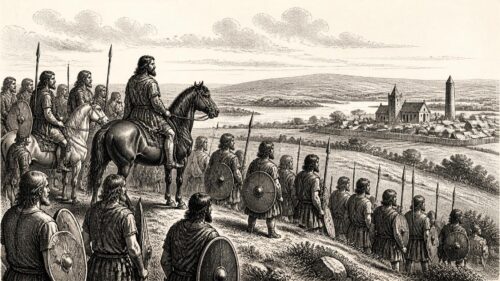
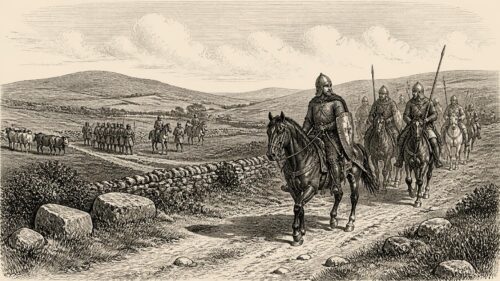
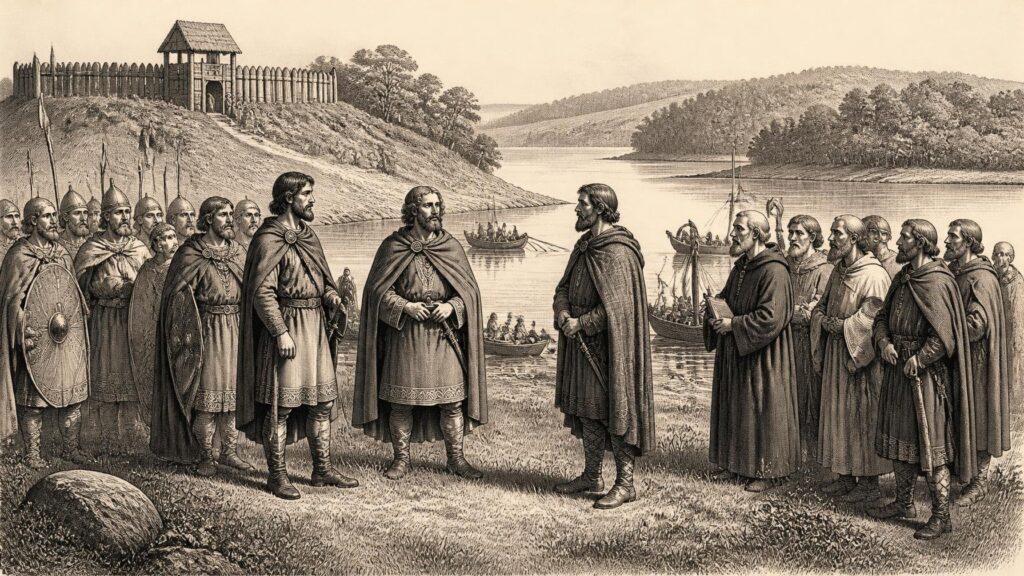
In 1258, the most striking political act in Ireland was not a battle but a meeting at Cáeluisce, on the Erne in Fir Manach. There, according to the Irish annals, Áed mac Fedlimid Ua Conchobair of Connacht and Tadc Ua Briain of Thomond met Brian Ua Néill, king of Tír Eógain. They made peace with one another and recognised Brian’s ríge na nGaedel Érenn: the kingship of the Gaels of Ireland. It was a bold revival of an old political language of island-wide supremacy, made in an Ireland divided among Gaelic lordships, the English lordship, ecclesiastical jurisdictions and powerful settler families.
The year should not, however, be mistaken for the restoration of a unified Irish monarchy. No surviving source shows Brian exercising authority throughout the island, and the assembly’s agreement did not bind every Gaelic ruler, much less the king of England’s administration or the Anglo-Irish towns and lordships. Its importance lies instead in the coalition it attempted to create. In a time when English castles, grants and military expeditions pressed particularly hard on the western and northern Gaelic polities, the meeting brought together leading figures from Tír Eógain, Connacht and Thomond around a deliberately expansive claim.
An Assembly on the Erne
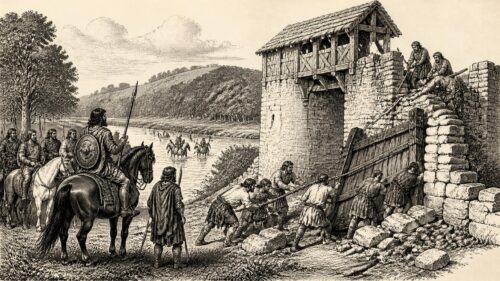
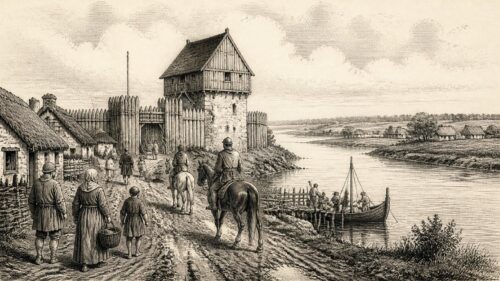
The annals place the gathering at Cáeluisce, a strategically resonant place close to the Erne’s route between Ulster and the north-west. English fortification had already made the locality a contested frontier. The Annals of the Four Masters record a castle at Cáeluisce; they also report that Gofraid Ua Domnaill had demolished a castle there in 1257 after conflict with the English. Thus the 1258 conference was held in a landscape where waterways, roads, lordship and fortification met, rather than in some remote ceremonial refuge.
The principal participants were Brian Ua Néill, Áed mac Fedlimid and Tadc Ua Briain. Brian had established himself as king of Tír Eógain after the severe dynastic struggles that had marked Ulster earlier in the century. Áed, son of Fedlimid Ua Conchobair, represented a Connacht dynasty whose relations with the English crown and local Anglo-Irish lords had repeatedly alternated between negotiated accommodation and war. Tadc was the politically assertive son of Conchobar Ua Briain, king of Thomond. Their alignment was therefore meaningful: it joined leaders from three of the most substantial Gaelic power bases still outside direct English control.
Yet the sources also preserve a revealing uncertainty about what was agreed. Annála Connacht says that kingship over the Gaels of Ireland was given to Brian, while hostages from Muintir Raghallaigh and from Uí Briúin territories between Kells and Drumcliff were delivered to Áed Ua Conchobair. The later Four Masters instead says that the hostages were handed to Brian. Both versions confirm that hostages were central to the settlement; they differ over their custody. That discrepancy matters. Hostages were not symbolic decorations but living guarantees of political obedience, and the difference suggests that the alliance’s internal hierarchy was more complicated than a simple submission of Connacht and Breifne to an uncontested high king.
Nor should the presence of Tadc be treated as proof that Thomond accepted permanent subordination to Brian. A later Thomond narrative gives a more contentious account of the meeting, portraying Tadc as resistant to the proposed supremacy. Whatever precisely passed between the leaders, the securely dated annalistic evidence permits a firmer conclusion: a major agreement was made, Brian received an exceptional title, and the men attending sought to coordinate Gaelic power across regional boundaries.
Connacht, Breifne and Hostages
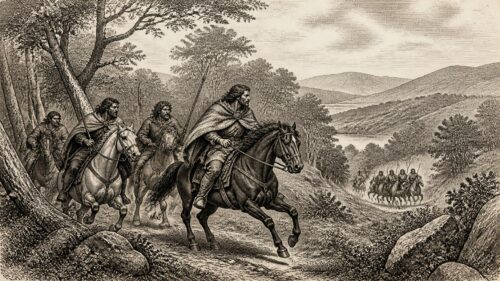
The political manoeuvres recorded elsewhere in 1258 show why hostage-taking and lordship were so urgent. Domnall, son of Conchobar Ua Ruairc, had been kept in detention by Fedlimid Ua Conchobair and his son Áed because of his father’s position. He was released during the year and installed as king of Breifne. The arrangement rapidly unravelled. Domnall killed Mac Raith Mac Tigernáin, chief of Tellach Dúnchada; the men of Breifne and Connacht then deprived him of his kingship, while the people of Tellach Dúnchada killed his brother Cathal. Art, son of Cathal Riabach Ua Ruairc, was subsequently made ruler of the eastern Uí Briúin.
This was not a peripheral feud. Breifne sat across vital routes between Connacht, Ulster and Meath, and its competing Ua Ruairc, Ua Raghallaigh and related interests could frustrate any larger alliance. The swift fall of a newly restored lord illustrates the limited reach even of powerful Connacht intervention. It also gives the hostage clauses at Cáeluisce their proper setting: rulers required assurances because succession, loyalty and control of client territories were inherently unstable.
Áed Ua Conchobair also ordered the demolition of episcopal residences at Elphin and Cell tSesin. The Connacht annalist explicitly gives the reason as fear that the Galls—foreigners, usually Anglo-Norman or English forces in this context—might occupy them. The action was defensive but severe. A bishop’s residence was a centre of administration, hospitality and status; pulling it down denied an enemy shelter and supplies while imposing immediate disruption on the churchmen and dependants who used it. It demonstrates how readily religious buildings could become assets in secular conflict.
The Western Sea Raid
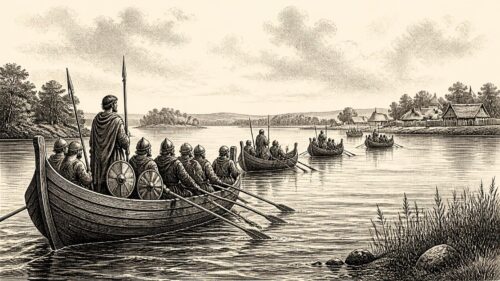
Conflict also arrived from the sea. The annals report that Mac Somurli came from the Hebrides with a large fleet, sailed around Ireland’s western coast into Connemara, and seized a merchant vessel. The cargo is unusually specific: wine, copper, cloth and iron. These goods offer a rare, concrete glimpse of the commerce moving through Atlantic waters. Wine points to long-distance links with continental or Anglo-French trading networks; cloth, copper and iron were valuable commodities for households, artisans, churches and lordly retinues. The ship’s loss was consequently more than an isolated theft. It struck at the supply lines that connected Connacht’s coast with wider markets.
Jordan d’Exeter, sheriff of Connacht, pursued the raiders by sea with a fleet carrying Anglo-Irish troops. Mac Somurli’s men had drawn their ships up on an unnamed island and armed themselves before Jordan landed. The encounter went badly for the sheriff: he was killed immediately, together with Piers Accabard, described as an excellent knight, and other prominent men. The pursuing force withdrew, while Mac Somurli returned to his own country with his plunder.
The episode is significant for its scale as much as its outcome. It records a sheriff using ships and armed men in an attempt to police Connacht’s seaways, but it also shows the vulnerability of that authority when confronted by experienced Hebridean seafarers. Ireland’s western coast was not an isolated edge of Europe. It was part of an Irish Sea and Atlantic world in which Hebridean, Scottish, Gaelic and Anglo-Irish interests could meet through trade, raiding, marriage and war.
War, Peace and Burned Food
In the south, the annals record a great war between the English and Conchobar Ua Briain. Ardrahan, Kilcolgan, many settlements and crops were burned. Such notices are concise, but their implications are plain. Destroying standing corn and stored food attacked the basis of ordinary subsistence, as well as a lord’s revenue and capacity to feed followers. Burning settlements displaced households, damaged workshops and destroyed stores. The named places in south Galway indicate that the conflict touched a region where settler expansion and Gaelic resistance were closely entangled.
At the same time, 1258 was not a year of uninterrupted warfare. Annála Connacht records a great meeting of Gaels and Galls at Mullach Laigide, held without Fedlimid Ua Conchobair, at which peace was made. The Four Masters likewise records a conference between the English of Ireland and the Irish in Fedlimid’s absence. This agreement complicates any simple picture of a general national war. The same year that produced a pan-Gaelic claim at Cáeluisce also saw separate, localised negotiations across the political divide. Alliances were situational; peace in one district did not end burning or raiding in another.
Church, Learning and New Foundations
Ecclesiastical affairs were equally shaped by both local and international connections. Walter de Salerna, the English royal nominee as archbishop of Tuam and dean of London, died in England during the year. Tomaltach Ua Conchobair, bishop of Elphin, was then elected to the archbishopric of Tuam. The change mattered in Connacht, where the archiepiscopal see possessed spiritual authority, landed interests and political weight. It also showed that appointments to major Irish churches could involve local chapters, Gaelic dynasties, the English king and the papacy.
At Armagh, Abraham Ua Conchobair received a pallium from Rome and celebrated Mass in it on 2 June, the clearest exact date preserved for an Irish ecclesiastical event in the year. The pallium, a papal vestment associated with metropolitan authority, publicly connected Armagh’s archbishop to the wider Latin Church. The death of Friar Reignerus, provincial minister of the Dominicans in Ireland, is also recorded. Dominican networks, like episcopal ones, linked Irish religious life to international institutions while remaining rooted in local houses and patrons.
In Leinster, a Franciscan friary was established at Clane, probably under the patronage of Gerald FitzMaurice FitzGerald, lord of Offaly. Archaeological and historical surveys date the foundation to about 1258. Its establishment points to a substantial local settlement and to the continuing spread of the friars, whose urban and pastoral model differed from that of older monastic communities. The annals also notice the deaths of Matha Ua Raduib, called ‘the Master’, and of the pious monk Ua Cuirnín. Their brief commemorations are reminders that learned clerics, teachers and religious specialists remained valued figures in thirteenth-century Irish society, even when warfare dominates the record.
What survives for 1258 is therefore a sharply uneven but vivid picture. It records elite assemblies, hostages, raids and episcopal appointments more readily than it records the names of farmers whose grain was burned or sailors whose vessel was taken. Still, the evidence is enough to show an Ireland in motion: a Gaelic coalition testing the language of high kingship at Cáeluisce; regional lordships struggling over Breifne; western trade exposed to maritime violence; and churches adapting, building and enduring amid political uncertainty.
Primary Sources
- Annála Connacht: Annal 1258
- Annála Connacht
- Annals of the Four Masters: Annal 1258
- Annals of the Four Masters
- Annals of Ulster, AD 1202–1378
- The Annals of Ulster, AD 1202–1378: English Translation
- Annales Dominicani de Roscoman
- Annales Dominicani de Roscoman: Latin Text
- Annales Breves Hiberniae: Annal 1258
- Annales Hiberniae
- Annalium Hiberniae Chronicon ad annum MCCCXLIX
- Annals of Inisfallen
- O’Neill (Ó Néill), Brian
- O’Brien (Ó Briain), Conchobar
- The Rise and Fall of the Clann Éinrí Aimhréidh Uí Néill: Dynastic Feuding and Geopolitics in the Late Medieval Irish Sea World
- Colonisation and Conquest in Medieval Ireland
- The Battle of Dysert O’Dea and the Gaelic Resurgence in Thomond
- County Kildare Urban Archaeological Survey
- Clane Abbey Community Centre Conservation Management Plan
- 1999:366 – Abbeylands, Clane, Kildare
- Clane (Co. Kildare)
- Exploring the Irish Annals