Creadran and Cherry Island1257 CE
In 1257, Irish politics were shaped by local conflicts and shifting alliances between Gaelic rulers and Anglo-Irish power. Conchobar Ó Ruairc surrendered Cherry Island castle to Fedlimid Ó Conchobair, but later destroyed it after its garrison withdrew. Dynastic rivalry, including blinding and killings, exposed Connacht’s instability despite Fedlimid’s peace with colonial leaders and royal charter. Gofraid Ó Domnaill demolished Cáel Uisce castle, burned Sligo and routed Anglo-Irish forces at Credran, though he was wounded. Fighting also affected Thomond. Meanwhile, Roscommon’s Dominican church was consecrated, Abraham Ó Conalláin travelled to Rome, and churchmen remained involved in political violence and patronage there.
Dateline
The surviving annals make 1257 appear less like a single national story than a sequence of sharp local crises: an island fortress changing hands in Breifne, a castle destroyed on the Erne, fighting around Sligo, a contested settlement in Connacht, and war in Thomond. Yet these were connected by the changing balance between Irish dynasties and the Anglo-Irish lordship. The year also contained a substantial religious landmark, the consecration of the Dominican church of St Mary at Roscommon. Its combination of warfare, negotiated submission, royal patronage and ecclesiastical building shows an Ireland in which political power was exercised through forts, kinship, hostages, tribute, churches and carefully brokered agreements.
Breifne’s Island Stronghold
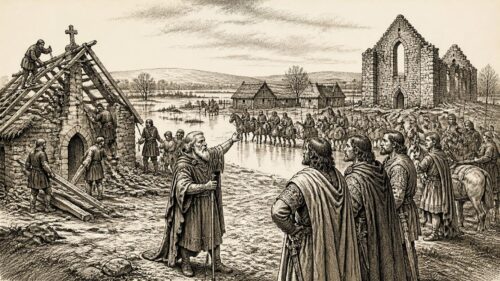
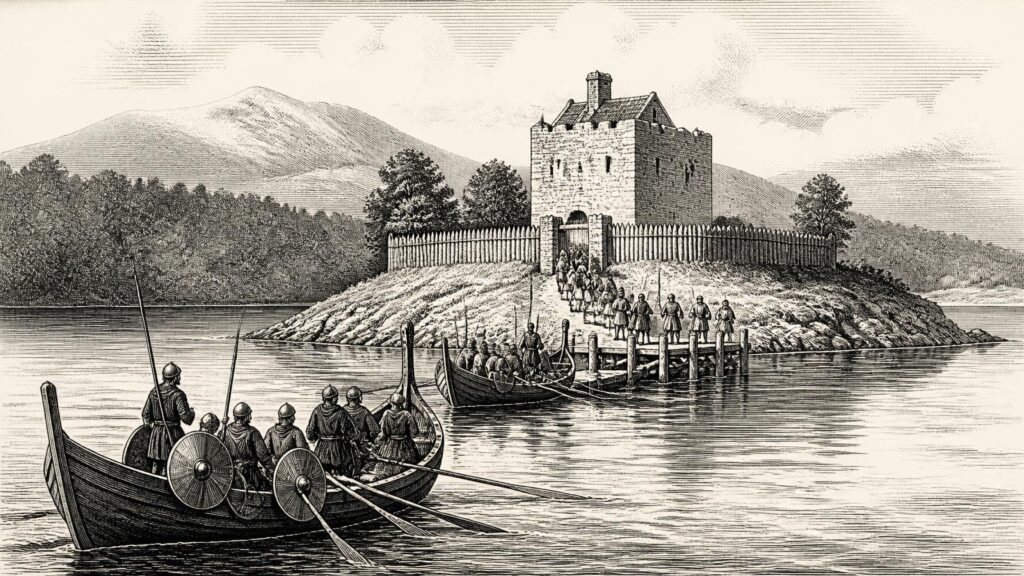
One firmly recorded episode concerned Conchobar, son of Tigernán Ó Ruairc, a leading figure in Breifne. According to Annála Connacht, he submitted to Fedlimid Ó Conchobair, king of Connacht, and to Fedlimid’s son Áed. The settlement was highly concrete: Conchobar offered them their choice of territory in Breifne and yielded the stone castle on Cherry Island, then called Cloch Insi na Torc, in Loch Finnmhaighe or Garadice Lough. Áed Ó Conchobair placed a garrison there. A fortified island was an exceptionally useful political asset. Water made access difficult, while the castle could watch local movement and proclaim that Connacht’s king had acquired a foothold in a rival lordship.
The arrangement did not hold. The same annal states that Ó Ruairc burned the stone castle and allowed its garrison to leave under an undertaking. This is an important reminder that medieval war was not simply indiscriminate destruction. The burning of a stronghold eliminated an opponent’s base, but the safe departure of its defenders, conditional on a promise, was a negotiated act. It also suggests that the value of the site lay not merely in its masonry but in who could man, supply and command it. The political struggle continued: Áed Ó Conchobair installed Sitric, son of Ualgarg Ó Ruairc, as king in opposition to Conchobar; Conchobar’s son Domnall then killed Sitric in retaliation. The Annals of Ulster further record Conchobar’s killing by Muintir Raghallaigh. These notices show succession in Breifne being fought out through rival candidates and alliances, rather than resolved by a settled rule of inheritance.
O’Conchobair Authority and Its Limits
Fedlimid and Áed Ó Conchobair were extending influence, but their own dynasty was marked by coercion. The Connacht annalist records that Cathal Cuircech, son of Áed and grandson of Cathal Crobderg, and another Áed, son of Conchobar, were blinded in 1257. It presents the deed as treacherous, driven by jealousy and envy, and as a violation of guarantees involving laymen, clerics and the relics of Connacht. The wording matters. Blinding removed men from eligibility for lordship in a political culture where bodily integrity was bound up with fitness to rule. The annalist’s emphasis on broken religious and social guarantees indicates that oaths backed by clergy and relics were not decorative ceremonies: they were recognised safeguards, whose breach demanded public condemnation.
Conflict with Breifne was nevertheless balanced by diplomacy with the colonial administration. Fedlimid met the justiciar, Mac William Burke and leading Anglo-Irish figures at Athlone, and the annal says that they made peace. No day or detailed terms are preserved, so the meeting should not be made to carry more certainty than it can bear. It does demonstrate that Athlone, a Shannon crossing and administrative centre, was a place where competing powers could negotiate. The King of England also issued Fedlimid a charter confirming his right to the five King’s Cantreds. These cantreds had been central to the Connacht settlement imposed after the Anglo-Norman conquest of the 1230s. In 1257, confirmation did not make Fedlimid independent of English royal authority; rather, it regularised his recognised position within a disputed landscape of rents, lordship and military pressure.
Áed’s great raid on Ó Ruairc, placed by Annála Connacht around Easter, makes plain how limited such peace could be. Raiding was a means of taking cattle and movable wealth, damaging a rival’s capacity to reward followers and demonstrating the reach of a ruler’s armed household. It affected more than combatants. Herds, food stores and labour were the resources on which ordinary households depended, while the movement of armed men made roads, river crossings and dispersed farmsteads insecure. The annals do not preserve a weather notice, harvest report or epidemic for this year. It is therefore safer not to infer an environmental crisis from a record whose chief concern is political and ecclesiastical disruption.
Gofraid Ó Domnaill’s Counterstroke
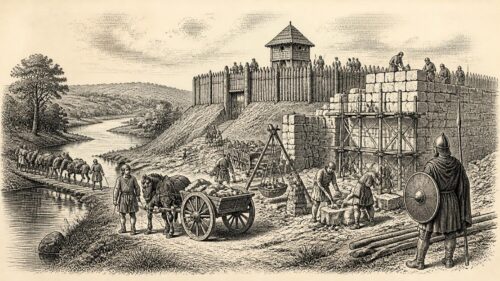
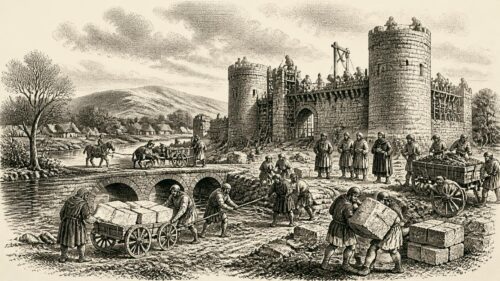
The most dramatic northern action was led by Gofraid Ó Domnaill, king of Tír Chonaill, with the Cenél Conaill. They demolished the castle of Cáel Uisce and killed its garrison. The castle had been part of the long, unsuccessful Anglo-Irish effort to secure an enduring position against the rulers of north-western Ireland. Its destruction was therefore more than a local raid: it announced that a fortified outpost could not sustain outside power without command of its hinterland. The annals do not supply a precise date, size of force or architectural description, and those details must remain unknown.
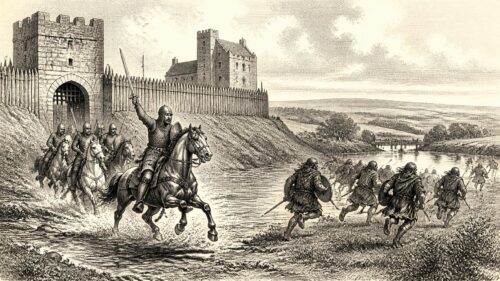
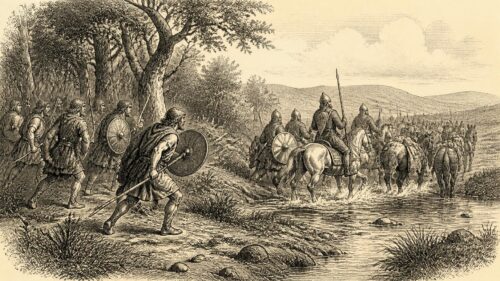
From there, Gofraid’s force moved against Sligo. The Connacht annalist says that many of the Galls were killed, the town was burned, and great prey was taken in Carbury. The pursuing Anglo-Irish force met the Cenél Conaill at Credran Coluim Cille, in the Rosses of Carbury, where it was routed. The Annals of Ulster adds that sixty or more of the Galls were killed and that Mac Griffin, described as a good knight, was captured. It also records the death from wounds of Donnchad, son of Cormac Ó Domnaill. Gofraid himself was seriously wounded. The Connacht account says the pursuit might have continued as far as the Moy had his injury not checked it; instead the victors returned home.
Later historical accounts have often closely linked this battle with the death in 1257 of Maurice FitzGerald, lord of Offaly and former justiciar. The contemporary annalistic evidence securely records both the victory at Credran and Maurice’s death in the same year, while later biographical interpretation places FitzGerald with the pursuing colonial force. It does not, however, provide a securely dated narrative proving precisely how or where he died. The distinction is worth preserving. What can be said firmly is that his death removed a magnate who had spent decades seeking to extend Anglo-Irish power into Connacht and the north-west, while Gofraid’s victory exposed the fragility of that expansion.
Thomond, Church and Community
War was also recorded in Thomond. Conchobar Ó Briain fought the Munster Galls, killing many of them, while Tadc Ó Briain made major raids; the opposing side killed a son of Domnall Connachtach Ó Briain. The notices are brief, but they show that the pressures visible in Connacht and Sligo had a southern counterpart. Neither “Irish” nor “English” was a sufficient description of politics on its own: local dynastic claims, lordship, land and the ability to protect dependants shaped alliances and hostilities.
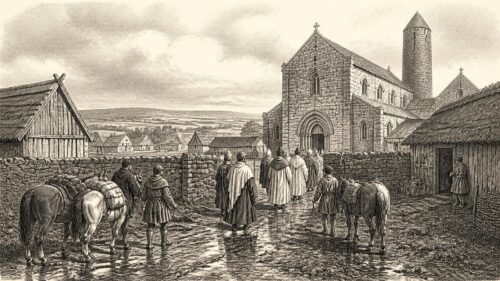
Amid this violence, religious institutions continued to attract investment. St Mary’s monastery at Roscommon was consecrated for the Dominican Order by Tomaltach Ó Conchobair. The house had been founded earlier by Fedlimid, and its consecration in 1257 marked the completion or formal dedication of an important new church in a Gaelic royal centre. Dominican friars were mendicants, committed to preaching, pastoral work and study; their presence connected Roscommon to an international religious order while relying on local patronage. In the same year Abraham Ó Conalláin travelled to Rome after his election to the archbishopric of Armagh, a journey that underlines the continuing importance of papal confirmation and wider ecclesiastical networks. The death of Macrobius, abbot of Clones, and the killing of Máel Pátraic Mac Éli, erenagh of Killala, show that monasteries and church lands remained embedded in the political world rather than insulated from it.
Thus 1257 was not a year in which one power gained Ireland. It was a year in which island castles could be won and burned, dynastic guarantees violated, peace made at Athlone and broken in raids, and a colonial force routed near Carbury. The consecration at Roscommon offered a different kind of endurance: an institution of worship, learning and patronage raised while neighbouring rulers contested the very ground on which authority rested.
Primary Sources
- Annála Connacht: Annal 1257
- Annals of Ulster otherwise Annála Senait: Year U1257
- Annals of Loch Cé: Part 11
- Annals of Inisfallen: Part 78
- Annals of the Four Masters
- Annals of the Four Masters: Part 9
- Annales Breves Hiberniae
- Annalium Hiberniae Chronicon ad annum MCCCXLIX
- FitzGerald, Maurice fitz Gerald
- O'Donnell (Ó Domnaill), Gofraid
- O'Neill (Ó Néill), Brian
- Annála Connacht
- Annales Dominicani de Roscoman
- County Roscommon Urban Archaeological Survey: Dominican Priory of St Mary
- Roscommon Dominican Friary
- Roscommon Abbey
- Roscommon Abbey: A Dominican Priory
- A History of the Irish Dominicans, Volume I
- A Medieval Island Church in Lough Garadice
- Castle, Cherry Island, Co. Leitrim
- Irish Annals: Exploring the Irish Annals
- List of Published Texts at CELT