Lasairfina’s Lough Key Gift1239 CE
In 1239, Ireland’s fragmented politics combined warfare, lordship and religious patronage. Domnall Mac Lochlainn defeated rival forces at Carnteel, regaining Tír Eógain after Anglo-Norman intervention. Maurice FitzGerald’s forces raided around Sligo, probing Ó Domnaill territory without securing lasting conquest. In Breifne, Fergal Ó Raigillig’s killing illustrated regional and dynastic conflict, though its date is disputed. Lasairfina, daughter of Cathal Crobderg Ó Conchobair and wife of Ó Domnaill, granted land at Ros Birn to Trinity Abbey on Lough Key. Cashel confirmed Dominican Dáuíd son of Cellach as archbishop. Annalistic discrepancies caution against certainty, while revealing intertwined power, land, kinship, and church.
Dateline
The surviving record for 1239 is unusually revealing precisely because it ranges from a battlefield in Tyrone to a small grant of land beside Lough Key. It shows an Ireland in which no single authority held uncomplicated control. Maurice FitzGerald, justiciar for Henry III, directed the government of the Anglo-Norman lordship from its eastern centres and pursued power in the north-west; Gaelic dynasties meanwhile defended, recovered and contested kingships through alliance, raiding and battle. Churches and religious houses were not apart from this political world. They received land, preserved memory and offered prestigious settings in which families asserted devotion, status and rights.
The year must nevertheless be handled with care. Medieval Irish annals normally arrange events under years, but the year assigned in one compilation can differ from that in another, especially for deaths and local conflicts. The Battle of Carnteel is securely placed in 1239 by the Annals of Ulster. Other notices entered under 1239 in the Annals of Connacht and the Annals of the Four Masters are valuable evidence, but some have a one-year displacement when compared with Ulster. Rather than forcing false precision, 1239 is best understood as a year of firmly recorded northern warfare, an Anglo-Norman incursion around Sligo, a Connacht religious endowment, and an important ecclesiastical confirmation at Cashel.
Carnteel and the Return of Mac Lochlainn
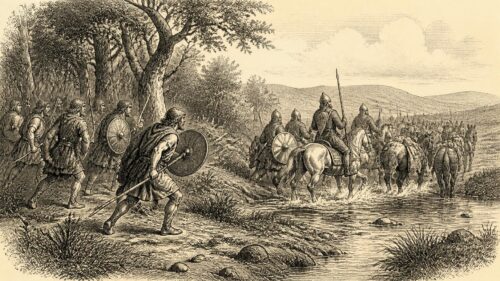
The clearest event was the Battle of Carnteel, fought near modern Aughnacloy in east Tyrone. Domnall Mac Lochlainn defeated opponents drawn from the rival Ó Néill interest, Cenél Móen and Airgialla. The annals name Domnall Ó Néill of Tamnach and Mac Mathgamna among the dead, alongside leading men of Cenél Móen and many others. Such naming matters: it was not merely an encounter between two abstract ‘tribes’, but a lethal struggle involving regional dynasties and their followers, whose losses could alter the balance of lordship across a wide area.
The victory restored Domnall Mac Lochlainn to the kingship from which he had been removed in 1238. That earlier overthrow had followed intervention by Hugh de Lacy, earl of Ulster, and Justiciar Maurice FitzGerald, who had installed an Ó Néill claimant after taking northern hostages. Carnteel therefore reversed, at least temporarily, a settlement backed by the lordship of Ireland. Mac Lochlainn’s recovery underlines a recurring limit upon Anglo-Norman military power: a large expedition could depose a ruler and exact pledges, yet could not necessarily sustain a chosen successor once its army had withdrawn.
Later accounts and modern biographical scholarship associate Mac Lochlainn’s resurgence in 1239 with a further clash against de Lacy, in which de Lacy’s son and a number of armoured followers were killed and the earl was driven from Ulster. That sequence belongs to the year’s wider political crisis, but the annals do not provide a day or a detailed narrative for it. What can safely be said is that Carnteel was more than a local feud. It reopened the contest for Tír Eógain and exposed the fragility of the lordship’s northern ambitions.
A Raid from Ballysadare
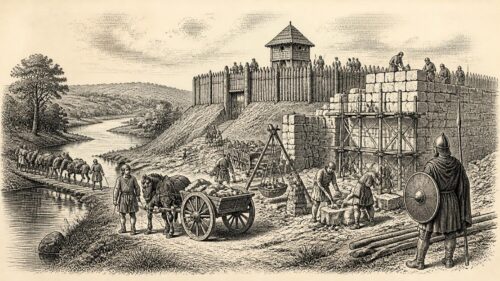
In the north-west, the Annals of Connacht record that the ‘Galls of Ireland’ raided Ó Domnaill, plundered Carbury, and sent scouting parties as far as Drumcliff; the justiciar himself waited at Ballysadare. In this context ‘Galls’ is the annalists’ usual term for the settler and lordship forces of English, Welsh, Flemish and other colonial descent, not a precise statement of nationality. The justiciar was Maurice FitzGerald, who had held office since 1232 and had substantial interests around Sligo as well as royal responsibilities.
The wording supplies a rare glimpse of how a campaign worked. A commander did not always ride with every raiding party. FitzGerald’s position at Ballysadare suggests a base from which he could supervise communications, receive detachments and protect the force’s line through the territory around Sligo Bay. The scouts’ reach to Drumcliff, north of Sligo town beneath Benbulben, indicates probing and intimidation rather than secure occupation. Carbury, the district later associated with north County Sligo, lay on the route between the lordship’s Sligo foothold and the Ó Domnaill kingdom of Tír Conaill.
For households caught in its path, a ‘prey’ was not an incidental military trophy. It meant the seizure of cattle and movable wealth, and potentially the disruption of food supplies, labour and household security. Yet the annalistic notice does not justify claims that all of Tír Conaill was conquered, nor does it identify every participant or give a precise date. Its importance lies elsewhere: it records a deliberate lordship operation at the edge of Gaelic power, while the Ó Domnaill dynasty remained sufficiently strong to resist any permanent advance. The raid formed part of a broader, unresolved contest for north-western Ireland, not its conclusion.
Violence and Lordship in Breifne
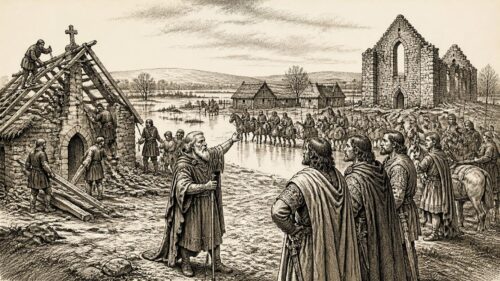
The same Connacht annal places the killing of Fergal son of Cú Chonnacht Ó Raigillig under 1239. Fergal was described as king of Dartry and Clann Fermaige, or, in an alternative source known to the annalist, ruler of eastern Breifne. He had raided the sons of Niall Ó Ruairc, plundered them and occupied a house they held. Maelruanaid, Fergal’s own son, and Conchobar son of Cormac Mac Diarmata then killed him after the Ó Ruairc party emerged under a promise or parole. The terse account conveys the tangled character of regional politics: kinship did not ensure loyalty, a raid could become a dispute over custody and safe conduct, and a house could be a focal point of power as well as shelter.
Chronology is particularly important here. The Annals of Ulster place Fergal’s death in 1240, while the Connacht annals and the Four Masters place it in 1239. It should therefore be connected to the political atmosphere of 1239, but not presented as a securely calendar-dated occurrence within that year. Either way, the episode reveals pressures around the boundaries of Breifne, Connacht and the Ó Ruairc sphere. It also cautions against imagining Gaelic lordship as static: authority was continually remade through raids, negotiated exits, retaliation and intra-dynastic rivalry.
Lasairfina’s Endowment
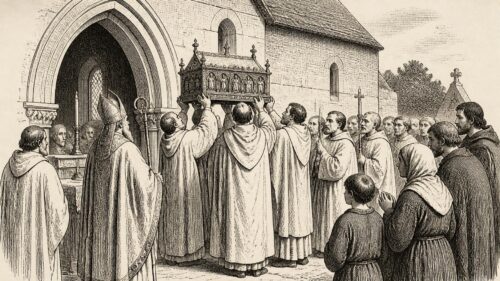
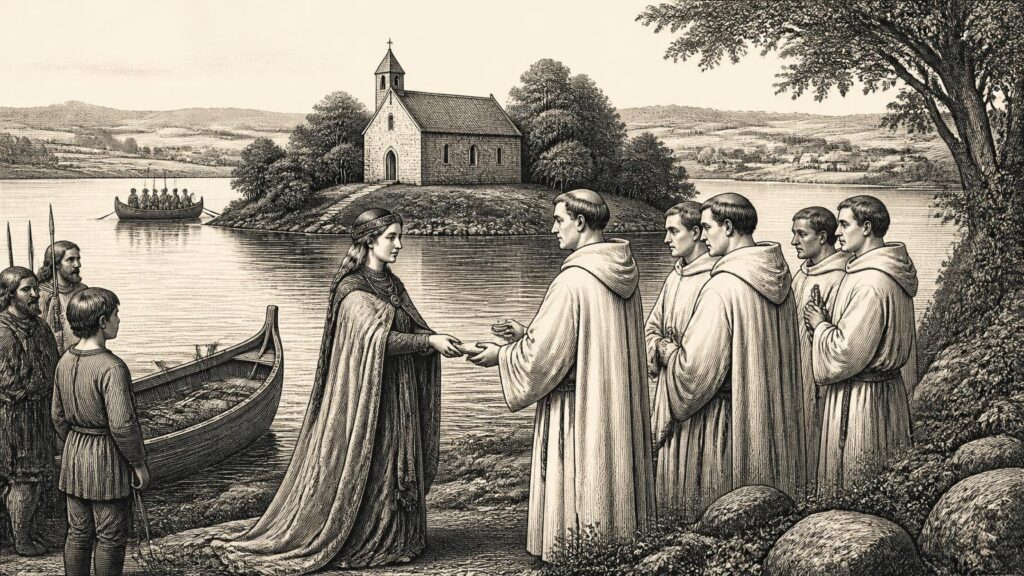
A much quieter entry is among the year’s most illuminating. Lasairfina, daughter of Cathal Crobderg Ó Conchobair and wife of Ó Domnaill, granted half a townland from her marriage estate at Ros Birn to Clarus Mac Máelín and the community of canons on Trinity Island in Lough Key. The gift was explicitly made in honour of the Trinity and the Virgin Mary. It is a firmly year-linked act in the Connacht annal, and it preserves the agency of a high-status woman whose familial connections joined Connacht’s leading Ó Conchobair line to the rulers of Tír Conaill.
The grant also makes visible the legal and economic substance behind aristocratic marriage. A marriage portion was land capable of being identified, held and conveyed; half a townland was not a vague expression of piety but a portion of productive territory with inhabitants, renders and agricultural potential. Lasairfina’s disposition could support a religious community while advertising the standing of her natal and marital families. Religious patronage was therefore devotion, but also public action in a society where land, kinship and commemoration were inseparable.
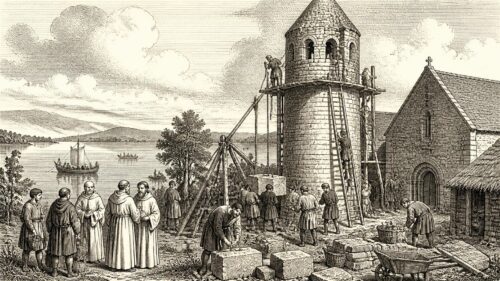
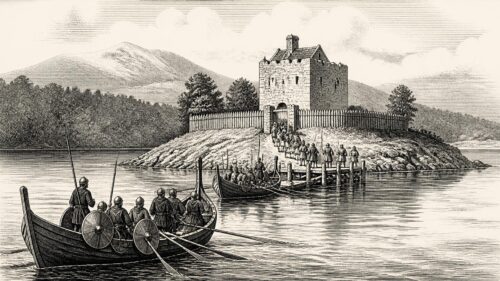
Trinity Island’s community was relatively new. Clarus Mac Máelín, dean of Elphin, had founded the house in 1215, and it had developed into a Premonstratensian abbey. Its island setting, within the lake-land of Magh Luirg, did not isolate it from politics: Anglo-Norman forces had briefly seized it during the Connacht campaign of 1235. By 1239, however, it could receive a gift from a woman tied to two major Gaelic dynasties. The transaction suggests that religious institutions could offer continuity amid shifting military fortunes. Their communities prayed, held land, preserved documents and carried family remembrance forward.
Cashel and the Preaching Friars
In Munster, the Annals of Inisfallen record the confirmation in 1239 of Friar Dáuíd son of Cellach as archbishop of Cashel. Dáuíd was a member of the Order of Friars Preachers, the Dominicans. His elevation is an important sign of the changing Irish church: the newer mendicant orders, committed to preaching, learning and pastoral work in towns and dioceses, were becoming integral to episcopal leadership as well as conventual life.
The annal does not supply the ceremony’s day, the identity of every consecrator or a programme of reform enacted that year. Still, confirmation to Cashel mattered. The archbishopric headed a province whose dioceses crossed territories ruled by Gaelic kings and Anglo-Norman lords. Dáuíd’s later career shows an energetic defence of metropolitan authority and high expectations of his bishops’ learning and conduct. In 1239, however, the responsible conclusion is simply that a Dominican friar’s appointment to one of Ireland’s foremost sees had been confirmed: a milestone in the institutional church, recorded alongside the very different forms of authority exercised at Carnteel, Ballysadare and Lough Key.
Deaths and the Limits of the Record
The Connacht annals also enter the deaths of Toirrdelbach, son of Ruaidrí Ó Conchobair, and Muirchertach son of Domnall Ó Briain, as well as Cormac son of Art Ó Máel Sechlainn. These notices mark the passing of people from powerful Connacht, Thomond and Mide kindreds, but they should not all be treated alike. The Annals of Inisfallen date Muirchertach’s death to 1241, not 1239. The discrepancy is a useful reminder that annals are indispensable contemporary and near-contemporary traditions, yet not modern civil registers.
What 1239 securely leaves us is not a story of a country moving in one direction. It is a cross-section of several Irelands: a recovered kingship in Tyrone; an ambitious lordship raid around Sligo; a disputed killing in the Breifne borderlands; a landed gift to canons on Lough Key; and the confirmation of a Dominican archbishop at Cashel. Conflict was pervasive, but so were institutions capable of recording grants, sustaining communities and giving political action a religious language. The year’s surviving notices are brief. Read carefully, they reveal a society in which battle, cattle, land, marriage, prayer and lordship were closely bound together.
Primary Sources
- Annála Connacht: Annal 1239
- Annála Connacht: Annal 1239 (Irish text)
- Annals of the Four Masters: Annal 1239
- Annals of the Four Masters: Annal 1239 (Irish text)
- The Annals of Ulster: Year U1239
- The Annals of Ulster
- Annals of Inisfallen: Annal AI1239
- Annals of Inisfallen
- MacLoughlin (Mac Lochlainn), Domnall
- O'Neill (Ó Néill), Brian
- FitzGerald, Maurice fitz Gerald
- O'Donnell (Ó Domnaill), Domnall Mór
- O'Donnell (Ó Domnaill), Maelsechlainn
- O'Reilly (Ó Ragallaig), Cathal
- MacGillapatrick (Mac Cellaig Ó Gilla Pátraic), David
- O'Melaghlin (Ó Máel Shechlainn), Cormac
- Trinity Abbey
- McDermott’s Castle
- Annála Connacht: Annal 1235
- Annals of Connacht (AD 1224–1544)