Nenagh’s Christmas Rising1347 CE
In 1347, Ireland comprised competing lordships, dynasties, church jurisdictions and towns. At Christmas, Domhnall Ó Ceinnéidigh led forces reportedly drawn from several provinces in a devastating assault on Nenagh and Ormond, sparing Nenagh Castle but exposing Butler authority while young Earl James Butler served in France. Annals also record killings, captures and successions across Connacht, Breifne, Ulster, Annaly and the south-east, revealing warfare affecting cultivation. Churches remained active through building, patronage and papal links. Learned figures were commemorated. Although plague spread in Europe, surviving Irish records place its arrival in 1348, making 1347 a year of political crisis before pandemic.
Dateline
In 1347, Ireland’s political map was defined less by a single government than by a crowded field of lordships, dynasties, church jurisdictions and fortified towns. The strongest evidence for the year comes from annals written in different regions and languages. They do not provide a complete national narrative, but together they record killings, successions, church initiatives and one especially dramatic attack: the destruction of Nenagh and much of the surrounding Butler lordship at Christmas. This was not an isolated outbreak of disorder. It exposed the vulnerability of an Anglo-Irish frontier in north Tipperary while regional Gaelic rulers continued to pursue their own rivalries across Connacht, Breifne, Ulster and the midlands.
Christmas at Nenagh
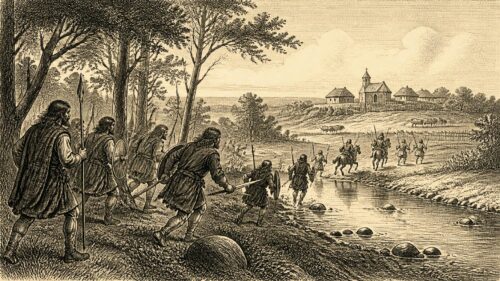
The most vivid firmly dated event was the assault recorded by the Franciscan chronicler Richard Clyn. At Christmas, Domhnall Ó Ceinnéidigh, son of Philip, attacked Nenagh. Clyn states that Ó Ceinnéidigh had made a conspiratio, or combination, with Irish forces described as coming from Munster, Connacht, Meath and Leinster. Such language is hostile and should not be read as a precise modern account of a centrally commanded national alliance. It does, however, show that contemporaries understood the attack as drawing strength beyond a single local quarrel.
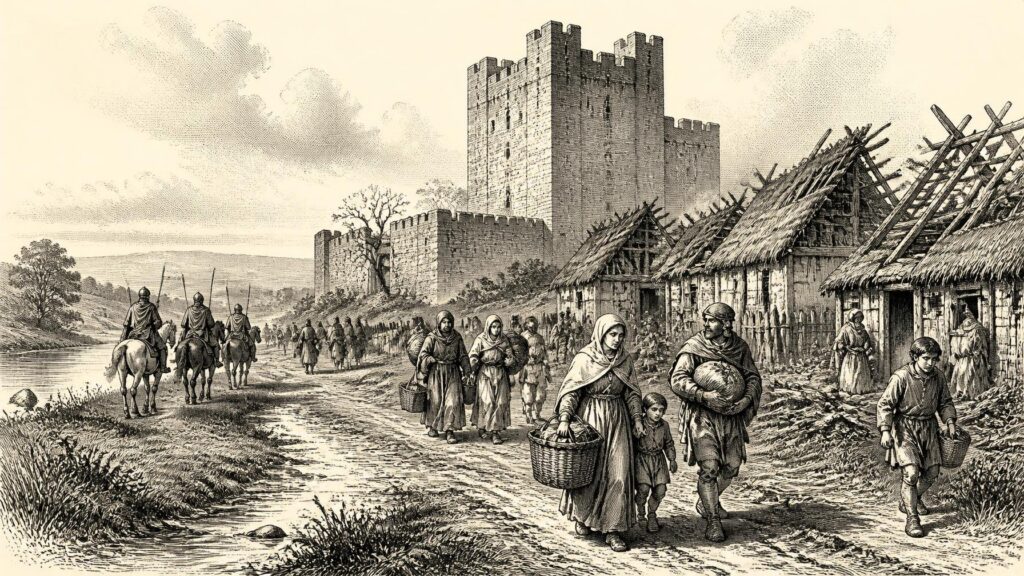
Clyn says that Nenagh town, the surrounding country and every castle of Ormond except Nenagh Castle were burned and destroyed. The distinction matters. A medieval town was not merely a collection of dwellings: it concentrated market activity, storage, crafts, rents and the people who supplied a lord’s administration. The countryside sustained it through cultivation, livestock and customary dues. Burning both town and country was therefore an attack on the practical basis of Butler power as well as on buildings. Clyn’s wording does not permit a reconstruction of the exact route, numbers or individual targets of the raiders, but it leaves no doubt about the scale he attributed to the devastation.
The survival of Nenagh Castle in the account is equally revealing. A defended stone stronghold could outlast the destruction of the settlement around it, yet its endurance could not by itself preserve normal lordship. The annalist’s later notice, under 1348, of a large guard at Nenagh and forced repairs to broken walls confirms that the consequences of the Christmas rising continued into the following year. Those measures should not be moved backwards into 1347; they nevertheless show why the attack mattered. In the final days of this year, north Tipperary had become a sharply contested borderland rather than a secure aristocratic estate.
Ormond’s Young Earl
The attack came during the minority and overseas service of James Butler, second earl of Ormond. Born in 1331, Butler had inherited an important but troubled inheritance after his father’s death in 1338. His lands, especially in northern Tipperary, had already suffered during disputes involving neighbouring magnates and growing pressure from Gaelic rulers. Modern biographical research places the restoration of his lands and title in February 1347, when the English king wanted him for service in France. Clyn separately records that on 11 November the earldom of Ormond and its regality were granted to the younger James Butler.
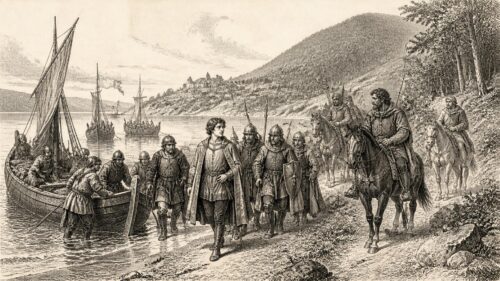
These notices reflect more than a change in a nobleman’s style. The Ormond regality carried extensive local privileges: courts, revenues and lordly authority within a territory that was meant to support the earl’s household, retainers and military obligations. Yet royal recognition did not make that authority secure on the ground. Butler’s connection with England was immediate. Clyn records that Maurice fitz Thomas, earl of Kildare, and Fulk de la Freigne entered France at the king’s invitation for the siege of Calais; Butler too served in France in 1347. Irish lords and officeholders could thus be tied into Edward III’s continental war even as their Irish lands required defence.
The coincidence was consequential. The lordship of Ormond was being formally reaffirmed for a young earl whose ability to supervise it personally was limited, while a major local challenge developed at Nenagh. It would be misleading to treat this simply as an ethnic struggle between fixed Irish and English blocs. Families, clients and military companies made alliances according to locality, advantage and inheritance. Still, Clyn’s account of an attack involving Irish forces from several provinces, directed against the castles and town of Ormond, demonstrates how fragile the reach of an Anglo-Irish liberty could be.
Killings, Captures and Successions
Elsewhere, the Irish annals preserve a dense record of political change. In Annaly, centred broadly on modern Longford, Gilla na Naem Ó Fergail died at Cluain Lis Beci after twenty-six years as chieftain. The Annals of Connacht praise him in conventional but revealing terms as a ruler who had overcome “the world and the Devil”; Cathal, son of Murchad, succeeded him. The formula joins political authority to Christian ideals of restraint and salvation, while the succession itself reminds us that lordship was personal, dynastic and continually exposed to dispute.
The same annals record the killing of Muirgius Mac Diarmata by Seoan Ruad, son of David Burke; the capture of Tadc Mag Ragnaill, chief of Muintir Eolais; and the discovery, killing and capture of Ó Ruairc gallowglasses in that territory by Clann Murchada. Gallowglasses were heavily armed professional warriors, commonly recruited across the Irish Sea world and employed by Irish and Hiberno-Norman lords. Their appearance in this entry is a reminder that local conflict was not fought only by a ruler’s household. Control of such troops, and the ability to intercept them, could alter a regional balance of power.
At Ballintober, William son of David fitz Miles was killed by Tadc Ruad Mac Diarmata Gall. The Annals of Ulster also report that Brian Mac Diarmata, described as fit to be king of Magh Luirg, was shot by an arrow in Roscommon town while with Bishop Ó Finachta. The alleged shooter, Ruaidhrí Ó Donnchadha of the Chamber, was then mutilated and killed in punishment. These terse notices are not courtroom records, but they show both the lethal immediacy of factional politics and the presence of ecclesiastical figures in places where secular rivalries unfolded.
Connacht’s wider instability is marked by the death of Áed, son of Áed Ó Conchobuir of Breifne, whom the Annals of Ulster styles king of Connacht: he was killed by Áed Ó Ruairc at Magh Enghaide. In the south-east, Clyn dates the treacherous killing of Domhnall Mac Murchadha and Murchadh Caomhánach by their kinsmen to 3 June. He calls both formidable warriors and enemies of peace, then adds that peace temporarily followed, the peaceful people rested and cultivation increased. The statement is unusually direct evidence for the effect of predatory conflict on ordinary rural life. Fields could be worked more securely when armed competition abated, even if only for a time.
Ulster, Churches and Learned People
In Ulster, Tomás Mac Artáin, ruler of Uí Echach, was hanged by the Galls; the Annals of the Four Masters identifies the executioners as the English. The sources do not explain the legal charge, place of execution or immediate political aftermath, so those details must remain unknown. Énrí, son of Áed Buidhe Ó Néill, also died during the year. In east Galway, Eoghan Ó Madadháin, chief of Síol Anmchadha, died and was succeeded by his son Murchadh. Such recorded transitions show that political continuity could be achieved by succession as well as by force, though neither process was guaranteed to be peaceful.
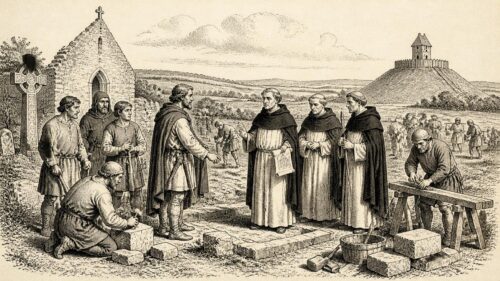
Religious and cultural life continued amid these tensions. At Kilkenny, Clyn records the burial on Palm Sunday, which also fell on the feast of the Annunciation, of Isabella Palmer, a long-widowed benefactor who had built the front of the Franciscan choir. On the first Sunday of Advent, the friars’ confraternity began work intended to fund a new bell-tower and repairs to their church. This was a practical urban religious enterprise: a church required fabric, bells, labour, patronage and an organised body able to sustain them.
Clyn also notes that Friar Richard, bishop of Ossory, obtained at the Roman curia an exemption from the jurisdiction and superiority of the archbishop of Dublin. This was a significant assertion of diocesan standing, pursued through papal channels rather than settled solely in Ireland. The Dominican friars in Ireland received a temporary papal licence from Clement VI to eat meat, something their rule had previously denied them. Neither notice explains the full circumstances, but both demonstrate that Irish religious institutions were connected to the wider Latin Church and its legal authority.
The annals additionally commemorate Aenghus Ó hEoghusa, praised as a master of the arts of poetry, and Aengus Ruadh Ó Dálaigh, called a sage without defect. Their deaths matter because learned families and poets preserved genealogies, praise poetry, law and historical memory. The Four Masters also records work on the church of Cill Rónáin for Fergal Ó Duibhgionnáin, while the death of his wife Finnguala appears in the Connacht annals. Such entries offer brief but valuable glimpses of patronage, clerical households and building activity beyond the great lordships.
Before the Plague
It is essential not to make 1347 in Ireland into a plague year. The great pandemic was spreading through Europe in 1347, and Clyn later included a report of a portent seen that year at a Cistercian house in Tripoli. But the Irish evidence places the devastating outbreak at Dublin, Drogheda, Howth and Dalkey in 1348, with further mortality recorded afterwards. No surviving Irish annal cited here records the plague’s arrival in 1347. For Ireland, this was the last year before that catastrophe became an immediate documented reality.
That distinction sharpens the significance of the year’s events. Ireland already faced violent competition, damaged settlements, contested revenues and insecure cultivation. Yet it also possessed active towns, functioning churches, networks linking Kilkenny and Rome, and aristocrats serving in a European war. Nenagh’s burning at Christmas was therefore not a prelude caused by plague, but a crisis rooted in the political conditions of 1347 itself.
Primary Sources
- Annalium Hiberniae Chronicon ad annum MCCCXLIX
- Annals of Connacht: Annal 1347
- The Annals of Ulster: Year U1347
- Annals of the Four Masters: Annal M1347
- Annals of the Four Masters: Irish Text, Annal M1347
- Annála Connacht: Edition Description and Sources
- Annals of Ulster: Irish Text
- Annals of the Four Masters: English Translation
- James Butler, Second Earl of Ormond — Dictionary of Irish Biography
- James Butler, First Earl of Ormond — Dictionary of Irish Biography
- The Franciscans in Kilkenny
- Materials for the History of the Franciscan Province of Ireland, A.D. 1230–1450
- Ireland: The Complete History of the Black Death
- A Tract on the Plague
- Plagues, Pandemics and Epidemics in Irish History Prior to COVID-19
- The Red Book of Ormond
- Calendar of Ormond Deeds, Volume II, 1350–1413
- Annals of the Kingdom of Ireland: National Library of Ireland Catalogue
- Ormond Papers, Additional Collection: National Library of Ireland
- Annales Dominicani de Roscoman