Moycova’s New Walls1252 CE
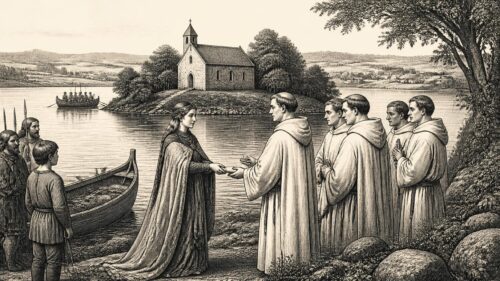
In 1252, Crown authority in Ireland was asserted through fortification, campaigning and monetary reform, amid persistent regional conflict. Maurice FitzGerald built castles at Cáel Uisce and Moycova, the latter under oversight, while Henry III ordered fortification and expansion at Annaghdown. Justiciar John FitzGeoffrey’s expedition secured Brian Ó Néill’s submission and his brother Ruaidrí as hostage, though rivalry divided both colonial forces and Irish lordships. Annals recorded raids, killings and deaths, alongside Máelmaedóc Ó Beolláin’s death at Drumcliff. A winter wind preceded exceptional drought and early harvest. New Dublin coinage strengthened royal control, but personal alliances, cattle and churches remained central.
Dateline
In 1252, Ireland’s political map was marked not by a single national event but by a connected series of actions in Ulster, Connacht, the lordship’s towns and the countryside. The year is unusually well illuminated by Irish annals, which independently record new fortifications, a major royal expedition, a severe summer drought and a reform of coinage. These records do not supply a complete diary: most entries give no day or month, and the annals’ language reflects the outlook of their learned compilers. Yet their agreement on several central developments makes 1252 a year in which power was visibly asserted through castles, hostages, armed musters and control of exchange.
Two Northern Fortresses
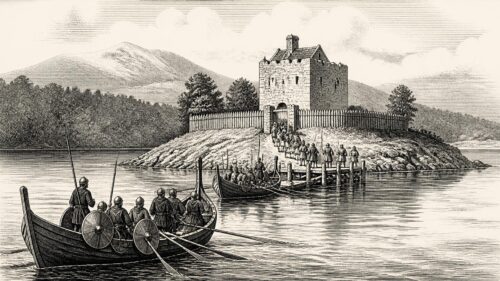
The annals place the erection of two castles in 1252 under Maurice FitzGerald, often styled Mac Maurice in Irish sources. One was at Cáel Uisce, ‘narrow water’; the exact site remains disputed, though it lay in the Lower Lough Erne–Erne corridor. The name should not be confused with the much later surviving tower-house at Narrow Water near Warrenpoint. The other was at Magh Cobha, or Moycova, in Uí Eachach, now represented by the fortification known as Seafin Castle near the Upper Bann in County Down.
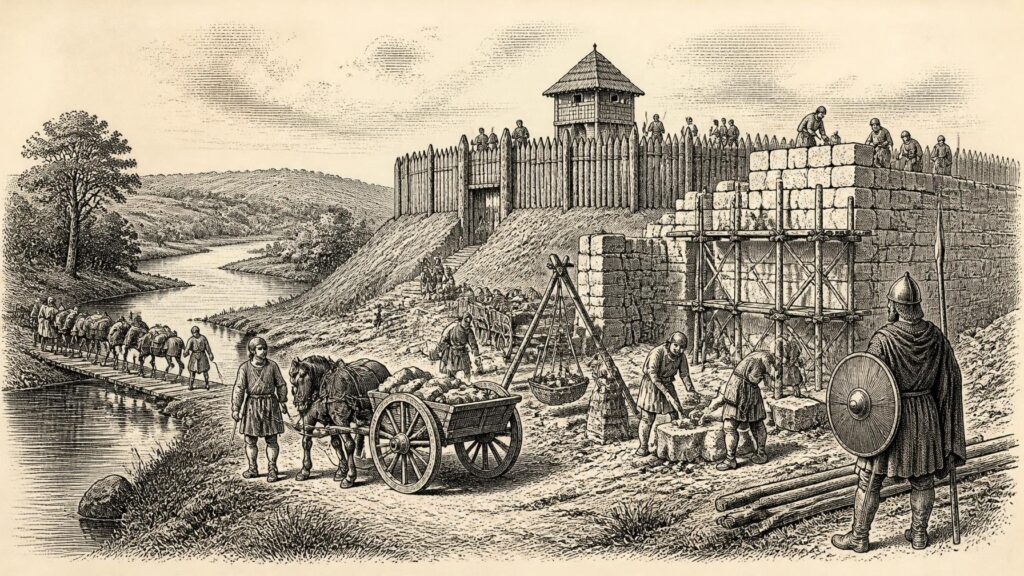
Magh Cobha was the more clearly documented project. The Northern Ireland historic-environment record connects the castle with royal directions of 1252: a mandate of 9 May instructed the justiciar to build a castle in a suitable place in Ulster, while an audit ordered on 16 December concerned expenditure on the fortification of Moycova. The annals’ notice that FitzGerald erected the castle thus belongs beside administrative evidence of Crown financing and oversight. Its position beside a river bend, close to the Drumadonnell’s junction with the Bann, gave it a defensible site and a means of watching movement through the district.
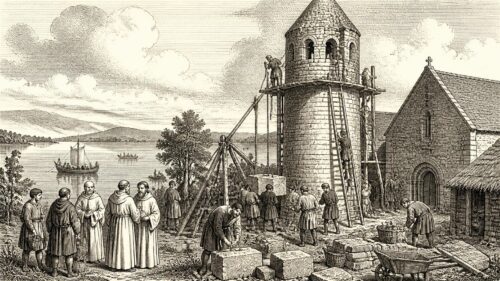
Neither castle should be imagined as a finished, isolated stone monument. A thirteenth-century castle was a military base, a store, a garrison settlement and a claim to exercise lordship over routes, labour and local produce. Building one required timber, stone, food, transport animals, skilled workers and guards. At Cáel Uisce, a new fort on the Erne also revived a strategically exposed position where earlier Anglo-Norman works had been attacked. Both foundations therefore reveal a government and its magnate allies attempting to make authority durable in regions where it remained negotiable and vulnerable.
Submission in Uí Néill Country
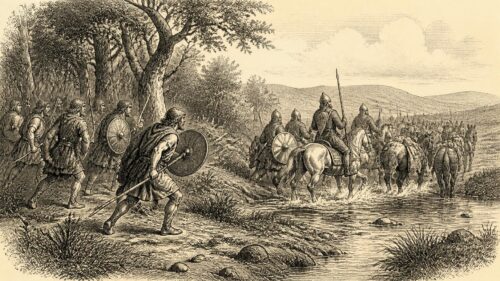
That vulnerability was evident in the justiciar’s expedition. The Annals of Ulster record that the justiciar of Ireland came with a great host to Armagh, moved from there into Uí Eachach and then withdrew towards Cluain Fiacna. John FitzGeoffrey was justiciar at the time. A royal official with substantial Irish interests of his own, he had already pursued a policy of campaigning and fortification beyond the most secure areas of the English lordship.
The immediate outcome was Brian Ó Néill’s submission and the surrender of his brother Ruaidrí as a hostage. Such a hostage was not merely a prisoner taken after battle. He was a living guarantee intended to bind a ruler to agreed terms and to deter renewed resistance. The annal’s wording gives no treaty text, duration or payment, so it cannot show precisely what Brian conceded. It does, however, show that the expedition achieved a demonstrable public acknowledgement of the justiciar’s power. It did not erase Brian’s standing in Tír Eógain, nor should submission be treated as permanent incorporation into the lordship.
The force itself exposed tensions within the colonial political community. During the expedition, the Four Masters and the Annals of Loch Cé report a violent quarrel in the camp at Dundalk between men of Meath and men of Munster, in which many from Munster were killed. The sources do not explain the dispute. What can safely be said is that an army described by Irish annalists as the host of the ‘Foreigners’ was not a single uniform body: it drew together regional contingents whose rivalries could turn deadly even while they campaigned under royal authority.
Rivalries Among Northern Lords
Irish politics were no less fractured. Conchobur Mac Cathmhaoil, chief of Cenél Feradach and, the annalists say, a peacemaker among Cenél Conaill, Cenél nEógain and Airgíalla, was killed by Brian Ó Néill’s followers. The circumstances were especially charged: Conchobur died while defending people under his protection, although he was himself under the safeguard of Ó Gairmleadhaigh and Ó Catháin. Protection, fostered alliance and surety were fundamental political relationships; the killing showed how easily their obligations could be tested or broken in competition for regional influence.
The Four Masters also place an incursion by Gofraid Ó Domhnaill into Tír Eógain in this year. He took cattle and captives, but Brian pursued the raiders and defeated the Cenél nEógain force in a hard fight, taking prisoners. Raiding was not random violence at the margins of society. Cattle were movable wealth, while captives and prisoners could be used for ransom, labour or bargaining. Elsewhere, Murchadh Ó Fallamhain, high constable of Connacht, was killed by men of Bréifne at Fidhnacha in Magh Réin. Taken together, these notices show that authority was contested within and between Irish lordships as well as between Irish rulers and the English administration.
Wind, Drought and Harvest
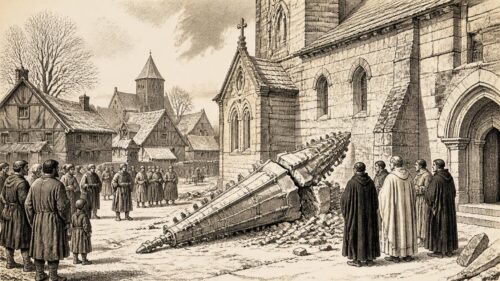
The weather left an equally striking mark on the annalists’ memory. The Annals of Loch Cé first note a great wind on the octave of Epiphany, which brought down houses and churches across Ireland. The wording does not permit a modern estimate of its track, strength or death toll, but it conveys a winter storm sufficiently destructive to damage both domestic buildings and ecclesiastical fabric.
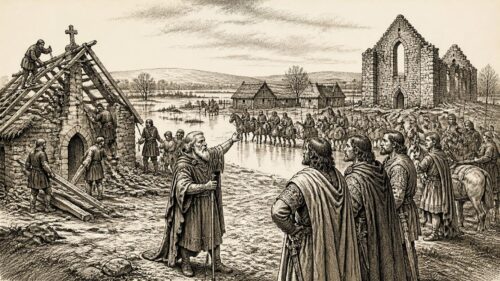
Summer brought the opposite extreme: great heat and drought. The annals say that people crossed the Shannon without wetting their feet, that wheat was cut twenty nights before Lammas, and that all corn was being reaped then; trees appeared scorched by the sun. These are vivid observations rather than measurements, but they securely establish exceptional dryness in the annalists’ account. An early harvest may have offered a brief advantage where grain ripened well, while low rivers could ease crossings and alter the movement of people and animals. Yet drought also threatened pasture, water supply and mills. No source for 1252 allows a reliable island-wide calculation of harvest yields, famine or prices, and none should be invented from the dramatic description. The responsible conclusion is narrower: contemporaries regarded the season as extraordinary, and it affected the rhythms of cultivation, travel and river life.
New Money and a Planned Town
The same year saw an important economic and administrative measure. The annals state that the king of England ordered new money to be coined in Ireland and that the previous currency was abandoned. Numismatic study identifies a Dublin issue of Henry III’s long-cross pennies in this period, recognisable by the triangle around the king’s bust. The project had been authorised in 1251, but the annalists’ placing of the replacement coinage in 1252 indicates the point at which the change was experienced or proclaimed in Ireland. It linked the Dublin mint, silver supplies, officials, merchants and royal revenue more tightly to the wider sterling economy.
Coin did not displace every older form of payment or exchange, particularly in rural Gaelic lordships where cattle and customary renders remained politically important. But new pennies mattered in towns, ports, lordly households and the exchequer, where rents, customs, wages and purchases increasingly required a reliable medium. Recoinage also made the Crown’s authority tangible: old pieces were withdrawn, new ones carried a royal image and legend, and the terms of trade changed in the hands of users.
A precisely dated royal act of 18 August adds a western counterpart to the northern castle-building. Henry III directed the justiciar to retain a place in the vill of Enachdune, or Annaghdown, suitable for fortification, to enlarge the settlement and to compensate the archbishop for affected ecclesiastical property. This was an instruction, not proof that a castle or expanded town was completed in 1252. Its significance lies in the proposed combination of defence, urban growth and negotiation with church authority on Lough Corrib, within a region where royal influence was limited.
Drumcliff’s Loss
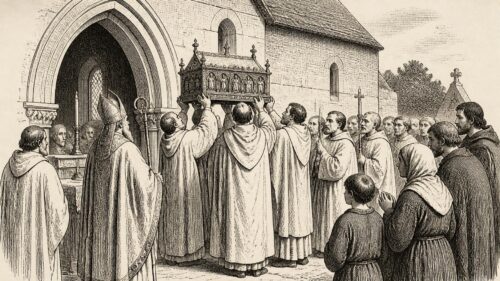
Religion appears in the year’s record through the death of Máelmaedóc Ó Beolláin, coarb, or successor, of Colum Cille at Drumcliff in what is now County Sligo. Both the Annals of Ulster and the Annals of Loch Cé praise his wealth, hospitality and high esteem among both ‘Foreigners’ and Gaels. Such praise was conventional, but it is still revealing. A major church office could be a centre of landed resources, patronage, learned prestige and hospitality, bringing clerics, local families, travellers and secular rulers into contact. His death was therefore more than a private bereavement within a monastery.
Other recorded deaths – including Conchobur Ó Dochartaigh of Ard Midhair, Gilla Íosa Ó Cearbhaill of Calraige Drumcliff and local chiefs in Muintir Chínaith and Tullach Garbhith – underline the density of authority below the level of kings and justiciars. The annals preserve these people because their households, churches and client networks mattered. They also preserve the year itself because literate ecclesiastical communities continued to observe weather, war, construction and death. In 1252, walls and coinage extended lordly ambitions, but political life still depended upon personal guarantees, regional alliances, resources drawn from the land and the institutions that remembered them.
Primary Sources
- The Annals of Ulster: U1252
- The Annals of Loch Cé: LC1252
- Annals of the Four Masters: M1252
- FitzGeoffrey, John | Dictionary of Irish Biography
- O'Neill (Ó Néill), Brian | Dictionary of Irish Biography
- SM8 /Down 57:3
- The Waterways Under the Normans
- Narrow Water Castle | Department for Communities
- The Irish Coinage of Henry III
- Chapter 13: The Irish Coinage of Henry III
- Parchment Conquest, 1171–1307
- Calendar of Documents Relating to Ireland, Volume 2, Item 77 (18 August 1252)
- Calendar of Documents, Relating to Ireland: Table of Contents
- Henry Savage Sweetman: The Man Who Uncovered Ireland’s Medieval History
- Exploring the Irish Annals
- The Rise and Fall of the Clann Éinrí Aimhréidh Uí Néill: Dynastic Feuding and Geopolitics in the Late Medieval Irish Sea World
- Medieval Ireland
- Irish Castles: 1180 to 1310
- Annales Hiberniae
- Texts Beginning with the Letter C | University College Cork
- Calendar of Documents Relating to Ireland, 1252–1284
- The Pope, a Knight and a Bishop on the Edge of Christendom: The Politics of Exclusion in Thirteenth-Century Ireland