Adomnán’s Sixty Return687 CE
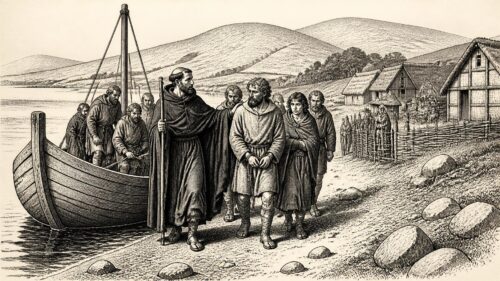
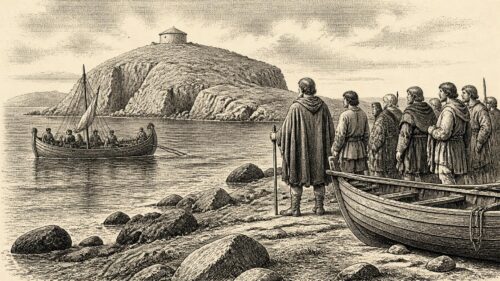
In the annalistic sequence for 687, Adomnán, abbot of Iona, returned sixty former captives to Ireland, probably people seized during King Ecgfrith of Northumbria’s raid of 684. Although the precise date and negotiations remain uncertain, Adomnán’s links with King Aldfrith and Northumbrian ecclesiastical networks likely enabled their release. The episode illustrates Irish Sea connections linking warfare, diplomacy and learning; Adomnán’s scholarly exchanges with Aldfrith may have occurred during related visits. The annals also record the deaths of abbots at Glendalough and Cork, and of a bishop attached to an uncertain monastery, alongside the unexplained killing of Feradach son of Congal.
Dateline
In 687 CE, the most memorable Irish development attached to the year was the return of sixty captives brought home by Adomnán, abbot of Iona. This is a year that requires unusual care with dates. The Annals of Tigernach and the Fragmentary Annals of Ireland place the episode under 687, while the corresponding entry in the Annals of Ulster stands in annal U687 but is aligned there with AD 686. Medieval Irish annals did not share one perfectly stable chronological system, and later compilations sometimes displaced material further. The recovery of captives is therefore securely recorded in the annalistic sequence associated with 687, but neither the day nor even an uncontested modern calendar year can be claimed. What is beyond doubt is the event’s importance: an Irish churchman crossed political boundaries and returned a substantial group of people from overseas captivity.
A Return from Captivity
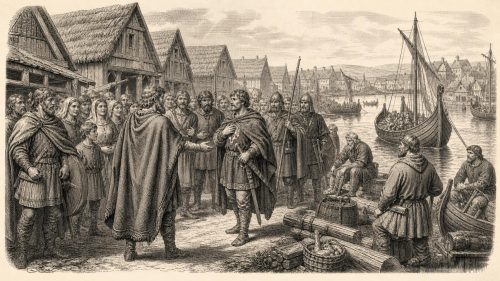
The terse Ulster notice says simply that Adomnán “brought back sixty former captives to Ireland”. The later Fragmentary Annals make the setting more explicit, stating that he freed captives whom the Saxons had taken from Ireland. That wording matters. These were not diplomatic hostages exchanged between rulers, at least not in the terminology used by the annals; they were people carried away as captives in the course of violence and treated as spoil.
The most convincing context is the Northumbrian expedition sent to Ireland by King Ecgfrith in 684. Bede, writing in Northumbria, condemned the raid in unusually severe language, saying that its troops devastated Ireland and spared neither churches nor monasteries. Irish annalistic traditions connect that attack especially with Brega, the rich lowland region around the lower Boyne and Blackwater. The sources do not name the sixty returnees, identify their home districts, or tell whether all had been seized in that one raid. Still, the sequence makes a connection highly probable: people taken in the Northumbrian assault were restored after the political change that followed Ecgfrith’s death in battle in 685.
The number itself gives the notice its human weight. Sixty was a large party to convey across the Irish Sea and a significant loss for the communities from which they had been taken. Their absence would have touched households, dependent labour, kin obligations and religious establishments as well as elite politics. Yet the record refuses the details modern readers most want: no names, no ages, no account of their sea passage, and no report of the reception on landing. Their recovery survives because Adomnán’s intervention was noteworthy, not because the chroniclers set out to preserve the experiences of ordinary captives.
Adomnán Between Iona and Northumbria
Adomnán was exceptionally placed to act. A member of the northern Uí Néill Cenél Conaill and abbot of Iona from 679, he led the Columban community whose influence and connections extended across northern Ireland, western Scotland and Northumbria. Iona lay off the west coast of what is now Scotland, but its abbot was deeply enmeshed in Irish affairs. The annal’s phrase “to Ireland” should not obscure that relationship: Adomnán belonged to an ecclesiastical world in which the sea was a route linking communities rather than a hard national frontier.
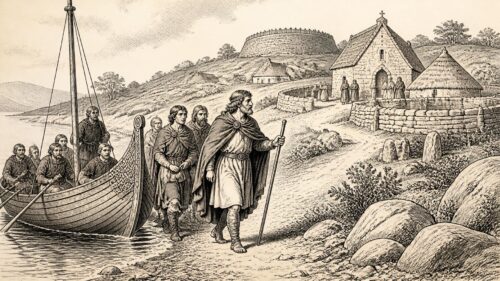
Northumbria’s new king, Aldfrith, offered an opening. He succeeded his half-brother Ecgfrith after the latter’s defeat by the Picts at Dún Nechtain in 685. Adomnán later referred in his Life of Columba to visits to his friend King Aldfrith, one after Ecgfrith’s battle and another two years later. Bede independently records that Adomnán travelled on a mission to Aldfrith. Read beside the Irish annals, this makes the liberation of the sixty captives a strong, though partly reconstructed, explanation for the first visit. The annals record the outcome; Bede confirms the mission; neither gives a narrative of the negotiations.
This was diplomacy conducted through learning, personal relationship and church authority as much as through royal embassies. Adomnán had standing as successor to Colum Cille, whose monastery had long-standing links with Northumbria. Aldfrith himself had close Irish and Ionan associations. Such connections did not erase the damage inflicted by Ecgfrith’s army, but they created channels through which redress could be sought. The return of the captives suggests that kingship after Ecgfrith could be responsive to a cleric who spoke for Irish interests.
Books, Belief and Caution
The journey also belongs to the history of Insular learning. Bede says that Adomnán gave Aldfrith his De locis sanctis, a learned account of Christian holy places associated with the travels of the Frankish bishop Arculf and supplemented by wide reading. Aldfrith then had the work copied and made available to readers. It is tempting to date that presentation precisely to the captive-return mission. Some modern accounts do so. The surviving evidence, however, only securely places the gift during a visit to Aldfrith; Adomnán made more than one journey to Northumbria. It is wiser to treat the book as closely associated with this diplomatic moment, rather than to claim that it was certainly handed over in 687.
That qualification does not diminish the significance. The same abbot who negotiated the return of captives was part of a far-reaching traffic in manuscripts, biblical learning and knowledge of the Mediterranean world. Iona was not an isolated island retreat. It was a centre from which ideas, texts and personnel moved through Irish Sea networks. The episode shows how ecclesiastical prestige could serve both intellectual exchange and practical protection.
Later in his career, Adomnán promoted the Lex Innocentium, the Law of the Innocents, which sought protection for women, children and non-combatants in warfare. That law belongs to 697, not 687, and should not be projected backwards as if it had already been proclaimed. Nevertheless, the recovery of people taken in war is a revealing earlier act in the career of a church leader later associated with limiting war’s victims. It demonstrates the same concern in action, without turning a later legal achievement into an event of this year.
Deaths in the Churches
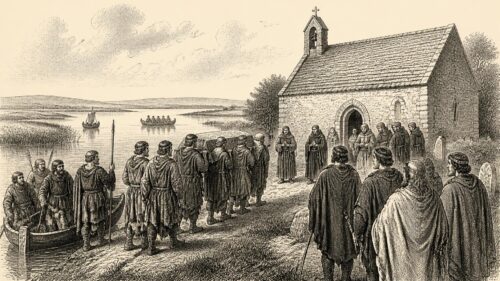
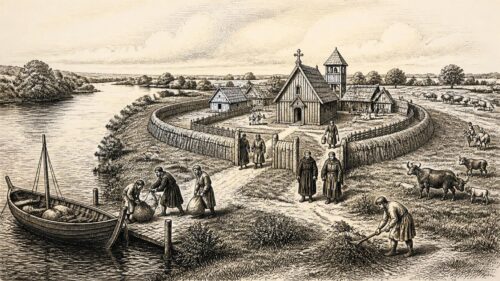
The annals for the year also mark losses among Irish ecclesiastical leaders. Do-Chuma Chonoc, abbot of Glenn dá Locha—Glendalough—died. The record’s conventional word, “repose”, expresses a Christian understanding of death rather than providing biography. We cannot reconstruct his abbacy, but his inclusion confirms Glendalough’s place within the network of communities whose leadership merited annalistic notice. Founded in the late sixth or early seventh century and set in the Wicklow valley of the two lakes, Glendalough was already an established religious centre, even though most conspicuous standing remains there are much later than 687.
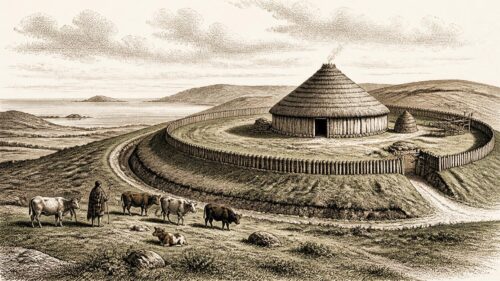
Roiséne, abbot of Corcach Mór, also died. The name is generally associated with Cork, but the annal offers no description of buildings, lands or dependants. It is nonetheless a useful reminder that ecclesiastical authority was distributed across the island, not concentrated at one royal centre. An abbot’s death could matter to a community’s property, patronage, learning and local alliances. Such offices were spiritual, but they also carried practical responsibilities in settlements supported by farming, cattle, gifts and the labour of lay households.
A third notice records the death of Oiséne, bishop of the monastery of Finntan son of Finnguine. The Annals of Tigernach preserve a differing explanatory identification, calling the foundation Fintan’s monastery and associating it with Mundu son of Tulchán. The variation warns against false precision. We can say that a bishop attached to a named monastic community died; we cannot safely identify the site, his jurisdiction or the scale of his authority from these brief entries alone.
Violence and Political Limits
The year’s first Ulster entry is equally spare: Feradach son of Congal was slain. No place, status, killer or motive is supplied. It may preserve a politically meaningful killing, but the evidence does not establish that Feradach was a king, nobleman or cleric. Early Irish annals frequently preserve such bare notices because names mattered to contemporary audiences who knew the surrounding circumstances. For later readers, their restraint is a warning: the political history of 687 cannot responsibly be inflated into a named war or dynastic crisis.
At the wider level, Ireland remained divided among many kingships, with Fínshnechtae Fledach of the Síl nÁedo Sláine ruling at Tara. Brega, the region struck by Northumbrian raiders, lay within the political heartland of his dynasty. Modern biographical scholarship considers it likely that Fínshnechtae used Adomnán as an emissary after the raid, although the contemporary annal entry does not name the king. That distinction is important. Royal power formed the background to the captives’ return, but the surviving record gives Adomnán—not a king—the active role.
What 687 Reveals
For all their brevity, the notices associated with 687 reveal an Ireland joined to its neighbours by conflict, seaways and scholarship. Northumbrian violence had reached Irish churches and communities; an Ionan abbot could answer it through contact at a foreign court; and the Irish Sea carried both captives and returning survivors. Meanwhile, the deaths of abbots and a bishop show the routine continuity of local religious institutions, even as leadership changed hands.
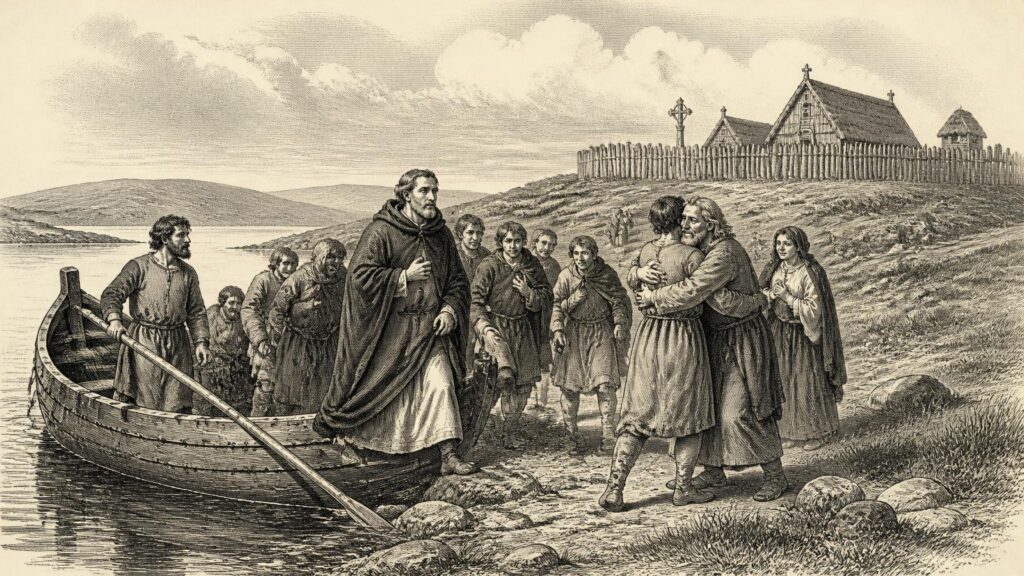
The central image of the year is therefore not a battle line but a homeward crossing. Sixty unnamed people returned, escorted or delivered through the efforts of Adomnán. Their recovery did not undo the raid that had uprooted them, and the sources do not tell what became of them afterwards. But the annals’ decision to record the return preserves a rare measure of repair in an age more often remembered for killing, plunder and the succession of rulers.
Primary Sources
- The Annals of Ulster, Year U687
- The Annals of Tigernach
- Fragmentary Annals of Ireland, Annals 85–100
- The Annals of Ulster: CELT Project Description
- The Annals of Tigernach: CELT Project Description
- Fragmentary Annals of Ireland: CELT Project Description
- Chronicon Scotorum: CELT Project Description
- Annals of the Four Masters
- Bede, Ecclesiastical History, Book IV, Chapter 26
- Bede, Ecclesiastical History, Book V, Chapter 15
- Adomnán
- Fínshnechtae Fledach
- The Northumbrian Attack on Brega in A.D. 684
- Where Was King Aldfrith of Northumbria Educated? An Exploration of Seventh-Century Insular Learning
- The Annals Attributed to Tigernach
- Exploring the Irish Annals
- Prosopographica Glindelachensis: The Monastic Church of Glendalough and its Community Sixth to Thirteenth Centuries
- Glendalough, County Wicklow
- Glendalough: Power, Prayer and Pilgrimage
- Glendalough Monastic Site and Visitor Centre
- Reassessing the ‘Jerusalem Pilgrims’: the Case of Bede’s De locis sanctis
- Beda Venerabilis, De locis sanctis: A Digital Critical Edition
- The Conversion of Britain: Religion, Politics and Society c. 600–800