

The Fall at Odba1072 CE
In 1072 Diarmait mac Máel na mBó, dominant ruler of Leinster, Osraige and Dublin, was defeated and killed at Odba by Conchobar Ua Máelshechlainn of Mide, probably with Tairdelbach Ua Briain’s support. His death shattered a personal network of alliances rather than a unified kingdom. Tairdelbach swiftly raided and secured hostages in Leinster and Osraige, gained Dublin’s submission, and consolidated Munster authority. Annals also record killings among regional rulers and ecclesiastical leaders, illustrating pervasive conflict. Cattle-raiding, captives, hospitality obligations and Dublin’s trade reveal political power’s economic and social foundations. Odba initiated Tairdelbach’s contested pursuit of Irish overkingship in ensuing years.
Dateline
For Ireland, 1072 was a year of abrupt political change. Diarmait mac Máel na mBó, the dominant ruler of the southern half of the island, was killed in battle, and the network of alliances and dependencies built around him began to break apart. His former protégé, Tairdelbach Ua Briain of Munster, moved quickly into Leinster, Osraige and Dublin. Elsewhere, local kings were killed in conflicts from Éile to eastern Ulster. The surviving record is overwhelmingly concerned with rulers, churches and warfare, but its references to cattle-raiding, captives, hospitality, towns and ecclesiastical officers also reveal something of the society upon which royal power depended.
Reading the Record
The events of the year are preserved in several annalistic compilations, including the Annals of Ulster, Tigernach, Inisfallen, Loch Cé, the Four Masters and Chronicon Scotorum. Their entries do not always agree. The Munster-centred Annals of Inisfallen give Tairdelbach Ua Briain a particularly prominent role, while other chronicles assign the decisive victory over Diarmait to Conchobar Ua Máelshechlainn of Mide. Some deaths are also placed under 1071 in one source and 1072 in another. Such differences reflect the annals’ transmission, regional viewpoints and occasionally imperfect chronology. The battle that transformed Irish politics, however, is unusually well dated: the strongest annalistic tradition places it on Tuesday, 7 February.
Diarmait’s Ascendancy
At the beginning of 1072, Diarmait mac Máel na mBó was probably Ireland’s most formidable ruler. From the Uí Chennselaig dynasty of south-eastern Leinster, he had extended his influence across Leinster and Osraige and had secured control of Dublin. His son Murchad, who predeceased him in 1070, had acted as ruler or governor of the Hiberno-Norse town and had campaigned in the Irish Sea. Diarmait had also helped Tairdelbach Ua Briain displace Donnchad mac Briain in Munster.
The annals reveal how contemporaries struggled to describe the breadth of Diarmait’s authority. Some call him king of Leinster and the foreigners, meaning chiefly the Hiberno-Norse inhabitants of Dublin. Others add Osraige, the southern half of Ireland, the Isles and even the Britons. These titles should not be read as evidence that he governed a united territorial state. His supremacy rested upon personal alliances, hostages, tribute, military intimidation and the obedience of lesser kings. Nevertheless, Dublin’s ships, warriors and commercial resources gave him advantages unavailable to most inland rulers.
The Battle of Odba
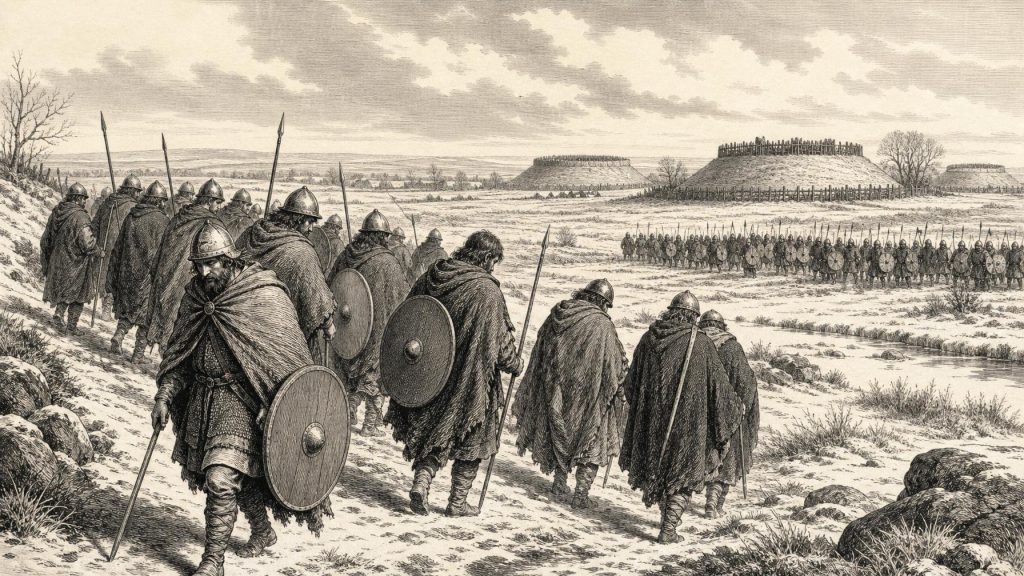
Diarmait’s long struggle with Mide ended at Odba, generally identified with the area of Moathill near Navan. Conchobar Ua Máelshechlainn, king of Mide and claimant to the prestigious kingship of Tara, had ruled for decades and repeatedly resisted Leinster intervention. Diarmait’s forces included Leinstermen and a substantial contingent from Dublin. The resulting defeat was severe: the annals agree that Diarmait fell amid a slaughter of Leinstermen and foreigners. The Four Masters add that he was beheaded and name Gilla Pátraic Ua Fergail, king of the Fortuatha of Leinster, among the dead.
Responsibility for the victory is reported differently. The Annals of Ulster, Tigernach, Loch Cé and Chronicon Scotorum credit Conchobar. The Annals of Inisfallen state that Diarmait was killed by Ua Máelshechlainn and Ua Briain, indicating that Tairdelbach’s forces fought beside the king of Mide. Modern historians therefore treat Tairdelbach’s involvement as likely, although his precise motives are not recorded. He may have turned against the older ruler who had once supported his rise, or simply recognised that Diarmait’s authority was weakening.
The battle destroyed more than a field army. Diarmait’s son and principal lieutenant was already dead, and no successor possessed comparable authority over Leinster, Dublin, Osraige and Munster. A later lament preserved by the Four Masters portrayed his death as the end of peace and feasting. Though poetic and partisan, its mood captures the political reality: a hierarchy centred upon one exceptional warlord had collapsed.
Tairdelbach Moves East
Tairdelbach Ua Briain exploited the vacuum with striking speed. According to the Annals of Inisfallen, he entered Osraige and Leinster, burned the territory of Uí Chennselaig and carried away many cattle and captives. He took hostages from Osraige and the wider province, the standard means by which a superior king secured obedience. Such operations combined warfare with economic extraction. Herds represented food, status, rent and the capacity to reward followers; captives could be retained, exchanged or enslaved.
Dublin also submitted. Inisfallen reports that the foreigners offered its kingship to Tairdelbach and that he placed a member of Diarmait’s extended family there. The arrangement was evidently fluid, for the same annal later identifies Gofraid, grandson of Ragnall, as king of Dublin. Gofraid, Domnall mac Gilla Pátraic of Osraige and a son of Conchobar Ua Máelshechlainn subsequently came to Tairdelbach’s residence and acknowledged his superior kingship. This was not island-wide government, but it marked the emergence of the Munster king as Diarmait’s principal successor in the contest for Irish overkingship.
Tairdelbach also blinded Conaing Ua Briain during the year. The terse notice gives no motive, but blinding was a recognised means of rendering a dynastic rival ineligible for kingship. His outward expansion was therefore accompanied by ruthless consolidation within the Ua Briain kindred.
Conflict Beyond Leinster
The wider annalistic record shows that political violence was not confined to Odba. Cú Ulad Ua Flaithrí, a deposed king of Ulaid, and Aisidh or Gabhadhán, king of Uí Gabla, were killed in an attack associated with southern Brega or the men of Mide. Some accounts say that they and many companions were burned inside a house. The episode probably belonged to the continuing struggles linking Ulaid, Brega, Mide and the eastern approaches to the midlands.
Ua Fócarta, king of Éile in the Irish midlands, was killed by an Ua Briain. The sources do not securely identify the killer or explain the encounter, so it cannot automatically be assigned to Tairdelbach’s eastern campaign. Ruaidrí Ua Canannáin, king of Cenél Conaill, was killed by Aengus Ua Máeldoraid, although some annals place this under 1071. These notices demonstrate the hazardous nature of local kingship, in which rival branches of royal families and neighbouring peoples competed continually for land, tribute and precedence.
Churches and Communities
Ecclesiastical institutions were integral to this political landscape. The Annals of Ulster record the deaths of Máel Muire Ua Muirigán, superior or airchinnech of Tuidnech, and Dub Díl, successor of Brigit. The latter title denotes the head of Brigit’s community at Kildare, an exceptionally prestigious female ecclesiastical office. The Annals of Inisfallen separately note the death of a woman of Kildare, possibly preserving a related but not certainly identical tradition.
A more disturbing entry in the Four Masters describes Murchad, son of Conchobar Ua Máelshechlainn, taking a forcible refection from Íseal Chiaráin and its Céli Dé community. The officer responsible for the poor was killed, after which land at Mag Nura was reportedly granted to the poor. Because this detail survives in a later compilation and lacks confirmation elsewhere, it should be treated cautiously. It nevertheless reflects genuine tensions surrounding hospitality. Churches were expected to feed kings and retinues, but an armed company could turn customary support into destructive exaction.
Monasteries remained centres of worship, education, manuscript culture, estate management and charity. No major surviving manuscript or work of art can be securely assigned to this single year. More broadly, however, eleventh-century Irish metalwork combined native forms with Scandinavian Ringerike and Urnes ornament, while church communities maintained the learning that allowed political events to be recorded and interpreted.
Land, Town and Trade
Most people experienced these political struggles indirectly. Rural households raised cattle, sheep and pigs, cultivated grain, produced dairy foods and owed renders or services to local lords and churches. The repeated annalistic emphasis on cattle was not decorative language: livestock formed a principal store of wealth. A raid that removed herds threatened winter provisions, seed resources, rents and the standing of an entire community. Burning settlements and carrying away captives could disrupt labour and family life long after armies departed.
Dublin was different in scale and character. By 1072 it was a fortified Hiberno-Norse town of timber houses, streets, workshops and waterfront activity. Archaeology reveals carpenters, metalworkers, leatherworkers, textile producers, merchants and fishermen, together with imported pottery, soapstone vessels and other goods. Silver pennies had been struck in Dublin since about 997, although barter, weighed silver and payment in goods continued. Control of the town meant access to ships, customs, skilled labour, coin and trade with Britain, the Isles and continental Europe.
This helps explain why Dublin’s allegiance was contested immediately after Odba. The town was not merely a trophy attached to Leinster. It was a political actor whose leading inhabitants could negotiate with competing kings, while its military and maritime resources could transform an inland campaign. Tairdelbach’s rapid intervention linked the cattle-rich economy of Gaelic lordship with the commercial wealth of Ireland’s foremost port.
A New Political Order
The central development of 1072 was therefore not simply the death of one king but the transfer and fragmentation of his power. Conchobar Ua Máelshechlainn won the battlefield victory and removed Mide’s greatest enemy, yet Tairdelbach Ua Briain gained most from the aftermath. Leinster was invaded, Osraige submitted and Dublin entered the Munster king’s sphere. The settlement remained unstable, and Conchobar himself would be murdered in 1073.
No assembly proclaimed an undisputed monarch of Ireland, nor did everyday institutions suddenly change. Fields were still worked, churches observed their calendars and Dublin’s workshops continued production. Yet the obligations surrounding those activities—tribute, hosting, military service and political allegiance—were being redirected. Odba ended the ascendancy of Diarmait mac Máel na mBó and opened the age in which Tairdelbach Ua Briain pursued the title and practical authority of a king of Ireland with opposition.
Primary Sources
- The Annals of Ulster: Year U1072
- The Annals of Tigernach: English Translation
- The Annals of Tigernach: Irish Text
- Annals of Inisfallen: Part 7
- Annals of the Four Masters: Part 17
- Annals of Loch Cé: Annal LC1072
- Chronicon Scotorum
- Diarmait (Diarmait mac Maíl (Máel) na Mbó)
- Ua Briain, Tairdelbach
- Ua Máelshechlainn, Conchobar
- Ua Conchobair Fhailge, Conchobar
- High-kings with Opposition, 1072–1166
- Viking
- 950–1450: Vikings, Normans and Medieval Mints
- Early Medieval
- Dublin City Walls and Defences
- The Archaeological Remains of Viking and Medieval Dublin: A Research Framework
- Medieval Ireland: Territorial, Political and Economic Divisions
- Kingship, the Church, and Silver in Ireland
- The Leinster Marshal Thesis
- Landscapes of Kingship in Early Medieval Ireland, AD 400–1150
- Migration and Viking Dublin: Paleomobility and Paleodiet through Isotopic Analyses
- Emerging from the Mist: Ireland and Man in the Eleventh Century
- Ireland in the Middle Ages