War, Truce and Murrain1133 CE
In 1133, Toirdelbach Ua Conchobair’s disputed high-kingship faced a Munster invasion of Connacht, which killed an heir but secured no submission. He later agreed a year’s truce with Conchobar Ua Briain, while Mide and Bréifne destroyed his Athlone bridge and fort. Feuds in Mide, Leinster and Fine Gall brought assassinations, reprisals, raids and the burning of Lusk church. Regional conflicts, deaths and accidents continued. Armagh’s succession remained divided between reformer Malachy and Muirchertach mac Domnaill. Clerical visits, learned figures and burnings featured in the annals. A devastating cattle and pig murrain damaged Ireland’s economy; an August solar eclipse was recorded.
Dateline
The Ireland recorded under 1133 was politically vigorous but deeply unstable. Toirdelbach Ua Conchobair, king of Connacht, claimed the high-kingship, yet his authority was neither uniform nor uncontested. Provincial kings, ambitious sub-kings, ecclesiastical dynasties and the Hiberno-Norse towns all pursued interests of their own. The annals consequently describe armies crossing provincial frontiers, fortifications being demolished, cattle driven away and prominent heirs killed. They also record negotiation, religious visitation, scholarship and environmental disaster. These notices are not a continuous diary: their order need not reproduce the exact sequence of the year, and later compilations sometimes duplicate or vary the same report. Nevertheless, several independent annalistic traditions make 1133 unusually well documented.
An Invasion of Connacht
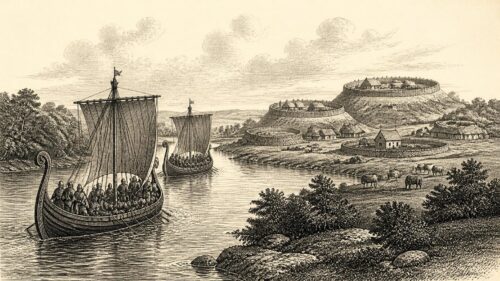
The year’s largest campaign was directed against Toirdelbach’s Connacht heartland. A southern army representing Leth Moga, the traditional southern half of Ireland, advanced under Cormac Mac Carthaig and Conchobar Ua Briain. These rulers belonged to rival Munster dynasties: Cormac led the Mac Carthaig kingdom of Desmond, while Conchobar represented the Uí Briain of Thomond. Their cooperation demonstrates how opposition to Toirdelbach could temporarily outweigh competition within Munster.
The invaders penetrated far enough to destroy or burn Dún Mughdorn and Dún Mór, the latter generally identified with Dunmore in County Galway. The wording suggests defended settlements or lordly strongholds, not the surviving Anglo-Norman stone castle at Dunmore, which belongs to a later period. Cathal son of Cathal Ua Conchobair, an heir-designate of Connacht, was killed, together with Gilla na Naem Ua Flainn, chief of Síl Maílruain. The loss of an eligible royal successor and an important subordinate ruler gave the expedition political weight beyond ordinary raiding.
Yet the southern army returned without hostages, submission or a permanent peace. In Irish kingship, hostages were tangible proof that an opponent had acknowledged superior authority. The campaign therefore inflicted grave damage without forcing Toirdelbach to concede control of Connacht. One later annalistic compilation preserves a duplicate version with a different name for Cormac’s partner, but the Annals of Tigernach, Chronicon Scotorum and the fuller parallel account support Conchobar Ua Briain’s participation.
Truce and the Shannon Frontier
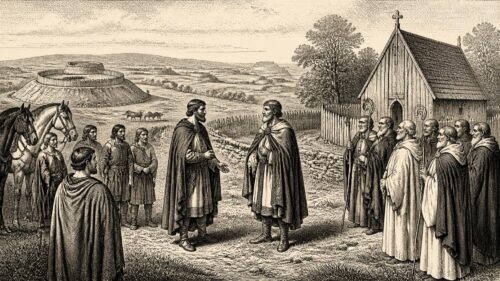
At Abhall Chethearnaigh, Toirdelbach and Conchobar Ua Briain subsequently attended a conference with senior clergy from Connacht and Munster. A one-year peace was arranged. The record does not provide a day or prove conclusively that the meeting followed the invasion, but the two events clearly belong to the same cycle of warfare and diplomacy. Clerics were not passive spectators: their standing, networks and command of sacred sanctions made them valuable mediators between kings.
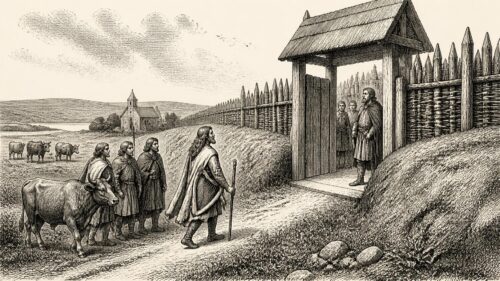
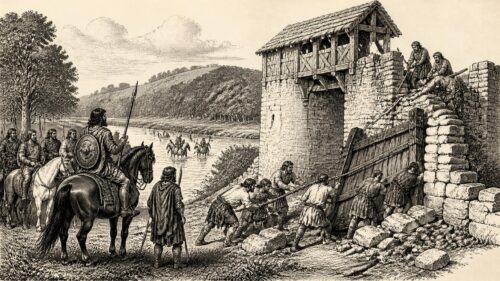
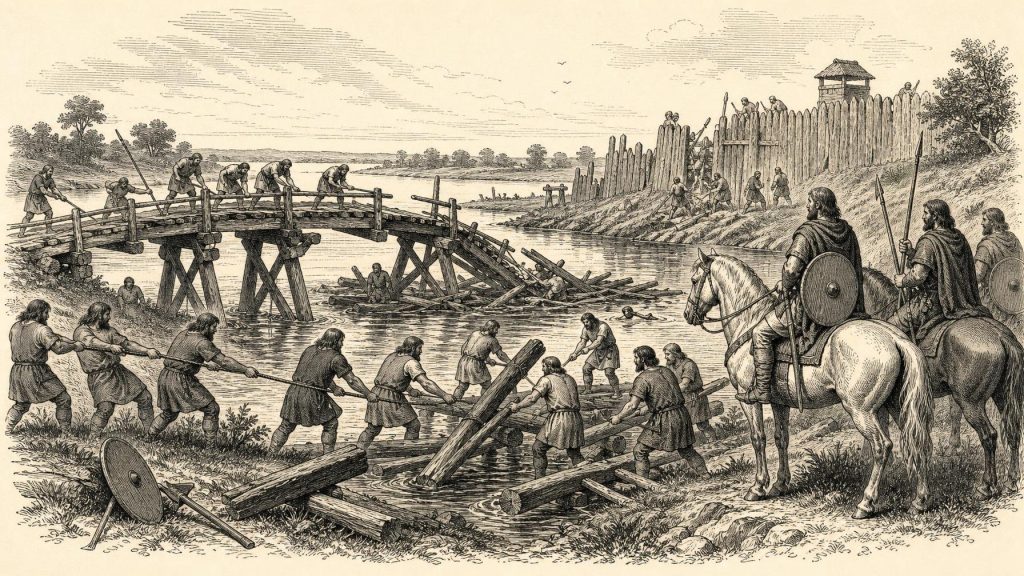
Toirdelbach also faced pressure along the Shannon. Murchad Ua Máelshechlainn, king of Mide, and Tigernán Ua Ruairc of Bréifne destroyed the bridge and castle at Athlone. Toirdelbach had sponsored successive timber bridges at this strategic crossing, accompanied by an early wooden fortification. Their destruction hindered the movement of Connacht armies into the midlands and attacked a visible instrument of royal power. These structures should not be confused with the great stone castle begun under English rule in the thirteenth century.
Vengeance in the East
A violent chain of retaliation linked Mide, Leinster and Fine Gall, the Scandinavian-influenced coastal district around Dublin. Conchobar, son of Murchad Ua Máelshechlainn and heir-designate of Mide, was killed by Donnchad Mac Gilla Mo Cholmóc, a Leinster claimant, and men whom the annals call “foreigners”. In this eastern setting the term most probably denotes Hiberno-Norse or Ostman warriors associated with Dublin. About a month later, Donnchad was himself killed by men of Mide in revenge.
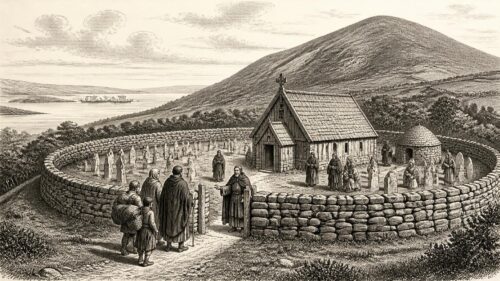
Lusk then suffered one of the year’s most disturbing attacks. Its church, relics and people were caught in a deliberate burning during the continuing feud. The chronicles differ over which of Murchad’s sons led the action, but agree that the destruction belonged to the vengeance taken for Conchobar. Murchad also plundered Fine Gall and eastern Leinster. Sacred status could restrain warfare, but it offered no dependable immunity when churches sheltered enemies, stored wealth or stood within a hostile territory.
Donnchad Ua Cerbaill, king of Airgialla, separately raided Fine Gall with the men of Fernmagh. The local foreigners overtook them at Finnabhair na nIngen. In the ensuing battle Ragnall son of Pól and many of his companions were killed, although Ua Cerbaill’s force was itself placed in serious danger. The encounter reveals Dublin’s surrounding communities as armed political actors, not merely merchants living apart from Gaelic Ireland.
Regional Conflict and Loss
Smaller wars continued across the island. The men of Tethba defeated Síl Muiredaig, Toirdelbach’s own wider dynasty, killing Amlaíb Ua Raduib, chief of Clann Tomaltaig, and capturing another notable. Tigernán Ua Ruairc raided the northern Uí Fhiachrach. In Leinster, men led by Ugaire Ua Tuathail and the Uí Muiredaig killed Máel Sechlainn, a descendant of Diarmait Mac Máel na mBó, and Eochaid Ua Nualláin of the Fotharta. In the west, Flaithbertach Ua Flaithbertaig was killed by a son of Lochlann Ua Lochlainn in revenge for his father. Two sons of Cú Chonnacht Ua Conchobair also drowned in Lough Ree, a reminder that elite households faced accidental as well as violent death.
Armagh and Church Authority
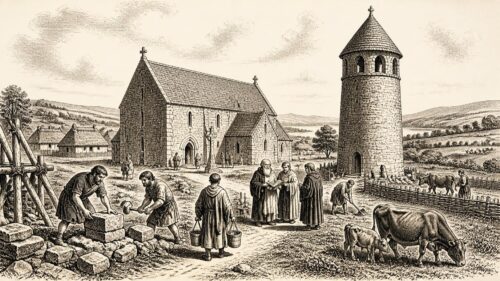
Irish church reform formed an important background to the year. The Synod of Ráth Breasail in 1111 had promoted territorial dioceses, while reformers sought canonical appointments and closer conformity with wider Latin Christianity. At Armagh, however, the succession remained contested. Malachy Ua Morgair had been consecrated for Armagh in 1132 but was opposed by the entrenched Clann Sínaig interest. Its candidate, Muirchertach mac Domnaill, still exercised the practical functions of the successor of Patrick.
In 1133 Muirchertach made a visitation of Tír Eógain, receiving a tribute of cows and horses and imparting his blessing. This combined pastoral, ceremonial and economic authority. The journey also displayed support in the territory of Cenél nEógain, whose rulers resisted Malachy’s claim. Malachy’s reforming consecration therefore did not instantly displace older ecclesiastical structures. The annals additionally record the deaths of Muiredach Ua Duibinnsi, airchinnech or ecclesiastical administrator of Louth, and Conaing son of Dub Dáléithe, a deputy airchinnech of Armagh.
Learning and law appear briefly through Gilla na Naem Ua Birn, buried at Roscommon. One chronicle calls him Ireland’s royal lawgiver, while another renders his position as royal steward. The variation cautions against assigning him a narrowly modern office, but both descriptions identify a senior learned or administrative figure attached to kingship. The death of Máel Brigte Ua hAinnín, praised for charity and religious devotion, was likewise considered worthy of national remembrance. Roscrea and Louth were burned during the year, although the surviving notices do not explain whether warfare, accident or another cause was responsible.
The Great Cattle Murrain
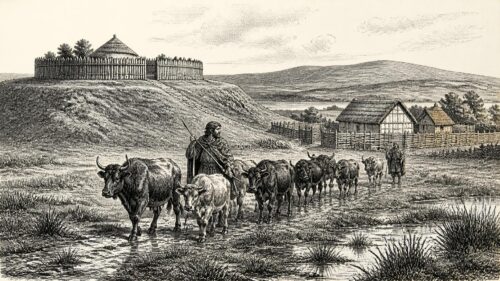
The most far-reaching event may have been neither battle nor royal conference, but a devastating livestock disease called Máelgarb. Chronicon Scotorum says that it killed the cows of Ireland and almost all its pigs. The Four Masters describe a cattle mortality without equal for centuries, leaving only a small remnant. Such language is rhetorical and cannot provide reliable totals, but agreement between chronicles indicates an exceptional and widespread outbreak. The disease continued into 1134, when cattle in the northern half of Ireland were reportedly still affected. Its precise cause cannot now be diagnosed responsibly.
Cattle supplied milk, butter, meat, hides and draught power; they also represented movable wealth and figured prominently in rents, tribute, compensation and political gift-giving. The simultaneous loss of pigs further reduced an important source of meat. Ordinary households may have faced diminished dairy supplies, weaker plough teams and difficulty meeting obligations to lords or churches. Elite power was affected too, since kings rewarded followers and measured raiding success through livestock. No annal explicitly records a general human famine in 1133, so one should not be asserted, but severe economic and nutritional stress is a reasonable inference.
Landscape, Town and Sky
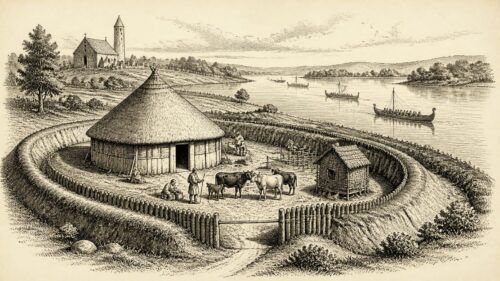
Most people lived in dispersed rural communities, working mixed farms and tending animals around enclosed homesteads. The year’s raids would have meant more than distant struggles among kings: they brought the seizure of herds, burning of buildings and disruption of seasonal labour. Along the coast, Dublin and Fine Gall belonged to a more urban and maritime economy of crafts, shipping and Irish Sea exchange. Gaelic rulers fought both against and alongside the Ostmen, whose military involvement in 1133 shows how thoroughly the towns had become embedded in island politics.
Chronicon Scotorum also records an eclipse of the sun at the third hour of the day. Modern astronomical calculations identify the phenomenon as the solar eclipse of 2 August 1133, visible across north-western Europe. The annalist offered no prophecy or elaborate interpretation, simply preserving the observation. Against a year of invasions, revenge killings, contested church government and catastrophic animal mortality, that restrained notice is revealing: Irish chroniclers watched the heavens as carefully as they recorded the changing fortunes of kings.
Primary Sources
- Annals of the Kingdom of Ireland: Annal M1133
- The Annals of Tigernach
- Chronicon Scotorum
- Chronicon Scotorum: Published English Edition
- Ua Conchobair, Tairdelbach (O'Conor, Turlough)
- Mac Carthaig, Cormac
- Ua Briain, Conchobar
- Ua Máelshechlainn, Murchad
- Ua Ruairc, Tigernán
- Ua Cerbaill, Donnchad
- Malachy (Máel-M'áedóc) Ua Morgair
- Ua hÁedacáin, Imar
- Mac Murchada, Diarmait (MacMurrough, Dermot)
- The Transformation of the Irish Church in the Twelfth Century
- Crisis and Recovery: Church and Society in Twelfth-Century Ireland
- Viking Collections
- The Zooarchaeology of Medieval Ireland
- Agriculture, Settlement and Society in Early Medieval Ireland
- The Archaeology of Livestock and Cereal Production in Early Medieval Ireland, AD 400–1100
- The Decline of the Cow: Agricultural and Settlement Change in Early Medieval Ireland
- Changing Human–Cattle Relationships in Ireland: A 6000-Year Isotopic Perspective
- The Economy of Early Medieval Ireland
- Early Medieval Dwellings and Settlements in Ireland, AD 400–1100
- Climate, Disease and Society in Late-Medieval Ireland
- History of Athlone Castle
- Athlone Public Realm Archaeological Assessment
- Archaeological and Cultural Heritage Assessment of Dunmore Route Options
- Five Millennium Canon of Solar Eclipses: −1999 to +3000
- Solar Eclipses of History