A Frontier Widens1177 CE
In 1177 Anglo-Norman expansion widened beyond footholds in Leinster, Meath and ports. John de Courcy secured Downpatrick, raiding eastern Ulaid but not conquering Ulster. Henry II’s Oxford council assigned Ireland to his son John and redistributed strategic lordships and speculative grants in Cork and Limerick, asserting authority. Anglo-Norman expeditions into Connacht and Munster encountered resistance, scorched supplies and limited success. Irish dynastic rivalries continued alongside invasion, while church institutions mediated violence and suffered attack. Synodal activity, disasters and deaths of learned figures illuminate religious and economic life. Ireland remained politically fragmented, yet conquest’s frontier and ambitions decisively expanded across Ireland.
Dateline
In 1177 the struggle for Ireland entered a new phase. The Anglo-Norman footholds established since 1169 remained concentrated in parts of Leinster, Meath and the southern ports, while most of the island was still governed by Irish kings. Yet campaigns in Ulaid, Connacht and Munster carried armed intervention into regions previously beyond sustained colonial control. At the same time, Henry II attempted to organise his claims from England, assigning lands, ports and responsibilities that he did not necessarily possess in practice. The year therefore joined conquest on the ground to lordship imagined on parchment.
John de Courcy Takes Down
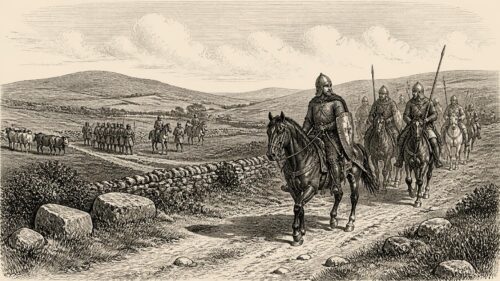
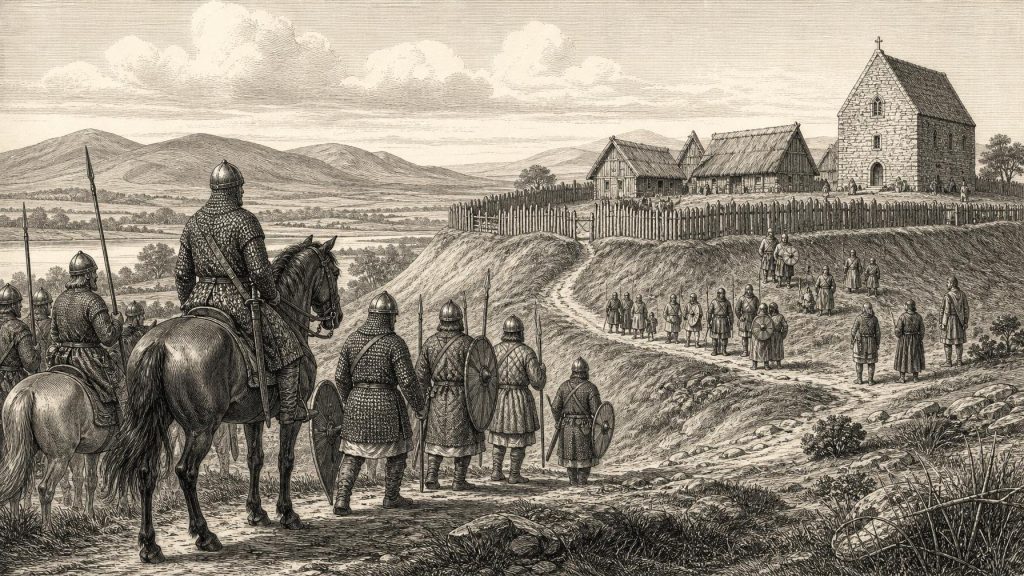
The year’s most consequential event was John de Courcy’s advance into Ulaid in north-eastern Ireland. According to Gerald of Wales, whose dramatic account must be treated cautiously, de Courcy left Dublin with only twenty-two men-at-arms and about 300 other soldiers. A modern reconstruction places his arrival at Dún Dá Lethglas, now Downpatrick, around 1 February. His operation appears to have been a personal venture undertaken without clear authorisation from William fitz Aldelin, Henry II’s chief representative in Ireland.
Down was both a royal centre of the Mac Duinn Sléibe kings of Ulaid and an important ecclesiastical settlement. Surprise gave de Courcy an immediate advantage over King Ruaidrí Mac Duinn Sléibe. The Annals of Ulster report the destruction of the settlement, the construction of a fortification and two victories over the Ulaid, followed by another over forces associated with Cenél nEógain and Airgíalla. Several northern nobles were killed, including Conchobur Ua Cairelláin of Clann Diarmata and Gilla Mac Liac Ua Donngaille of Fir Droma.
The surviving accounts do not provide a perfectly consistent sequence. The Annals of Tigernach even state that de Courcy suffered defeat and was captured, whereas other annals and the subsequent course of events show him retaining a base at Down. Such contradictions warn against presenting every episode in the later heroic story as securely dated fact. What is certain is that de Courcy established himself in eastern Ulaid during 1177 and withstood efforts to remove him.
From Down, his forces moved into Dál nAraidi, Uí Tuirtri and Fir Lí. Domnall, grandson of Cathasach and king of Dál nAraidi, was killed. Armoy was burned ahead of the advancing army, apparently to deny it supplies, while de Courcy’s men burned Coleraine and other churches. These raids did not amount to the conquest of all Ulster. They opened a new, exposed frontier whose survival depended upon fortifications, mobile troops and negotiated relationships with neighbouring Irish rulers.
Henry II’s Irish Settlement
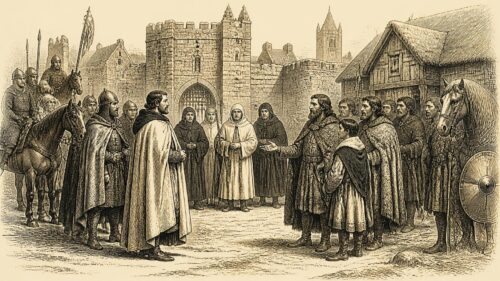
In May, Henry II held a council at Oxford at which Ireland occupied a prominent place. Roger of Howden says that Henry designated his ten-year-old son John as king of Ireland and sought papal approval for a future coronation. That coronation never occurred, and John was more commonly styled lord of Ireland. The decision nevertheless established Ireland as a dynastic possession intended for Henry’s youngest son, even though John remained in England and exercised no personal government there in 1177.
The council also reorganised royal oversight following Strongbow’s death in April 1176. William fitz Aldelin received custody of Wexford and lands formerly controlled by Strongbow; Hugh de Lacy retained an important role at Dublin; and Robert Poher was assigned Waterford. Military obligations in Leinster were grouped around Dublin, Wexford and Waterford. These arrangements strengthened Henry’s hand in ports essential for communication with Britain and limited the freedom of colonial magnates.
Henry also made ambitious territorial grants. Robert fitz Stephen and Miles de Cogan received the so-called kingdom of Cork, while Philip de Braose was granted Limerick for the service of sixty knights. These were speculative awards: Irish rulers and communities still held much of the land concerned. The grants reveal a widening colonial programme, but not an accomplished island-wide government. They also cut across the settlement agreed with Ruaidrí Ua Conchobair in the Treaty of Windsor in 1175, under which Ruaidrí’s authority had been recognised beyond the existing Anglo-Norman territories.
Campaigns in West and South
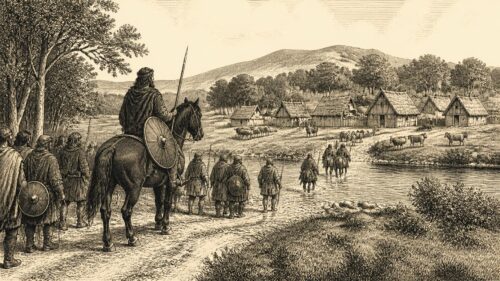
Connacht experienced its first recorded Anglo-Norman incursion. Murchad, a son of Ruaidrí Ua Conchobair, brought Miles de Cogan and troops from Dublin and Meath to Roscommon as part of a rebellion against his father. Guided by Murchad, the force crossed the settled plain towards Tuam, burning churches and other sites. Ruaidrí was then in western Connacht but mobilised resistance as news of the invasion spread.
The Connacht population responded by removing cattle and possessions into defensible country. Tuam and neighbouring settlements were emptied, while buildings that might shelter or provision the invaders were burned. De Cogan’s force reportedly spent three nights at Tuam without obtaining adequate food or plunder. Harassed during its retreat, it escaped eastwards with uncertain losses. Ruaidrí later blinded Murchad, a severe but familiar means of rendering a royal rival ineligible for kingship.
In Munster, Robert fitz Stephen and Miles de Cogan moved to claim Cork. The Annals of Inisfallen describe the city as invaded and besieged by them in conjunction with an Irish Mac Carthaig contender. A detachment campaigned at Achad Deó, and another movement towards Waterford met strong Irish resistance east of Lismore. Fitz Stephen and de Cogan reached Cork late in the year, but their effective authority remained limited to the city and nearby districts.
Philip de Braose arrived through Waterford and attempted to approach Limerick. Faced with a defended and hostile landscape, he abandoned the venture rather than storm the town. His retreat demonstrated the gulf between Henry II’s grants and the power required to enforce them. Meanwhile, the Annals of Inisfallen record extensive warfare between Thomond and Desmond, with devastation from Limerick towards Cork. Irish dynastic conflict and Anglo-Norman expansion were increasingly intertwined rather than separate struggles.
Gaelic Power and Political Violence
Irish politics continued to follow its own regional contests. Áed Ua Néill, known as Áed in Macáem Tóinlesc, was killed by Máel Sechlainn Mac Lochlainn and his son Ardgal; Ardgal also died in the encounter. The struggle concerned control of Cenél nEógain and the wider northern balance of power. De Courcy’s intervention therefore struck a region already divided by competition among Ulaid, Cenél nEógain, Airgíalla and other kingdoms.
Violence also touched Leinster and the north-west. Máel Mórda son of Fáelán, described as a leading royal heir in Leinster, was killed by the Uí Tuathail. At Derry, Niall Ua Gailmredhaigh was killed after a house was burned around him. His attackers subsequently made peace with the community of Colum Cille, promising land, compensation and the rebuilding of a cleric’s house. Political force remained constrained, at least in principle, by sanctuary, ecclesiastical negotiation and the obligation to make restitution.
Church, Learning and Daily Life
Cardinal Vivian, a legate of Pope Alexander III, came to Ireland and presided over a synod. The Four Masters place it on the first Sunday of Lent and say that bishops and abbots enacted numerous ordinances, but the provisions cannot now be reconstructed securely. Gerald of Wales later claimed that Vivian proclaimed Henry II’s rights, whereas William of Newburgh presented the legate as sympathetic to Irish resistance at Down. His mission illustrates both papal involvement and the difficulty of separating ecclesiastical reform from political conflict.
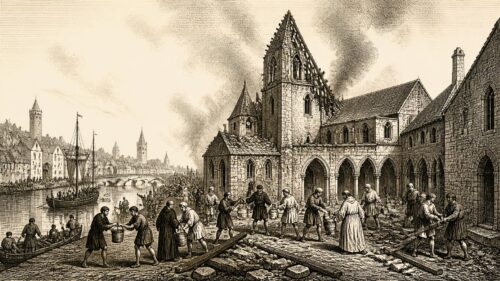
The burning of churches in Ulaid, Connacht and Munster shows why clerical communities were deeply involved in warfare. Churches served not only as sacred places but also as repositories, meeting points and potential quarters for armies. Yet 1177 belonged to the longer twelfth-century reform era, when diocesan organisation and international orders were reshaping Irish religious life. Older communities, hereditary church offices and devotion to local saints continued alongside these changes.
The annals offer rare glimpses beyond kings and armies. A sudden flood at Glendalough swept away a bridge and mill, carried fish into the settlement and drowned a fisherman downstream near Arklow. A severe hailstorm damaged cultivated land in Cuircne. Such notices reveal communities dependent upon mills, bridges, fishing, livestock and vulnerable harvests. The removal of cattle before the Connacht invasion likewise shows both the central economic value of herds and the practical means by which rural people resisted an army.
Learned culture also suffered losses. Amlaíb Ua Domnalláin, ollamh of Connacht in poetry, died, while the Annals of Ulster record the killing of Ua Coinnecén, a leading northern timpanist, together with his wife and household. Poets and musicians were professional members of aristocratic society, preserving genealogy, reputation and political memory. Their appearance beside kings and churchmen in the annals reflects the status of learning and performance in Gaelic Ireland.
By year’s end no single power ruled Ireland. Ruaidrí Ua Conchobair still commanded substantial authority, Irish kingdoms remained resilient, and many royal grants were little more than claims. Nevertheless, de Courcy’s foothold in Ulaid, the assaults on Connacht and Munster, and Henry II’s Oxford settlement widened the geography and ambition of conquest. The political map had not been replaced, but its frontiers had begun to shift decisively.
Primary Sources
- The Annals of Ulster: Year U1177
- The Annals of Tigernach
- Annals of the Four Masters: Annal M1177
- Annals of Inisfallen: Annal AI1177
- Mac Carthaigh’s Book
- Courcy, John de
- Gerald of Wales (Giraldus Cambrensis)
- Henry II, the Council of Oxford and Angevin Overlordship in Leinster, 1177–85
- From Kingdom to Colony: Framing the English Conquest of Ireland
- The Medieval Irish Kings and the English Invasion
- The Irish Kings and the English Invasion
- The Origins of the Lordship of Leinster and the Role of William Marshal: Perceptions and Reality
- ‘Lord of the Foreigners of Ireland’: 1177–86
- The Anglo-Normans in Ulster
- Downpatrick: Irish Historic Towns Atlas
- Carrickfergus: Irish Historic Towns Atlas
- Medieval Ireland 1150–1550
- Three Medieval Settlements
- Transformation from Pre-Norman Monasticism to the Introduction of the Religious Orders into Ireland
- Religious Orders
- Irish Ecclesiastical Politics and Anglo-Norman Sponsorship: The Patronage of the Vita S. Patricii
- Hiberno-Papal Relations in the Late Twelfth Century
- The Making of a Myth: Giraldus Cambrensis, Laudabiliter, and Henry II’s Lordship of Ireland
- Gerald of Wales: The Conquest of Ireland
- Royal MS 13 A XIV: Gerald of Wales, Topographia Hiberniae and Expugnatio Hibernica