Reynolds, X Case and Maastricht1992 CE
Dateline
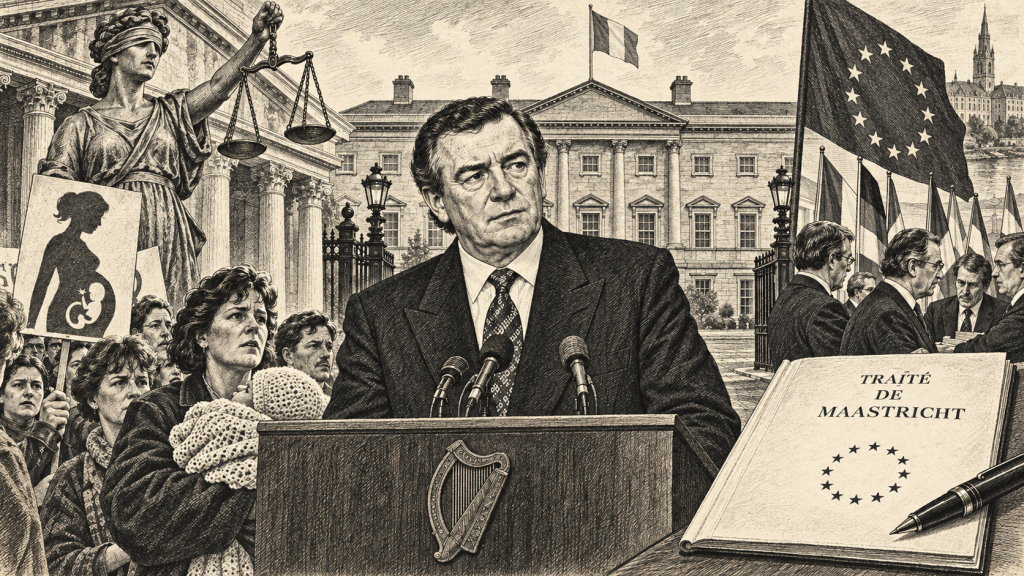
In 1992 Ireland experienced a rapid sequence of political, constitutional and social changes. Charles Haughey’s long career as Taoiseach ended in February and Albert Reynolds succeeded him. The X Case forced the State to confront the practical meaning of the constitutional ban on abortion, the Maastricht Treaty required a referendum on Ireland’s place in the emerging European Union, and a general election at the end of the year reshaped party politics. These events made 1992 one of the most consequential years of the early 1990s.
The economy remained fragile. Unemployment was about 15 per cent and the country was still adjusting to the long aftermath of the 1980s crisis. Yet Ireland was increasingly tied to European institutions and investment, and the decisions made in 1992 would have lasting consequences for constitutional law, foreign policy and domestic politics.
Reynolds Replaces Haughey
Charles Haughey resigned as Taoiseach in February after years of controversy and internal Fianna Fáil pressure. Albert Reynolds, who had challenged his leadership and had been dismissed as Minister for Finance the previous November, won the party leadership and became Taoiseach. Reynolds inherited a Fianna Fáil–Progressive Democrats coalition but immediately presented himself as a different kind of leader, promising a more direct style of government and a renewed effort to address Northern Ireland.
His administration did not enjoy a settled year. The coalition relationship was difficult and the economic environment remained demanding. Nevertheless, Reynolds quickly became central to two issues that would define his premiership: European integration and the developing peace process.
The X Case
In February the Attorney General obtained an injunction preventing a fourteen-year-old girl, known as X, from travelling to England for an abortion. She was pregnant as a result of rape and had expressed suicidal intent. The case caused an immediate national crisis because it brought the constitutional protection of the unborn into direct conflict with the life and mental health of a pregnant girl.
The Supreme Court overturned the injunction in March. It held that abortion was constitutionally permissible where there was a real and substantial risk to the life of the pregnant woman, including a risk of suicide. The judgment did not introduce a general right to abortion, but it established an interpretation of Article 40.3.3 that would dominate Irish constitutional and political debate for years.
The controversy returned to the electorate on 25 November. Voters rejected the proposed Twelfth Amendment, which sought to exclude the risk of self-destruction as a ground for abortion, but approved the Thirteenth and Fourteenth Amendments. These protected freedom to travel abroad and freedom to obtain or provide information about services lawfully available in another state. The result demonstrated that voters were unwilling to reverse the Supreme Court’s core reasoning while also seeking constitutional clarity on travel and information.
Maastricht and Europe
Ireland also voted on the Treaty on European Union, signed at Maastricht in February. The Eleventh Amendment allowed the State to ratify the treaty and become a member of the European Union. The referendum was approved by a large majority in June, reflecting the broad pro-European consensus that had developed since Ireland joined the European Communities in 1973.
Maastricht was important because it moved European integration beyond the existing economic communities. It created the European Union, set a path towards economic and monetary union and expanded cooperation in foreign policy and justice. For Ireland, participation promised access to a deeper single market and substantial structural and cohesion funding, but it also raised questions about sovereignty and the direction of European integration.
Election and Political Realignment
The Twenty-Sixth Dáil was dissolved in November and a general election was held on 25 November, the same day as the three abortion-related referendums. Fianna Fáil remained the largest party but lost ground. Labour made major gains under Dick Spring, while Fine Gael also remained a significant force. The Progressive Democrats suffered heavily.
The election did not produce an immediate government. Negotiations continued into the new year, eventually producing the first Fianna Fáil–Labour coalition in January 1993. That outcome would have been difficult to imagine only a few years earlier and showed how coalition politics was becoming increasingly normal in the Republic.
Northern Ireland and the Wider Setting
Violence continued in Northern Ireland throughout 1992, but the British and Irish governments also pursued political talks involving constitutional parties. Reynolds and British Prime Minister John Major developed a working relationship that would later become crucial to the peace process. The year did not bring a ceasefire, but the political architecture for deeper negotiations was beginning to take shape.
Economic conditions remained difficult. Central Statistics Office data show unemployment at roughly 15 per cent, and the early 1990s recession across Europe limited the pace of recovery. Yet Ireland’s European orientation, fiscal stabilisation and expanding export sectors provided the basis for stronger growth later in the decade.
The Year in Perspective
By the end of 1992, Ireland had a new Taoiseach, a transformed constitutional debate on abortion, approval for Maastricht and an election result that pointed towards a new coalition arrangement. None of these changes was complete in itself. The X Case left legal and political questions unresolved; European integration would continue to provoke debate; and the peace process remained uncertain.
What makes 1992 distinctive is the concentration of turning points. The year forced the State to reconsider how constitutional principles worked in real life and confirmed that Ireland’s political future would be shaped increasingly by coalition government, European integration and difficult social questions that could no longer be contained within older assumptions.
Primary Sources
- Houses of the Oireachtas: The X Case, Dáil 1992
- Department of the Taoiseach: Twenty-Sixth Dáil
- Dáil Éireann: Nomination of Taoiseach, 14 December 1992
- Referendum (Amendment) Act 1992
- Constitution of Ireland: amendment history
- Thirteenth Amendment of the Constitution Act 1992
- Fourteenth Amendment of the Constitution Act 1992
- Referendum (Amendment) (No. 2) Act 1992
- CAIN: Chronology of the Conflict 1992
- Central Statistics Office: Historical unemployment rates