The Divorce Vote and Clontibret1986 CE
In 1986, Ireland faced economic hardship, social change and intensified Northern conflict. Garret FitzGerald’s coalition confronted debt, unemployment and emigration, while legislation addressed poverty, welfare and public archives. Voters decisively rejected a constitutional amendment permitting limited divorce, though separation and marital breakdown remained prominent realities. The census recorded 3,540,643 people; Self-Aid highlighted mass unemployment, and Knock airport symbolised regional aspiration. Chernobyl contamination fears and the Russborough art theft caused concern. The Anglo-Irish Agreement provoked unionist resistance, culminating in Peter Robinson’s loyalist incursion into Clontibret. Sinn Féin ended Dáil abstention, prompting a republican split, revealing deep enduring strains across Irish society.
Dateline
In 1986, Ireland’s public life was shaped by arguments over the family, the State and the Border. In the Republic, a referendum on divorce exposed the distance between legal arrangements inherited from an earlier Ireland and the realities of marital breakdown. In Northern Ireland, the Anglo-Irish Agreement of November 1985 continued to provoke a fierce unionist backlash, while the Irish Government acquired a formal, if strictly consultative, place in discussions on Northern affairs. Economic insecurity remained an inescapable part of everyday life. Yet the year also brought conspicuous expressions of civic initiative, from an unprecedented unemployment concert in Dublin to a new western airport at Knock.
A Government Under Pressure
The Fine Gael–Labour coalition led by Taoiseach Garret FitzGerald entered 1986 struggling to reconcile reforming ambitions with a harsh fiscal environment. Public debt, heavy interest payments, unemployment and renewed emigration constrained policy and fostered a sense that the country’s difficulties were structural rather than temporary. An Economic and Social Research Institute study published in November, The National Debt and Economic Policy in the Medium Term, captured the central preoccupation: debt was not merely an accounting problem but a limit on the State’s room for manoeuvre.
Legislation passed in 1986 also reveals the range of pressures facing government. The Finance Act adjusted taxes and reliefs; the Social Welfare Act and Health (Amendment) Act addressed parts of the welfare and health systems; and the Combat Poverty Agency Act provided a statutory basis for an institution devoted to studying and combating poverty. Combat Poverty held its first meeting in September. Its creation did not solve widespread hardship, but it acknowledged that poverty required sustained research and policy attention, rather than being treated simply as an individual failure or an inevitable by-product of recession.
Another measure, the National Archives Act 1986, laid important foundations for the preservation and management of State records. It did not come fully into force until 1988, so it should not be presented as the instant creation of a working new archive in 1986. Nevertheless, its enactment marked a significant statement of principle: public records were part of the national inheritance and required a modern statutory framework.
Divorce Before the Electorate
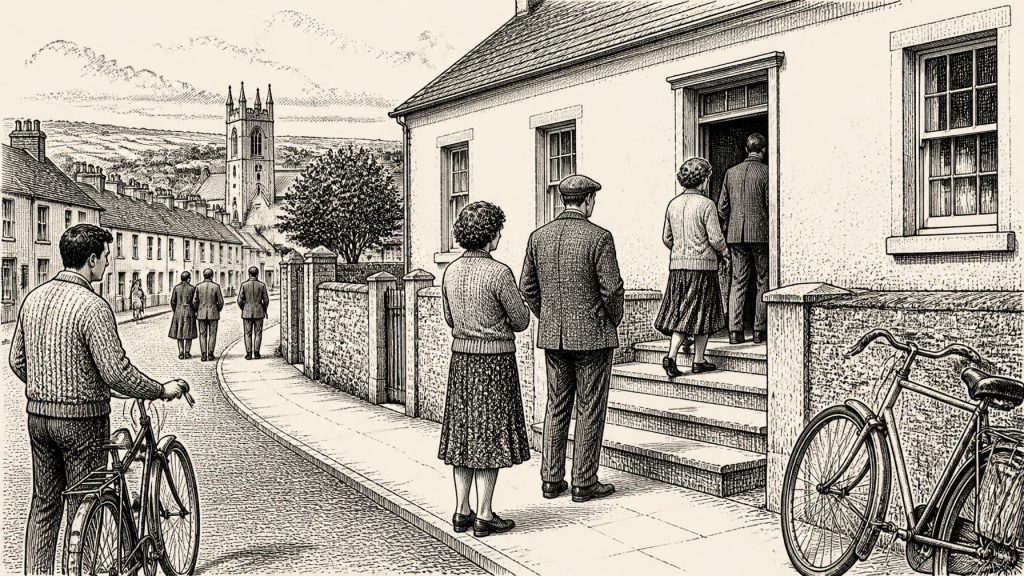
The most consequential domestic event was the referendum of Thursday 26 June. At issue was the Tenth Amendment of the Constitution Bill, 1986. The Constitution then expressly prohibited any law providing for the dissolution of marriage. The proposal would have removed that absolute bar, allowing the Oireachtas to legislate for divorce in narrowly prescribed circumstances. A court would have had to be satisfied that a marriage had failed, that the failure had lasted for at least five years, that reconciliation was not reasonably possible, and that adequate provision had been made for a dependent spouse and children.
Those terms matter. The proposal was not for instant or uncomplicated divorce. It was designed to permit divorce after prolonged marital failure and subject to judicial safeguards. Yet the campaign widened far beyond technical family law. Supporters argued that people trapped in failed marriages needed a route to legal finality and the possibility of remarriage. Opponents warned that divorce would weaken marriage, damage children and unsettle the family as protected by the Constitution. Catholic bishops, lay Catholic organisations, anti-divorce campaigners, political parties and women’s organisations all participated in a debate that was often emotionally charged and closely followed.
The result was decisive: 935,843 voters, about 63 per cent, rejected the amendment; 538,279, about 37 per cent, supported it. The vote retained the constitutional prohibition. It also demonstrated that the Republic’s social debates could no longer be treated as matters settled quietly between political leaders and church authorities. The referendum campaign brought competing accounts of marriage, personal autonomy, parental obligation, religion and law into homes, parish halls, newspapers and broadcast discussion. Although the result was a defeat for FitzGerald’s government, the issue of marital breakdown had been made publicly unavoidable.
The referendum should therefore be read with care. It firmly established what voters decided in June 1986, not a simple verdict on every Irish family or every Catholic voter. The census that year included a separate category for people who were separated, an administrative recognition that separation was a lived social condition. The legal ban on divorce remained, but the circumstances that had made reform a national question did not disappear.
Counting a Strained Society
On Sunday 13 April, the Republic held its census of population. It counted 3,540,643 people. A census is a snapshot, not a complete explanation of a society, but the 1986 return came during a decade in which many households knew unemployment, precarious work or the departure of relatives for Britain, North America and elsewhere. In May, contemporary unemployment figures cited in the campaign around Self-Aid put more than 232,000 people out of work. Such numbers were experienced not abstractly but through interrupted careers, deferred household plans and the prospect that young adults might have to leave Ireland to find work.
Self-Aid, staged at the RDS in Dublin on 17 May, translated that anxiety into a national cultural event. The fourteen-hour benefit concert, broadcast live by RTÉ, drew an audience of about 30,000 and featured 27 acts, including U2, Christy Moore, Rory Gallagher, The Pogues and the Boomtown Rats. Inspired by Live Aid but directed towards unemployment at home, it mixed entertainment with appeals for jobs, training and local initiative. A concert could not alter the underlying economy, but its scale showed how unemployment had become a shared public concern and how musicians and broadcasters could mobilise a language of national responsibility.
There were other, more regional signs of ambition. Ireland West Airport at Knock, County Mayo, was officially opened on 30 May. Associated above all with the persistence of Monsignor James Horan and local support, the airport was intended to connect the west more directly with emigrant communities, pilgrims, visitors and commercial opportunities. In a period when much attention centred on decline, Knock represented an effort to use transport infrastructure to counter remoteness.
Fallout and Cultural Loss
Ireland also felt the distant consequences of the Chernobyl nuclear disaster. The reactor accident occurred in Soviet Ukraine on 26 April; a sharp rise in radioactivity on air filters at Glasnevin was recorded on 2 May, signalling the plume’s arrival over Ireland. Rain produced uneven deposition, prompting a substantial monitoring programme of air, water, vegetation and foodstuffs, particularly milk, vegetables and meat. The available measurements did not require restrictions on the sale or consumption of Irish-produced food. Still, the episode brought unfamiliar anxieties about invisible contamination into kitchens, farms and public discussion, and underlined Ireland’s environmental connection to events far beyond its shores.
On 21 May, thieves stole major Old Master works from the Beit collection at Russborough House, County Wicklow. The robbery was a striking cultural shock: Russborough’s collection was among the State’s most important private collections held for public benefit, and the theft revived fears about the security of cultural property. It also gave criminal activity a disturbing visibility in an Ireland already worried about economic and political instability.
The Agreement’s First Full Year
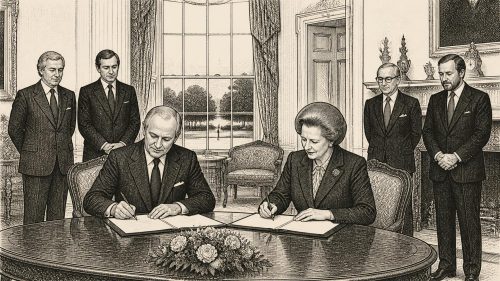
North of the Border, 1986 was the first full calendar year in which the Anglo-Irish Agreement had to be made to work. Signed at Hillsborough on 15 November 1985 by Margaret Thatcher and Garret FitzGerald, the agreement did not transfer sovereignty over Northern Ireland to Dublin. Rather, it established an Anglo-Irish Intergovernmental Conference through which the Irish Government could put forward views and proposals on political, security, legal and cross-border matters. The agreement explicitly retained the sovereignty and administrative responsibilities of both governments. Its importance lay in giving Dublin a recognised and continuing role in Northern Ireland affairs, especially where no devolved administration existed.
For many unionists, that consultative role was intolerable. Fifteen unionist Westminster MPs resigned their seats to force by-elections on 23 January, seeking a popular repudiation of the agreement. Fourteen unionists were returned; the SDLP captured Newry and Armagh. The exercise showed the depth of unionist mobilisation but did not compel London to abandon the agreement. The political atmosphere remained febrile, with street demonstrations, loyalist organising and a continuing failure to restore a devolved system accepted across the community divide.
The danger of that confrontation crossed the Border on the night of 7 August. Peter Robinson, deputy leader of the Democratic Unionist Party, led several hundred loyalists into Clontibret, County Monaghan. The crowd entered the village, attacked the Garda station and badly injured two gardaí. Detectives fired warning shots into the air before the crowd dispersed, and Robinson was arrested. The incursion was presented by its organisers as a protest about Border security and the Anglo-Irish Agreement; for residents and the Irish authorities it was a grave breach of the Republic’s security and a vivid reminder that the Northern conflict could not be neatly contained.
Republican Recalculation
Republican politics changed direction in Dublin that autumn. At Sinn Féin’s Ard Fheis on 1–2 November, delegates voted to end the party’s policy of abstention from Dáil Éireann. The decision did not mean acceptance of British sovereignty in Northern Ireland, nor did it end abstention from Westminster. It did, however, authorise Sinn Féin representatives elected in the Republic to take their seats in the Dáil, a substantial tactical and constitutional shift after decades of refusal.
The decision caused an immediate split. Ruairí Ó Brádaigh, a former Sinn Féin president, and Dáithí Ó Conaill walked out with others and went on to establish Republican Sinn Féin. The break showed that electoral participation was contested within republicanism itself. In the context of the Anglo-Irish Agreement, continuing violence and growing electoral organisation, the November decision indicated that a section of the movement saw parliamentary politics in the Republic as a field that could no longer be left unused.
Thus 1986 did not produce a single national turning point. It was a year in which several difficult realities were named more openly: failed marriages, poverty and joblessness, the vulnerability of cultural treasures, environmental uncertainty, and the interwoven politics of North and South. The institutions and arguments visible that year would continue to shape Irish public life long after its immediate disputes had passed.
Primary Sources
- Referendum on the Tenth Amendment of the Constitution Bill, 1986 – Dissolution of Marriage
- Tenth Amendment of the Constitution Bill, 1986 – No. 15 of 1986
- Divorce in Ireland: Referendum 2019
- 1980–89
- The Divorce Referendum in the Republic of Ireland: Resisting the Tide
- Census Through History
- Census 1986 Volume 1 – Population
- Census 1986 Volume 7 Table 16
- Chernobyl
- Chernobyl, its Effect on Ireland
- Self-Aid
- The National Debt and Economic Policy in the Medium Term
- Combat Poverty Agency Act, 1986
- A Poverty-Free Ireland
- National Archives Act 1986
- Governing Legislation
- Russborough Paintings Stolen
- Ireland West Airport Celebrates 40 Year Anniversary With Special Event
- Agreement Between the Government of the United Kingdom of Great Britain and Northern Ireland and the Government of Ireland
- Westminster By-Elections (NI), Thursday 23 January 1986
- By-election Results: 1983–87
- Chronology of the Conflict 1986
- Arrest of Peter Robinson at Clontibret, 7 August 1986
- Peter Robinson Arrested
- Sinn Féin Ard Fheis, 1–2 November 1986: Chronology of Main Events
- The Long War: The IRA and Sinn Féin