
Glacial Refugia31802 BCE
The reference year 31,802 BCE represents a Late Pleistocene setting rather than a securely dated Irish event. Cave remains, freshwater deposits and glacial geology provide the surviving evidence. Open landscapes supported tundra vegetation, freshwater habitats and large mammals while ice expanded unevenly across the British-Irish region. Later glaciation removed much of the earlier surface record, limiting certainty about local conditions and their timing. Castlepook research, Derryvree evidence, regional reconstructions and radiocarbon calibration therefore require cautious interpretation. The article explores habitable environments before wider ice cover while distinguishing modern archival chronology from the broad dating ranges supported by surviving scientific evidence.
Dateline
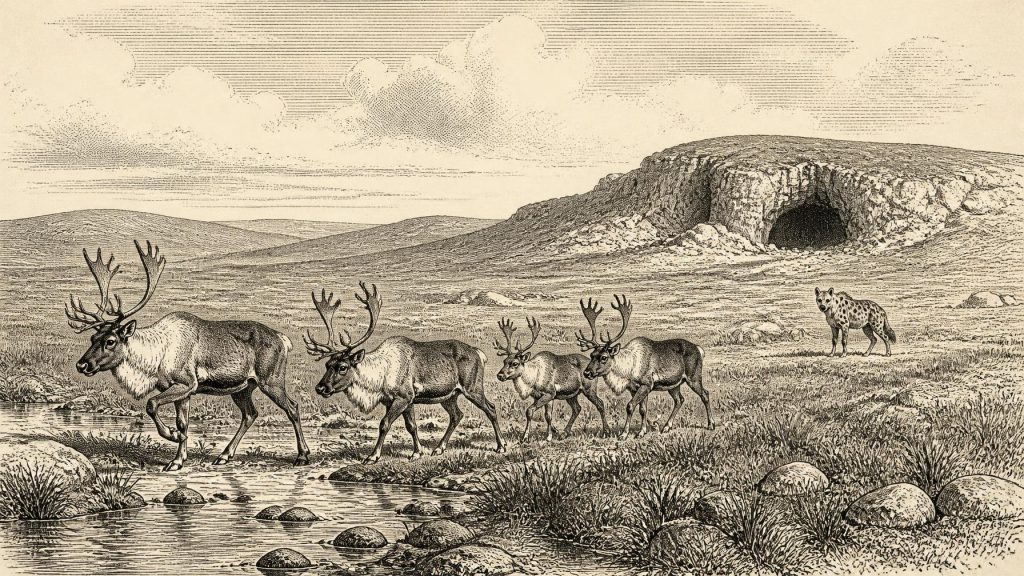
31,802 BCE is an archive reference year within the Late Pleistocene. No Irish event can be assigned securely to this exact date. The period is reconstructed from cave remains, freshwater deposits and glacial geology.
Before Wider Ice Cover
Some landscapes remained open, cold and biologically active even as the British-Irish Ice Sheet expanded. Tundra vegetation, freshwater habitats and large mammals formed part of this changing environment.
A Fragmentary Record
Later glaciation removed much of the earlier surface record. What survives must therefore be interpreted cautiously and at broad chronological scales.
Source References
Hover over a number to see the source. Select it to open the source.
- [1] Research draws on Castlepook studies, Derryvree environmental evidence, BRITICE-CHRONO, National Museum collections and radiocarbon calibration research.
Primary Sources
Research draws on Castlepook studies, Derryvree environmental evidence, BRITICE-CHRONO, National Museum collections and radiocarbon calibration research.



