
Derryvree’s Treeless Fen31614 BCE
Around 31,614 BCE, Ireland lay within the unstable Late Pleistocene climate of Marine Isotope Stage 3, not a precisely recoverable year. At Derryvree, County Fermanagh, freshwater silts dated broadly to 36,900–31,700 calibrated years BP formed between glacial advances. Their pollen, plants and insects reveal a cold, treeless wetland of sedges, mosses, juniper, pools and tundra-like vegetation. Ireland’s ice cover varied regionally before the later Last Glacial Maximum, while lower sea levels reshaped coasts and routes. Southern caves preserve diverse cold-stage fauna, though dating is complex. Possible human butchery evidence remains uncertain; no contemporary settlements, society or culture are securely documented.
Dateline
“31,614 BCE” is a modern way of pinning a deep prehistoric interval to a numbered calendar. Nobody in Ireland recorded such a year, and the evidence cannot distinguish one season, let alone one day, from the next. The responsible frame is therefore broader: this point falls in the Late Pleistocene, during Marine Isotope Stage 3, within the long, volatile last glacial cycle. The best Irish evidence is expressed in calibrated ranges and environmental phases, not annual events.
One especially useful range comes from Derryvree, near Maguiresbridge in County Fermanagh. Organic freshwater silts there returned a conventional radiocarbon age of 30,500 ± 1,100 radiocarbon years BP; calibration places the deposit broadly at about 36,900–31,700 calibrated years BP. Thus 31,614 BCE lies close to, but cannot be securely isolated within, the later end of the dated interval. The deposit illuminates an Ice-Age landscape that existed between episodes of glaciation, rather than furnishing a chronicle of a particular year.
A Fen Between Ice Advances
Derryvree was exposed in a road cutting through a drumlin, one of the streamlined hills fashioned by glacier ice. Its sequence is powerful because organic layers of freshwater silt and fine sand lay between two thick sheets of till, sediment deposited directly by ice. The lower till records an earlier glacial episode; above it, water accumulated and plants, insects and small organisms left their remains; the upper till shows that ice later returned across the site. It is a rare survival from a landscape that successive ice sheets repeatedly scraped away or buried.
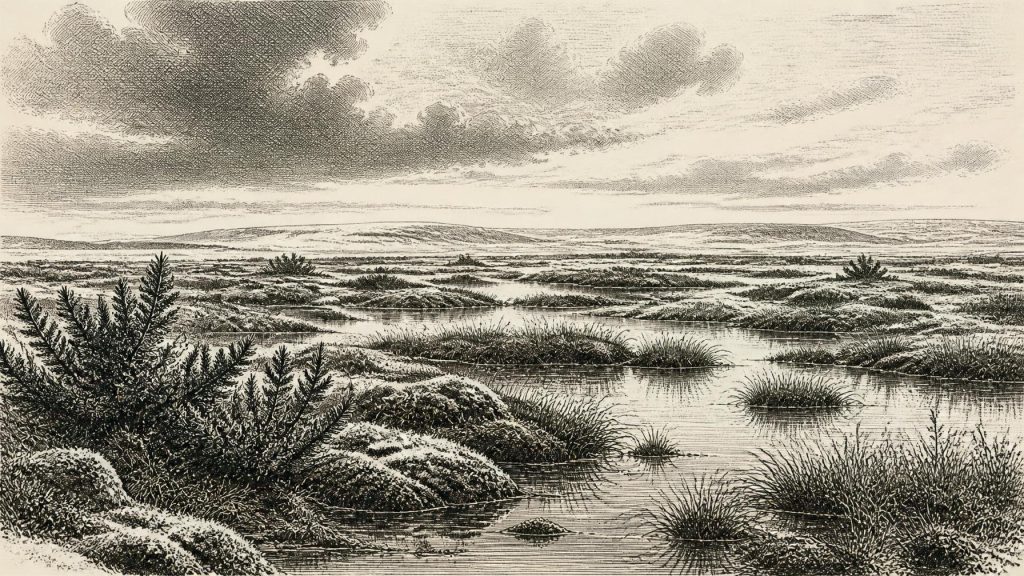
The fossils identify neither a green Ireland nor a featureless white wilderness. Pollen, plant macrofossils, mosses and beetles point to cold, open, treeless ground with wet hollows and pools: a tundra-like muskeg, in the older Irish Quaternary terminology. Grasses and sedges were prominent, accompanied by juniper and herbs. A bogbean seed, a small but telling fossil, indicates freshwater or wet ground capable of sustaining aquatic and marginal plants. Insects of northern, cold-climate aspect reinforce the conclusion. This was a patchwork of damp vegetated ground, mossy margins and open water, held within a periglacial climate of hard winters, short growing seasons, frost action and seasonal thaw.
That reconstruction is evidence-based, but it needs limits. The plants and insects came from one protected basin in Fermanagh, not from every valley and coast of the island at once. Pollen can travel and older material can be reworked. “Tundra” is consequently a useful ecological comparison, not a claim that every square mile resembled any single modern Arctic place. Nevertheless, Derryvree firmly demonstrates that at some point during its dated interval north-central Ireland was locally ice-free, watered and vegetated.
Ice Sheet in Formation
At this date Ireland had not yet reached the Last Glacial Maximum, the later phase—broadly around 26,000 to 21,000 years ago—when the British–Irish Ice Sheet covered all or almost all of the island’s low ground. Its ice history was neither simple nor synchronous. Glaciers expanded and contracted in response to abrupt North Atlantic climate shifts, while individual sectors advanced at different times. The Derryvree organic beds and related Fermanagh deposits place an important constraint on that history: extensive ice could not have occupied their sites while freshwater sediment was being laid down.
Some reconstructions infer that ice cover in Ireland was still limited before about 32,000 calibrated years ago, followed by build-up and expansion. Other evidence from the western seaboard, particularly dated marine microfauna and shells, indicates substantial ice loading during parts of the wider 40,000–19,000-calibrated-years-BP interval. These are not irreconcilable statements. They show why a single island-wide map for 31,614 BCE would imply precision the evidence does not possess: an ice margin could be advancing in one sector while an inland wetland or coastal marine environment survived elsewhere or at another point in the same millennia.
Sea level was much lower globally than it is now because enormous volumes of water were locked in northern ice sheets. Ireland was not the familiar island of modern maps. The Irish Sea basin and Atlantic shelves were altered landscapes of shallow sea, exposed ground and changing ice-fed waters. Yet lowered sea level did not automatically create an easy, permanent land route between Ireland and Britain. The reachability of Ireland by animals or people depended on shifting shorelines, channels, ice, weather and the availability of usable terrain, not merely on a line drawn between present coastlines.
Animals of the Open Country
Southern Irish caves provide a complementary, if complicated, record. Castlepook Cave, also called Mammoth Cave, near Doneraile in north County Cork has produced one of Ireland’s most important assemblages of Pleistocene vertebrates. Its identified cold-stage animals include woolly mammoth, reindeer, giant deer, spotted hyaena, wolf, foxes, brown bear, hare and lemmings. This is not a picture of an empty land. It is evidence for a food web capable, at favourable times, of sustaining large grazers and browsers, predators and scavengers.
But a cave bone assemblage is not a census. Many Castlepook remains were excavated in the early twentieth century, before present standards of stratigraphic recording, and bones from different deposits and ages may have become mixed. Carnivores carried and chewed some material; water and later disturbance also altered contexts. Modern re-dating has shown that several earlier determinations from Castlepook, Foley and Shandon caves were too young, sometimes by thousands of radiocarbon years. The revised work indicates that particular mammals, including giant deer and spotted hyaena, were present in Ireland during MIS 3 and may have disappeared locally before the Last Glacial Maximum. It does not prove that every species in the collection lived together at Derryvree’s precise moment.
The animal evidence nevertheless gives scale to the Fermanagh wetland. Reindeer could exploit open, seasonal country; mammoths and giant deer imply access to extensive forage beyond a tiny pool margin; hyaenas and wolves point to carcasses, hunting opportunities and competition among carnivores. Ireland was part of a wider north-west European ecological zone, rather than an isolated biological enclave. Movements of animals would have been recurrent responses to climate, forage and passable routes, not evidence of organised migration controlled by a human authority.
People: A Possibility, Not a Polity
There is no securely excavated settlement, hearth, stone-tool workshop, burial, house floor or enduring camp from Ireland that can be assigned to 31,614 BCE. Accordingly there can be no responsible account of Irish government, diplomacy, tribes, named leaders, warfare, religious institutions, learning or trade networks in this year. Such subjects belong to historical societies with documentary or substantial archaeological records; they cannot be recovered from a handful of sediments and cave bones.
A reindeer femur from the Castlepook collection has, however, been reported as bearing marks consistent with cutting fresh tissue by a sharp stone tool and as dating to roughly 33,000 years ago in reporting on the find. If the marks and association are sustained by further specialist study, it would be exceptionally important evidence that one or more people processed a reindeer in Ireland during MIS 3. It would show an episode of animal use, perhaps by a very small and mobile party, not a settled population or a continuous occupation. The cave’s complex excavation history and the broader problems of dating its fauna make caution essential. A bone’s age is not automatically the date of a cut, and one modified specimen cannot supply a whole social world.
The absence of a settlement record is also not proof that nobody ever crossed into Ireland. Ice has eroded surfaces, rising seas have drowned former coasts, acidic soils damage bone, and hunter-gatherer visits may leave little behind. Yet historical method requires the opposite caution as well: absence cannot be converted into a story of Palaeolithic villages, seasonal hunting territories or cultural identity. The first substantial and unambiguous archaeological record of human lifeways in Ireland remains vastly later, among Mesolithic hunter-gatherers after the final retreat of the ice.
Daily Life Without a Household Record
If people did reach Ireland in this interval, the wider European Upper Palaeolithic provides only a comparative context, not direct Irish proof. Elsewhere, mobile groups used carefully made stone tools, worked hides and bone, shared food and knowledge, and adjusted movements to highly seasonal animal landscapes. Reindeer in particular could offer meat, fat, hides, sinew and bone. None of that permits us to state that a specific Irish group possessed a given tool tradition, language, ritual or artistic practice. No Irish artefact assemblage of this date demonstrates it.
Religion and culture are similarly beyond direct recovery. There are no known shrines, graves, images, ornaments or inscriptions from Ireland securely belonging to this interval. The Derryvree flora shows resilience rather than belief; the Castlepook fauna shows an ecosystem rather than a mythology. The most meaningful cultural lesson lies in the discipline of uncertainty: Ireland’s deep past is not a blank page, but its surviving marks are fragmentary and must not be made to speak in invented voices.
A Landscape Before the Maximum
Around the modern label 31,614 BCE, then, Ireland should be envisaged as a changing cold-stage land on the threshold of much more extensive glaciation. In Fermanagh, a freshwater fen or wetland supported sedges, mosses, insects and other life amid open, treeless ground. Across longer MIS 3 timescales, caves in the south preserve traces of an unexpectedly varied mammal community. Ice, water, frost and shifting sea levels repeatedly reorganised habitats and later destroyed much of their evidence.
The chief development was environmental, not political: a habitable but severe periglacial mosaic existed during an unstable interval before the island was overwhelmed more fully by the later ice sheet. Derryvree’s silts, rather than a king, battle or monument, are the closest thing Ireland has to a contemporary record. They preserve a small wet world between glaciers—and the reminder that even in the Ice Age, the island’s landscape was dynamic, locally diverse and only imperfectly known.
Primary Sources
- A Middle Midlandian Freshwater Series at Derryvree, Maguiresbridge, County Fermanagh, Northern Ireland
- Early Midlandian–Middle Midlandian, Pleistocene, Northern Ireland
- Figure 6.— The Subdivision of the Quaternary Period in Ireland
- Irish Pleistocene Biostratigraphy
- A Reconsideration of the Radiocarbon Dating of the Marine Isotope Stage 3 Fauna from Southern Ireland
- The Irish Quaternary Fauna Project
- Radiocarbon Constraints on the History of the Western Irish Ice Sheet Prior to the Last Glacial Maximum
- Radiocarbon Constraints on the Age of the Maximum Advance of the British-Irish Ice Sheet in the Celtic Sea
- Timing and Pace of Ice-Sheet Withdrawal Across the Marine–Terrestrial Transition West of Ireland During the Last Glaciation
- Exploring Controls of the Early and Stepped Deglaciation on the Western Margin of the British Irish Ice Sheet
- Extent and Deglacial Chronology of the Last British-Irish Ice Sheet; Implications of Exposure Dating Using Cosmogenic Isotopes
- Last Glacial Maximum Cirque Glaciation in Ireland and Implications for Reconstructions of the Irish Ice Sheet
- Episodic Speleothem Deposition Tracks the Terrestrial Impact of Millennial-Scale Climate Change in Western Europe
- Pleistocene Vertebrates in the British Isles
- Mammoth Cave
- Castlepook Cave, Castlepook South, County Cork: Excavation Report 2022
- Prehistoric Details: Mell Flint Flake
- The Mesolithic in Ireland: When Was It?
- New Insights on the Fauna of Ireland’s Younger Dryas and Early Holocene from Alice & Gwendoline Cave
- The Colonization of Ireland: A Human Ecology Perspective
- Red Deer in Ireland: Genetic Evidence for Two Separate Populations
- Menyanthes trifoliata: Fossil Record